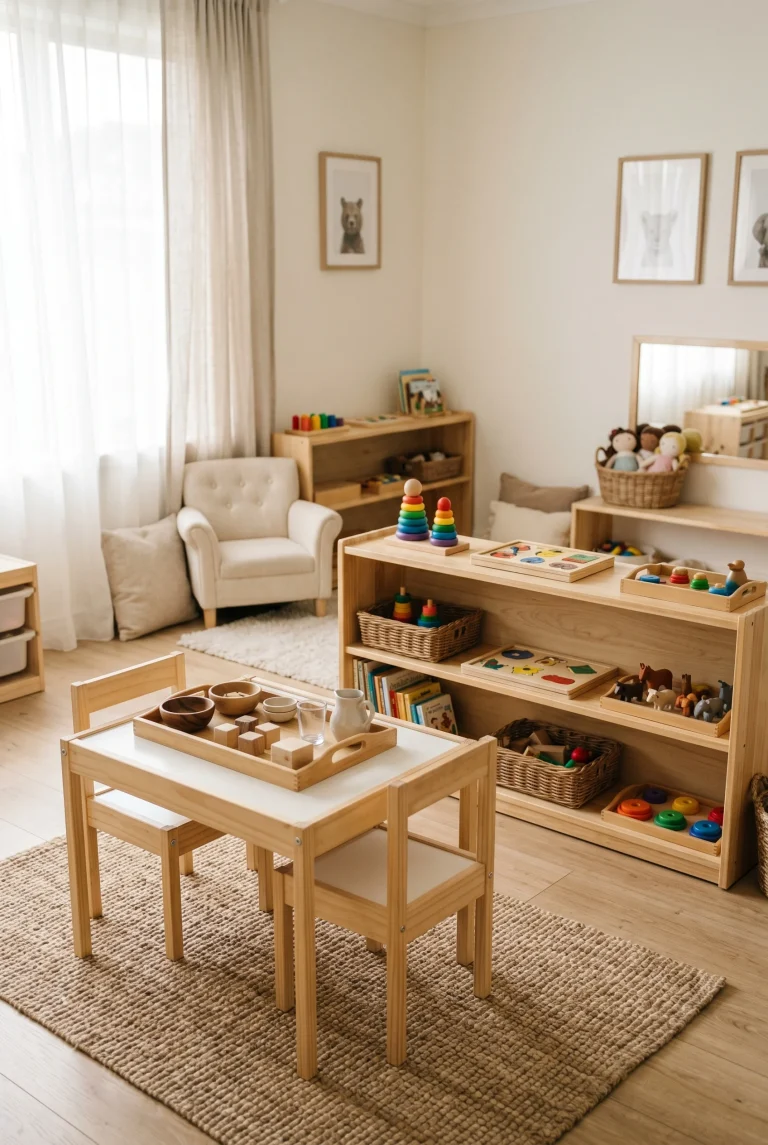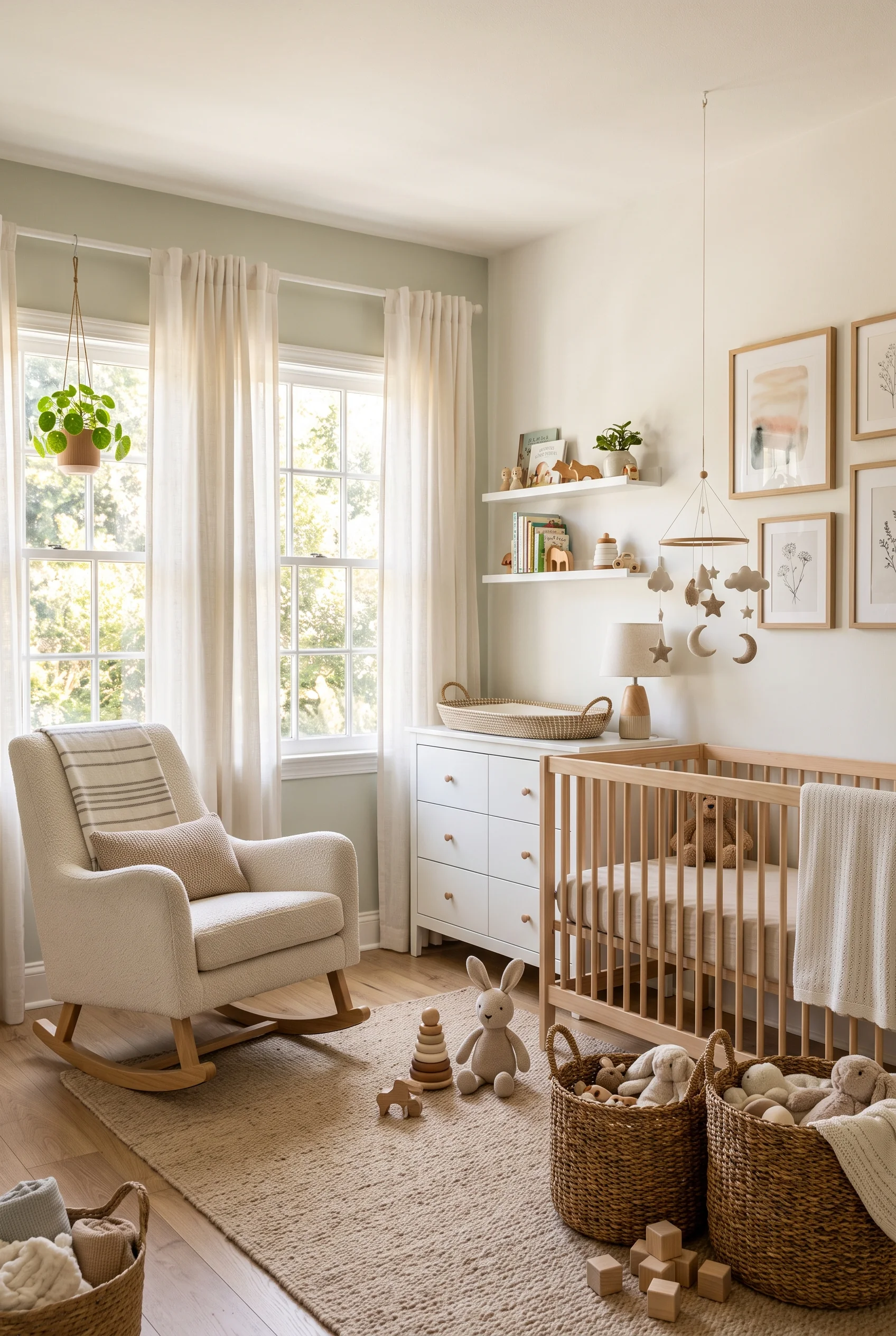
13 Small Nursery Ideas to Maximize Space
Small nursery ideas often start with a familiar problem: a room that looks beautiful in photos but feels tight the moment a crib, dresser, and glider all need to fit into it.
Every square foot matters when the space is compact, and the choices that look effortless in a finished room usually started with careful planning around scale, storage, and light.
A nursery under 100 square feet can still feel calm and complete if the furniture works harder and the palette stays quiet. That’s the throughline in the thirteen rooms ahead: nothing here is oversized, nothing is wasted, and every piece earns its spot.
This roundup leans on real rooms rather than theory, pulling from soft neutral nursery palettes that make a small footprint read larger, layout logic borrowed from Montessori-inspired room design, and the same space-stretching strategy covered in our guide to small playroom ideas.
You’ll find storage that hides in plain sight, furniture that pulls double duty, and styling details that make a tight corner feel intentional instead of cramped. Whether the nursery is a converted closet or a shared guest room, the goal stays the same: a space that feels calm, functional, and entirely yours before baby arrives.
DISCLOSURE: Some of the links provided on this page are affiliate links. This means if you choose to make a purchase through these links, we may receive a small commission at no extra cost to you.
Furniture, Palette, and Zones That Do the Heavy Lifting
Before any accessory gets chosen, a handful of bigger decisions shape whether a small nursery actually works: what the furniture does, what color surrounds it, and how the floor plan splits into zones.
Get those right and everything smaller- the bins, the baskets, the styling- tends to fall into place. The five rooms below show how vertical storage, dual-purpose furniture, and a quiet palette work together to stretch a modest footprint. An organized closet and a dedicated reading corner round out the approach.
Built-In Shelving Claims the Wall, Not the Floor
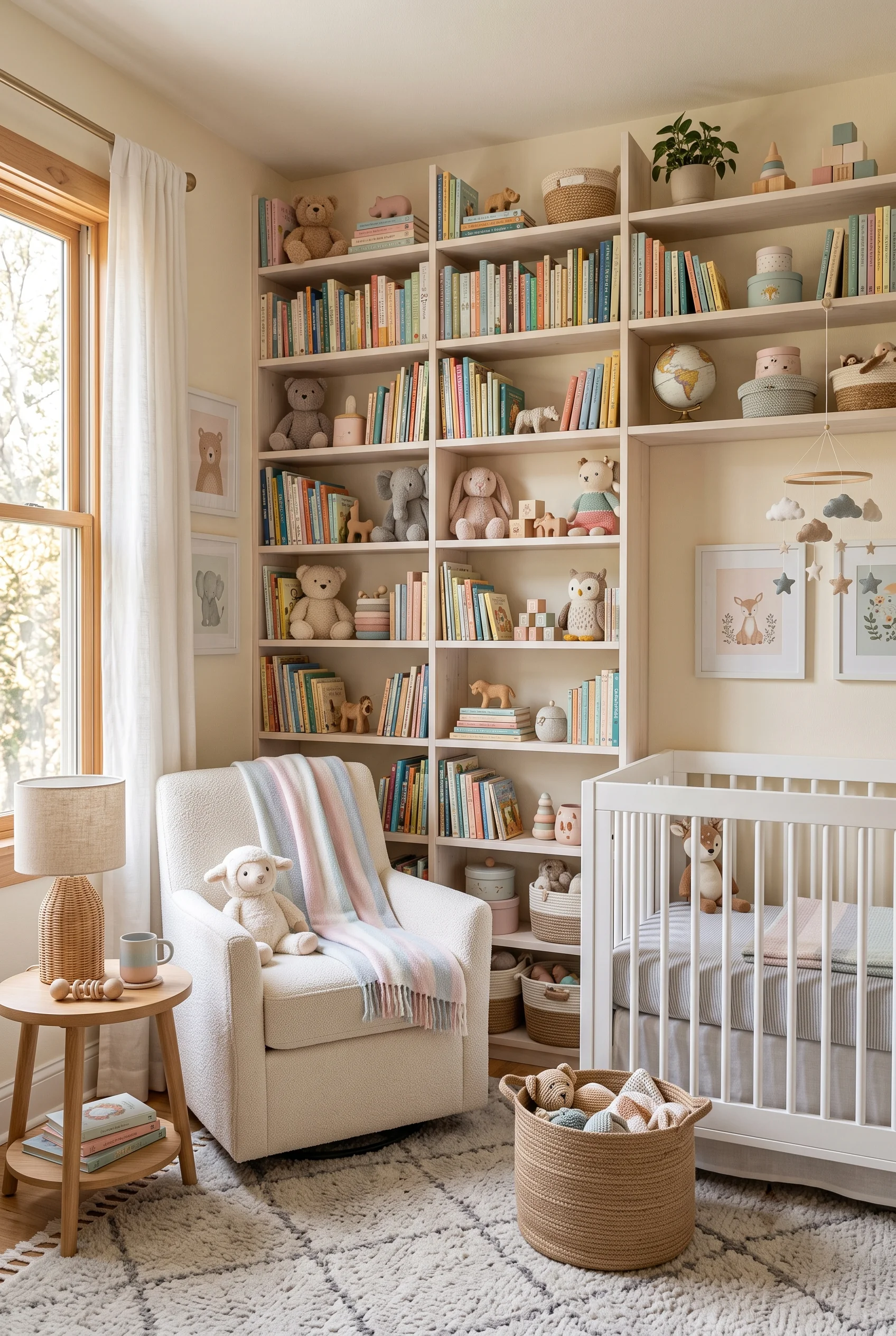
Floor-to-ceiling shelving turns an entire wall into the room’s real storage system. Books, stacked bins, and a rotating cast of stuffed animals all have a place here, which means the floor stays clear for a rocker and a stretch of rug.
The narrow, honey-toned shelves read as furniture rather than a warehouse rack, especially with framed woodland prints breaking up the rows. A cushioned glider tucked beside the crib gives the whole wall a reason to exist beyond storage.
A Dresser That Pulls Double Duty as the Changing Station
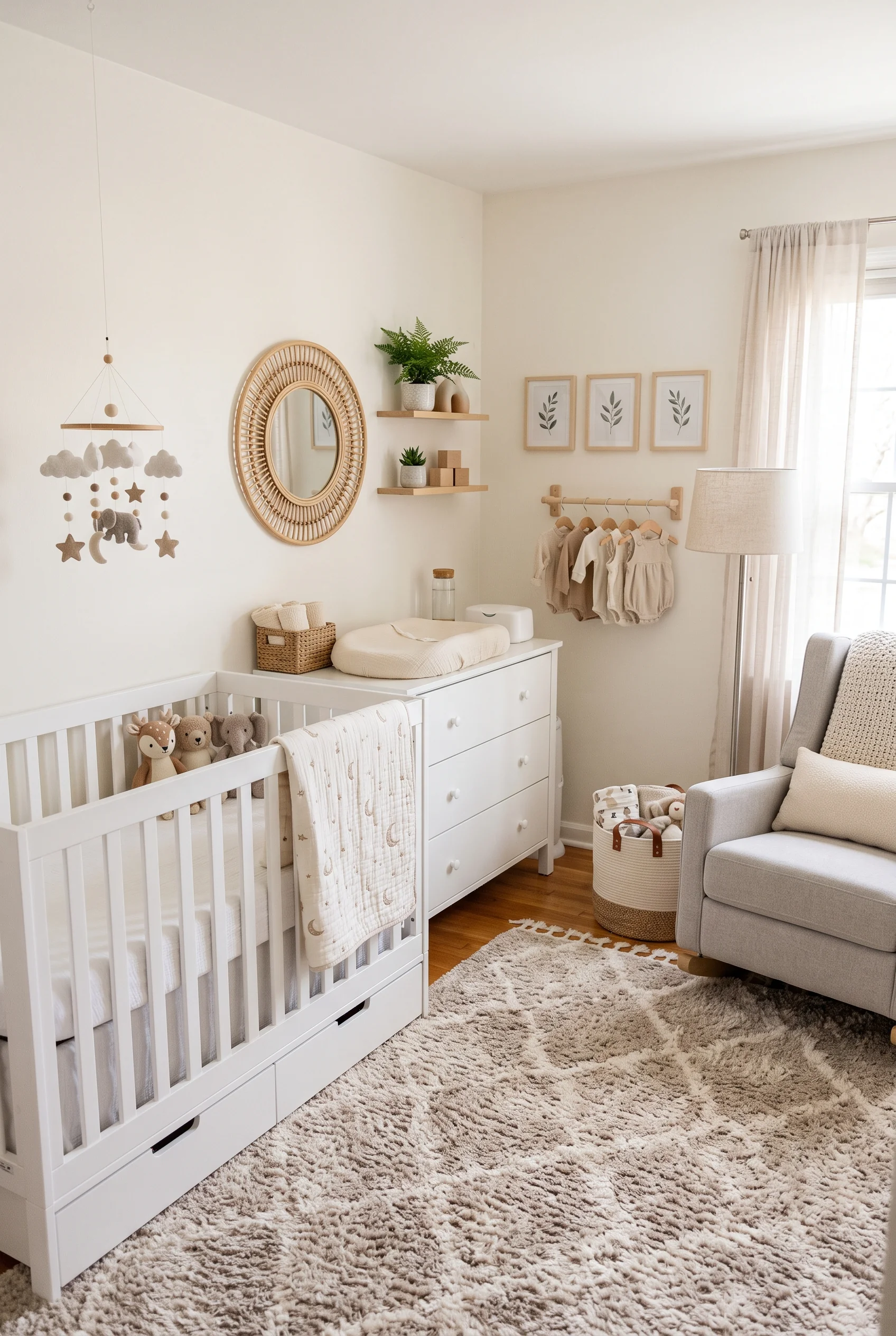
The dresser under the window does two jobs at once: everyday storage below, a padded changing topper above. There’s no separate changing table competing for square footage, just one piece doing what two used to.
The crib repeats the same logic. Built-in drawers underneath hold spare sheets and out-of-season sleepers, so nothing extra needs to sit against the wall. A nearby wall-mounted rod keeps the next few days’ outfits in view instead of buried in a closet.
Even the rattan mirror above the dresser earns its keep, bouncing window light back across the room while the glider and its basket of loveys round out the corner.
Shop this pick: Convertible Crib with Built-In Storage Drawers, Cribs are the single highest-intent purchase in any nursery post, and the built-in drawer feature gives this one a distinct, searchable hook over a standard crib.
A Blush Canopy Adds Personality Without Adding Bulk
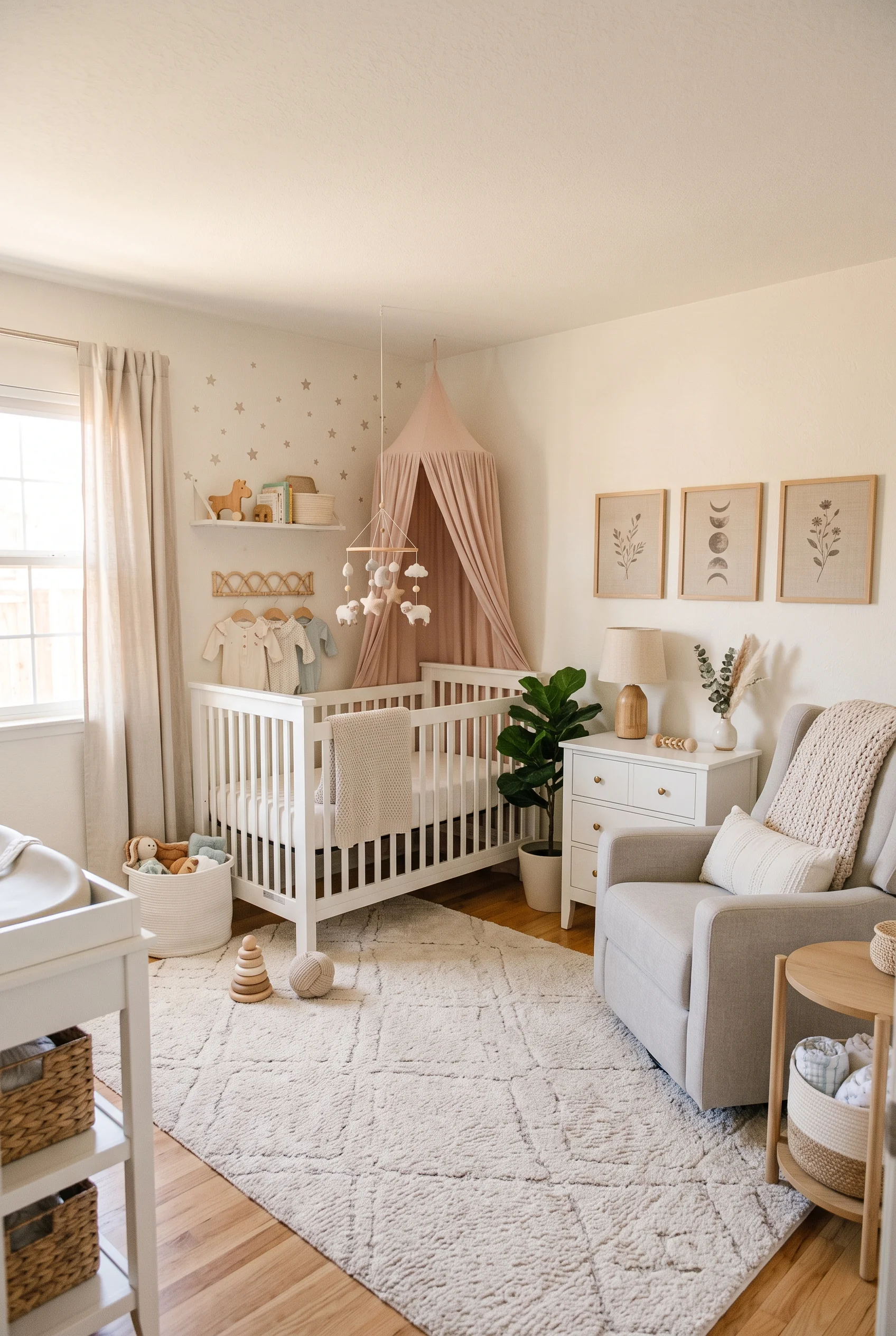
Blush pink shows up in exactly one place: the canopy draped above the crib corner. Everything else- the walls, the curtains, the dresser- stays a warm off-white, so the pink reads as a moment rather than a theme.
Scattered star decals repeat the same restraint. They’re small, tone-on-tone, and stop just short of the ceiling instead of spreading across every wall. The effect is a room that photographs like a nursery but lives like a calm, grown-up space.
A single fiddle-leaf fig and a stack of neutral throws next to the crib keep the palette from tipping into pastel-on-pastel territory.
A Closet That Reads Like a Catalog, Thanks to Clear Bins
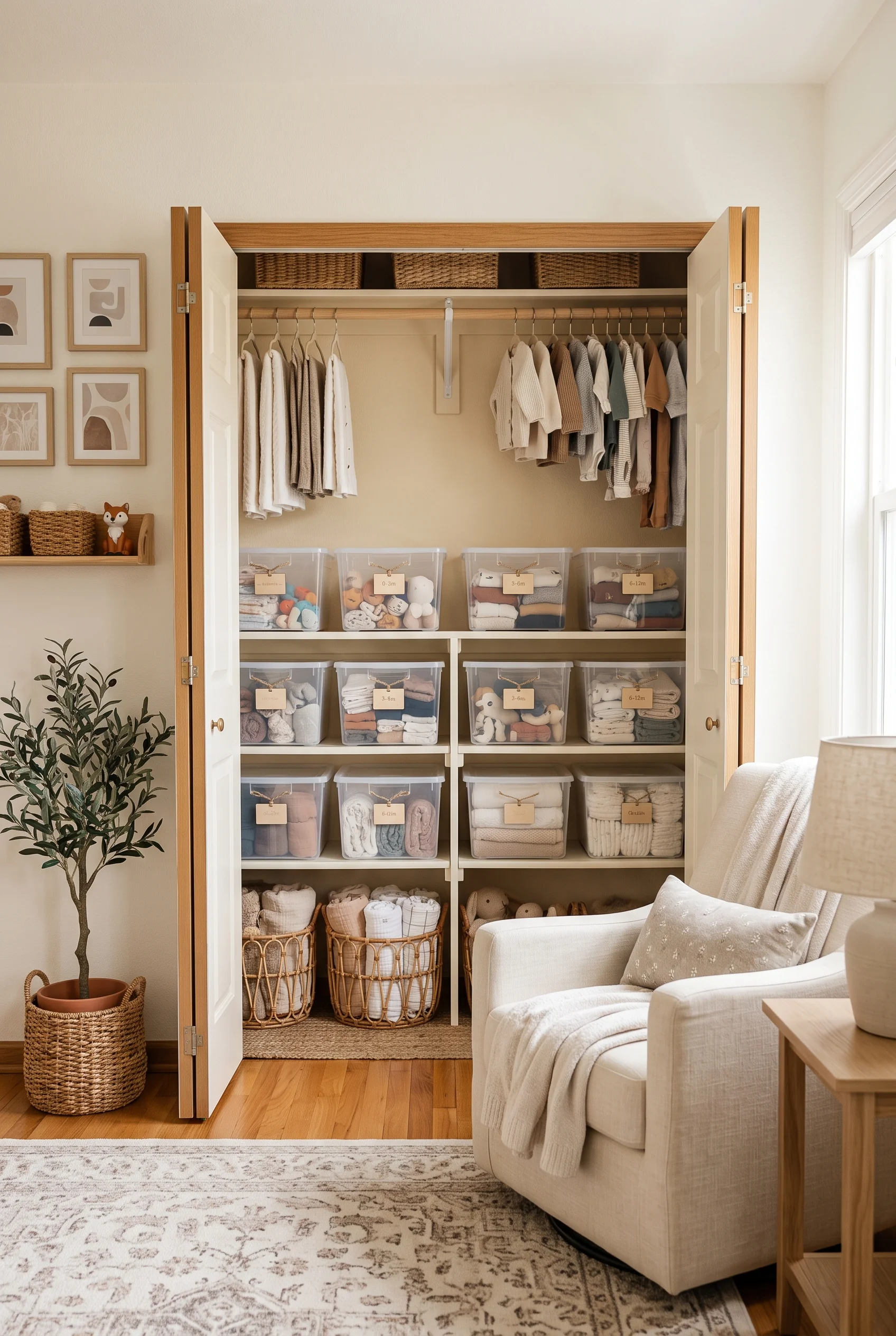
A set of clear stackable storage bins turns a standard reach-in closet into a sizing system. Each one is labeled by age, 0 to 3 months, 3 to 6, and stacked two high, so finding the next size up doesn’t mean unpacking three others first.
Rattan baskets on the floor hold bulkier items, rolled swaddles and off-season blankets, while the top shelf keeps decorative baskets purely for looks. Clear plastic is for anything time-sensitive; natural fiber is for anything that just needs to look tidy.
A folded stack of matching hangers and a small gallery wall keep the closet from feeling purely utilitarian.
A Reading Corner Tucked Beside the Crib
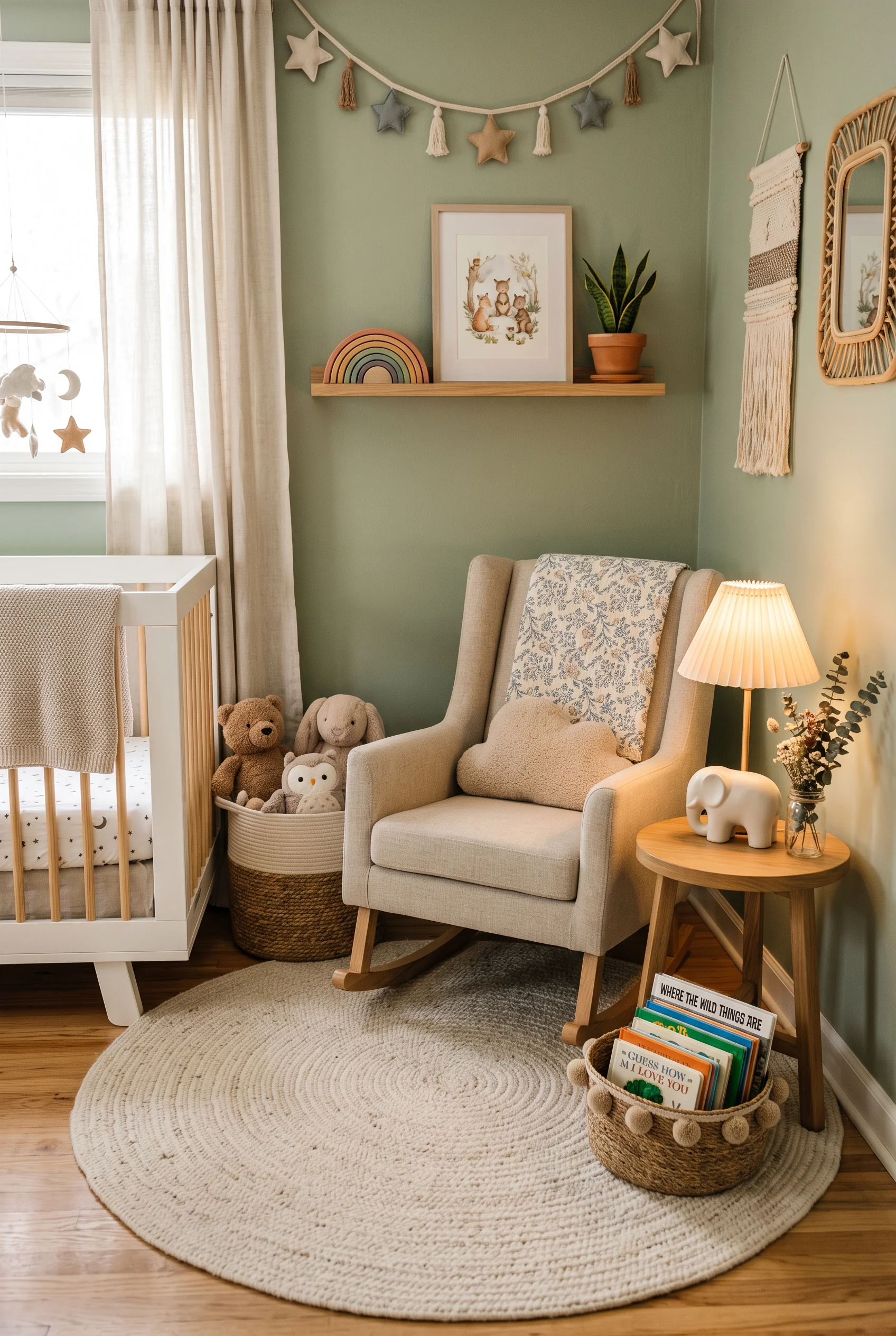
Story time doesn’t need its own room, just a chair, a rug, and a basket within arm’s reach. A slouchy tan armchair angled into the corner, and a round jute rug mark the nook without adding a single wall.
A pom-pom-trimmed basket keeps favorite titles upright and visible, which matters more than a bookshelf when a toddler is choosing at bedtime. The small round table beside the chair holds just a lamp and a ceramic elephant, nothing competing for space.
Sage green walls keep the corner connected to the rest of the room rather than boxed off. Our roundup of reading nook ideas for kids has more ways to build one in a tight space.
Fixtures and Furniture Engineered for a Tight Footprint
Once the wider structural choices are set, the details that make a small nursery function day-to-day come down to specific fixtures engineered for tight quarters. Wall-mounted lighting, a crib scaled to the room, a changing table that folds into almost nothing, and storage that lives under the crib itself all solve the same problem from different angles: how to fit full function into a fraction of the space a nursery usually gets.
Wall Sconces Free Up the Nightstands for What Matters at 2 a.m.
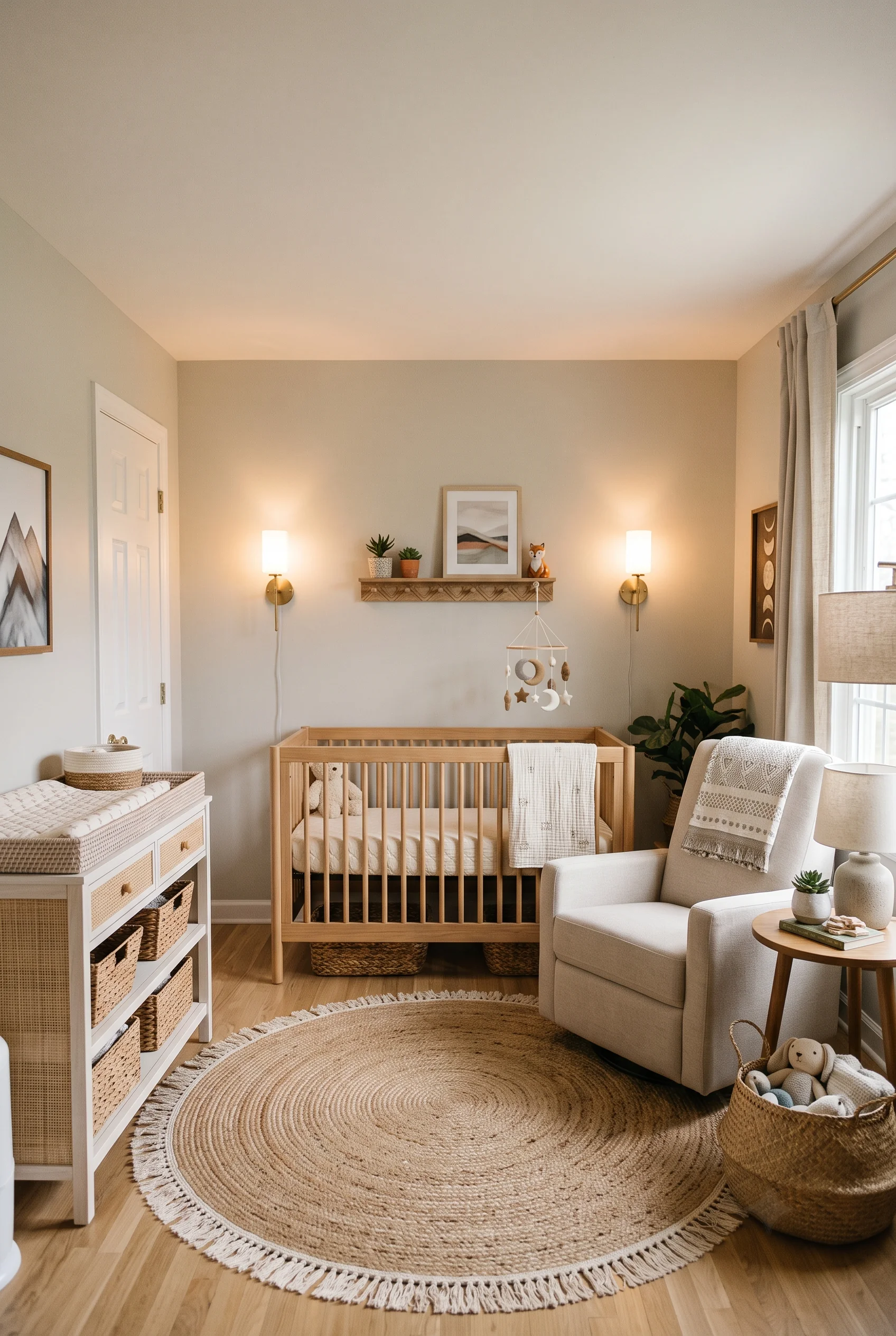
Brass sconces flank the shelf above the crib, so neither nightstand needs to hold a lamp. That leaves both surfaces free for a water glass, a monitor, or whatever gets carried in during a middle-of-the-night feeding.
The warm glow sits at eye level instead of overhead, low enough to soothe a baby back to sleep without a jarring wash of light. A floating shelf between the two fixtures holds just a single framed print and a small fox figurine.
Both sconces are plug-in, so no electrical work stood between this room and a softer bedtime routine.
A Crib Sized to the Room, Not the Showroom
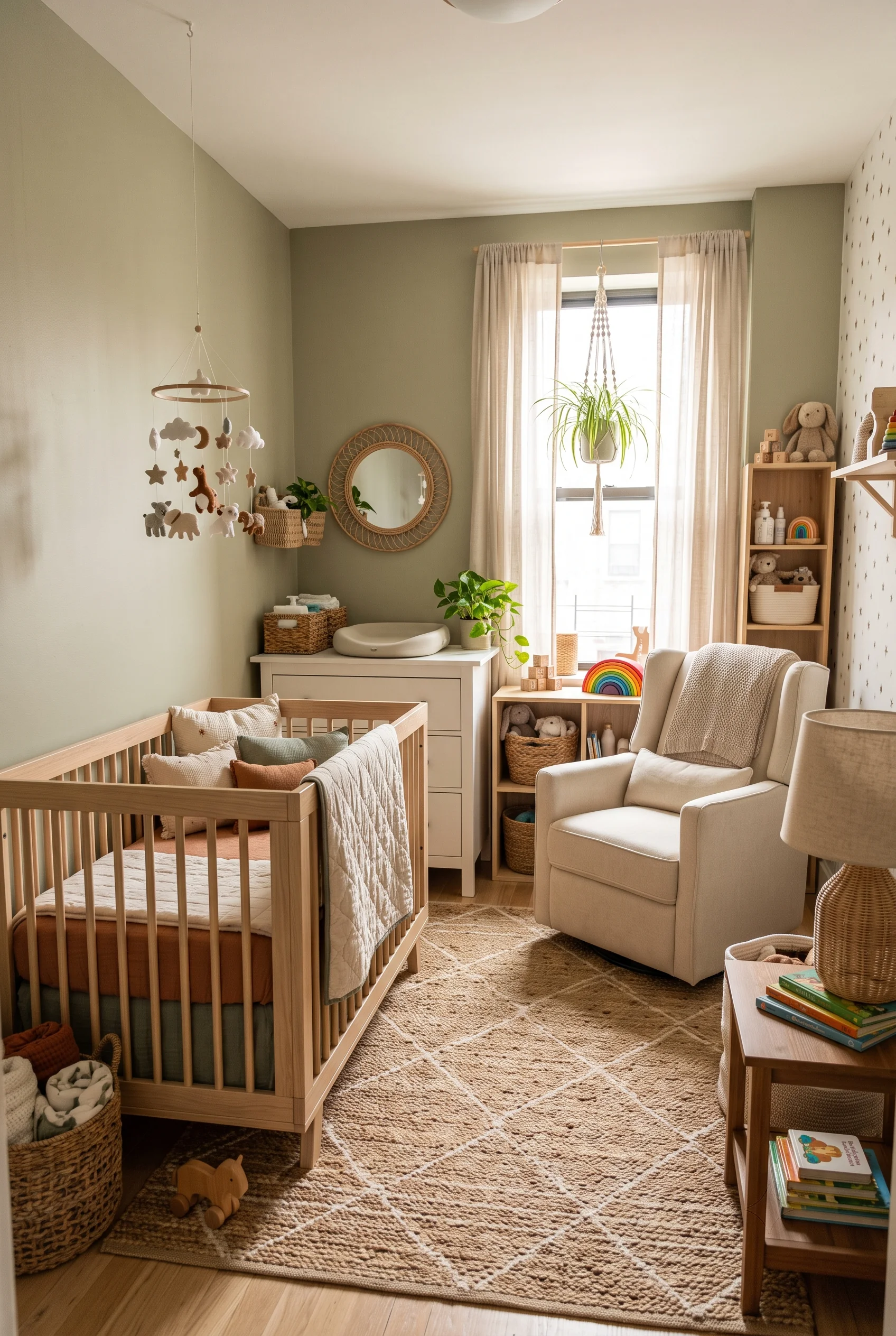
A noticeably smaller crib leaves real floor space on either side of this corner, instead of running edge to edge. That gap is what keeps a narrow nursery from feeling like storage with a mattress wedged into it.
Warm wood tones on the crib match the dresser and floating shelf, so the smaller scale doesn’t read as a compromise. A rattan mirror and a hanging clothes rack fill the wall space a bigger crib would have blocked entirely.
Sage walls and a jute rug ground the room in the same warm palette, so the scaled-down crib feels like a deliberate choice rather than the room’s fallback option.
An X-Frame Changing Table Built to Fold Away
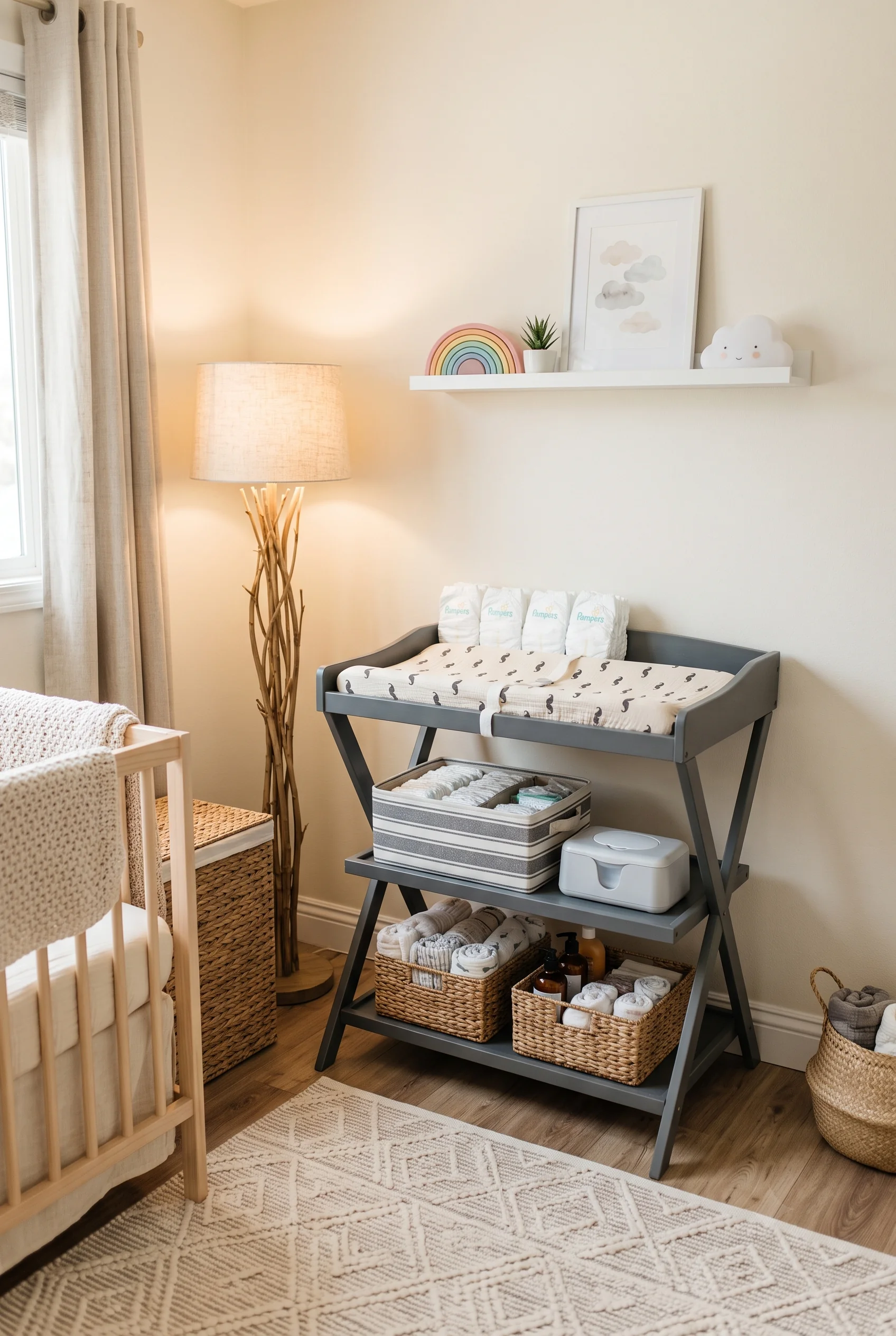
Shop this pick: Foldable X-Frame Changing Table. A freestanding changing table is a recognizable, must-buy nursery item, and the foldable frame is a specific enough feature to stand out as its own affiliate pick.
The gray X-frame changing table looks more like a bar cart than baby furniture, which is the point. Three open shelves below the changing pad hold diapers, wipes, and folded towels in reach without a single drawer to dig through.
Because the frame is lightweight and collapsible, this station can move to a closet or fold flat once the changing phase ends, instead of becoming a bulky dresser nobody needs anymore. A woven basket and a driftwood floor lamp soften what could otherwise read as purely functional.
It’s built for a season, not a decade, and it doesn’t pretend otherwise.
The Space Under the Crib Earns Its Keep
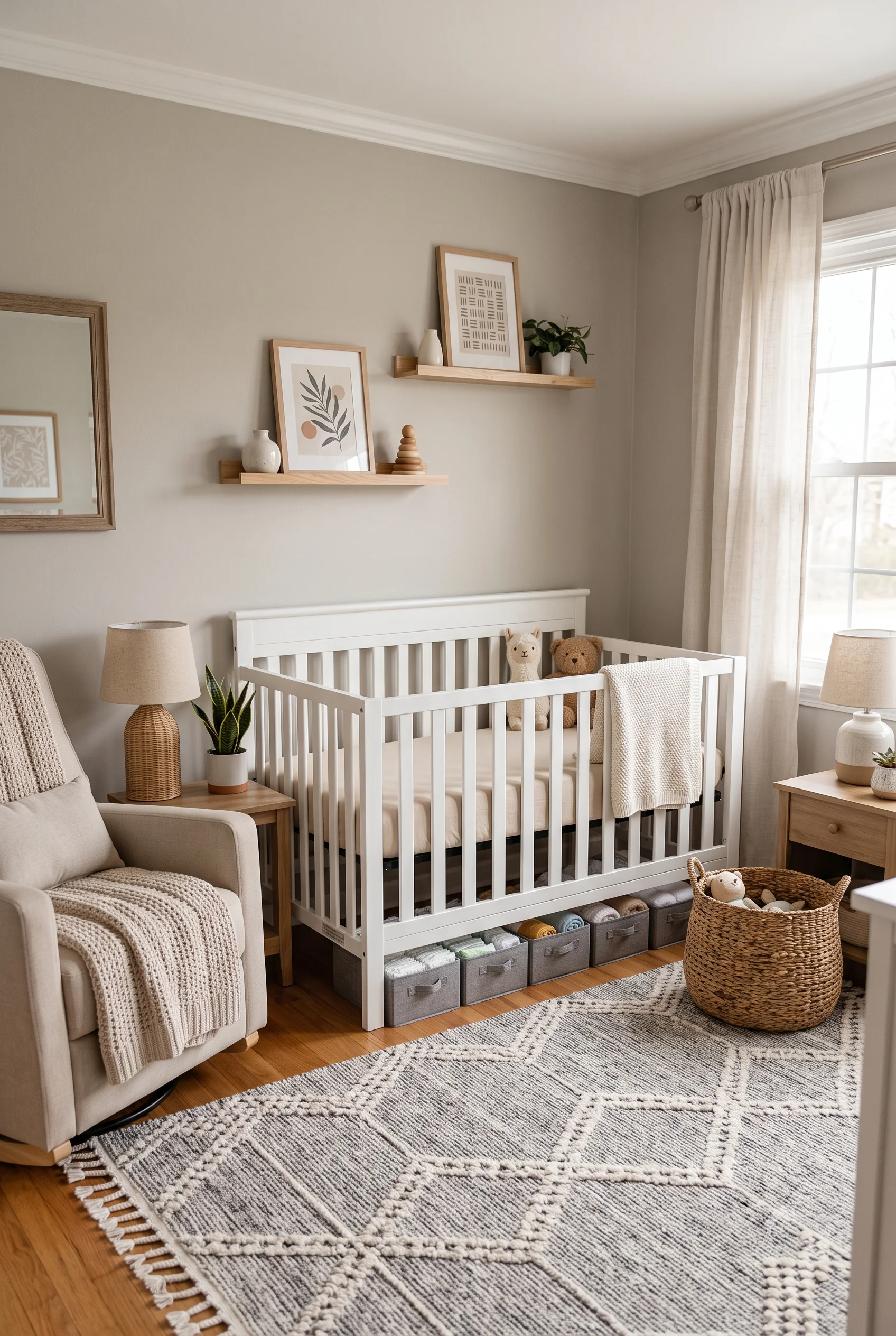
Six fabric bins line up in the dead zone under the crib, the strip of floor most nurseries waste entirely. Spare sheets, swaddles, and out-of-season layettes live here instead of taking up drawer space in the dresser across the room.
Soft-sided fabric storage bins with handles slide out easily with one hand, which matters when the other arm is holding a baby. A woven basket at the crib’s foot holds the overflow, loveys and blankets in daily rotation rather than storage.
Nothing here needs a label to make sense, though the same logic scales up nicely; our playroom organization ideas post covers it for toy bins once the nursery grows into a playroom.
A System That Outlasts the Crib
The same bins can slide under a toddler bed later, or move to a closet floor entirely. Nothing about this setup expires when the crib does.
Finishing Touches That Make the Room Feel Bigger
The last layer of a small nursery isn’t about storage or furniture at all. It’s about light, reflection, and small personal touches that make a room feel finished. Hooks, curtains, and a mirror don’t add square footage on their own. Neither does a well-styled set of baskets, but together they change how spacious the room feels and how much personality it carries.
An Accordion Peg Rack Catches Hats, Totes, and Bonnets
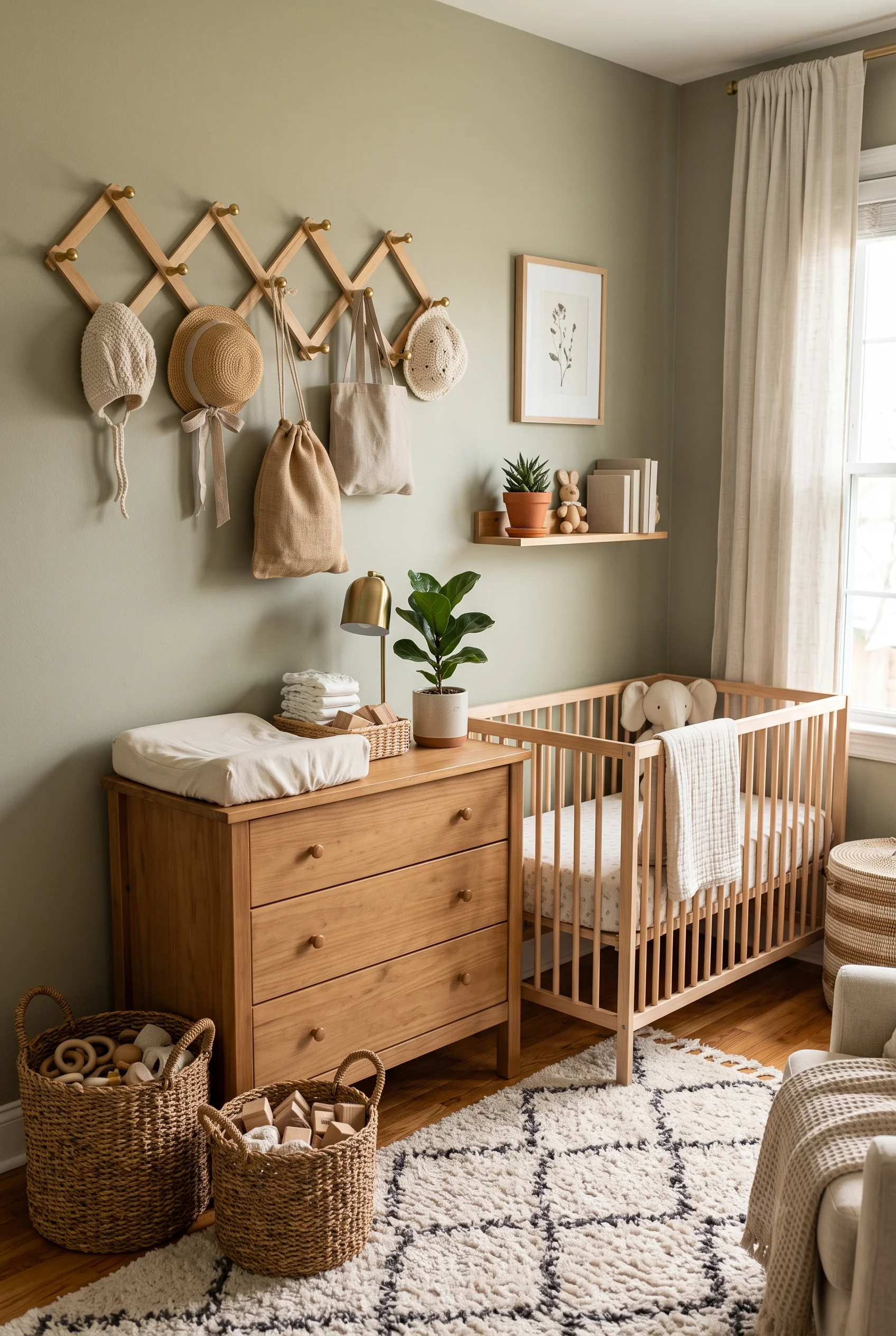
An expandable wood peg rack takes the place of a coat closet the room doesn’t have. A knit bonnet, a straw sun hat, and a canvas tote hang at staggered heights, each one visible instead of buried in a drawer.
Because the rack folds flat against the wall when not in use, it never competes with the floating shelf and framed print beside it. The brass pegs pick up the same warm tone as the dresser’s drawer pulls, so the storage reads as styling first and function second.
A drawstring pouch and a second sunhat round out the display, filling the wall without a single frame on it.
Sheer Curtains Let the Room Borrow Light From Outside
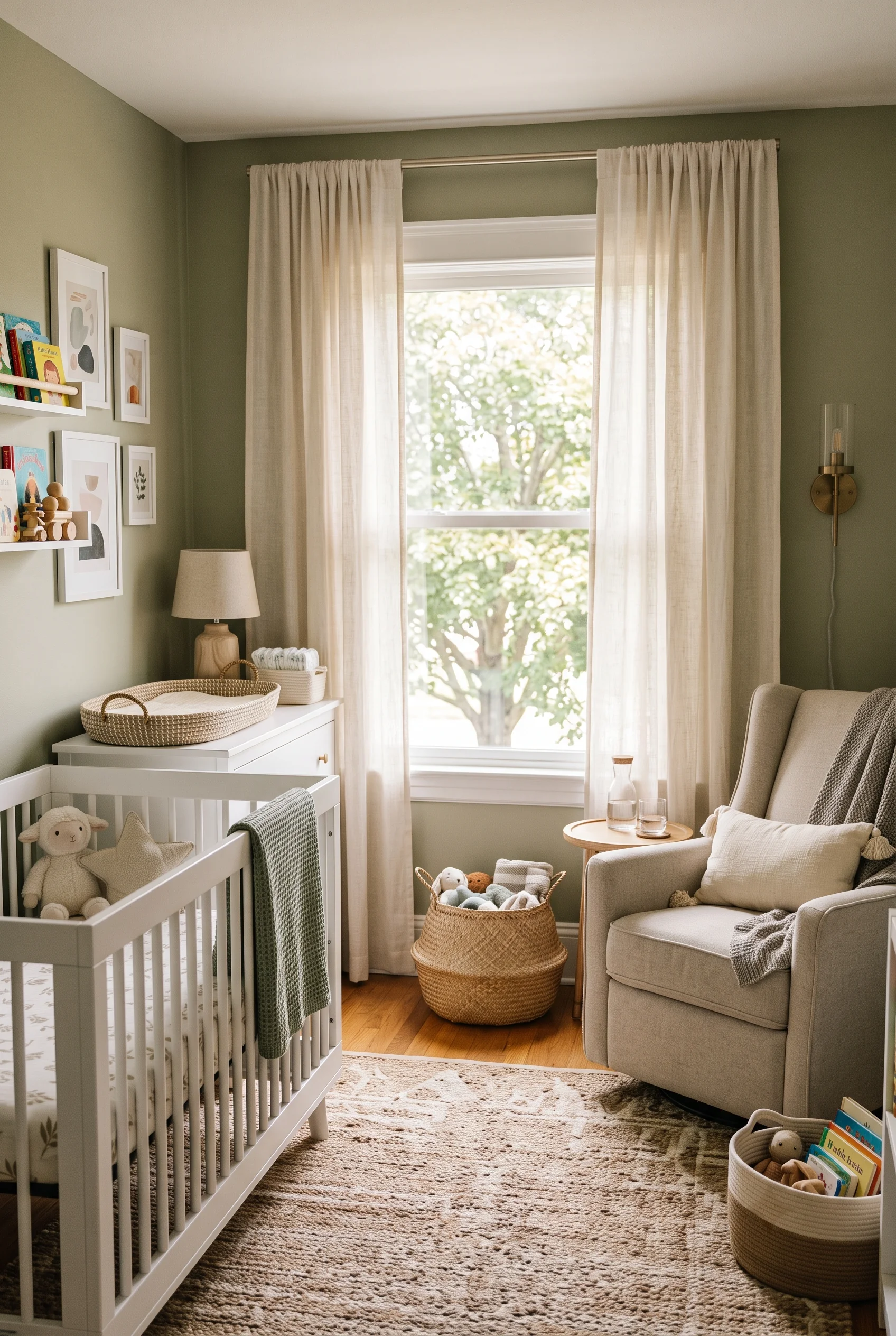
Floor-to-ceiling sheers hang loose enough to catch every bit of afternoon light, filtering it into something soft rather than blocking it out. The fabric is barely there, more suggestion of a curtain than a heavy drape.
That matters more in a small room than a large one. Blackout panels and heavy prints tend to visually shrink a space, while sheer, pale fabric keeps the wall behind the window from reading as a wall at all.
Paired with a warm brass sconce and a gallery of framed botanicals, the window becomes the brightest, most open point in the room rather than competing with the furniture around it.
A Rattan-Framed Mirror Doubles the Light in the Corner
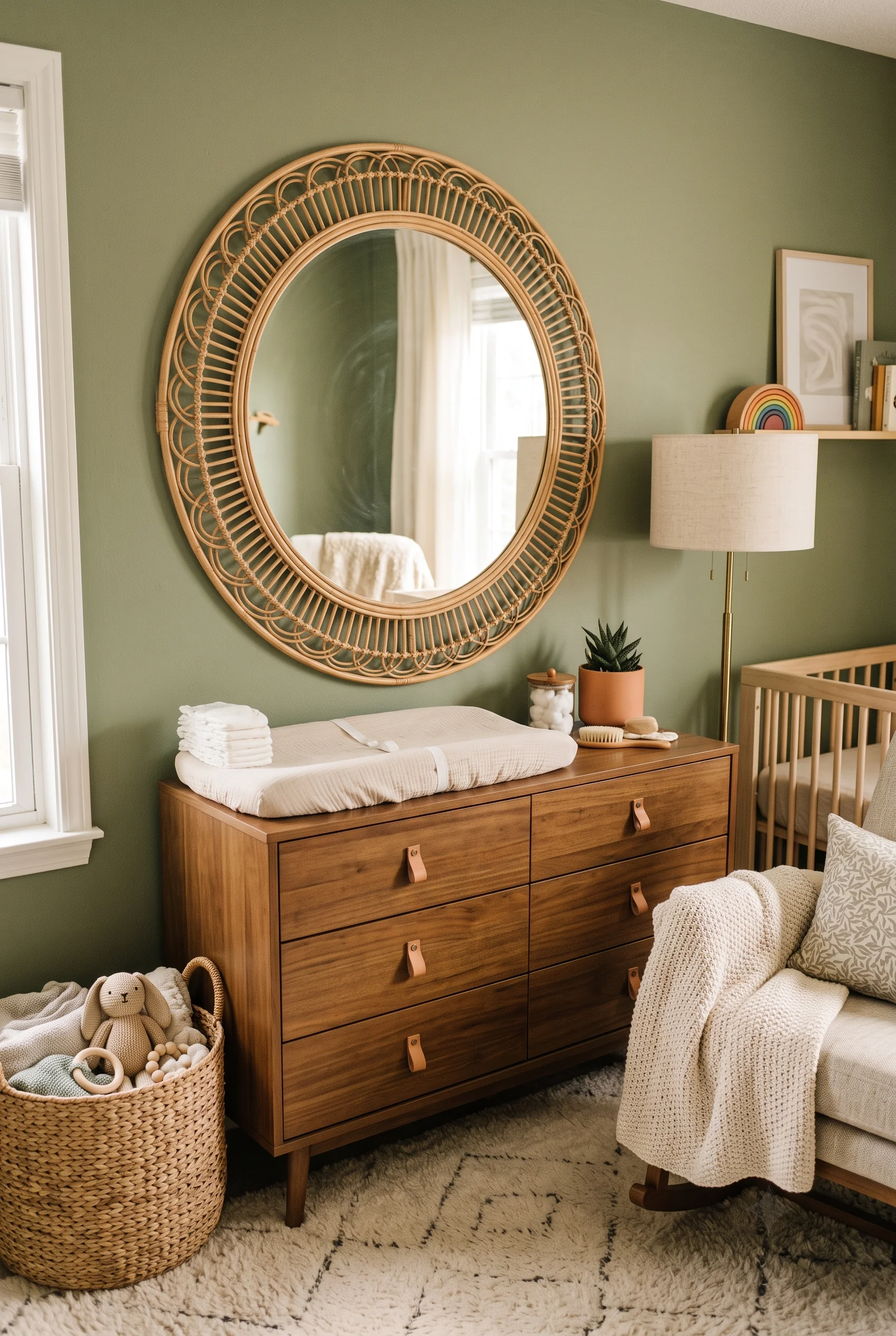
Shop this pick: Round Rattan-Framed Wall Mirror, The oversized rattan mirror is the unmistakable focal point of the vignette, a decor piece readers will want to source exactly as shown.
A round mirror in a woven rattan frame hangs directly across from the window, catching daylight and bouncing it back into the room’s darkest corner. The scale is generous, nearly as wide as the dresser below it, which makes the wall feel taller than it is.
Below, a glass jar of cotton balls and a small wood brush sit next to a potted succulent, everyday changing-table items styled like they belong on display. Nothing about the vignette looks like clutter, even though every piece has a job.
The mirror’s texture keeps the moment from feeling like a straight furniture showroom; the woven frame answers the room’s other rattan and wood tones instead of introducing something new.
Woven Baskets Turn a Bookshelf Into a Toy System
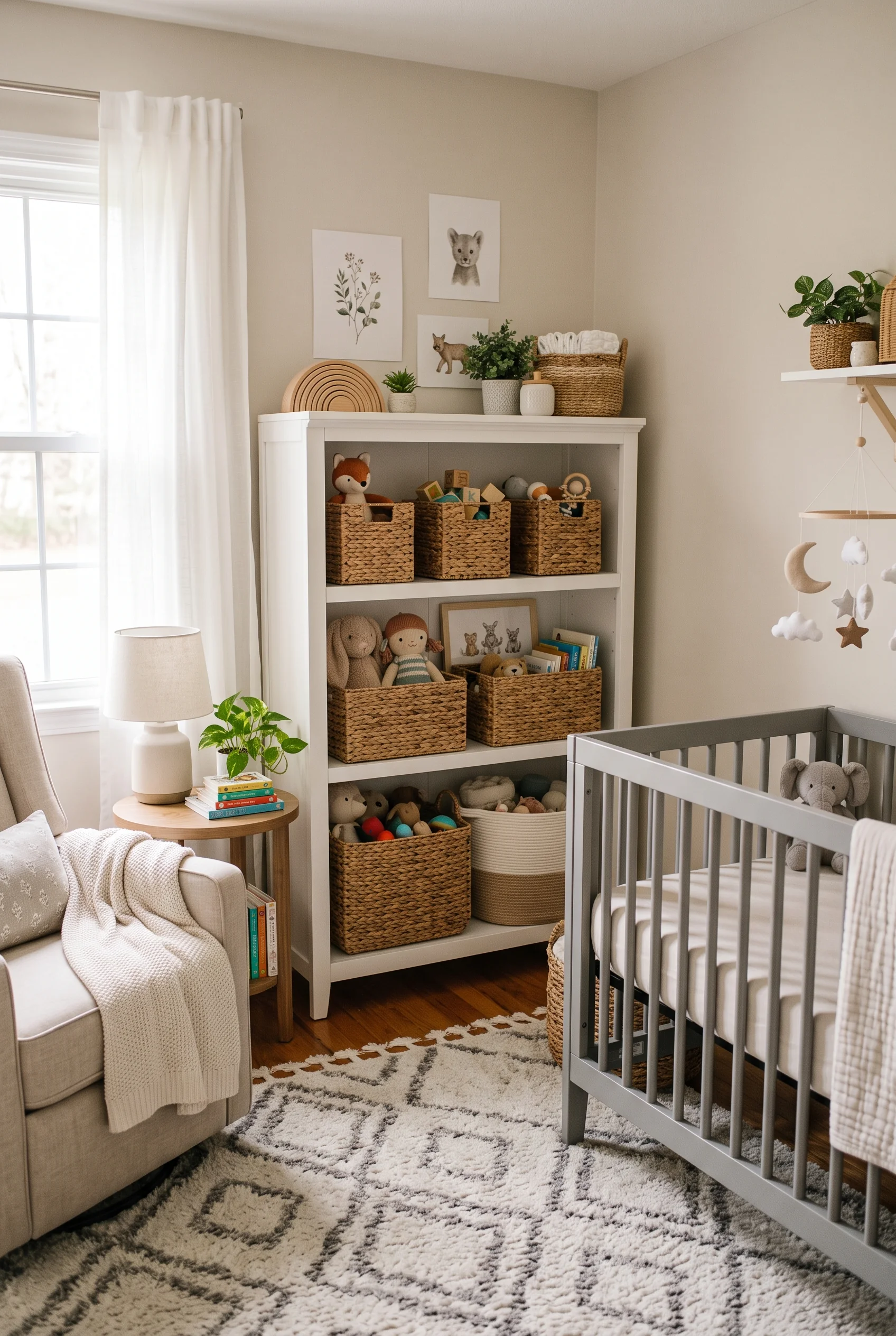
Water hyacinth baskets fill every shelf of an otherwise plain white bookcase, sorting stuffed animals, blocks, and board books into categories a toddler can actually manage. Nothing spills over the edges because each basket has a job and a limit.
The natural texture warms up what would otherwise be a stark, boxy piece of furniture. A rope basket in the mix breaks up the visual rhythm just enough that the wall of baskets doesn’t read as one repeated pattern.
A rainbow toy stacked on top and a gallery of animal prints keep the whole corner feeling like part of the room rather than a storage unit wedged beside the crib.
A Small Nursery That Feels Complete, Not Compromised
Every one of these thirteen rooms solves the same basic problem in a different way: how to fit sleep, storage, and changing into less space than a nursery usually gets, without giving up a place to sit. None of them do it with one dramatic fix. It’s shelving plus a compact crib plus a folding changing table plus a handful of woven baskets, stacked choices that add up to a room that works.
That’s really the throughline behind small nursery ideas that hold up over time. The goal isn’t to squeeze in more, it’s to be more deliberate about what earns a spot in the room at all.
A dresser that also changes diapers. A mirror that also throws light across a dark corner. A rug that also marks off a reading nook without a single wall.
Start with whichever idea solves your biggest problem right now, whether that’s a closet that needs bins and labels, or a corner crying out for a reading chair. You don’t need all thirteen changes to feel the difference; even two or three, chosen well, can make a tight nursery feel calm instead of cramped. Clutter has a way of creeping back in even after the big furniture is settled, and that’s where our minimalist kids’ room ideas guide picks up, with more ways to pare back what’s on display.
However small the space, a nursery built around thoughtful choices rather than square footage will always feel bigger than its measurements suggest.