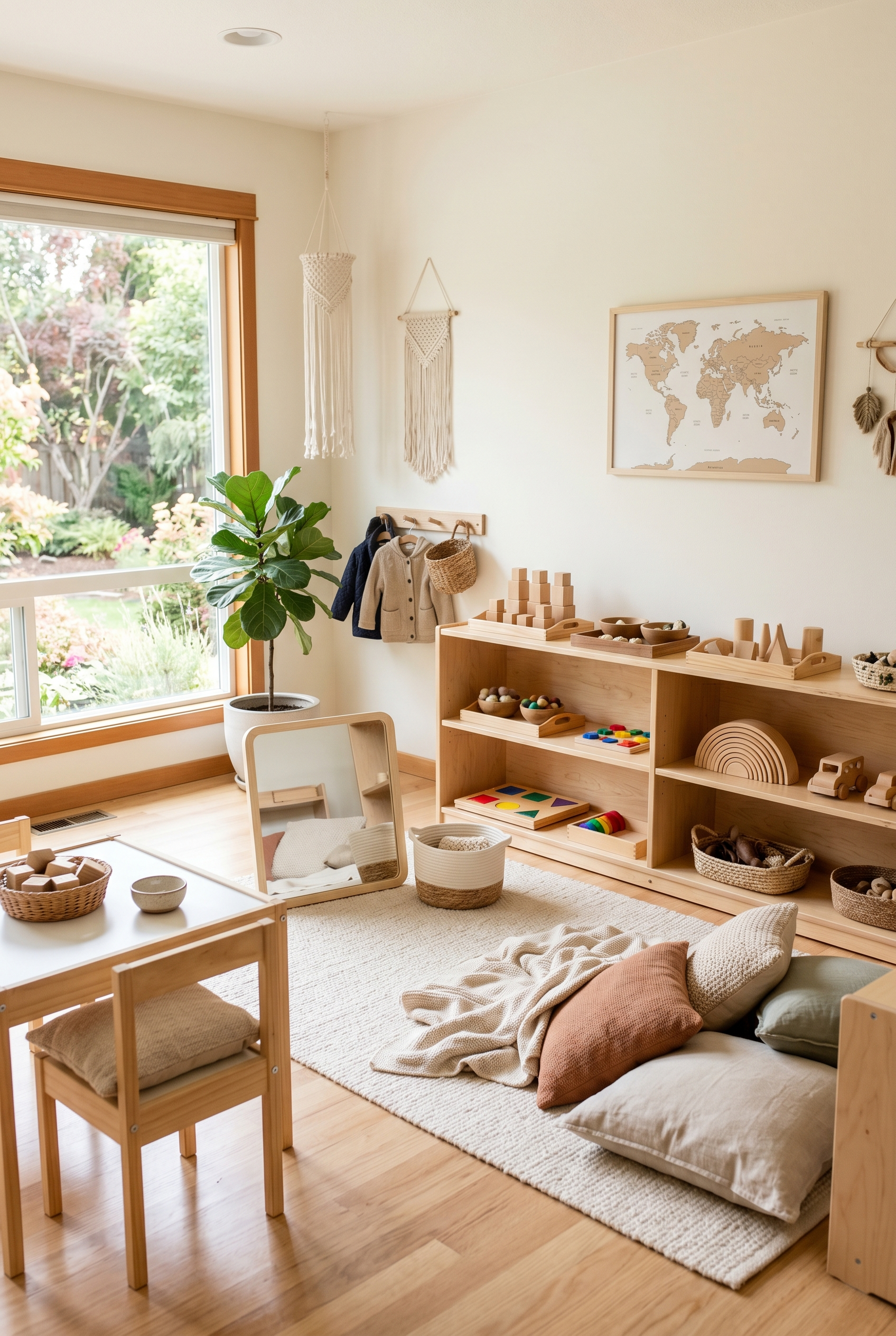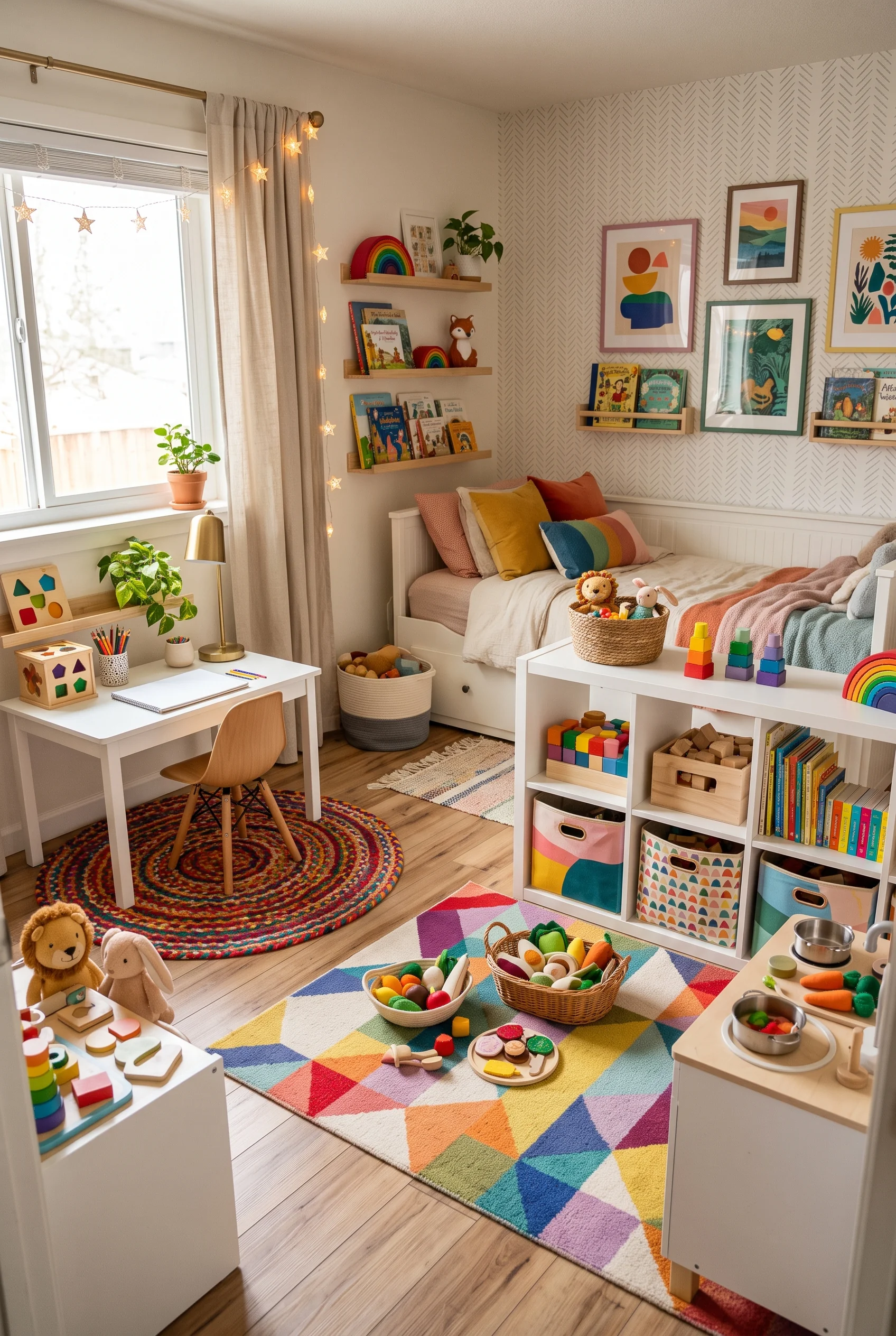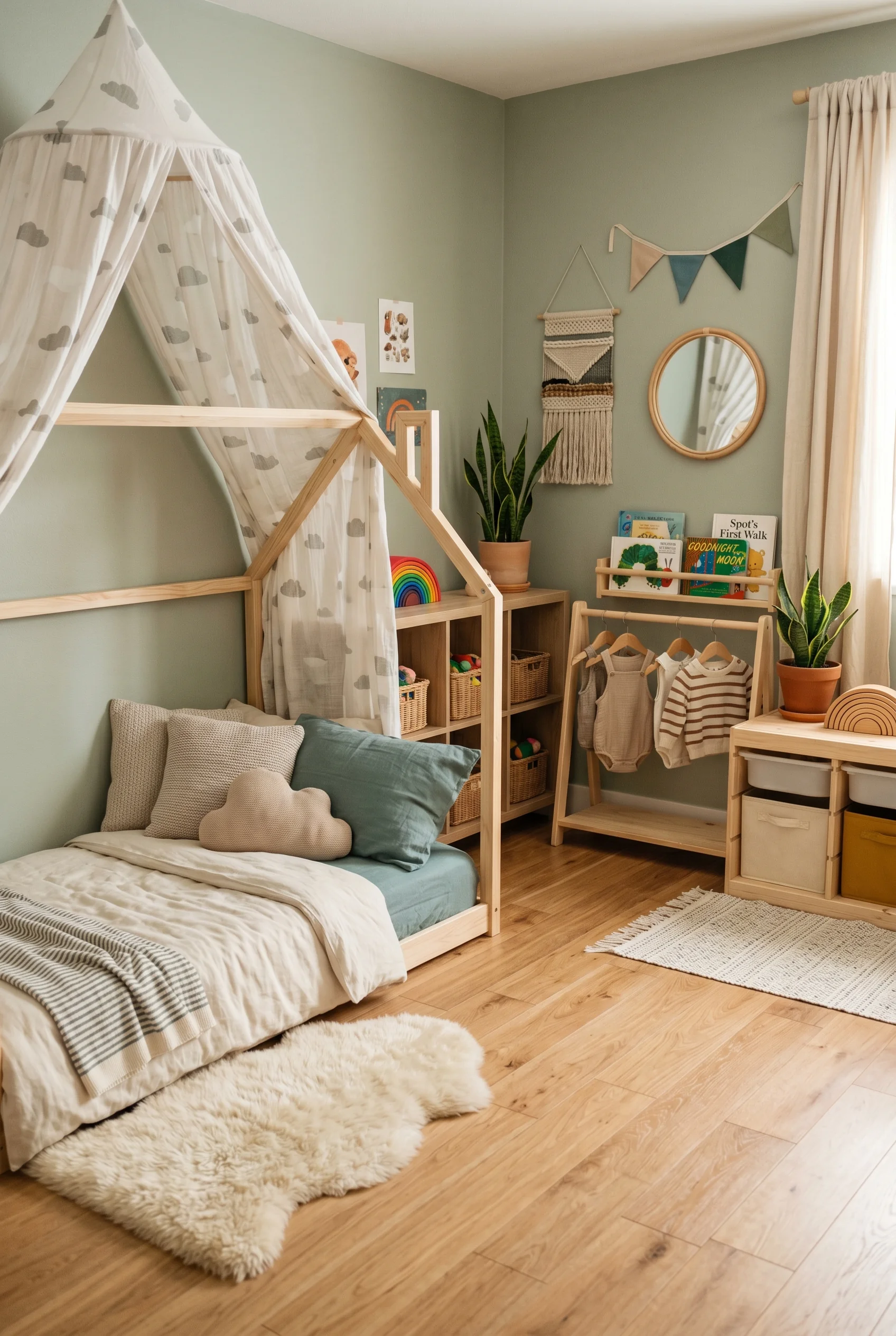
23 Montessori Bedroom Ideas for Toddlers That Encourage Independence
Montessori bedroom ideas often begin with one simple shift: bringing everything down to a toddler’s scale. A bed she can climb into without help. A shelf she can reach on her own. A hook low enough that a coat actually gets hung up instead of dropped on the floor.
None of it requires a full renovation. Just a handful of thoughtful changes that give a toddler more ownership of her own space.
The goal isn’t a picture-perfect nursery frozen in time. It’s a room that grows alongside a child who is learning to dress herself, choose her own books, and put her own toys away. When the furniture and storage match her size and developmental stage, independence tends to occur naturally. A calm color palette and a few well-chosen natural materials help too. They soften the room visually and keep everyday life from feeling chaotic.
If you’re creating a home that follows Montessori principles beyond the bedroom, our guide to Montessori playroom ideas explores many of the same accessibility concepts in a dedicated play space. Planning storage at the same time? Our favorite Montessori toy storage ideas make it easier to keep everyday items organized without sacrificing independence. And if you’re transitioning from a baby’s room, these neutral nursery ideas offer plenty of inspiration for creating a space that evolves beautifully into the toddler years.
DISCLOSURE: Some of the links provided on this page are affiliate links. This means if you choose to make a purchase through these links, we may receive a small commission at no extra cost to you.
Sleep Spaces Toddlers Can Manage Themselves
A toddler’s bedroom lives or dies by the bed itself. Low frames let a child climb in without a boost, while soft lighting and calm textures turn the transition into something a toddler can manage on her own terms.
Add smart storage built right into the frame, and the same piece that holds her at night also holds her books and pajamas by day. These four rooms show how much independence a single well-chosen bed can carry.
Built Around a Toddler’s World
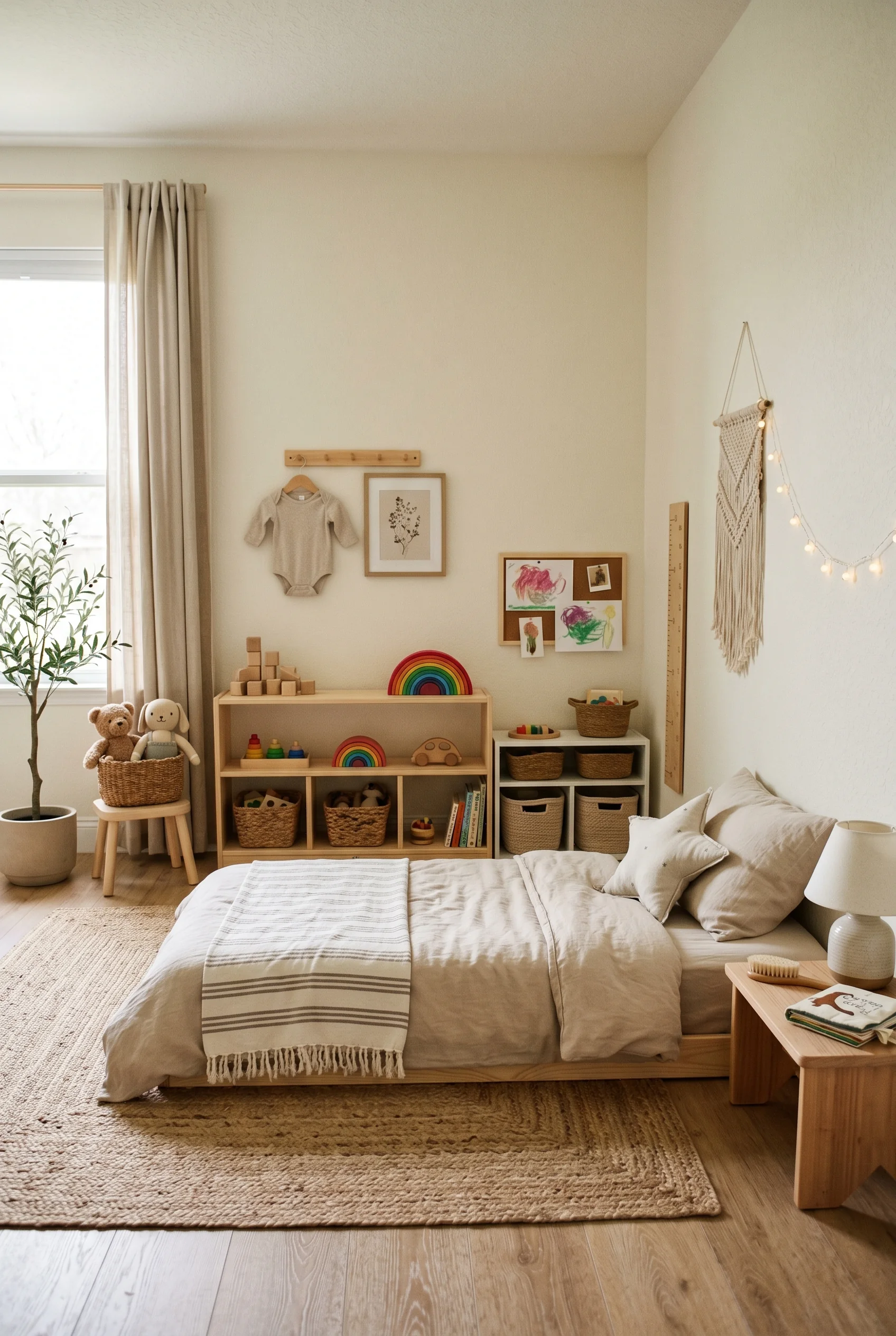
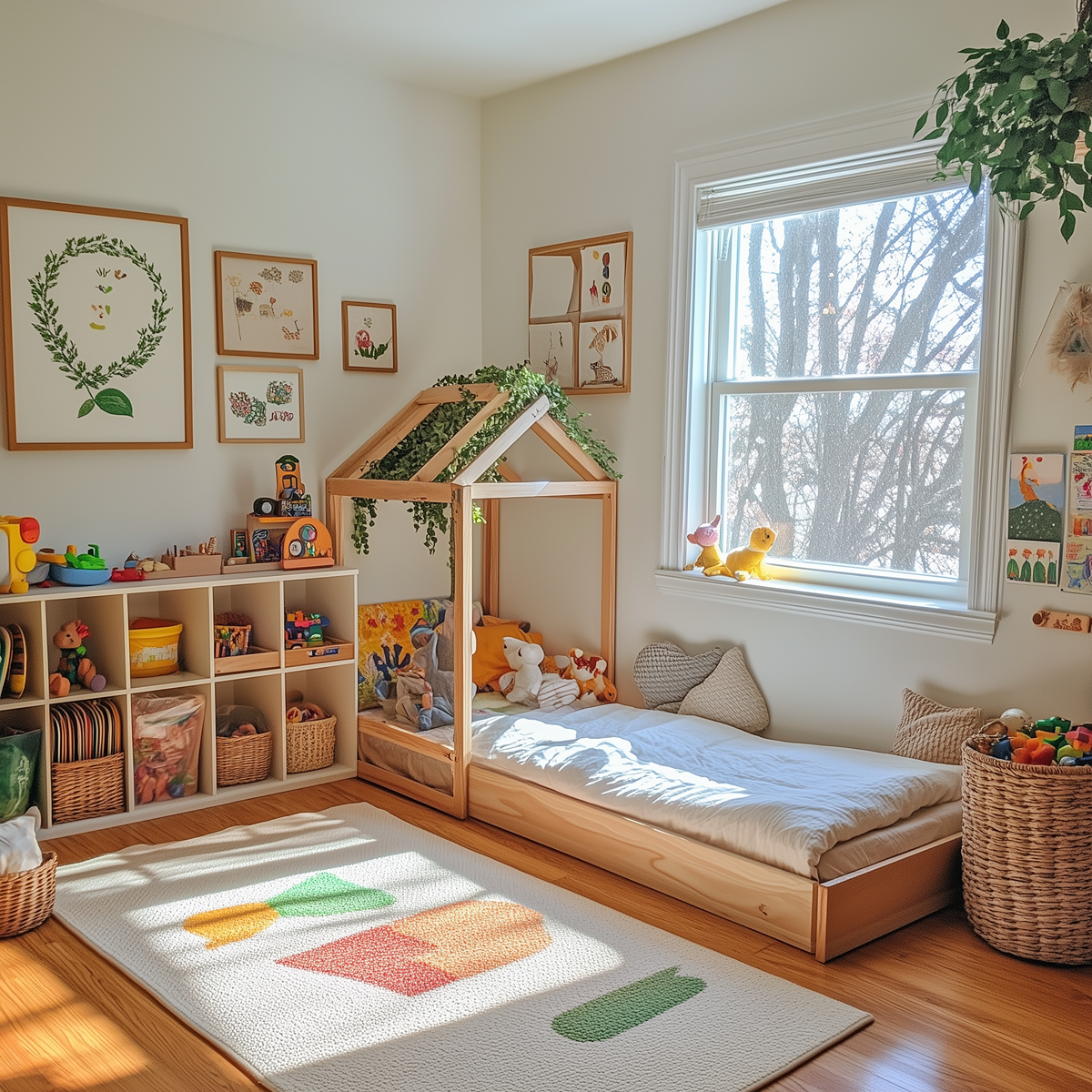
Warm ivory walls and natural wood furniture give this bedroom a soft, calming feel without looking overly themed. The floor bed sits just inches above the rug, making it easy for a toddler to climb in and out independently while reinforcing one of Montessori’s core principles.
Across the room, open shelving keeps favorite toys, puzzles, and books within easy reach instead of tucked away behind closed doors. Woven baskets help contain smaller items while preserving the room’s clean, uncluttered look. Every element feels intentionally scaled to the child rather than the adult.
Simple artwork, a low clothing rail, and layered natural textures add personality without overwhelming the space. It’s a bedroom that feels peaceful today while leaving plenty of room to grow as your toddler’s interests change.
A Floor Bed That Makes Independence Feel Natural
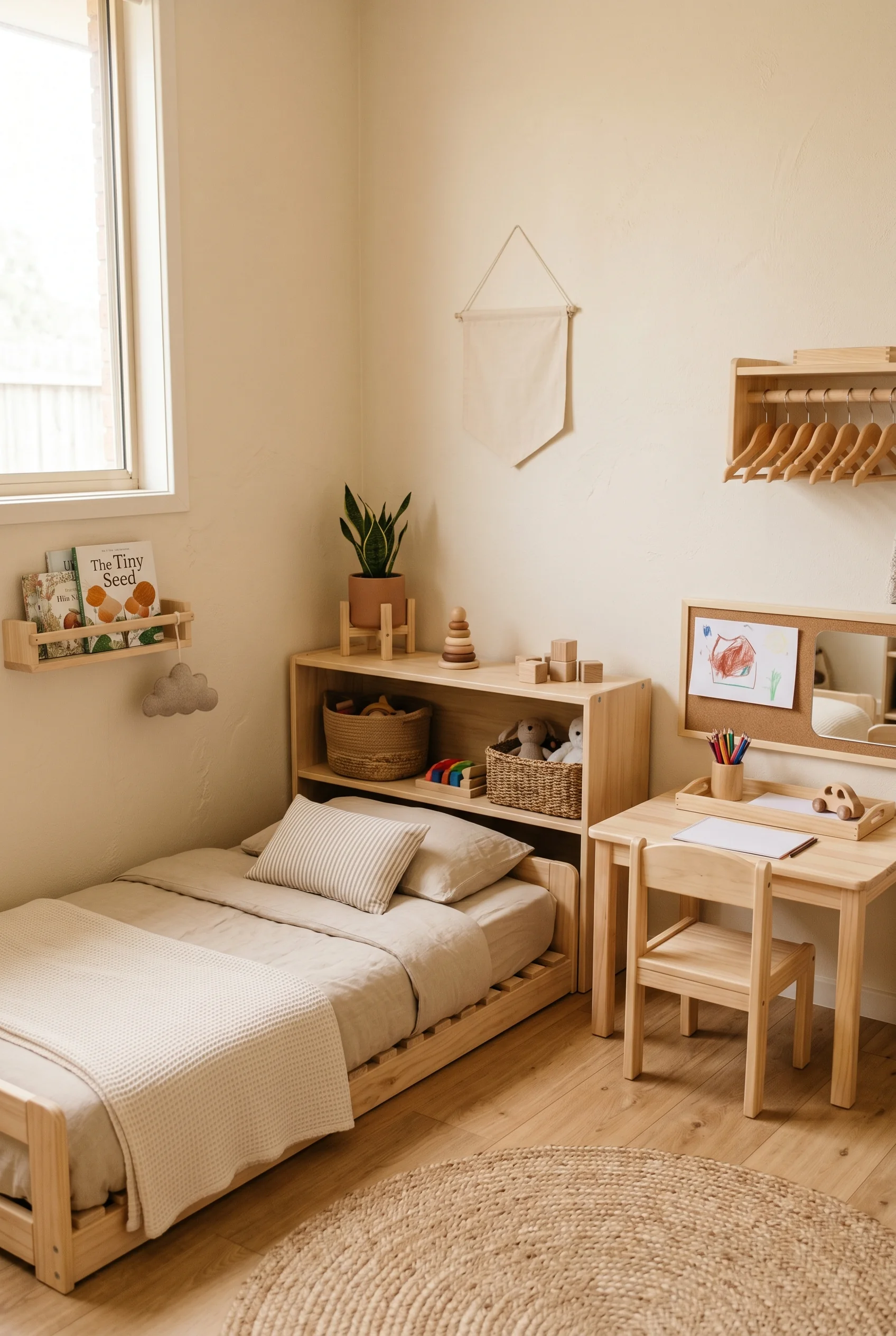
The floor bed is the natural focal point here, sitting just inches above the hardwood so a toddler can climb in and out without help. There’s no high mattress to navigate or bulky bed frame dominating the room. Soft neutral bedding and warm wood tones create a peaceful place to wind down while keeping the overall look simple and timeless.
Just beyond the bed, a child-sized desk, low bookshelf, and open clothing rack reinforce the same Montessori principle. Everything is within easy reach, encouraging independence throughout the day, not just at bedtime. Books, toys, art supplies, and tomorrow’s outfit all become accessible without relying on an adult.
Natural wood, woven baskets, and an uncluttered layout add warmth without overwhelming the room. Rather than relying on themed decor, this bedroom lets thoughtful furniture choices do the heavy lifting, creating a space that can easily grow alongside its little owner.
A Sleep Space That Builds Confidence
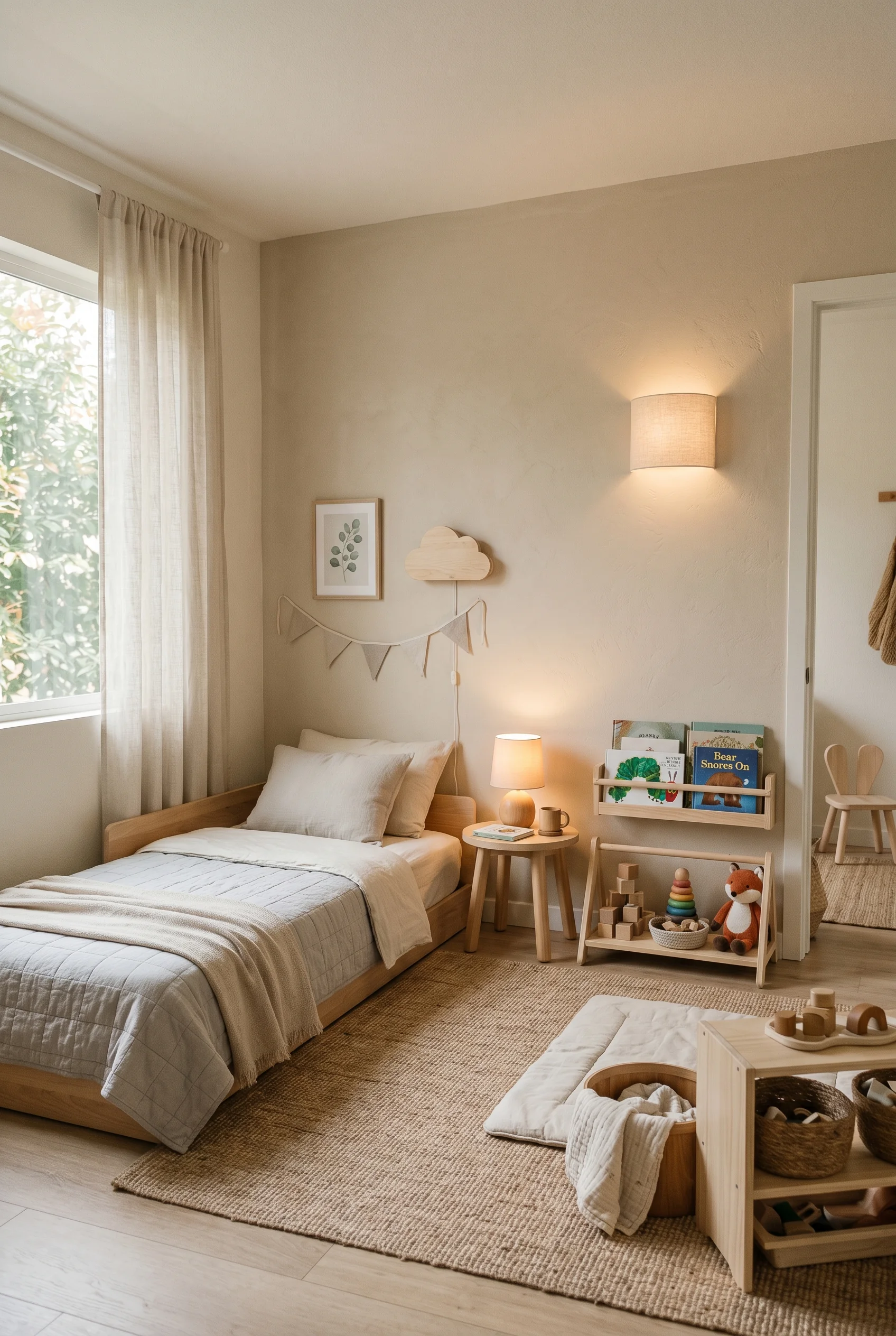
Every part of this bedroom is arranged around what a toddler can do on her own. The low bed makes climbing in and out effortless, while the nearby bookshelf keeps favorite bedtime stories within easy reach instead of tucked away on a high shelf. Even the small table lamp creates a soft glow that helps the room feel calm as the day winds down.
Rather than filling the room with oversized furniture, the design leaves generous open floor space for both play and quiet moments before bed. The toy shelf holds just enough carefully chosen materials to feel inviting without turning the sleep area into another playroom. Everything has a place, making cleanup feel manageable for little hands.
Natural wood, soft textiles, and warm neutral colors keep the room peaceful without feeling plain. It’s a thoughtful reminder that a Montessori bedroom isn’t simply about a floor bed—it’s about creating an environment where children can confidently navigate their own routines from morning until bedtime.
Every Piece Has a Purpose
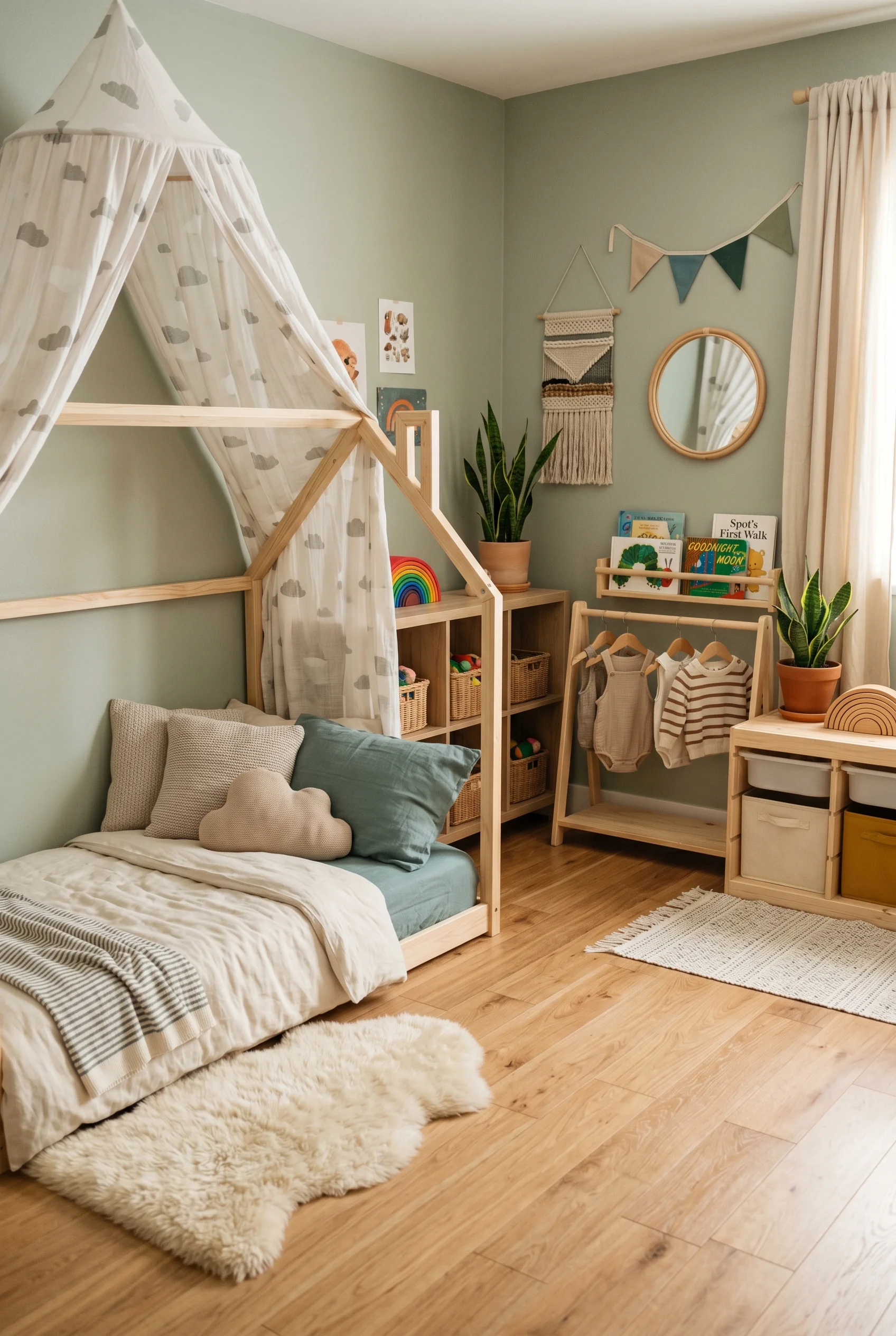
The house bed naturally draws the eye, but the surrounding furniture makes this room work so well. A single shelving unit stores toys, displays books, and creates a visual boundary between the sleeping and play areas without crowding the room. Every item remains within a toddler’s reach, encouraging children to choose activities and put them away independently.
Across the room, an open clothing rack makes getting dressed part of the daily routine instead of something that always requires an adult. Nearby, a low bookshelf keeps favorite stories visible, while storage cubes below provide an easy place to return toys after playtime. Nothing is hidden behind oversized furniture or difficult-to-reach cabinets.
The result is a bedroom where nearly every piece serves more than one purpose. Instead of filling the room with extra furniture, thoughtful Montessori storage creates dedicated spaces for sleeping, dressing, reading, and playing while keeping the overall design calm and uncluttered.
Storage Systems Built for Little Hands
Independence often hinges more on storage than almost anything else in a toddler’s room.
When shelves sit low, bins are labeled, and closets are organized to a toddler’s height, cleanup stops being a battle and becomes something a child can actually do herself.
If cleanup time is still a daily struggle, these playroom organization ideas pair well with everything below. These six rooms handle the challenge in six different ways, from a curated toy rotation to a fully accessible closet.
Toy Storage That Skips the Step Stool Entirely
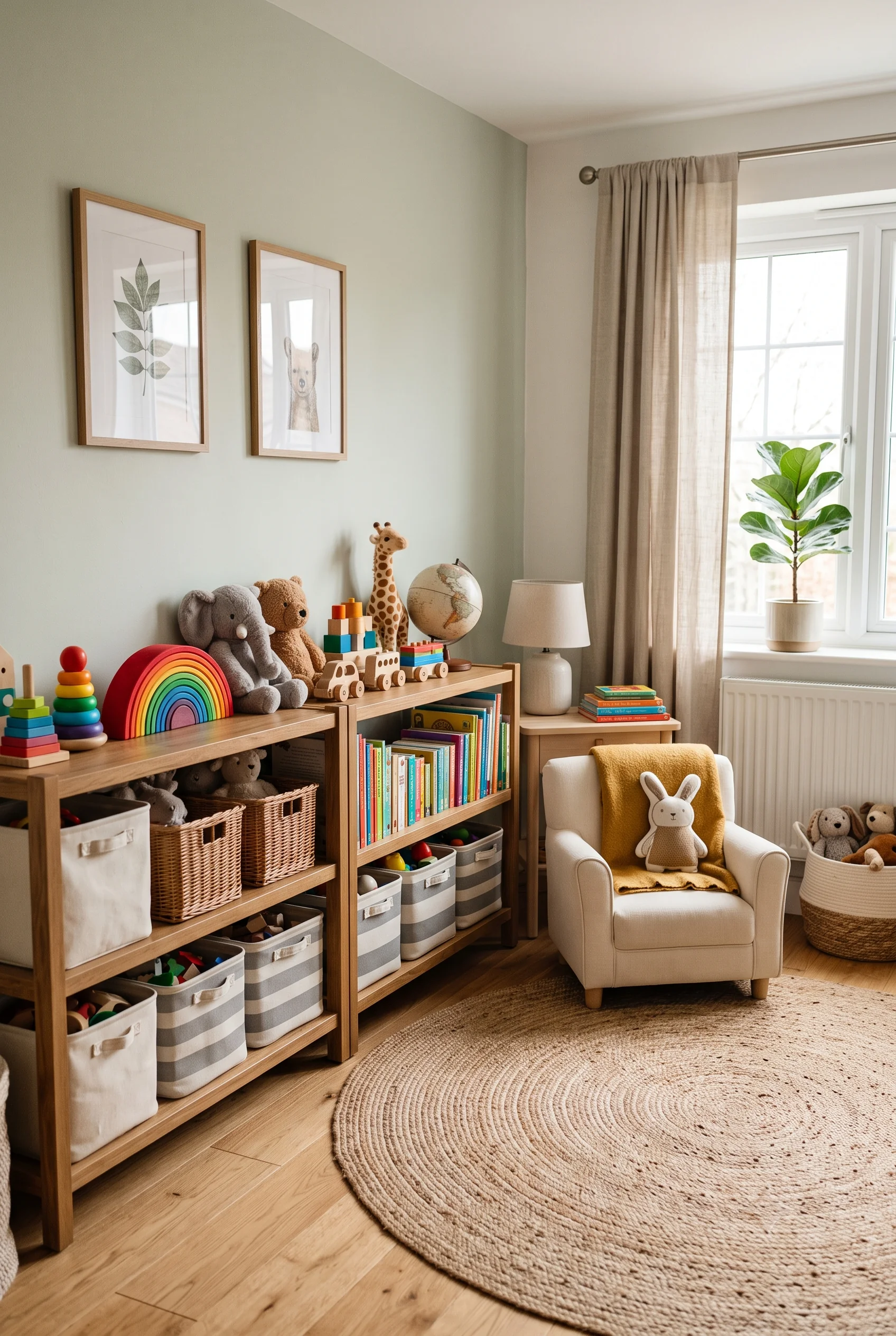
A bookcase topped out at exactly toddler height means a rainbow stacker, a wooden train, and a shelf of picture books all sit within reach without a boost from an adult. Fabric bins in the lower two rows hold blocks and figurines, loosely sorted by type.
The very top shelf, just out of a toddler’s grasp, holds the stuffed animals and the globe, giving a parent a place to keep a few things special or fragile without locking them away entirely.
A cream armchair nearby means this corner doubles as a spot to read through the picture books pulled straight off the shelf.
Bins That Teach Organization Naturally
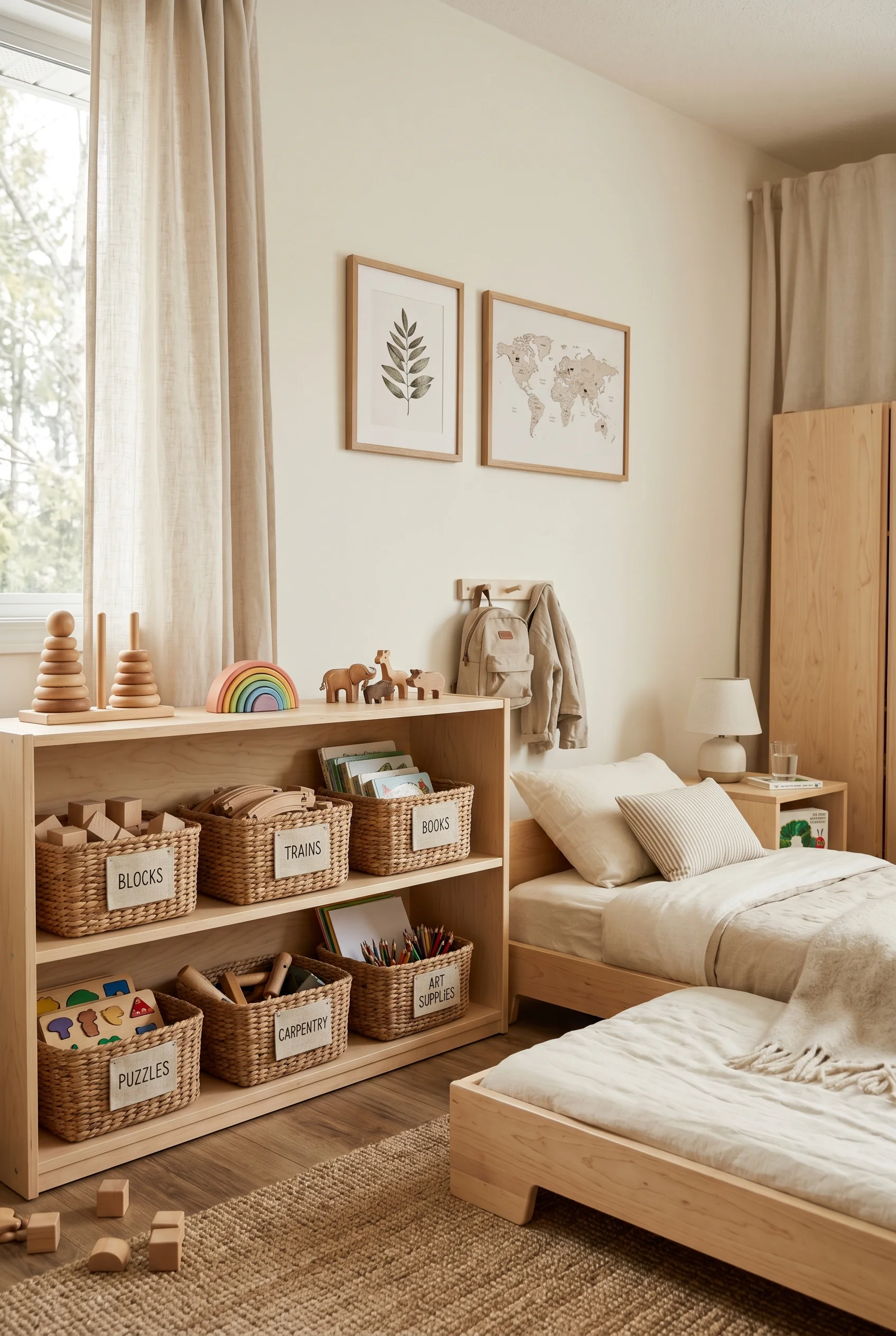
Every basket on this low shelf has a clear purpose, making it easier for toddlers to understand where things belong before they can even read the labels. Blocks, puzzles, books, trains, and art supplies each have their own dedicated home, turning cleanup into a simple routine instead of a guessing game.
Because everything is displayed openly, children can see their options without digging through overflowing toy bins. That visibility encourages more independent play and makes putting things away feel just as manageable as taking them out. The baskets also soften the look of the shelving, keeping the room organized without feeling rigid or institutional.
A few thoughtfully displayed toys along the top shelf add personality while preventing visual clutter. The result is a storage system that works with a toddler’s natural abilities, helping them build confidence every time they choose an activity or clean up after themselves.
A Coat Hook Low Enough to Actually Get Used
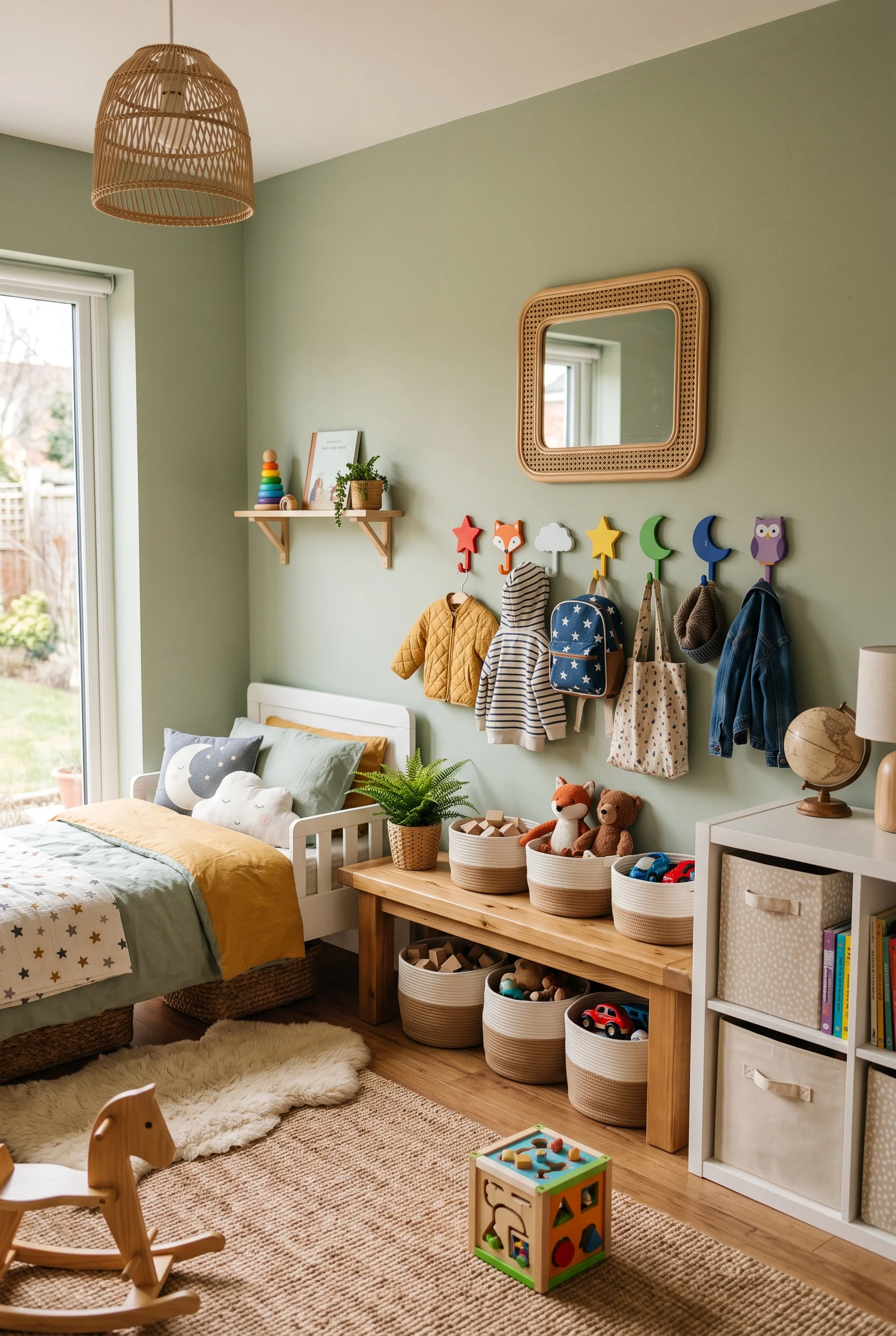
Star, fox, and cloud-shaped wood hooks line this wall at a height a toddler can reach without stretching, holding a quilted jacket, a striped hoodie, and a star-print backpack instead of letting them pile up on the floor by the door.
A rattan mirror above lets a child do one last check before heading out, while the bench below holds baskets of stuffed animals and toy cars within the same easy reach.
The hooks sit low enough that the coats never quite touch the floor.
Fewer Toys Out, More Left Waiting Their Turn
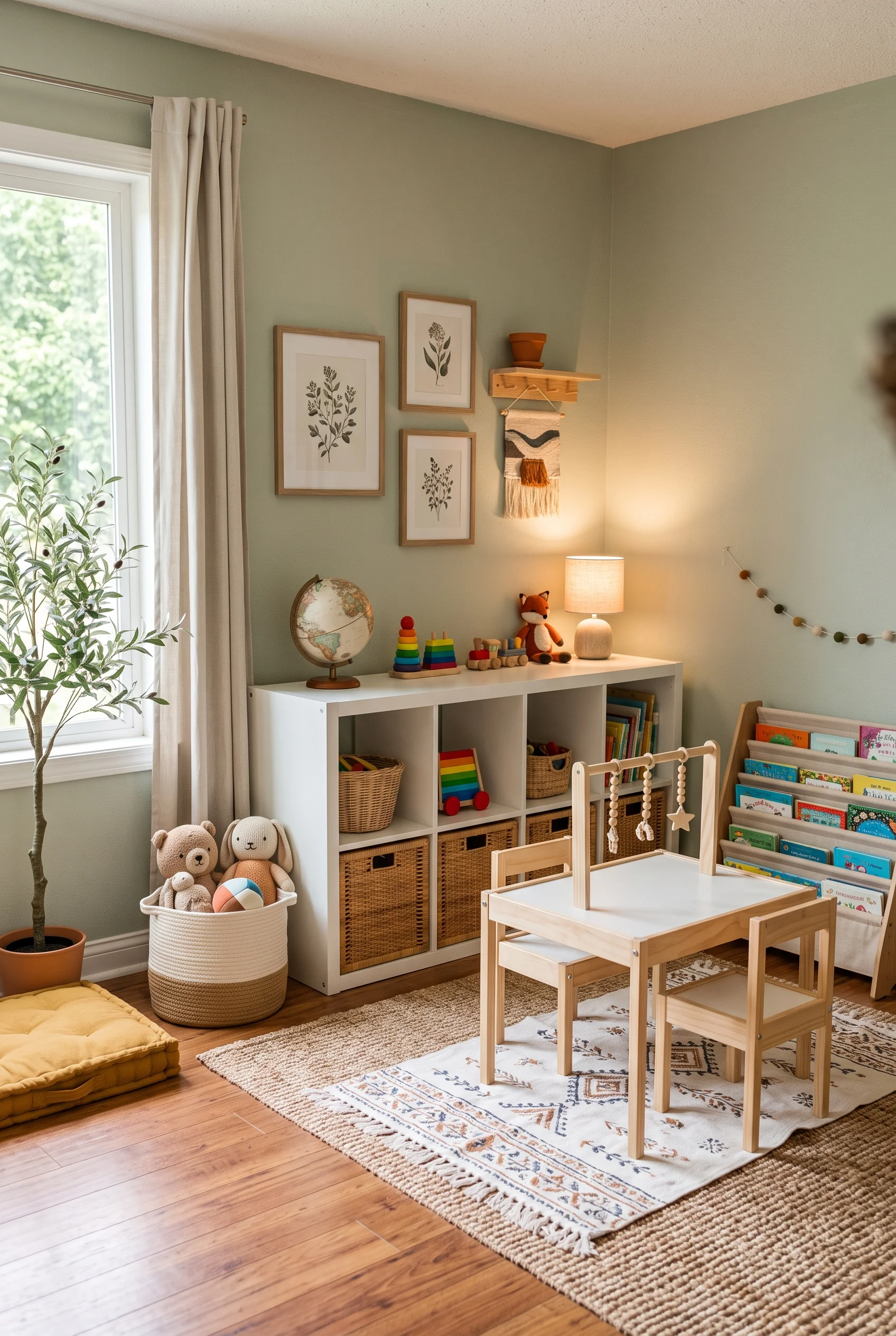
Only a handful of toys sit out on top of this cabinet: a wooden stacking rainbow, a toy train, and a stuffed fox, while dozens more wait out of sight in the woven baskets and drawers underneath. That kind of restraint keeps the surface from turning into visual noise a toddler has to sort through just to find something to play with.
A small white table nearby gives those chosen few toys somewhere to be used, not just displayed. Swapping out what sits on top every few weeks keeps the whole setup feeling new without ever buying anything else.
Where Getting Dressed Doesn’t Need Backup
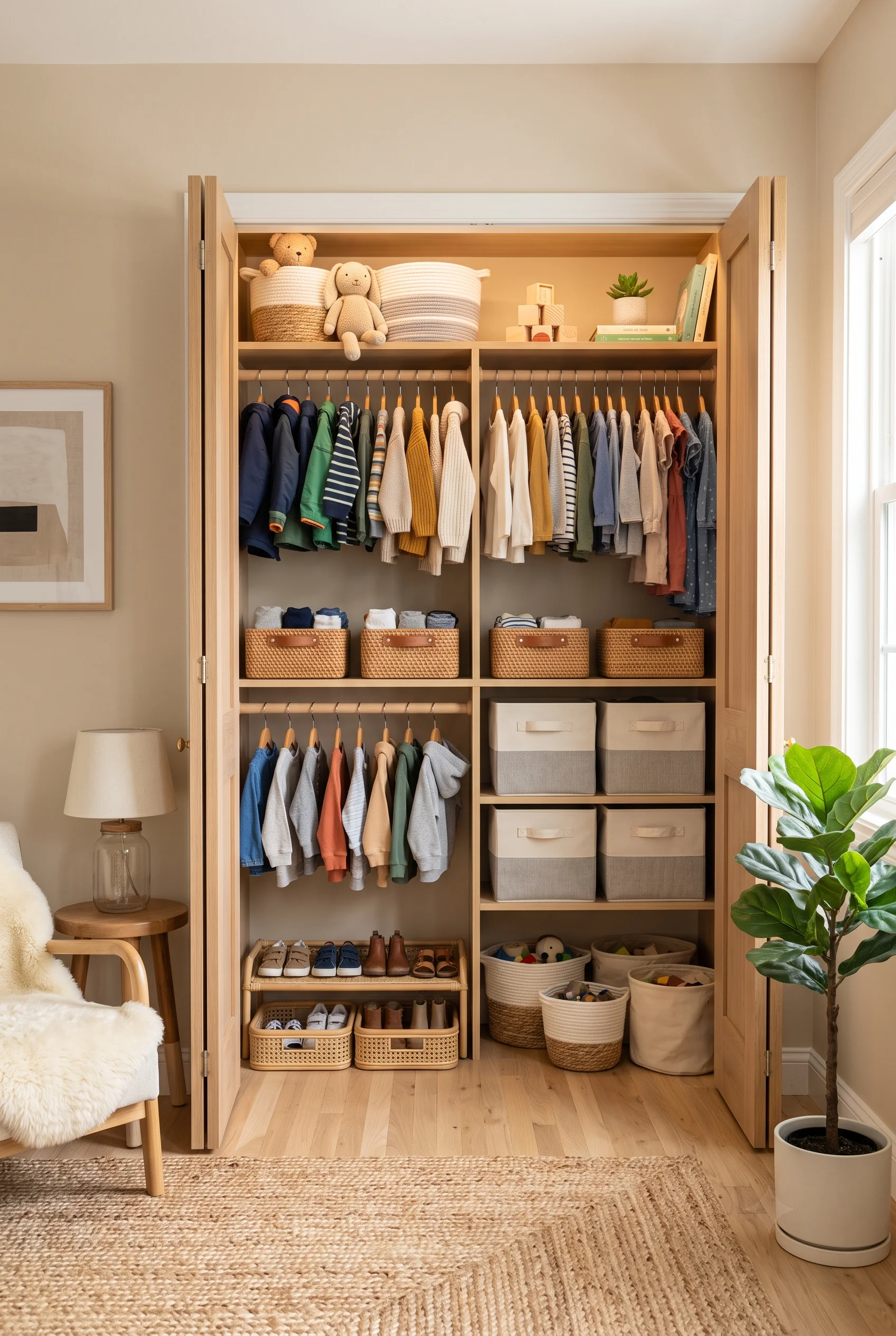
Two rows of hanging rods split this closet in half, with everyday shirts and jackets on top and a second, lower rod for a toddler who’s tall enough to reach her own hoodie. Folded pants and socks sit in woven baskets at the same eye level, sorted enough to find a match without help.
A low shoe rack near the floor keeps sneakers and boots paired and ready by the door. The top shelf, well out of reach, holds the keepsakes and out-of-season pieces that don’t need little hands finding them.
The lower rod hangs at exactly hoodie height, close enough to the folded socks that an outfit comes together in one stop.
One Shelf, a Dozen Baskets, Zero Clutter
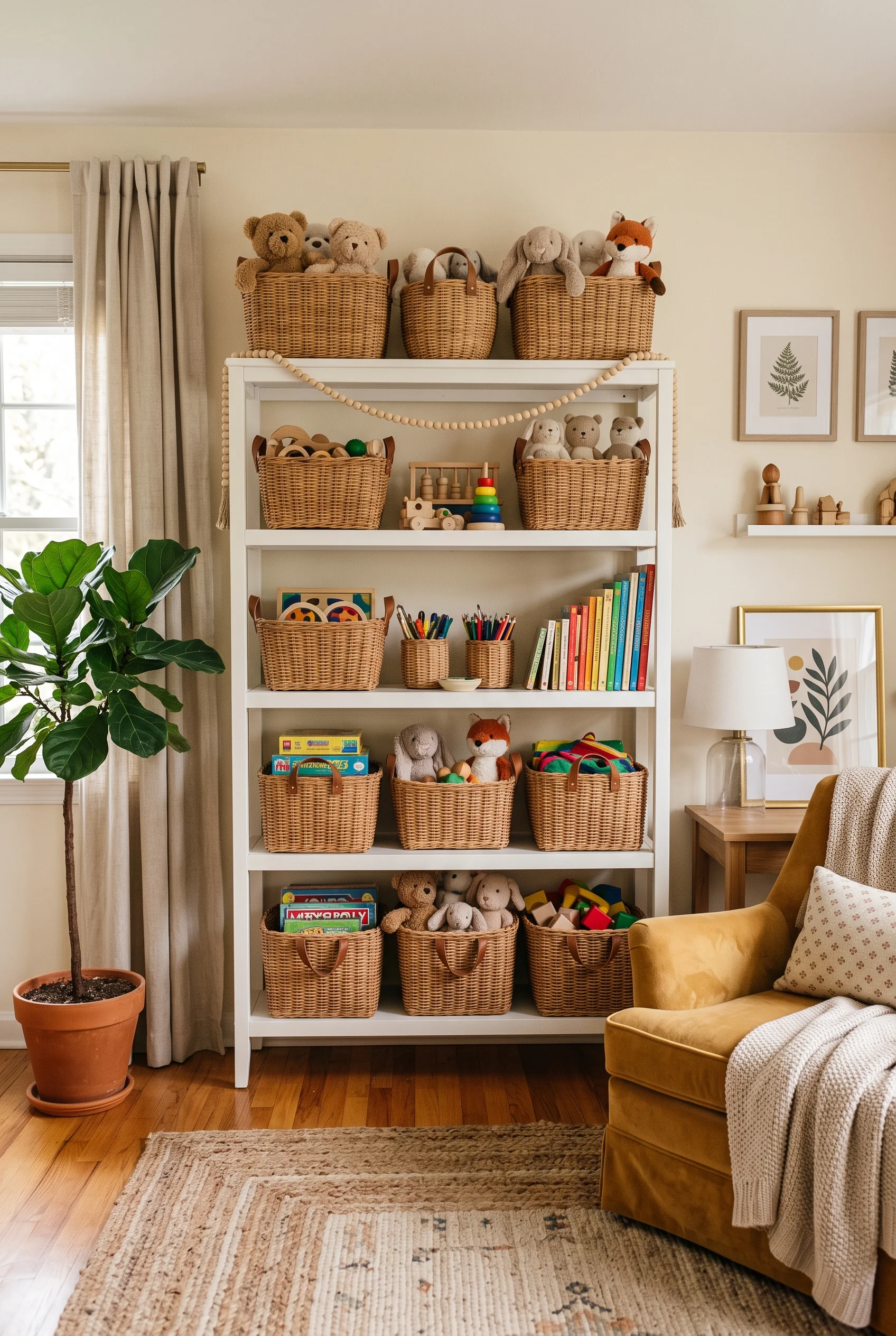
Nearly every inch of this bookcase is filled with matching woven baskets, stacked three across on five separate shelves. The consistency is what keeps a room this full of stuff from ever reading as messy. Board games, colored pencils, and picture books each get their own basket instead of competing for space on an open shelf.
A mustard velvet chair pulled up beside it adds a spot of color against all that natural wicker. Matching baskets in five neat rows calm the eye more than any single toy ever could.
Furniture and Creative Corners for Independent Play
Furniture scaled to a toddler’s actual size does more than look charming in photos; it gives a child ownership of an activity from start to finish.
A table she can sit at unassisted, an instrument she can reach, a spot to hang up her own drawings: each corner gives a toddler something to do independently, without waiting on a grown-up to set it up for her.
Two Chairs, No Booster Seat Required
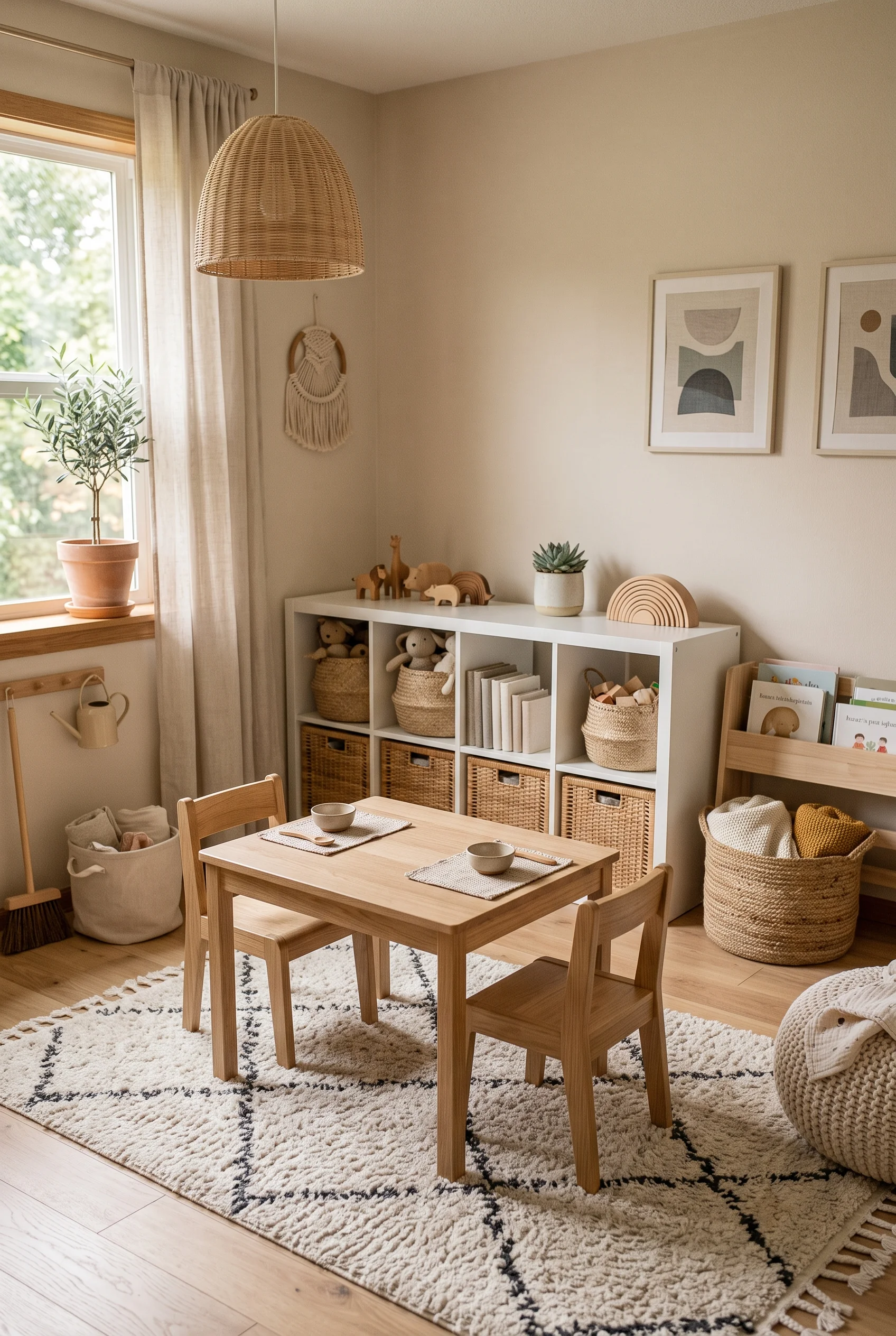
Two ceramic bowls and spoons wait on woven placemats atop a table scaled so small that a toddler’s feet actually reach the floor from her chair. No booster seat, no adult-sized furniture to climb onto, just a spot built entirely around her own proportions.
A rattan pendant light and a hanging macrame planter warm up the corner, while the cube storage against the wall keeps wooden animals and books close enough to grab between bites. Even the watering can and broom hanging near the window are toddler-height too.
A whole ecosystem of child-scaled tools sits within reach here, letting a toddler serve herself, water her own plant, or sweep up her own mess.
The Gallery Wall That Changes Every Week
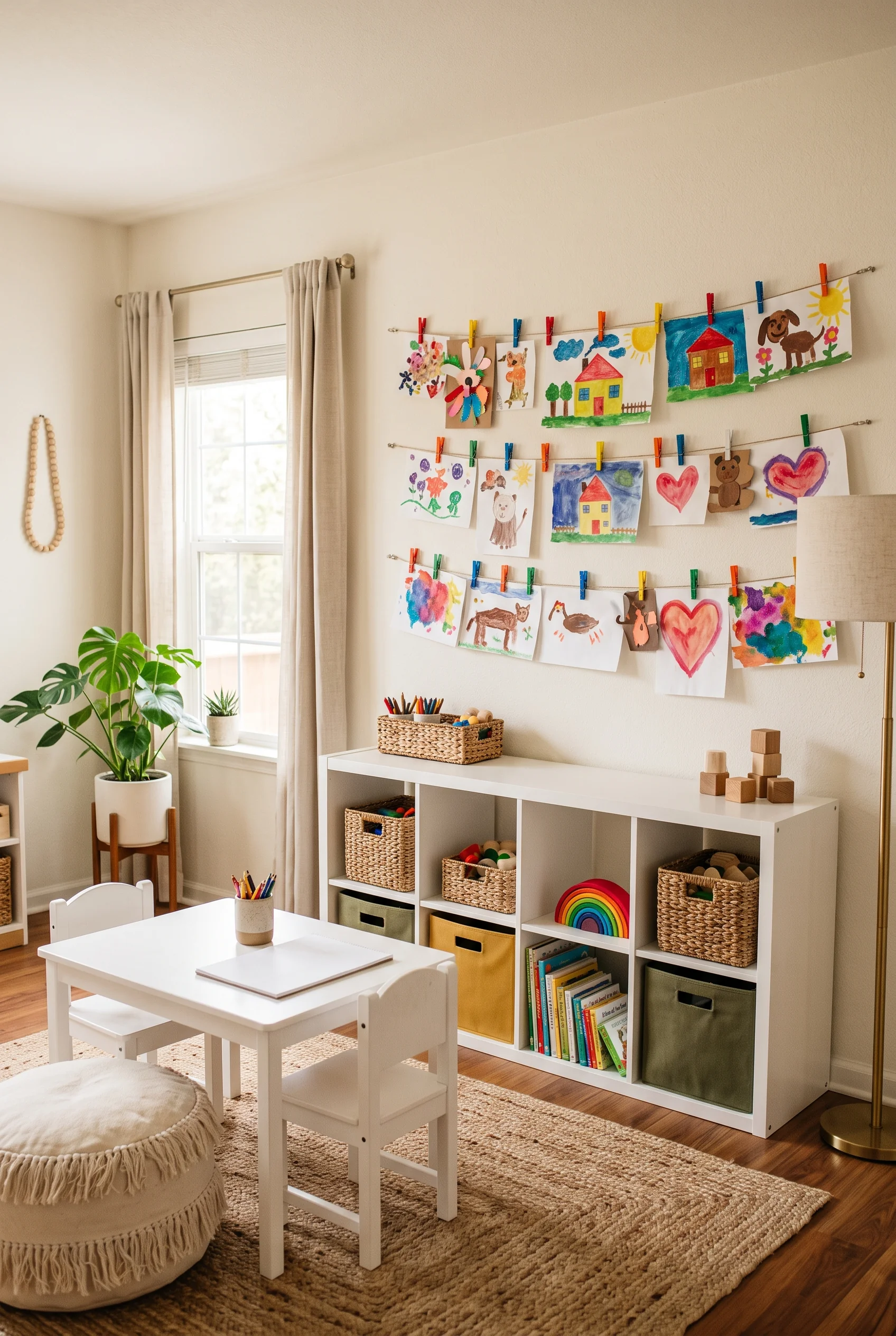
Three lengths of wire strung across the wall hold a rotating gallery of a toddler’s own artwork, clipped up with mismatched colorful clothespins instead of frames. Nothing here is precious or permanent, which means new drawings can go up as soon as they’re finished, with no debate about which piece deserves wall space.
A white cube shelf below holds crayons, paper, and a few well-worn toys, all within reach of the small table where the art actually gets made. A round knit pouf adds a second seat for anyone who wants to watch.
The entire wall serves as a living scrapbook, updated by the artist herself.
An Instrument Corner That Doesn’t Need an Audience
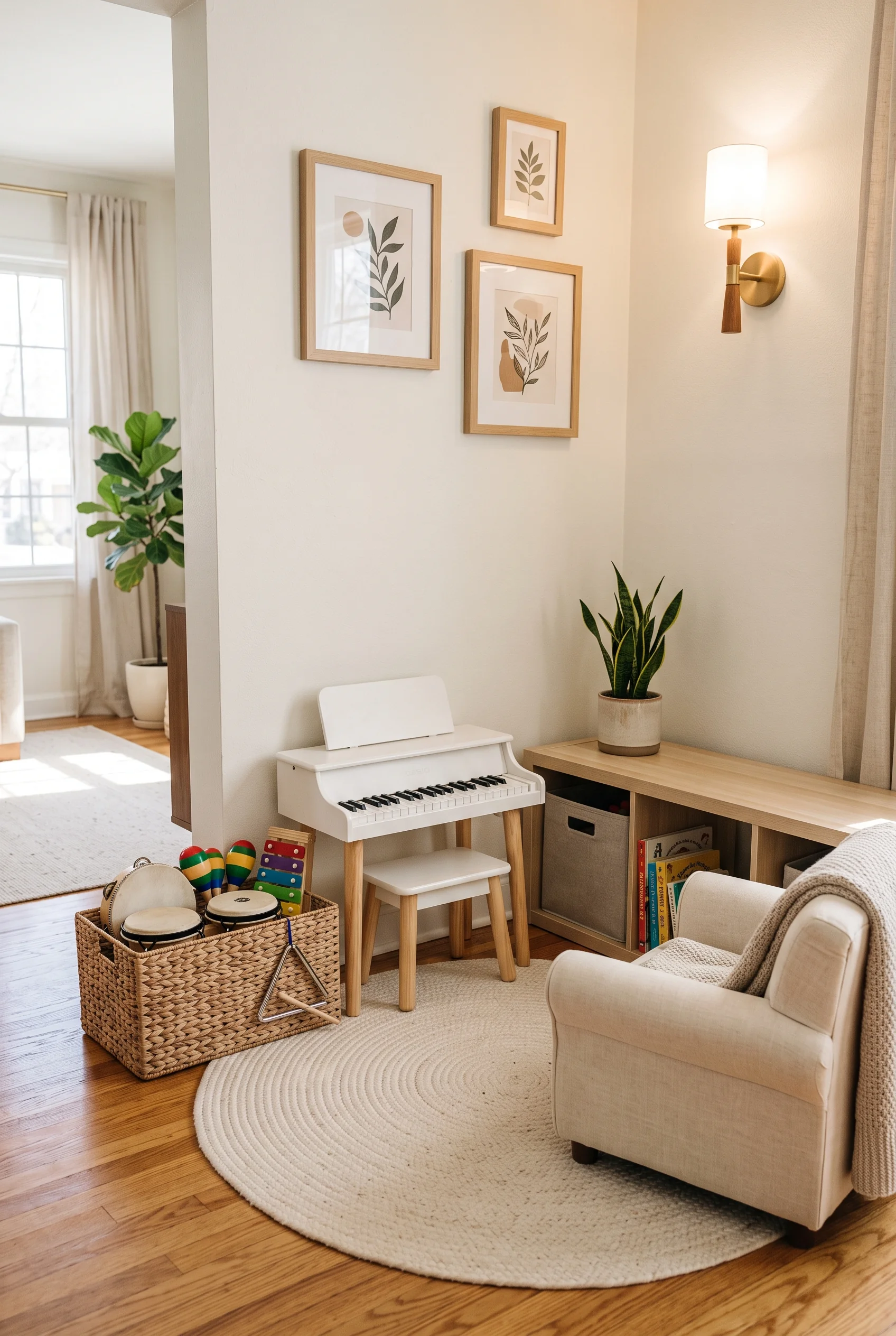
A toddler-sized piano and stool sit low enough for small hands to actually reach the keys, tucked into a hallway nook rather than a dedicated playroom. A woven basket beside it holds a tambourine, a set of maracas, and a small triangle, enough variety to make noise without needing anything plugged in.
A framed botanical print gallery and a brass sconce keep the corner looking more like a reading nook than a rehearsal space, which makes it easy to fold into a shared living area. A cream armchair nearby means someone can sit and listen, or just as easily ignore the racket entirely.
Music here isn’t a scheduled activity. It’s just another shelf a toddler can reach.
Cozy Retreats and Quiet Corners
Not every corner of a toddler’s room needs to be about learning or tidying. A soft chair, a pile of cushions, or a canvas tent gives a child somewhere to retreat when a room full of toys starts to feel like too much.
If a dedicated book corner is on your list too, these cozy reading nook ideas pair naturally with the quiet spaces below. These four spaces all serve the same purpose, even though none of them look alike.
No Furniture Left to Climb On
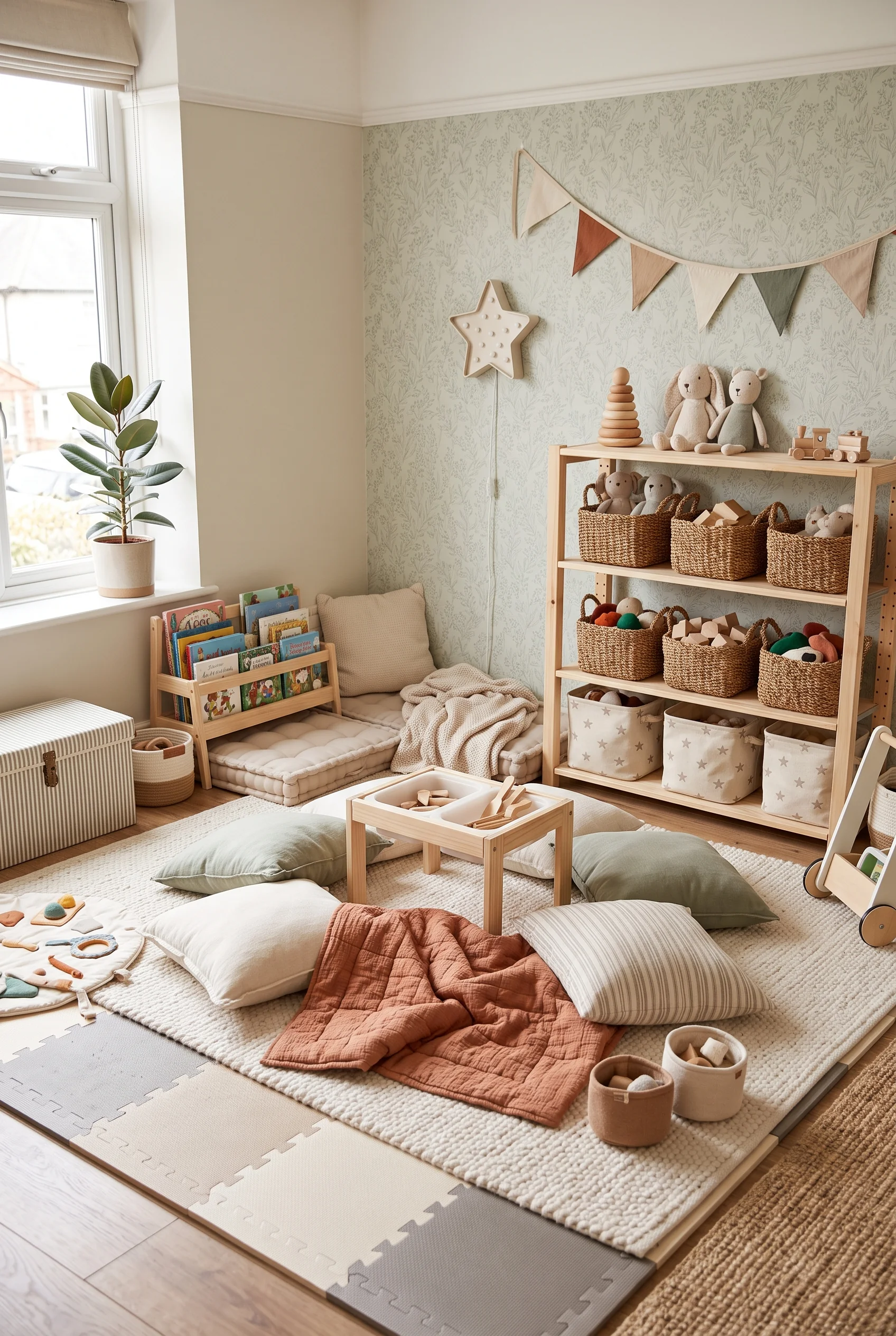
Interlocking foam tiles cover the floor here instead of a rug, cushioned enough for tumbling without a single hard edge nearby. A low two-bin wooden table sits at the center, just tall enough for sorting blocks while seated on the floor rather than in a chair.
Floor cushions in cream, sage, and rust replace a sofa, giving a toddler somewhere soft to land without needing to climb onto adult furniture. A star-shaped night light and a triangle bunting keep the mood playful rather than sterile.
Nothing in the room rises higher than a stack of cushions.
A Rug Full of Things to Touch, Not Just Sit On
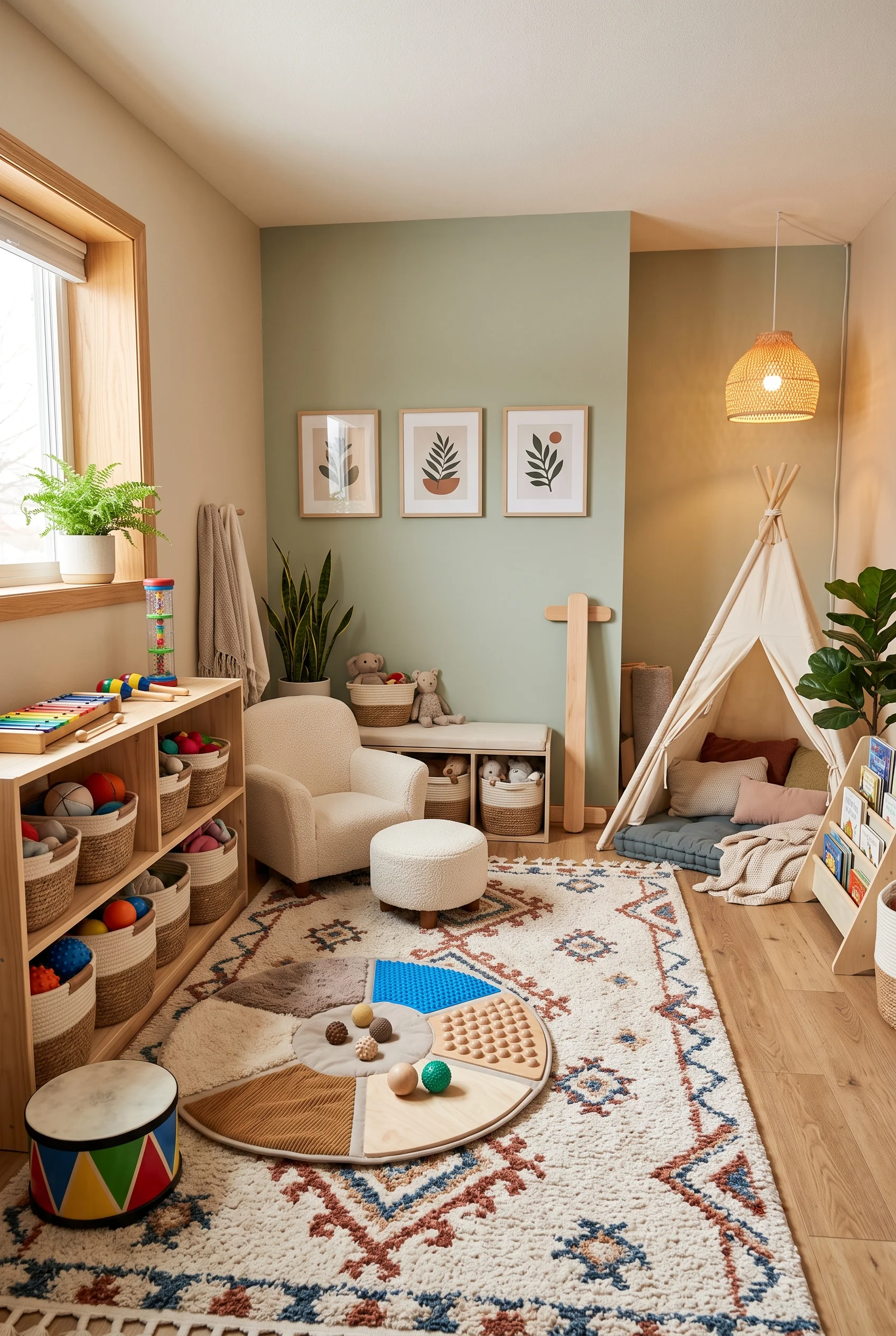
A round wooden sensory board sits in the middle of the rug, its pie-slice sections filled with nubby fabric, smooth wood balls, and a textured rubber grid, an entire tactile experience a toddler can explore without a single word of instruction. A basket beside it holds a drum, maracas, and a small triangle for the moments that call for noise instead of quiet touch.
A boucle armchair and a matching knit ottoman give the corner somewhere soft to land in between. A setup built for hands more than eyes.
Color, Texture, and Natural Materials
The calmest Montessori-inspired rooms tend to lean on the same few ingredients: a soft, muted palette, real wood and woven textures, and a plant or two to bring some life into the corners. None of it reads as trendy or overdone; it just feels warm. These four rooms show how much mood a handful of natural materials can set on their own.
A Palette Soft Enough to Never Clash With Anything
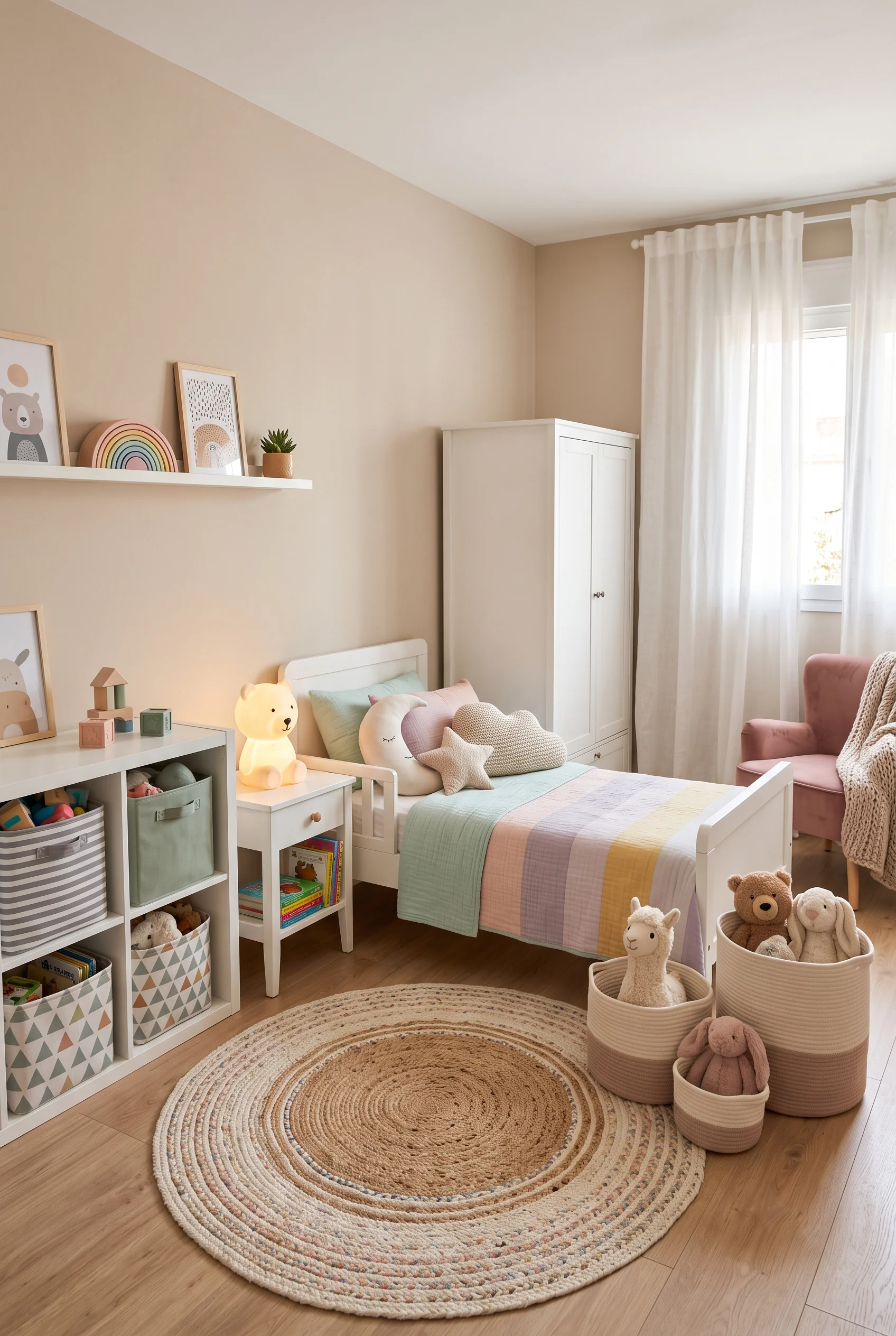
Beige walls and a white wardrobe give this room a blank, calm base, which leaves room for a quilt striped in mint, blush, and lavender to be the loudest thing in the space, and even that stays soft. Cloud and star throw pillows echo the pastel palette without adding pattern on top of pattern.
A dusty pink velvet chair in the corner is the one piece that breaks from white and wood, warming up the room without overwhelming it. A floating shelf holds a small rainbow and a pair of framed prints, low enough to double as art a toddler can actually study.
Nothing in this room fights for attention; all soft edges and quiet color stacked one on top of the other.
A Woodland Cast of Characters Instead of a Print
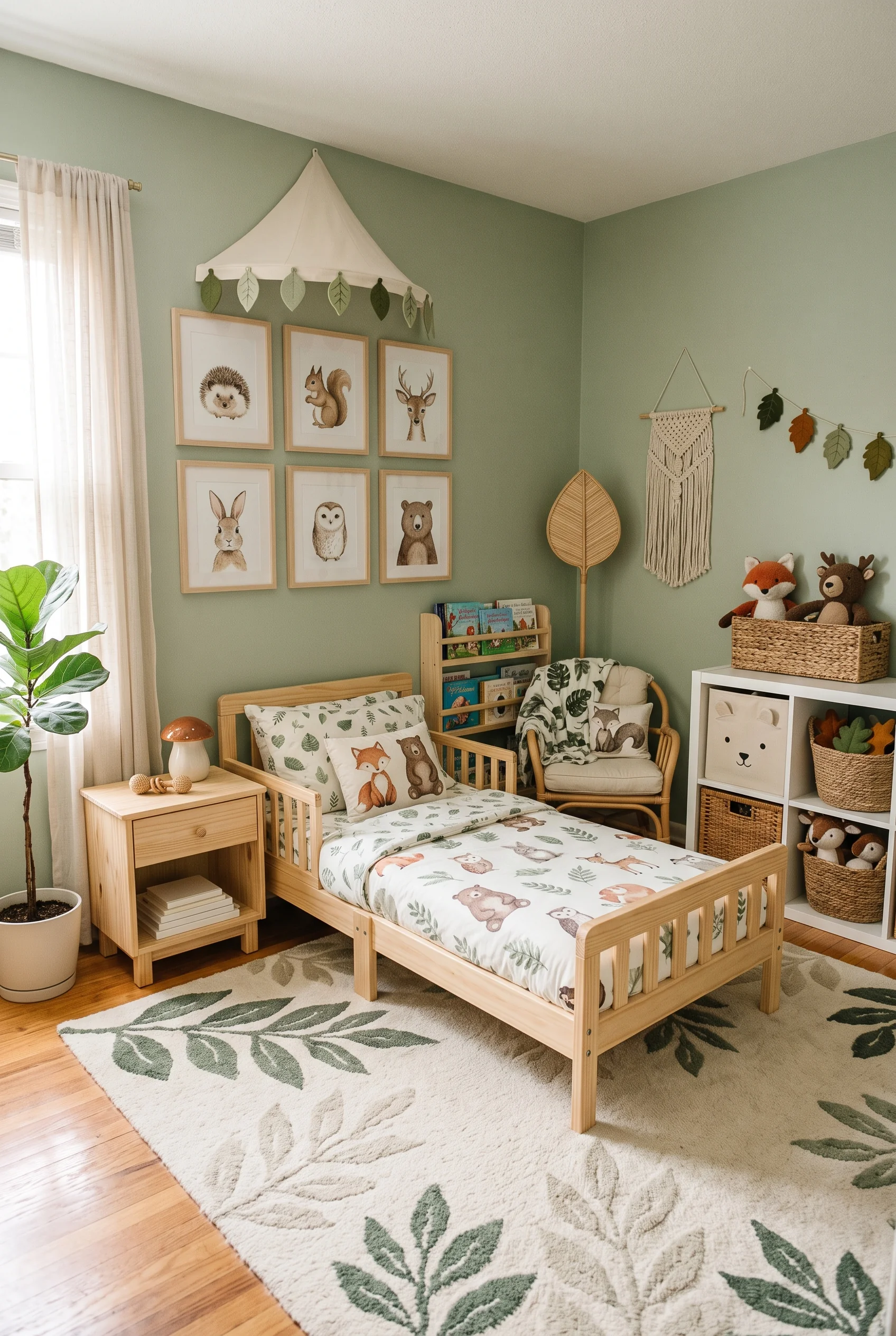
Sage green walls set a mossy backdrop for six framed woodland animals, a hedgehog, a squirrel, and a bear among them, lined up above the bed and echoed in the animal print bedding below. A canvas canopy drape and a leaf garland soften the corner without adding another pattern into the mix.
A mushroom-shaped lamp and a leaf-shaped wall hook keep the nature theme going in small, playful details rather than an overwhelming forest mural.
Every piece points back to the same handful of animals, a small, specific cast rather than a generic forest scene.
Designed at Toddler Eye Level
A surprising amount of a toddler’s world happens below adult eye level, closer to three feet off the ground than five. Mirrors, artwork, and even a growth chart all do more when they’re placed where a toddler actually looks, rather than where they look best in a photo taken standing up. These five rooms build their decor around that lower sightline.
A Mirror That Actually Belongs to Her
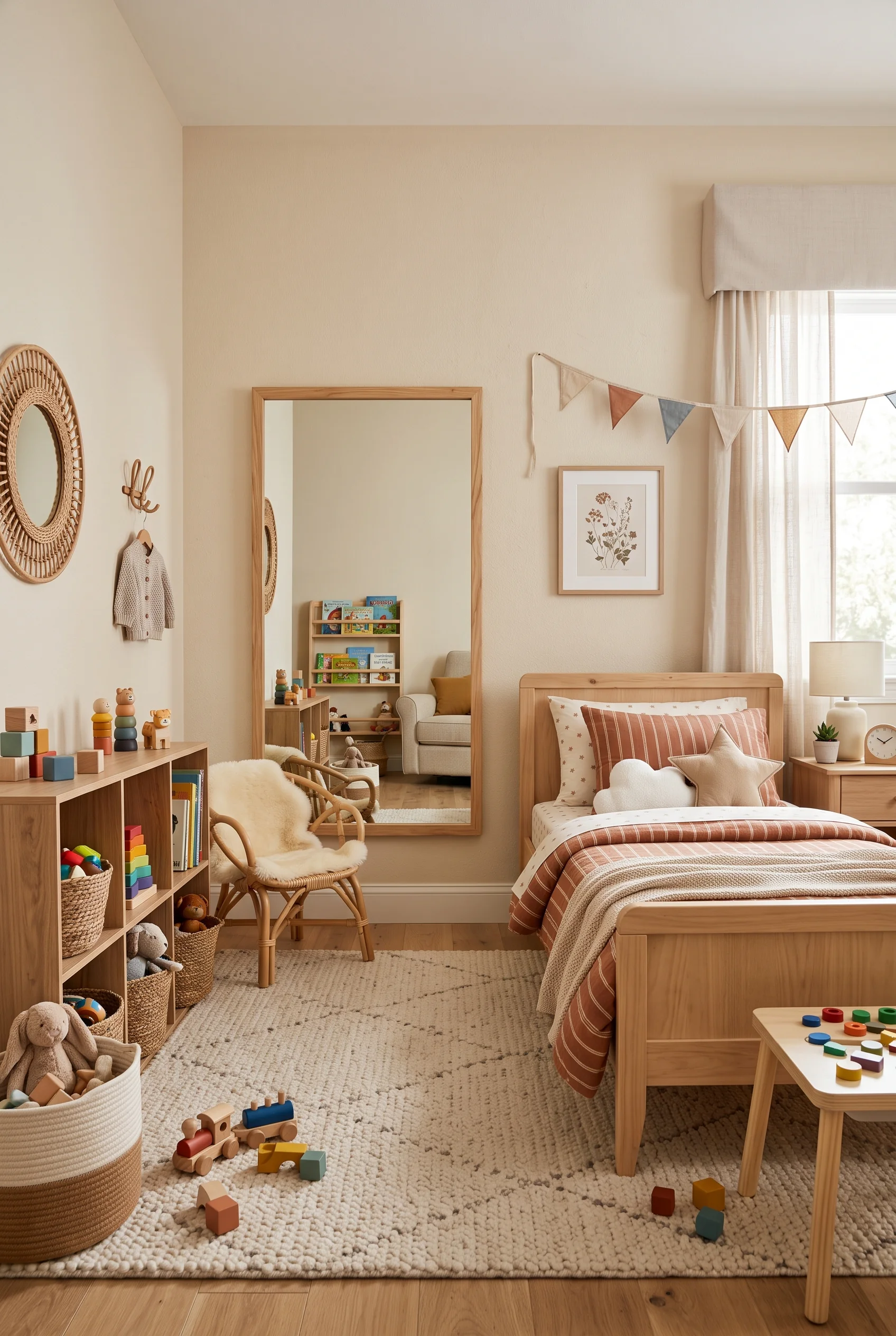
A tall wood-framed mirror leans in the corner at a height built for a toddler’s own reflection, not an adult’s. It’s a small detail, but one that turns getting dressed or checking out a new outfit into something she can do entirely on her own.
Rust-striped bedding and a cloud pillow warm the nearby bed, while a rattan chair draped in sheepskin gives the corner a second soft surface. The mirror also bounces extra light back into the room from the window across the way.
A mirror set this low gets used constantly, for outfit checks, funny faces, or just a quiet moment before nap time.
A Rug That Draws the Line Between Playing and Not
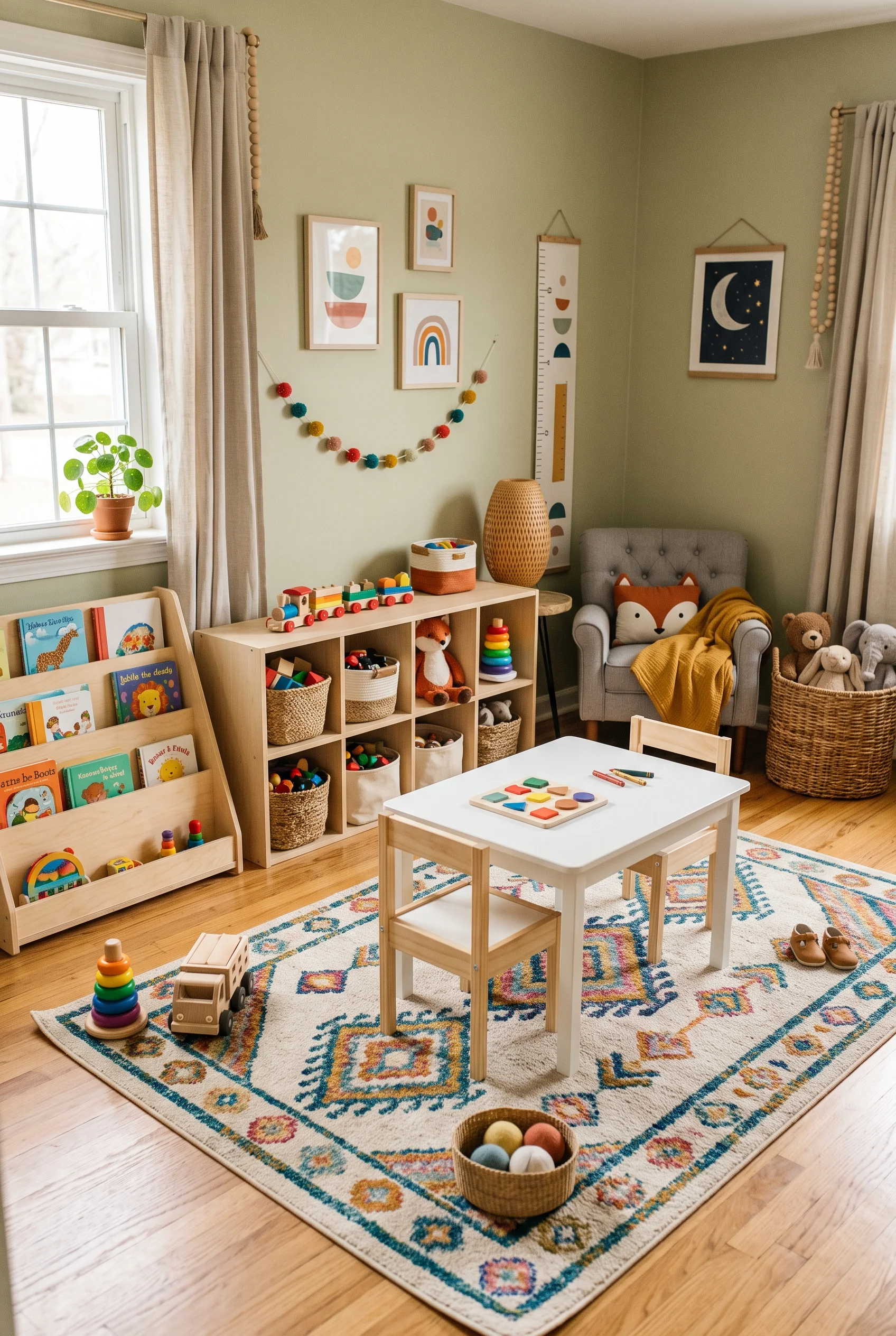
A boldly patterned rug marks exactly where play happens in this room, without a single wall or gate. A small table and chair sit right at its center, close enough to the rug’s edge that toys stay contained without anyone enforcing a boundary.
A tufted gray chair holds a stuffed fox just off to the side, while a bookshelf stocked with baskets and books lines the wall behind. The rug’s busy pattern also hides crayon marks and spilled snacks far better than a plain one would.
The rug’s edge does the job a low wall or gate would do in a bigger room.
Art Hung Where She Can Actually See It
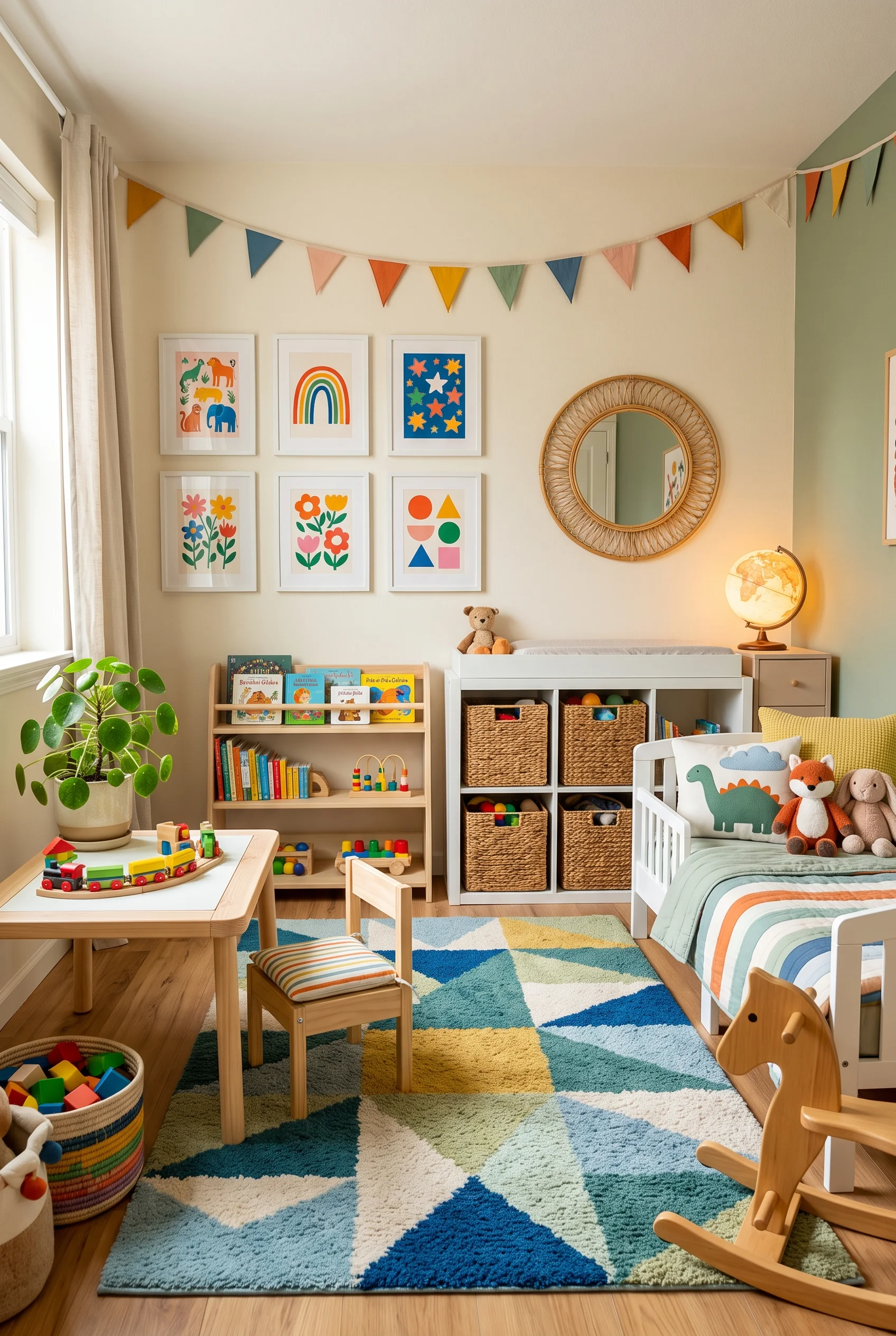
Bright color does most of the decorating on this wall: six framed prints, animals, a rainbow, and flowers among them, all hung low enough that a toddler standing on the floor sees them at full height, not just the bottom third of the frame the way most kids see art in most rooms.
A round rattan mirror and a canvas growth chart share the same wall, both placed with the same low logic. A wooden rocking horse and a rainbow-striped bed nearby keep the rest of the room just as playful.
Every frame lines up at the same low height, a deliberate row rather than a scattered gallery.
A Wall That Teaches Without Trying Too Hard
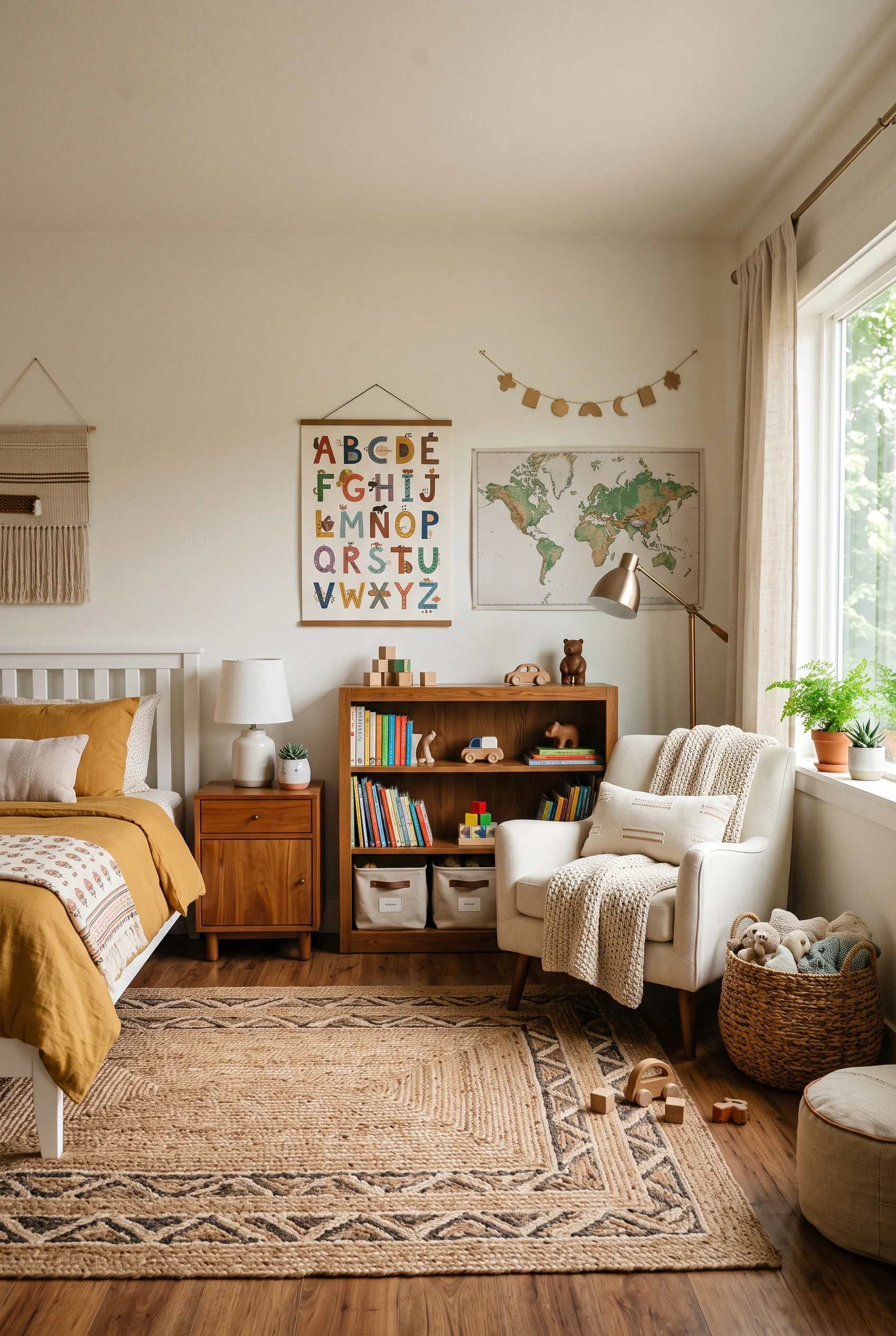
An illustrated alphabet poster and a world map share the same wall here, hung at a height low enough to actually get looked at rather than admired from across the room. A small wooden garland of moons and clouds softens the more academic edges of the two.
A walnut bookshelf below holds a mix of picture books and wooden toy animals, blurring the line between a bookshelf and a nightstand. A brass floor lamp and a cream armchair nearby make the corner just as good for bedtime stories as it is for tracing letters during the day.
The moon-and-cloud garland softens the alphabet poster’s edges, so the wall reads more like a bedtime story than a lesson plan.
A Growth Chart That Doubles as a Story
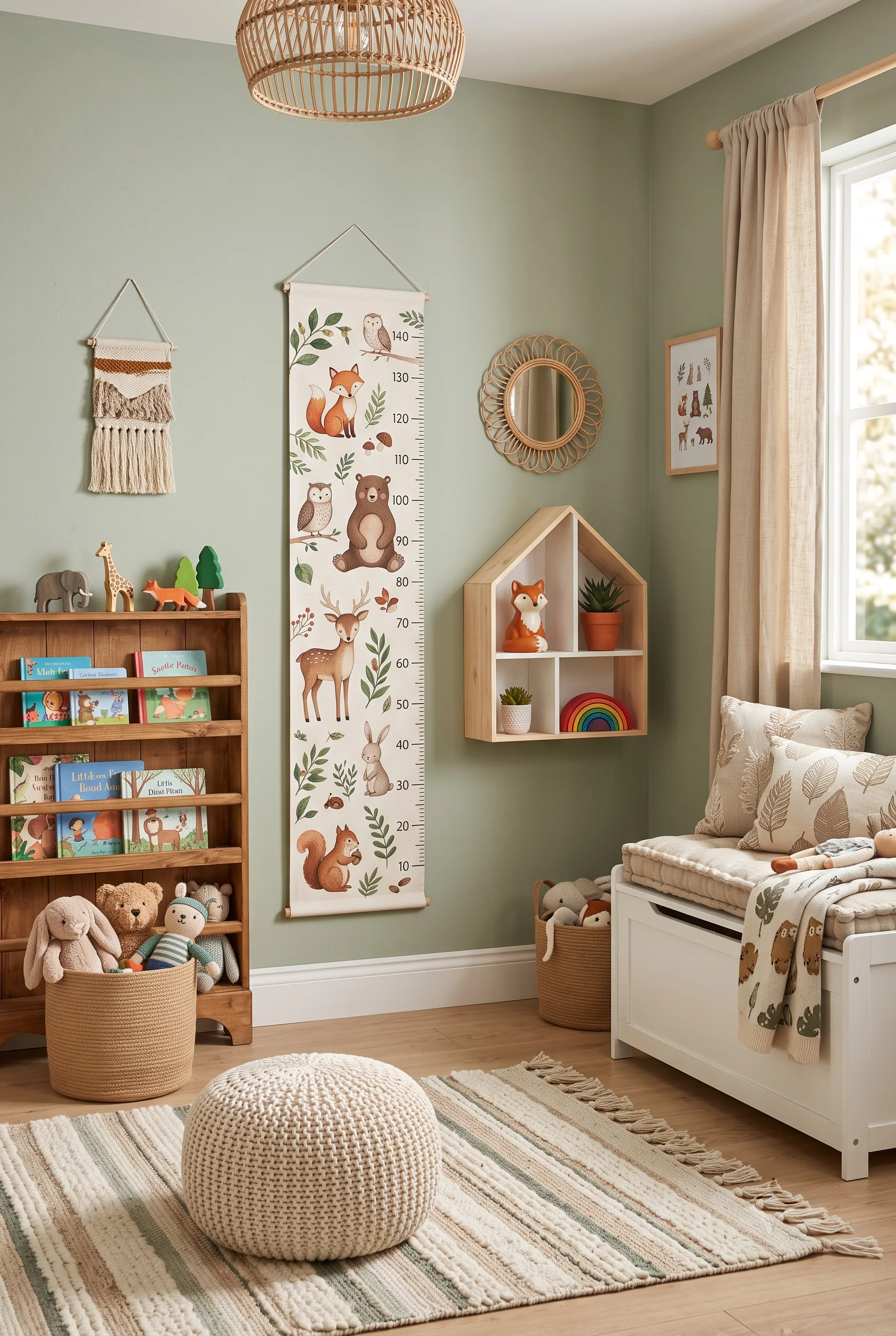
A canvas growth chart hangs at the center of this wall, its numbered scale illustrated with an owl, a fox, and a bear climbing higher with every ten centimeters. It turns a height measurement into something worth looking forward to, rather than a pencil mark a toddler barely notices.
A house-shaped wall shelf beside it holds a single fox figurine and a small potted succulent, while a rattan sunburst mirror adds warmth without competing for attention. A window bench piled with leaf-print pillows gives the corner somewhere to sit while the measuring happens.
Every few months, this wall tells the same story again, just a little taller.
Independence Grows One Small Change at a Time
None of these twenty-seven rooms require a full remodel. A lower bed, a hook at the right height, a rug that quietly marks off a play space- each idea works completely on its own, and most of them cost far less than a new piece of furniture.
The real thread running through good Montessori bedroom ideas isn’t a specific color palette or a certain shelving brand. It’s a willingness to look at a room from about three feet off the ground and ask what a toddler could actually reach, see, and manage without calling for help. Start with whatever gap feels most obvious in your own house, whether that’s a closet she can’t dress herself from or a toy bin she can’t lift.
Pick one or two changes that fit your space and your child’s stage, rather than trying to recreate all twenty-seven at once. A floor bed makes sense for a toddler who already climbs out of her crib. A rotating toy shelf matters more once the toy collection has outgrown the room. Let the room grow and change as she does, the same way you’d update it for a more grown-up, clutter-free kids’ space down the road.
The goal was never a perfectly styled photograph. It’s a bedroom that quietly hands a little more independence back to the child living in it, one low shelf and one reachable hook at a time.