35 Kids Bedroom Storage Ideas That Make Small Rooms Feel Bigger
If your child’s bedroom feels like it’s shrinking by the week, you’re not imagining it. Toys multiply, clothes outgrow drawers, and books pile up faster than any shelf can hold them, especially in rooms with fewer square feet to spare. The good news is that small kids’ bedroom storage ideas don’t require a renovation, just a smarter use of the walls, corners, and furniture you already have.
A well-organized kids’ room does more than look tidy. It gives children a sense of independence when they can find their own socks or put away their toys, and it gives parents a room that resets in minutes, not hours. Whether you’re outfitting a nursery, a shared bedroom, or a solo big-kid room, the right storage keeps the space feeling calm rather than chaotic.
In this roundup, you’ll find real rooms built around vertical shelving, multi-functional beds, and closet systems built for tiny clothes. Cozy reading nooks that hide storage in plain sight round out the mix. We’ve pulled ideas from clutter-free kids’ room layouts, calm toy storage systems, and easy-cleanup playroom setups to show what’s actually possible in a small footprint. Pick even one or two ideas that fit your space, and you’ll notice the difference.
DISCLOSURE: Some of the links provided on this page are affiliate links. This means if you choose to make a purchase through these links, we may receive a small commission at no extra cost to you.
Furniture That Multiplies a Small Room’s Square Footage
In a small bedroom, every piece of furniture has to earn its place twice over. The best small-space rooms don’t add more furniture; they choose beds, desks, and shelving that already provide storage. Height becomes as valuable as floor space, and a bed frame becomes a place to tuck away everything from board books to out-of-season clothes. These five rooms show how far the right furniture choices can stretch a tight footprint.
Height Does the Heavy Lifting in a Reading Corner
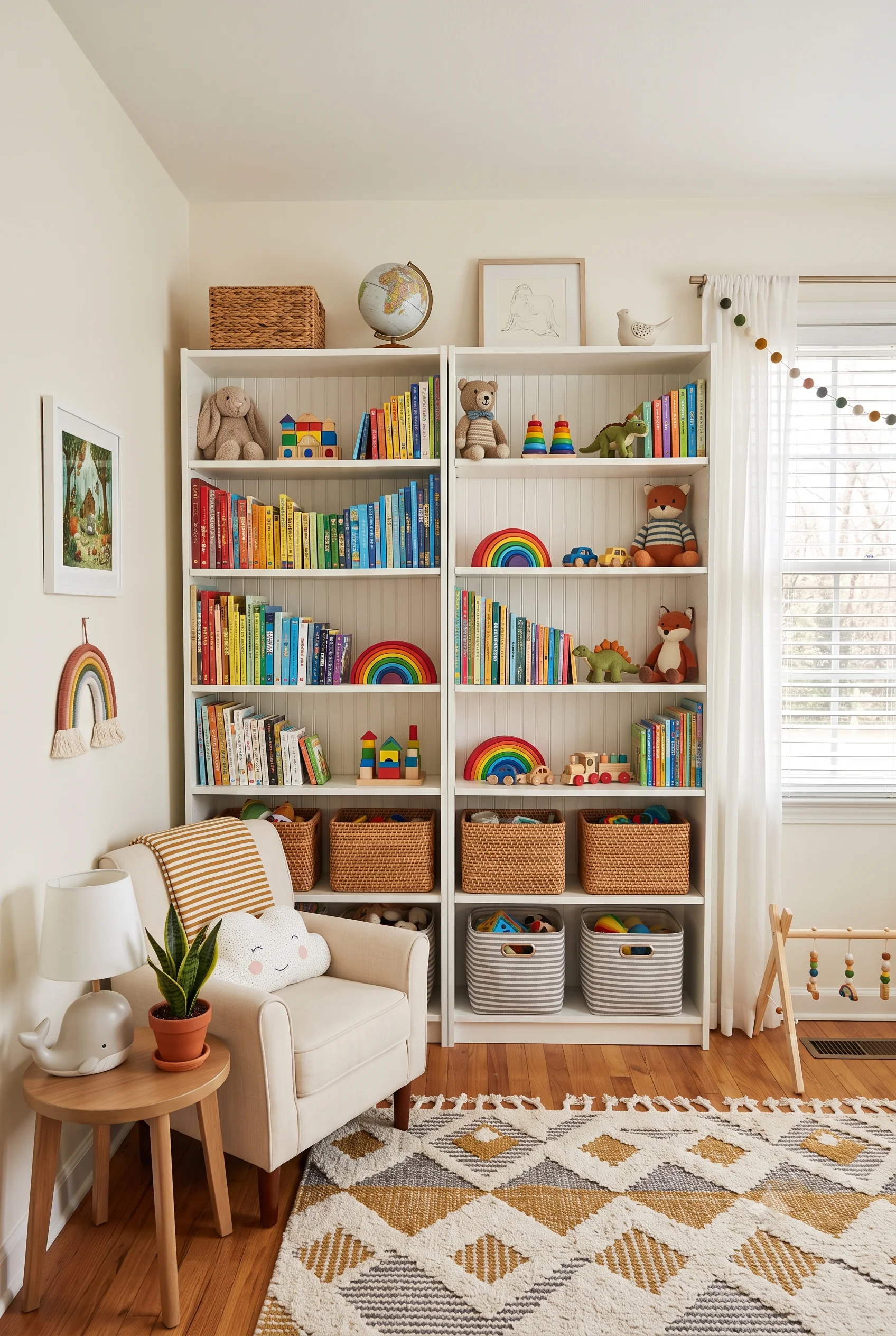
Two matching bookcases stretch nearly to the ceiling in this reading corner, and the eye follows every shelf upward instead of stopping at eye level. Books are grouped by color on the middle shelves, while woven baskets along the bottom catch blocks, stuffed animals, and puzzle pieces, with no lid in sight.
The top shelves hold a globe and a keepsake basket, things worth displaying but not needed daily, while the lower shelves stay in easy reach for little hands. A cushioned chair and side table tuck into the leftover corner, with room enough for a place to actually sit and read.
One Corner, Two Jobs: Sleep and Study Share a Footprint
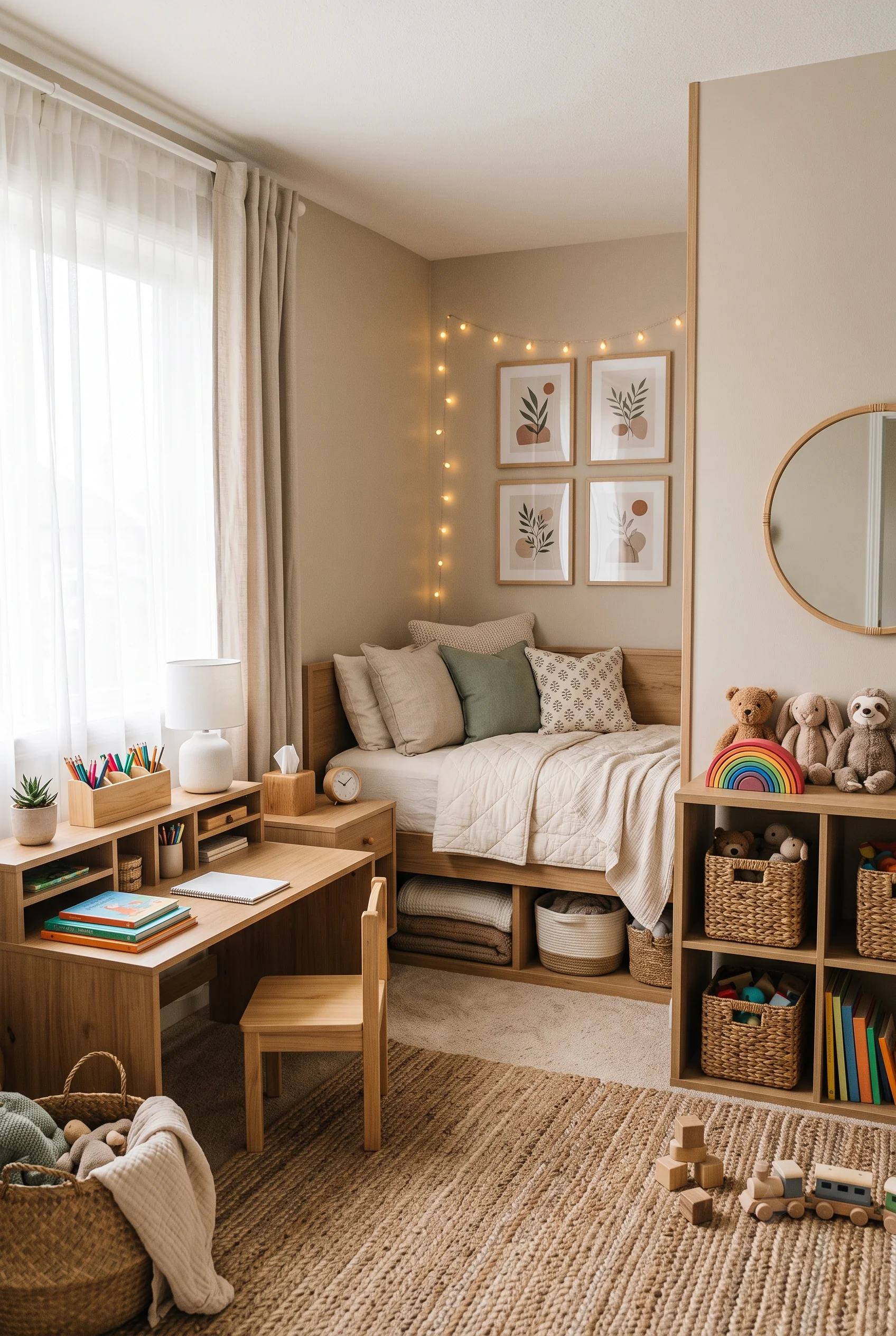
A daybed with drawers built into its base anchors this corner, tucked beneath a run of string lights and framed botanical prints. Rolled blankets and a woven basket slide into the open shelf below the mattress, keeping extra linens out of the closet entirely.
Just a few feet away, a desk with built-in cubbies and a slim drawer holds pencils, notebooks, and a tissue box without spreading across the surface. The two pieces share a single wall, so the rest of the room remains open for the woven toy shelf and its baskets of stuffed animals.
Rolling Bins Turn the Space Under the Bed Into a Toy Library
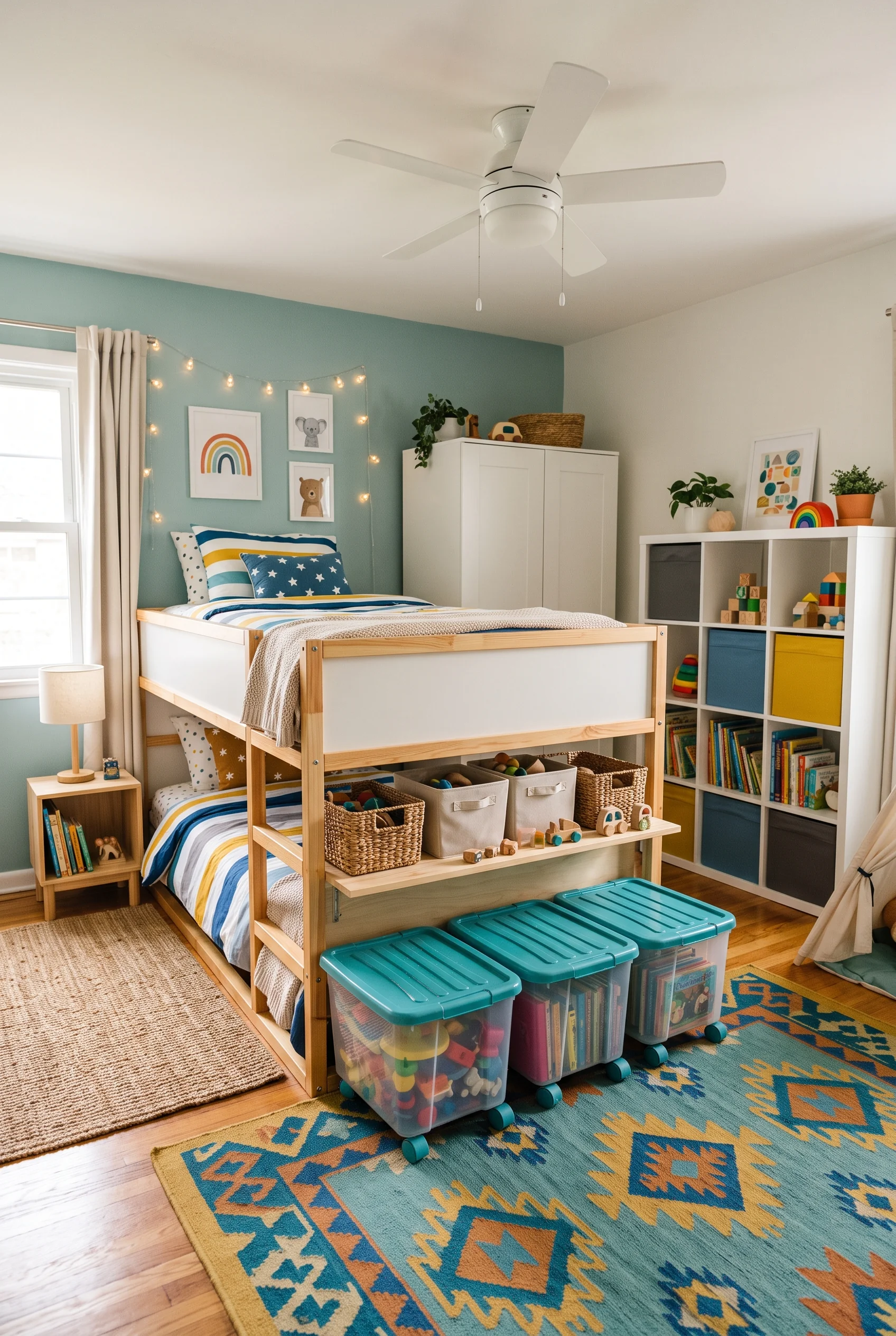
Underneath this raised bed, a shelf holds woven baskets of wooden toys at exactly the height a child can reach without help. Below that, three teal-lidded bins on wheels roll out from under the frame, each one holding books or toys sorted by type.
Because the bins have wheels, cleanup doesn’t require crawling under the bed frame, just a gentle tug. The whole setup sits against a cheerful teal wall dotted with string lights, so what could be an awkward gap under a bed instead reads as its own mini storage wall.
Shelves at Staggered Heights Make Cleanup Feel Like a Game
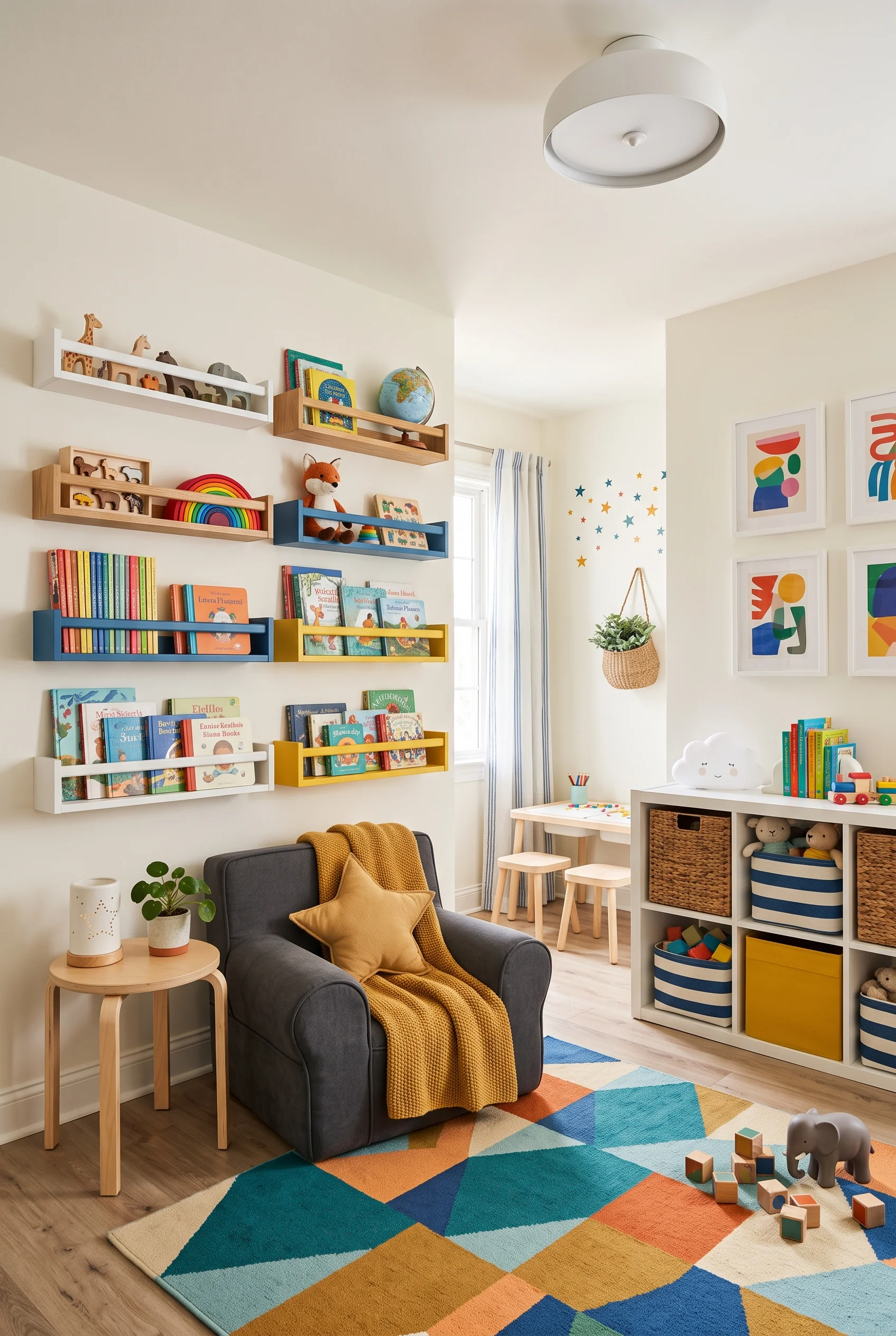
Slim picture-ledge shelves in white, blue, and mustard climb this wall at varying heights, holding board books face-out alongside small wooden animals and a rainbow stacker. Because the shelves sit low enough for a toddler to reach the bottom rows, putting a book back doesn’t require a parent’s help.
A cushy armchair and ottoman sit below, turning the wall into a built-in library rather than a shelf that competes for floor space. Across the room, a cube shelf with fabric and woven bins handles the toys that don’t need to be on display.
A Bunk Bed That Sleeps Two and Stores for Both
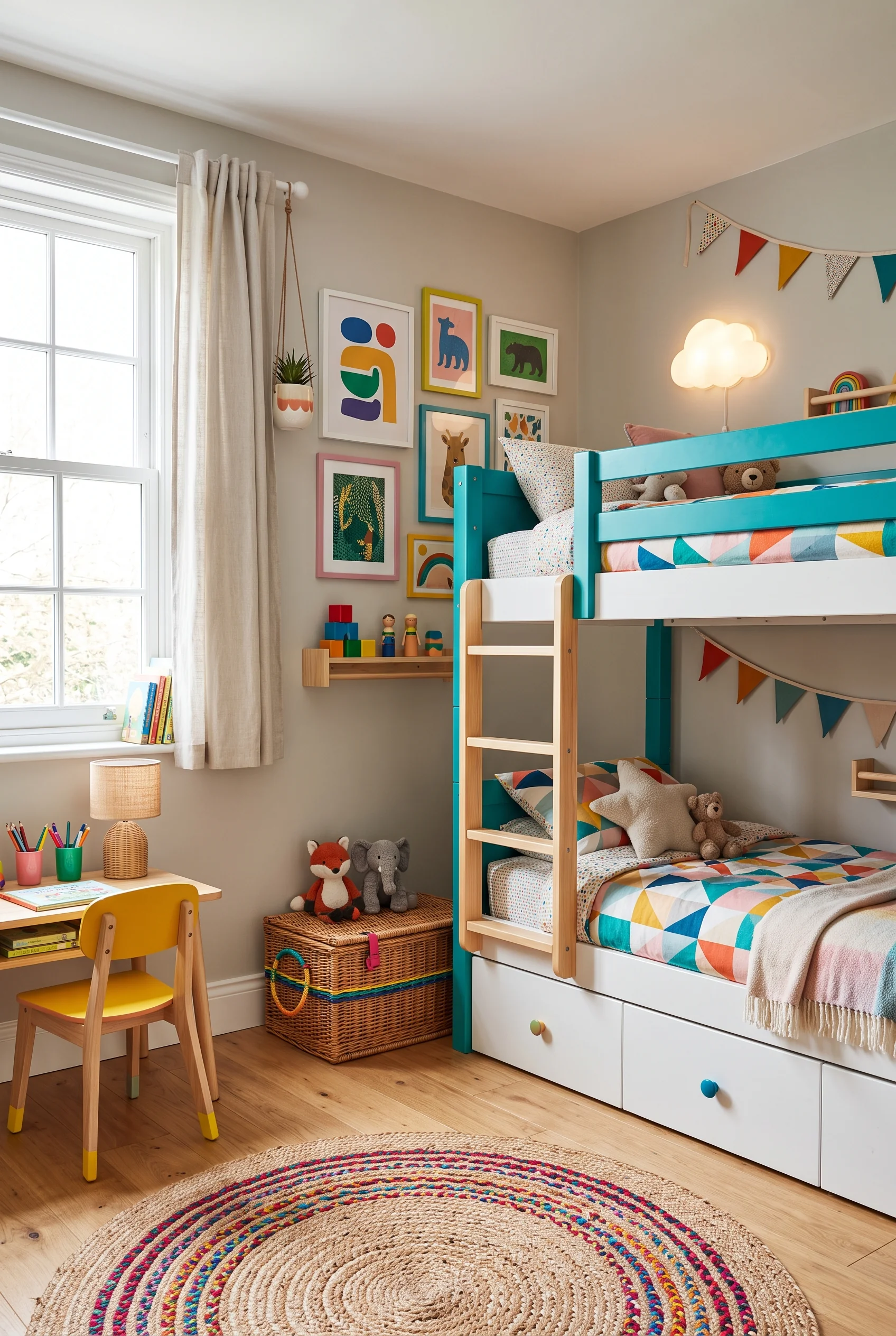
This teal bunk bed does triple duty in a shared room: a sleeping spot up top, a second bed below, and a bank of drawers built into the base for clothes or extra bedding. A ladder wall shelf beside the frame holds books within reach of the bottom bunk.
For siblings splitting one room, this kind of frame means the floor stays clear for the desk and toy chest tucked into the opposite corner, giving each child a footprint of their own even on a shared wall. For more ways to divide the square footage fairly, shared kids bedroom ideas cover layouts built specifically for two children in one room.
Small Systems That Corral the Little Things
Toys with fifty pieces and closets with fifty tiny outfits need more than a shelf; they need a system. The rooms below use clear bins, curated toy rotation, and concealed desk storage to keep small items from taking over. Even the back of a door earns its keep. None of these ideas require new furniture, just a smarter way of using what’s already there.
Clear Bins Turn Guesswork Into a Glance
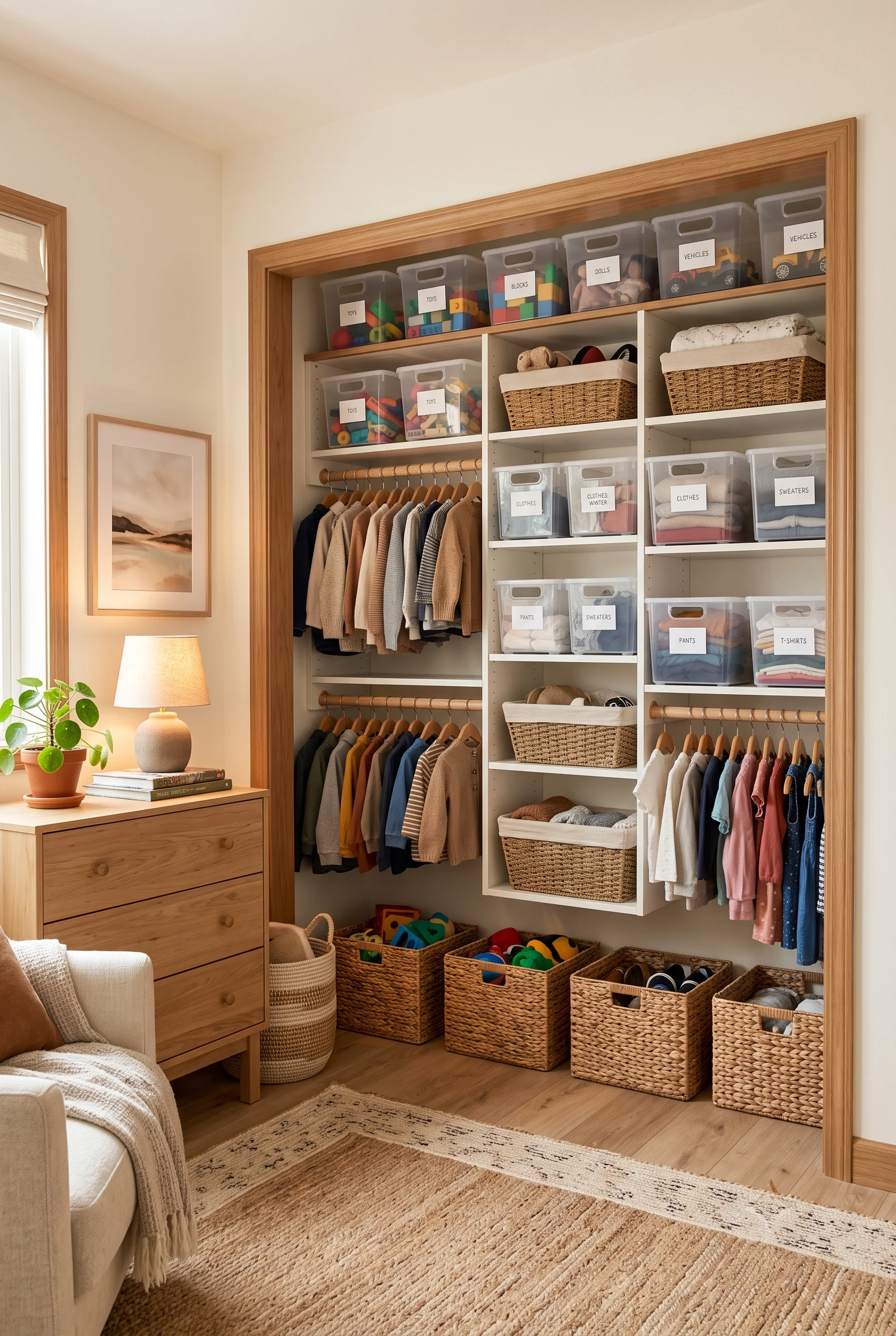
Every bin in this closet is labeled and see-through, so a quick glance from the doorway shows exactly where the vehicles, dolls, and building blocks live. A set of clear stackable bins handles the toys, while woven baskets below hold shoes and out-of-season layers.
The system works because it doesn’t rely on memory. A child, or a tired parent at bedtime, can find what they’re looking for without opening five containers first. Hanging rods on either side keep everyday clothes accessible, so the closet handles both clothing and toy overflow within a single footprint.
A Few Toys Out at a Time Keeps the Floor Calm
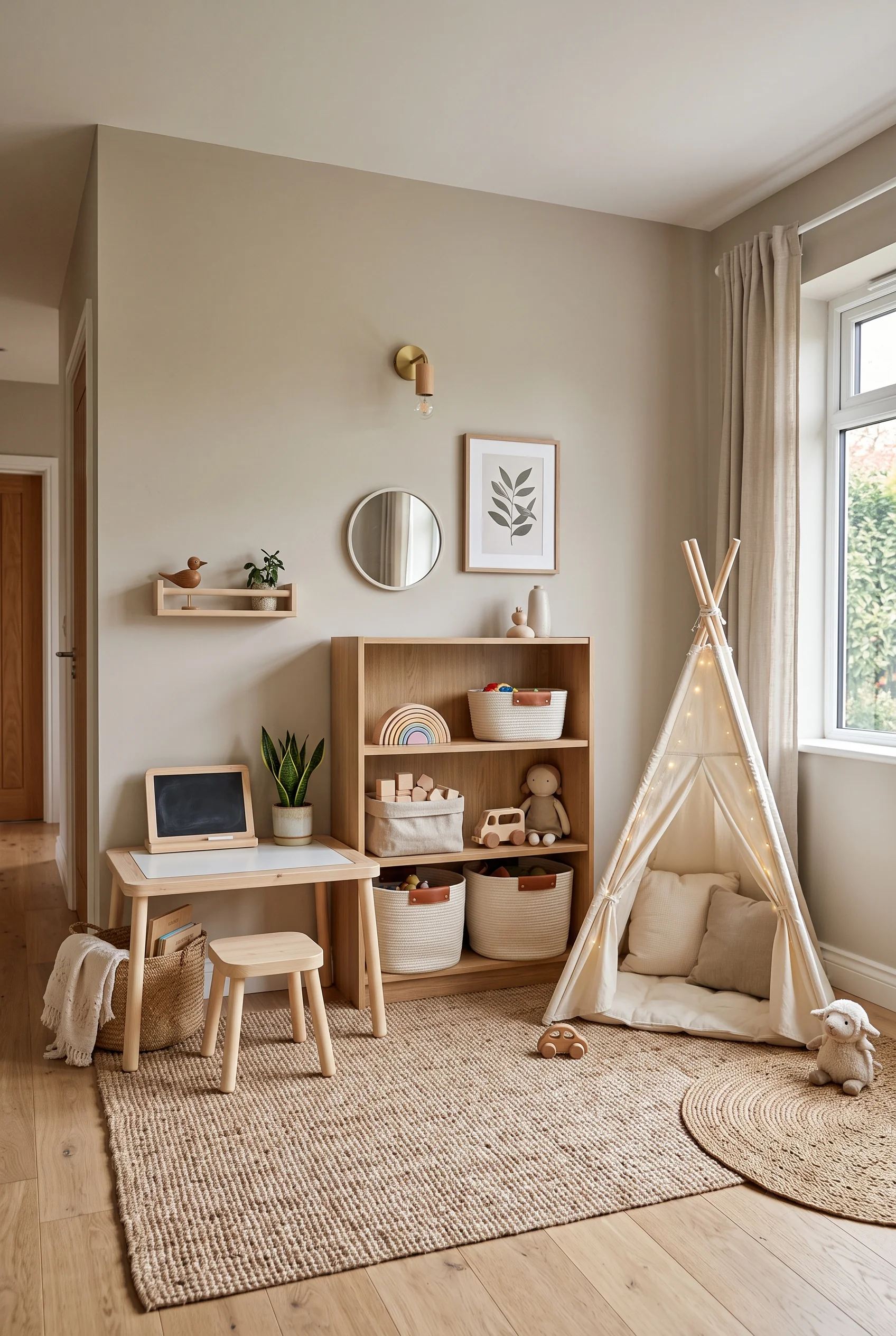
This corner holds a teepee, a small table, and one modest bookshelf, and that restraint is what keeps it calm. Only a handful of toys sit out on the shelf at once, tucked into two woven baskets, while the rest stay stored elsewhere and rotate in later.
Swapping which toys are visible every week or two keeps play feeling fresh without adding a single new item to the room. The two baskets on the shelf end up looking half as full as the closet actually holds behind them.
The Back of the Door Becomes Prime Real Estate
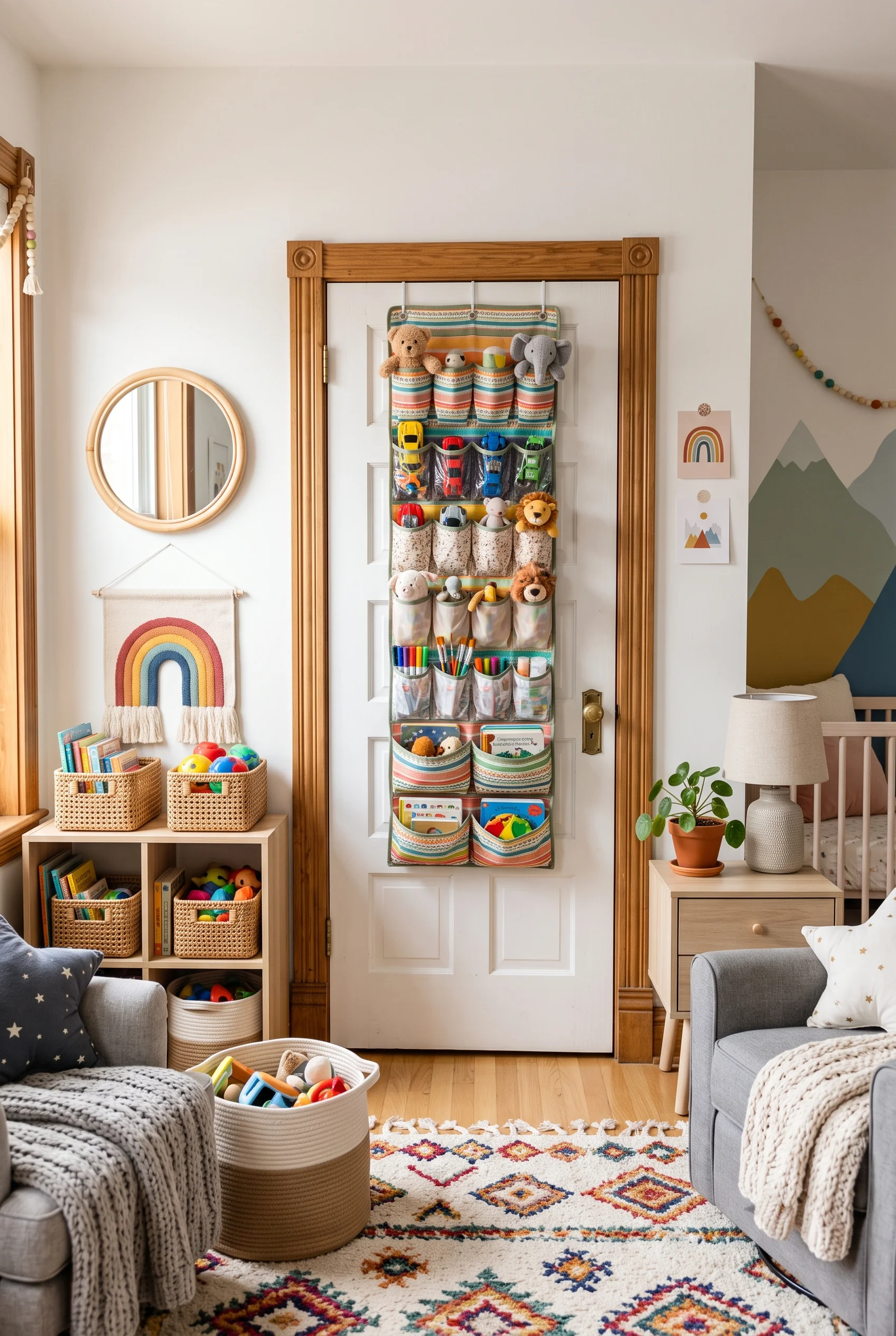
A canvas pocket organizer hangs on the back of this door, sorted top to bottom by category: stuffed animals up high, cars and trucks in the middle rows, art supplies and books toward the bottom. Nothing here takes up an inch of floor or shelf space.
This door was doing nothing but swinging open and shut before the organizer went up, and now it works as hard as any shelf in the room. A round mirror and a woven basket of extra plush toys round out the space just outside the door’s reach.
Storage That Doubles as Décor
Certain rooms hide their storage so well that it takes a second look to find it. A bench doubles as a toy box, a pegboard doubles as wall art, and a stack of woven baskets reads as texture before it reads as organization. These five spaces show how well function and style can share a footprint.
A Reading Corner That Earns Its Keep in Storage
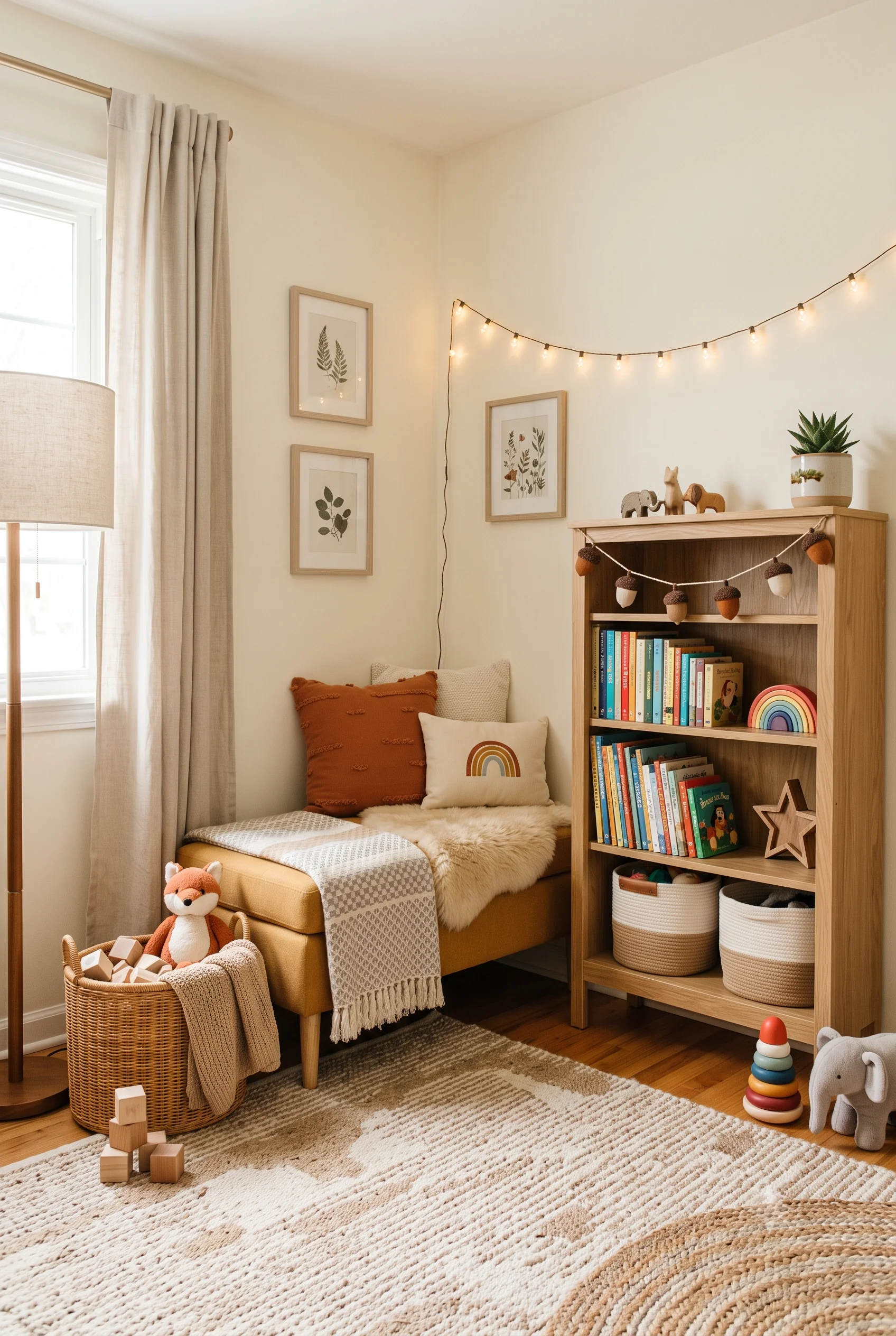
A cushioned bench topped with a fur throw and rust-colored pillows looks like pure lounging space, until you notice the wooden toy chest tucked beside it, holding cloth-bound books and stuffed animals. String lights swagged along the ceiling line turn the corner into a spot kids actually choose over the rest of the room.
The nearby bookshelf holds a rotating cast of picture books and a felt garland of acorns overhead, keeping the whole nook feeling seasonal rather than static. For families building a similar spot from scratch, cozy reading nook ideas offer layouts centered on a single comfortable seat.
A Pegboard Turns a Blank Wall Into a Rotating Display
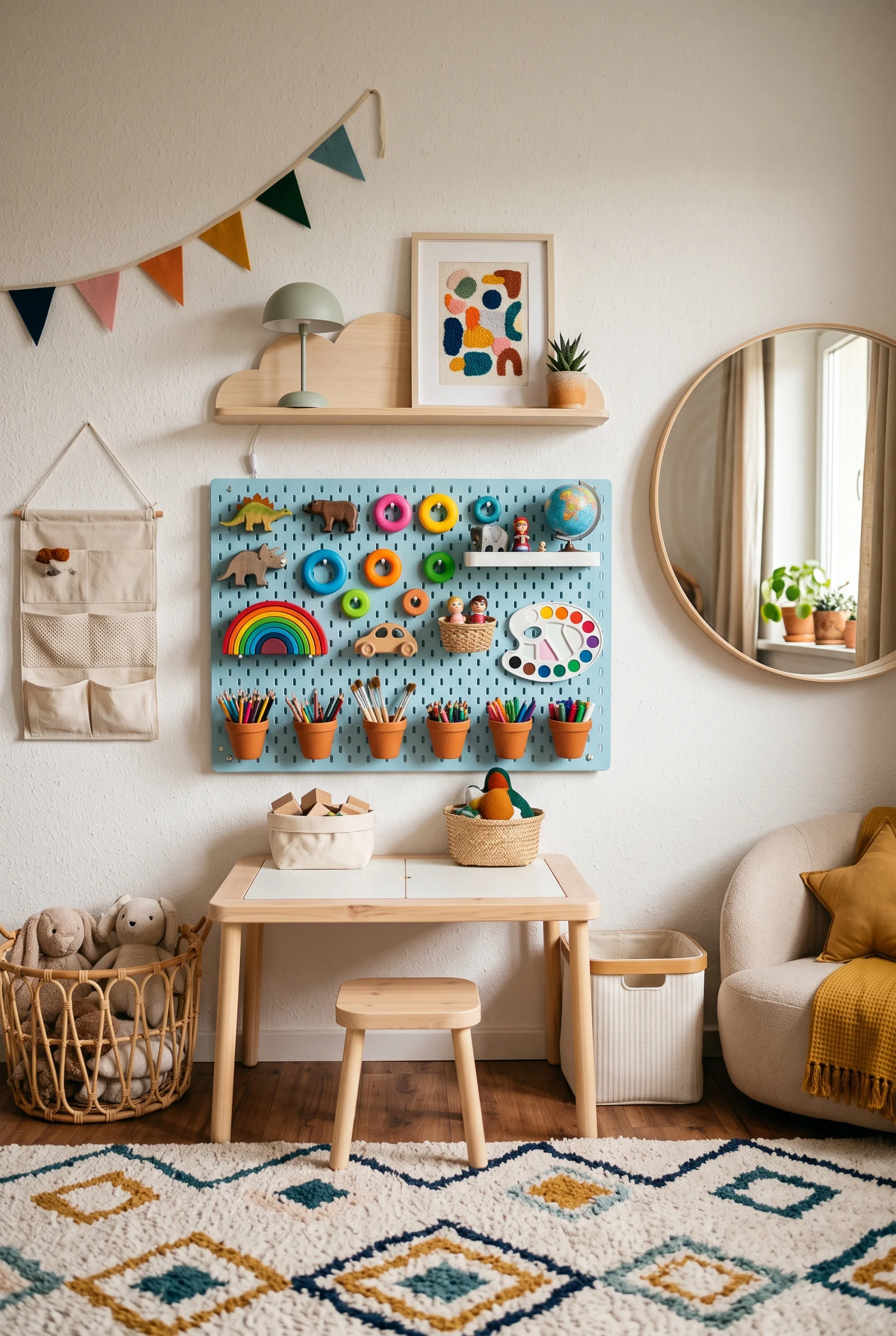
Wooden animals, rainbow rings, and terra cotta cups of pencils all hang from a single powder-blue pegboard, arranged with the same intention as a gallery wall. A small shelf mounted mid-board holds a globe and dolls, while a paint palette hangs within reach of the craft table below.
The beauty of a pegboard is that none of it is permanent. Hooks and shelves move as a child’s interests shift from dinosaurs to art supplies, so the wall keeps up with the room instead of needing to be redone.
Built-Ins Blend Into the Walls They’re Built From
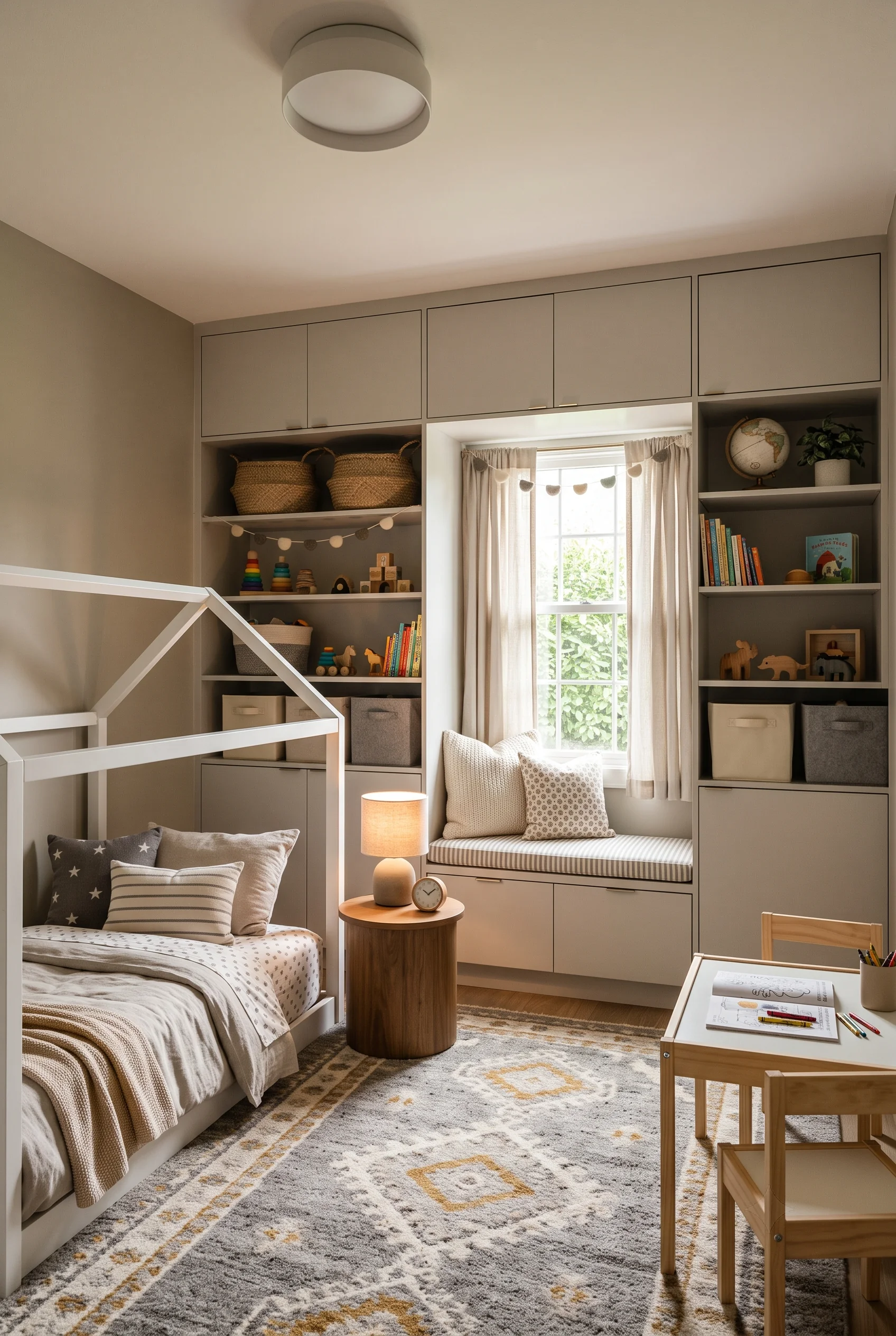
Floor-to-ceiling cabinetry wraps this entire wall, broken up only by a cushioned window seat with drawers underneath. Open cubbies hold baskets and bins at the child’s level, while closed cabinets above keep bulkier or rarely used items out of view entirely.
Painted the same soft gray as the walls, the whole unit reads more like architecture than furniture. It’s a bigger investment than a bookshelf or basket, but it solves storage for an entire wall in one uninterrupted sweep.
A Bench at the Foot of the Bed Does More Than Sit Pretty
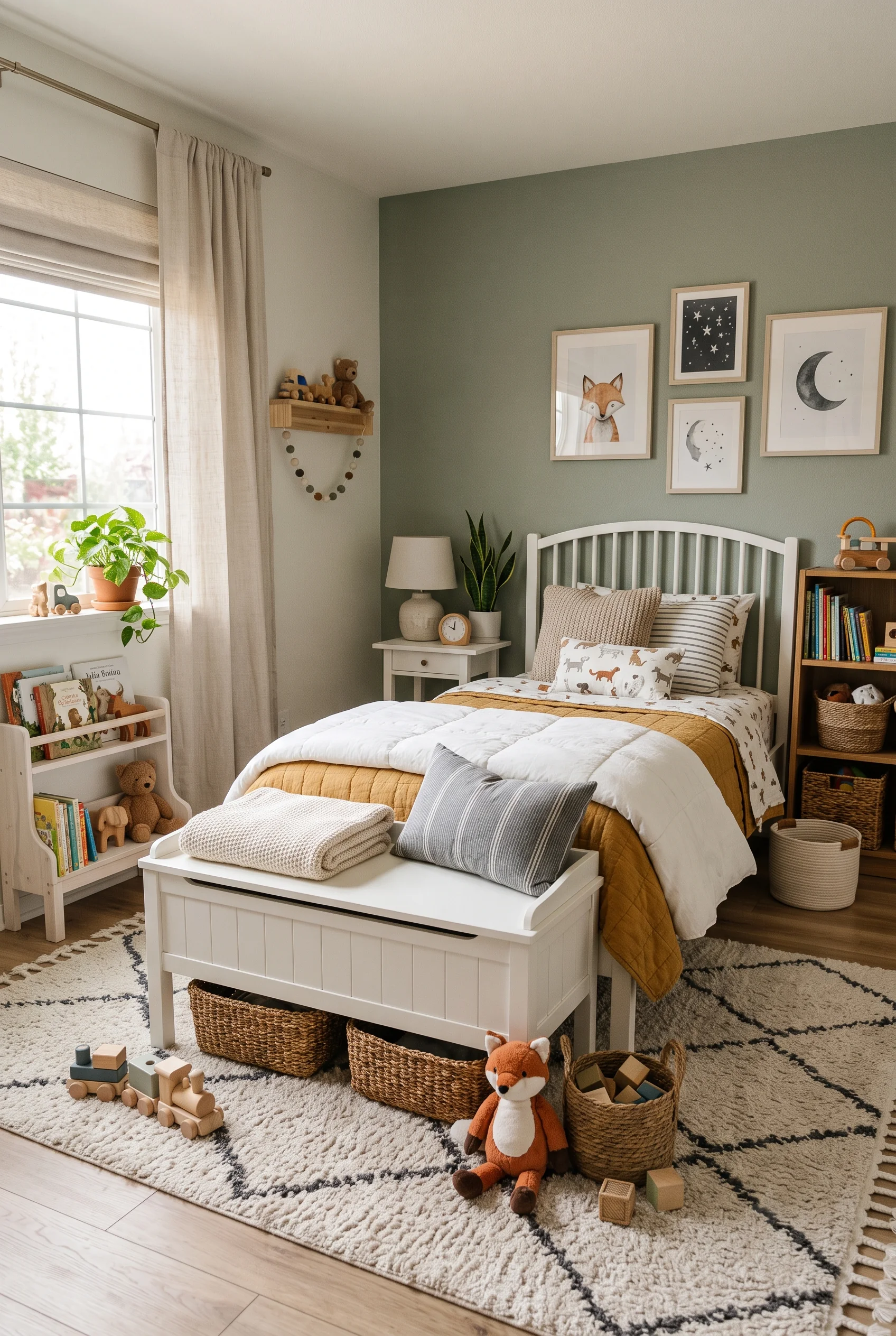
This white storage bench holds folded blankets and a striped pillow on top, but lift the lid, and it swallows extra bedding or off-season pajamas. Two woven baskets slide under for toys, keeping the sage-green room’s forest theme intact without a plastic bin in sight.
Placed at the foot of the bed, it also gives a place to sit while pulling on shoes, something a freestanding toy box rarely offers. The wall-mounted shelf above holds stuffed animals just out of a toddler’s reach until nap time is truly over.
Woven Baskets Add Texture While They Hide the Mess
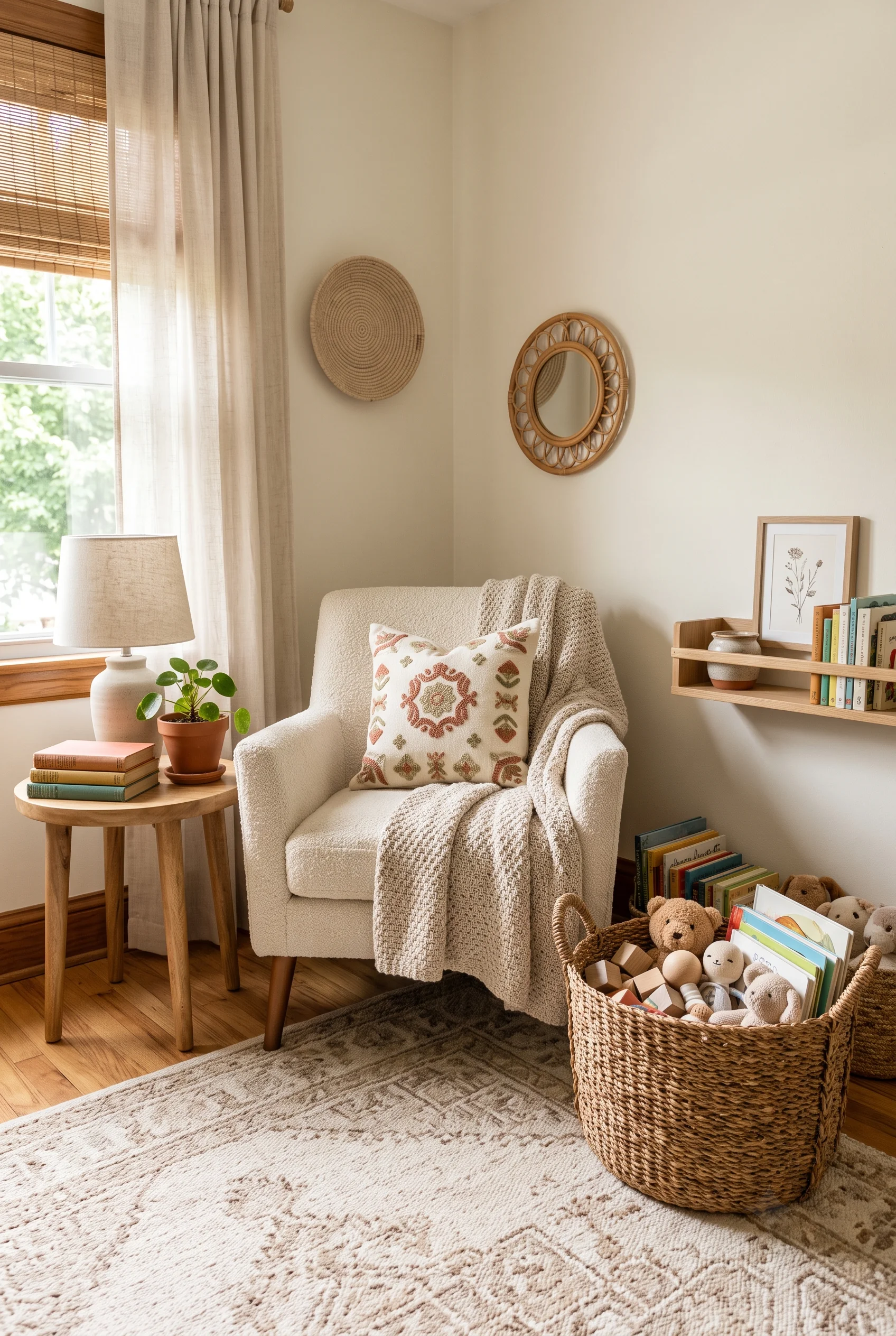
A boucle armchair, a rattan mirror, and a pair of oversized woven baskets give this reading corner its warmth, and the baskets are doing real work. One holds books, the other holds a rotating pile of stuffed animals and building blocks, both easy to tip over and refill.
The baskets pick up the same natural tones as the rest of the room, so they read as styling first and storage second, the kind of corner that never once looks like an afterthought.
Systems That Keep the Order Going After Day One
Organizing a room is the easy part. Keeping it that way through school mornings, laundry day, and a four-year-old’s changing interests is the real test. Labeled bins, sorted drawers, and hooks at kid height carry this stretch, built for repetition rather than a single tidy photo.
Hooks at Kid Height Turn Grabbing a Bag Into a Habit
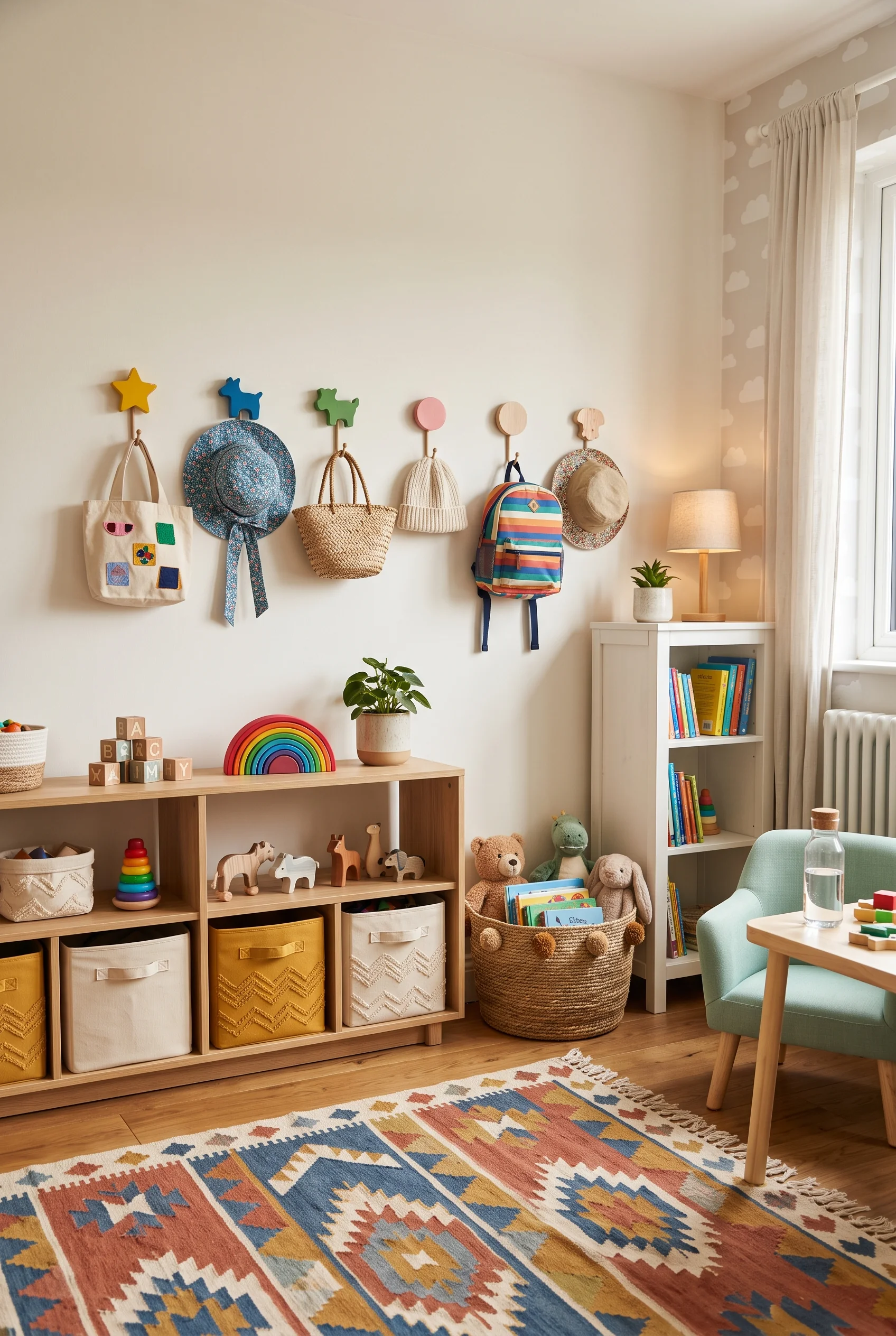
A row of playful hooks, shaped like stars, animals, and simple circles, holds sun hats, a woven tote, and a striped backpack at exactly a child’s reach. Nothing here requires opening a drawer or asking for help getting dressed to go outside.
Below the hooks, a low shelf unit mixes open bins with fabric drawers, so blocks and stuffed animals stay just as reachable. When storage is at a child’s height rather than an adult’s, putting things away stops being a request and becomes routine.
Divided Drawers Keep Tiny Treasures From Turning Into Chaos
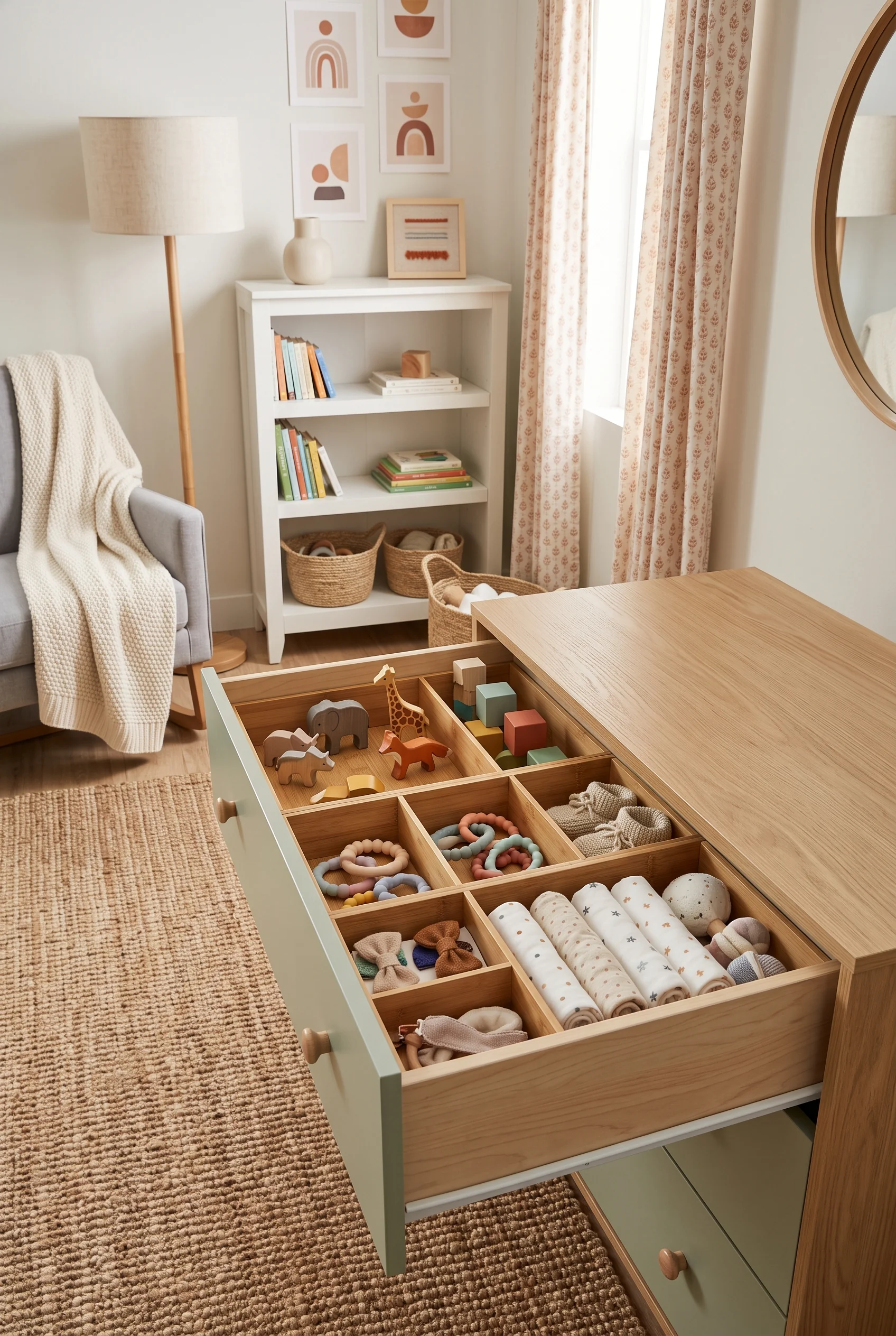
Open this drawer and every item has its own compartment: wooden animals in one square, teething rings in another, bows and socks sorted into slots entirely separate from rolled swaddles. Nothing shifts into a jumbled pile the way it would in a single open drawer.
This kind of divided tray matters most for the smallest items, the ones that are easy to lose in a deep drawer and hardest to find again at 2 a.m. A few dollars in drawer dividers can do more for daily sanity than a whole new dresser.
A Rainbow of Drawers Makes Putting Toys Away Feel Like a Game
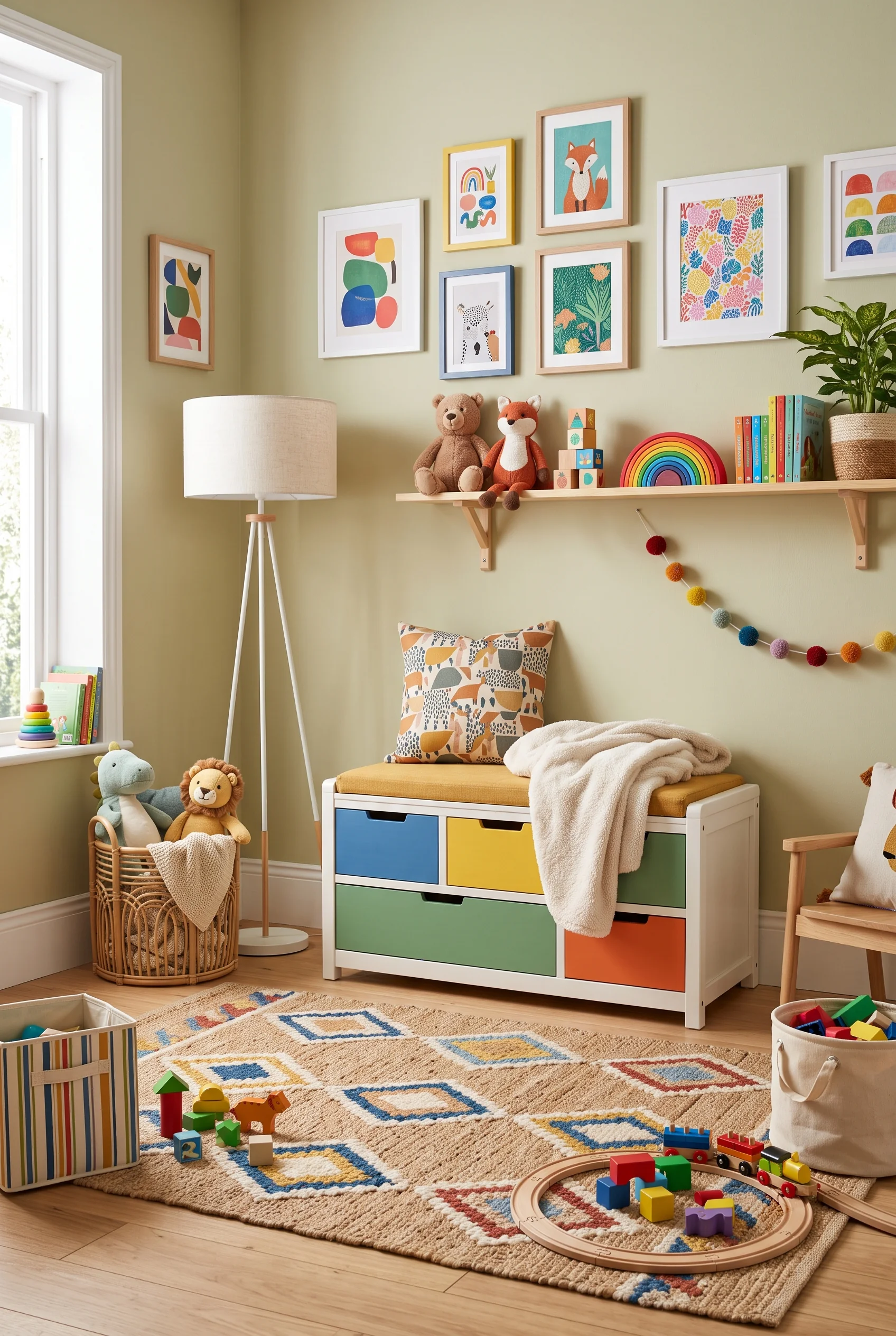
This bench holds four drawers in blue, yellow, green, and orange, one color for each toy category. Blocks, cars, dress-up pieces, and art supplies each get their own drawer, color-coded so a child can match the toy to its home without reading a label.
A mustard cushion on top turns the whole piece into extra seating, and a soft blanket and pillow suggest it also doubles as a quiet reading spot. It’s a toy chest that never looks like one, at least not until the drawers open.
Picture Labels Let Toddlers Clean Up Without Asking for Help
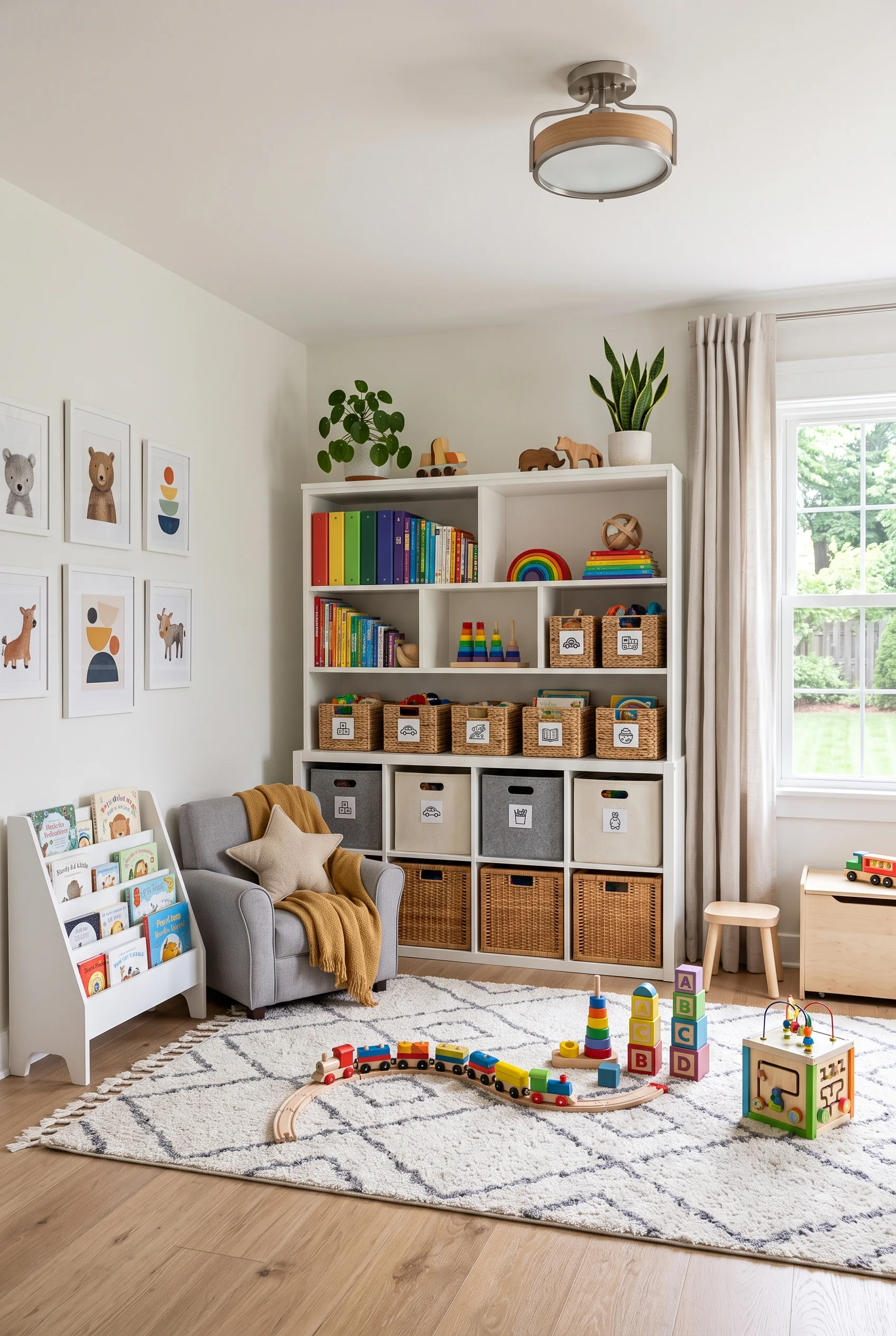
Each woven and fabric bin on this shelf carries a small icon, a car, a block, a book, so a child who can’t read yet still knows exactly where to return what they were playing with. The shelving unit mixes open cubbies for display with covered bins for everyday toys.
That one small addition, a picture instead of a word, is often the difference between a system a toddler can use independently and one that still requires a parent’s help every time.
A Closet Zoned by Category Instead of by Guesswork
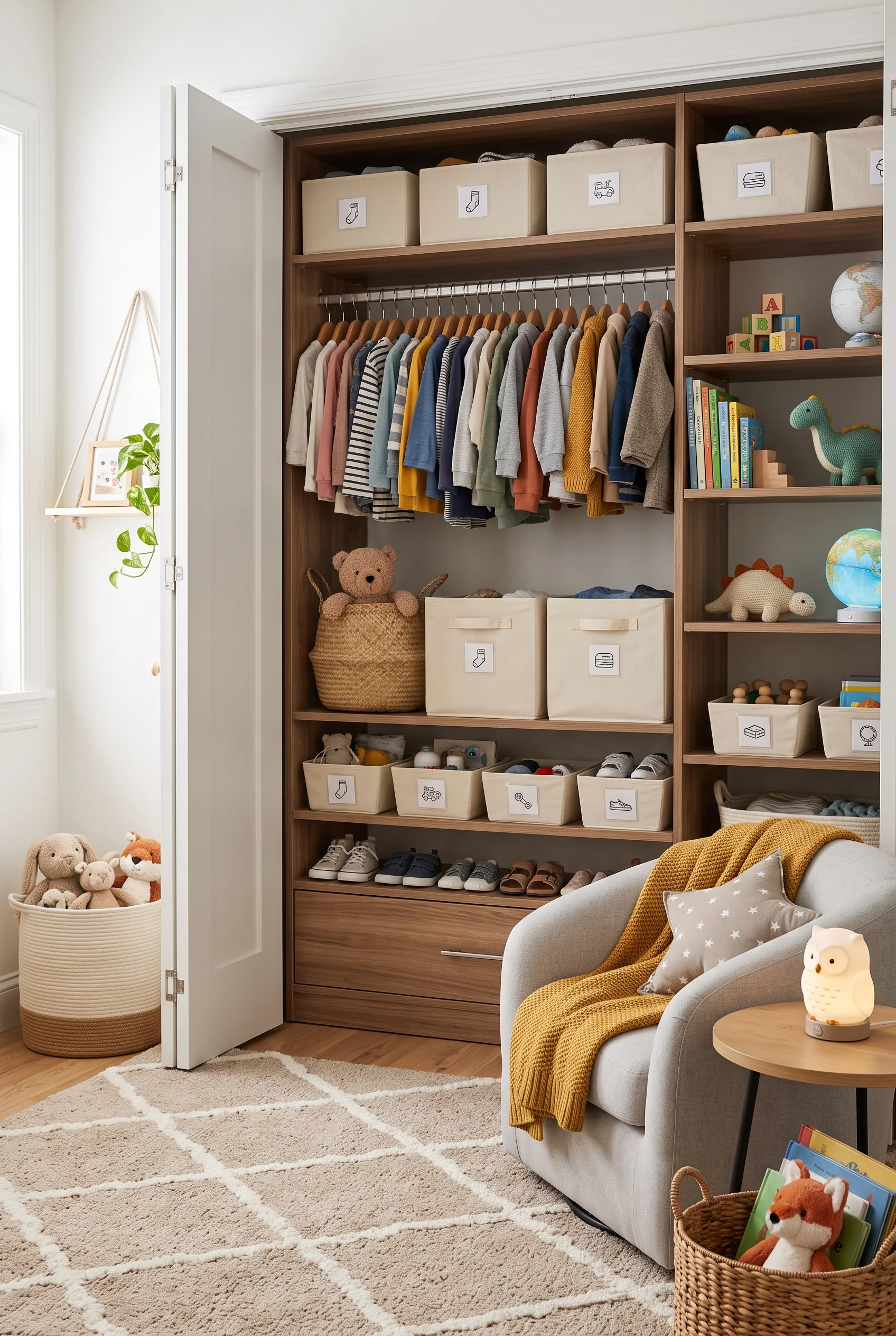
This closet splits cleanly into zones: hanging clothes on one rod, folded basics in labeled bins, and shoes lined up on their own shelf. A stack of drawers off to the side catches everything else, each bin carrying a small icon label matching the toddler-friendly system used throughout the room.
A cozy armchair sits just outside the closet doors, close enough that getting dressed and picking out a book can happen in the same corner. Zoning a closet this specifically takes more setup than a single rod and shelf, but it pays off every single morning.
Space-Saving Furniture for Rooms That Do Double Duty
Some rooms need to be a bedroom, a study, and a playroom all before breakfast. This stretch leans on furniture built to pull double duty: a loft bed, a floating desk, a bed that folds into the wall, letting one room hold all three jobs without ever feeling like it’s doing too much at once.
A Loft Bed Turns the Floor Into a Second Room
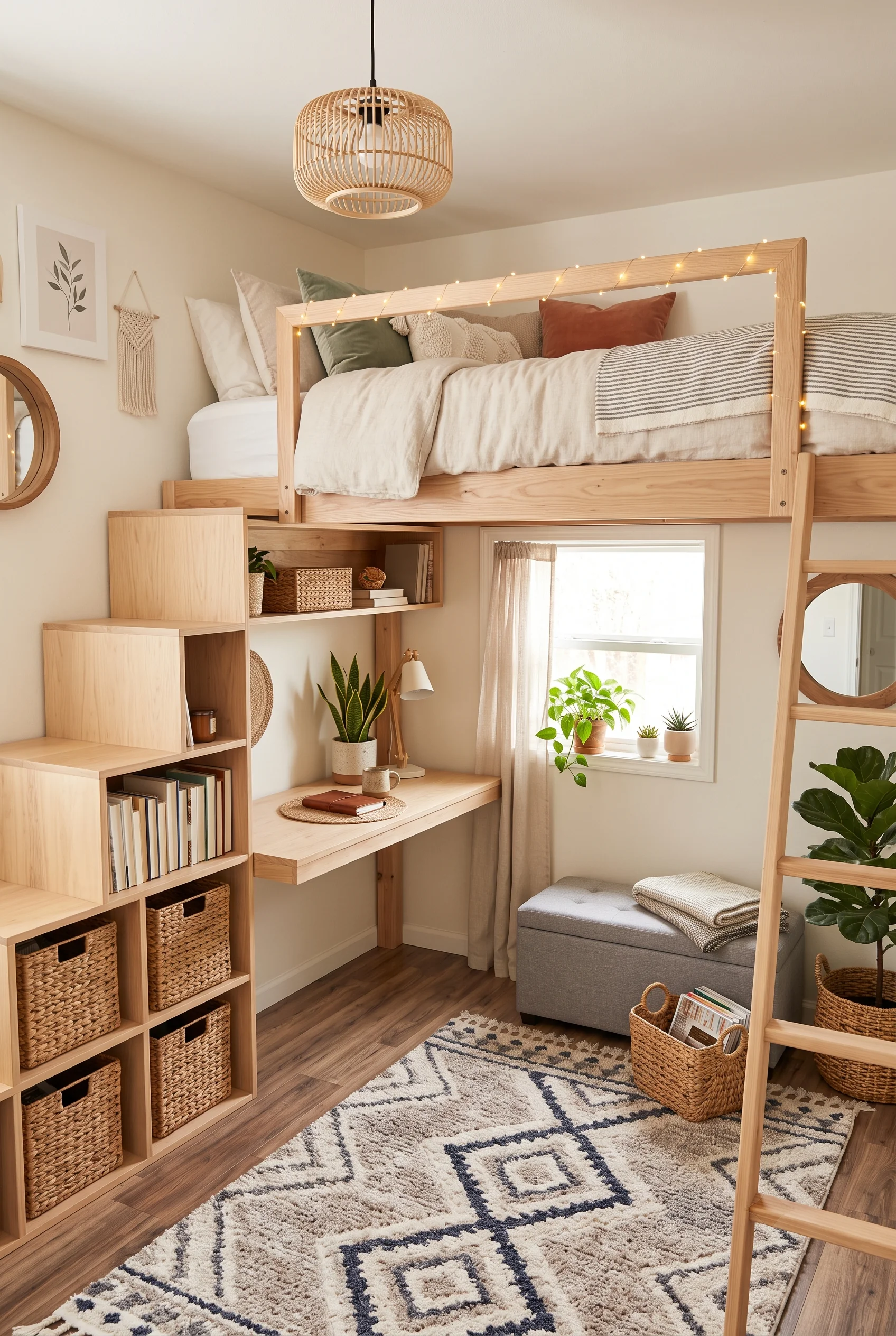
Raising the bed frees up the entire footprint underneath for a desk, a shelf ladder, and a reading spot tucked by the window. String lights along the bed frame and a soft glow pendant keep the upper level feeling cozy rather than exposed.
Cubbies built into the stair-step ladder hold books and a few keepsakes, doing double duty as both a handhold on the climb up and extra storage. For a small room that needs to serve as a sleeping, studying, and playing space within the same square footage, a loft frame like this one solves all three at once.
Corner Shelves Claim the One Spot Everyone Forgets
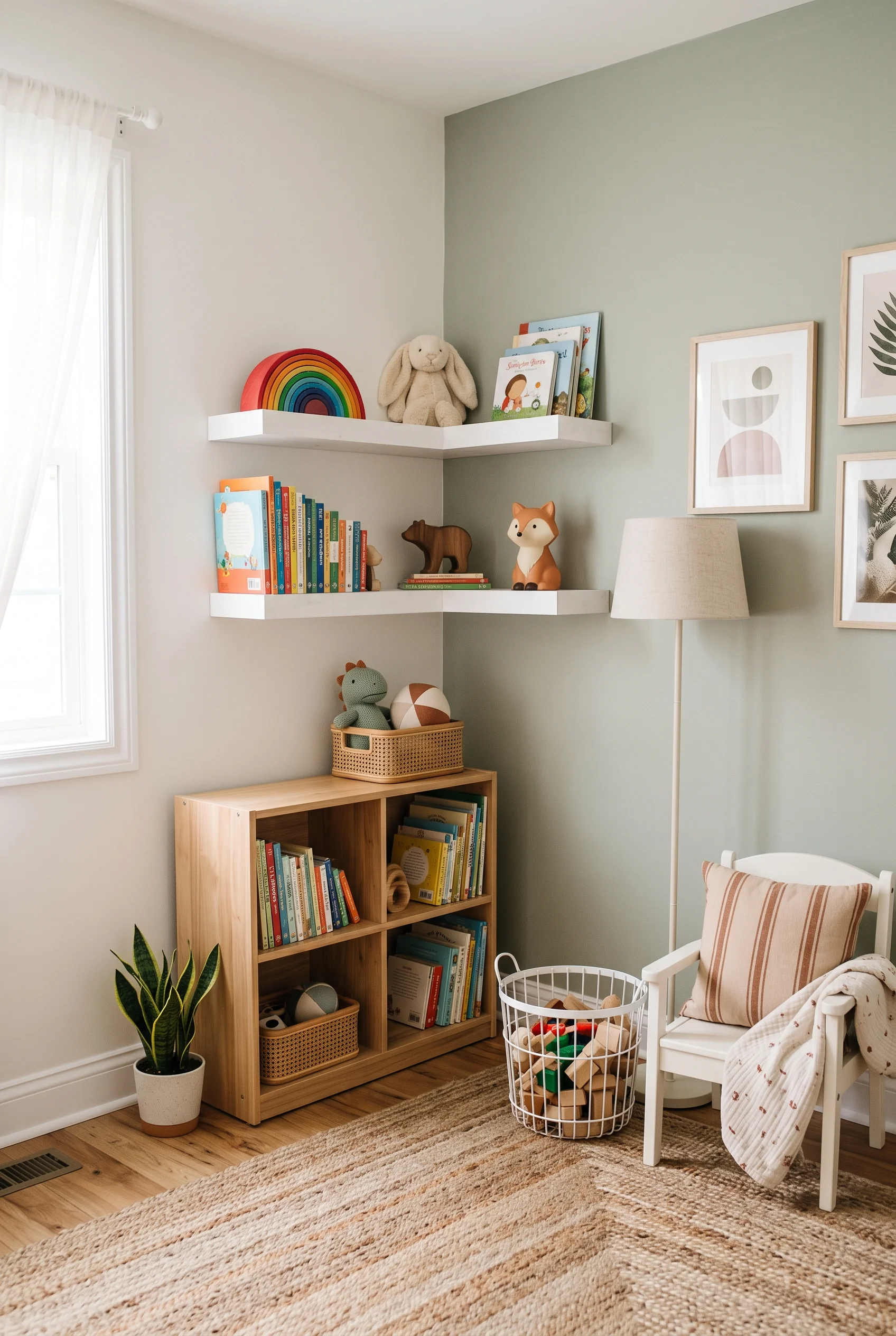
Two white shelves meet at the corner of this room, holding a wooden rainbow, a plush bunny, and a small stack of picture books at a height easy to reach and just as easy to restyle. Corners are often the most wasted space in a small room, and this one carries real storage instead of standing empty.
Below the shelves, a compact bookcase with woven bins handles the toys that need a home but not a spotlight. The pairing keeps the corner from feeling like an afterthought.
An Ottoman That Swaps Blankets for Seating in One Move
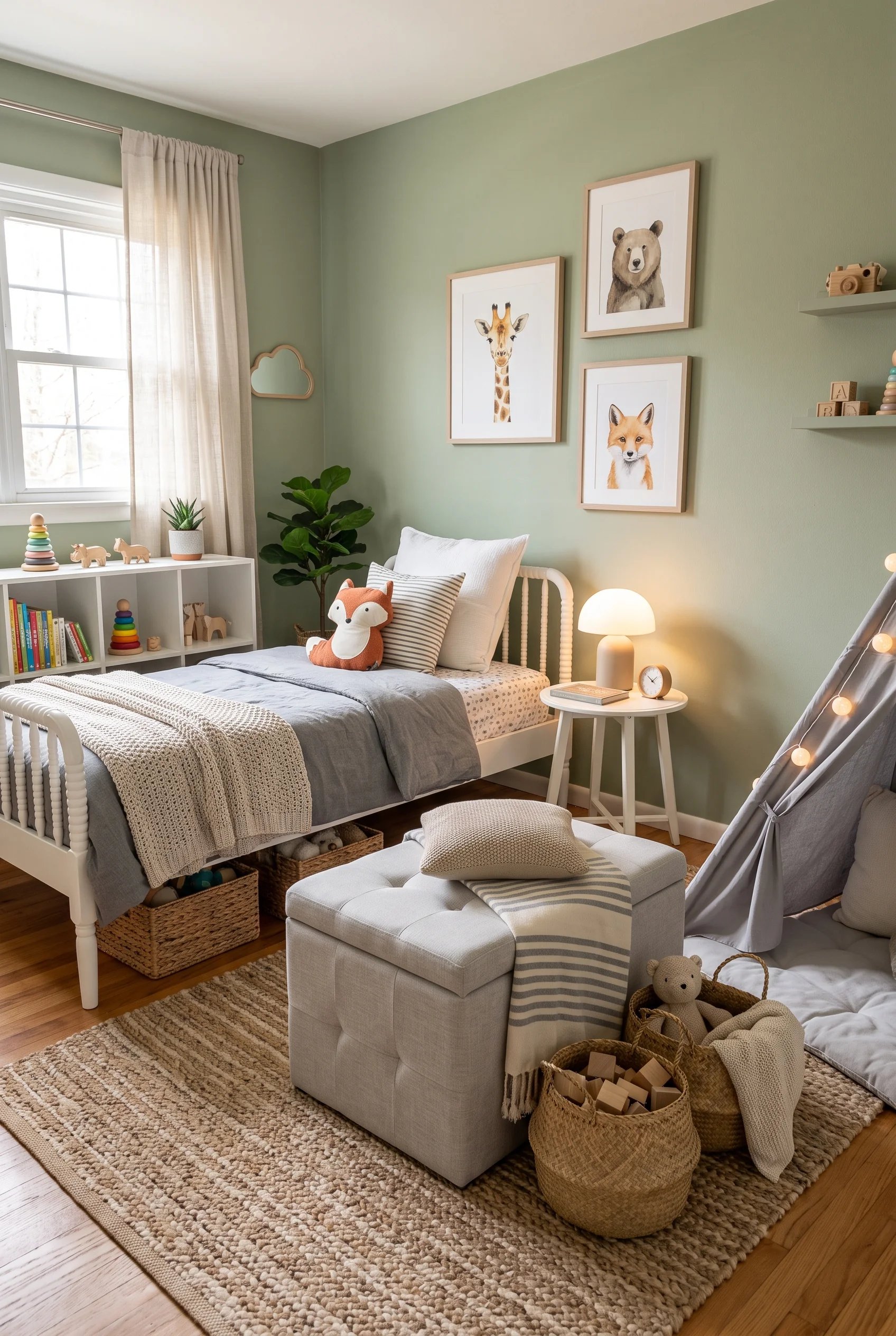
A tufted gray ottoman sits at the foot of this sage green bed, holding extra throws and pillows inside its lift top. It reads as a simple accent piece until it’s opened, at which point it becomes the spot where off-season bedding disappears.
Paired with two woven baskets nearby, the ottoman keeps the room’s soft, forest-inspired palette from ever being interrupted by a plastic bin. A teepee corner just beside it gives the whole room a second cozy landing spot for stuffed animals and quiet time.
A Rolling Cart Brings the Art Studio Wherever Play Happens
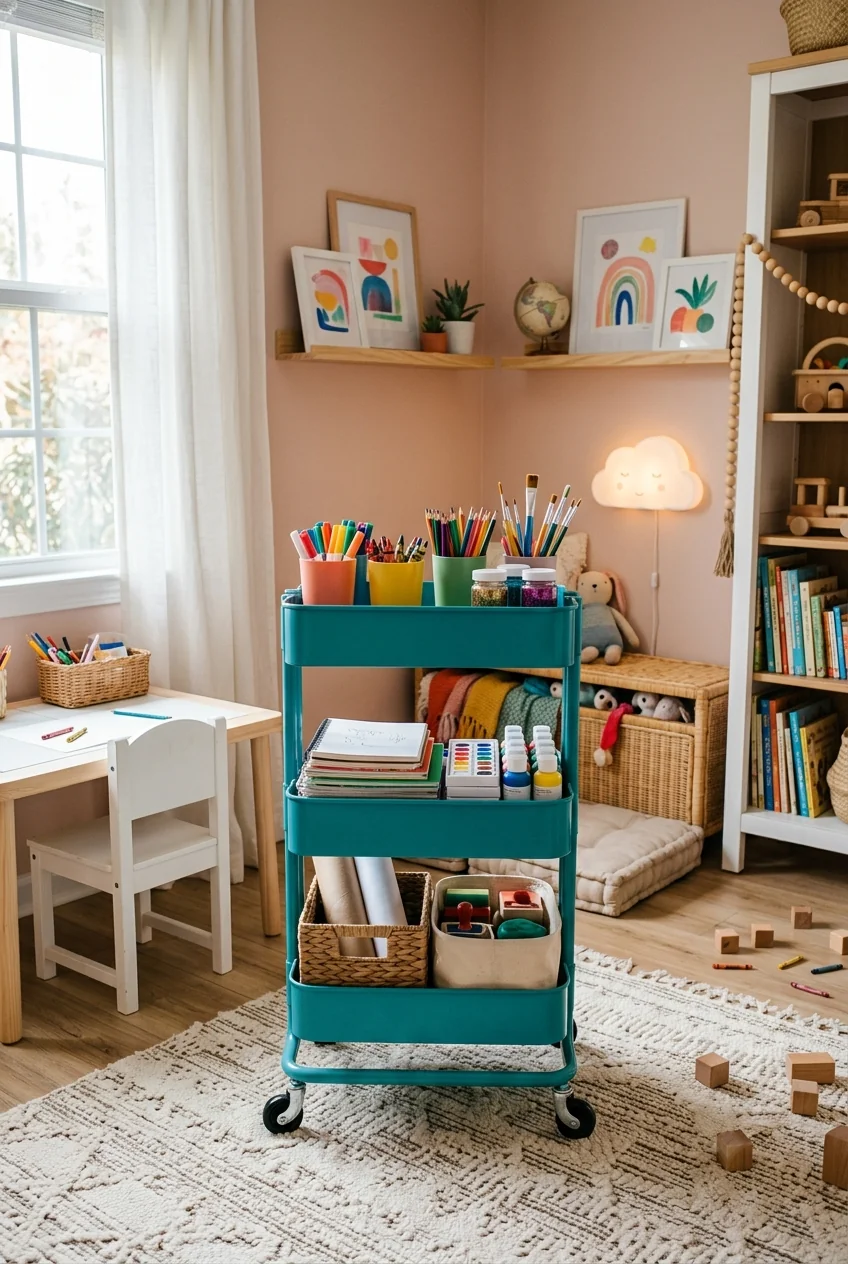
This teal three-tier cart holds everything from paintbrushes and colored pencils to glitter jars and rolled paper, all sorted by tier and accessible from every side. Since it rolls freely on its casters, the whole art station can move from the desk to the rug to wherever the child settles that day.
A cart like this solves a problem shelves can’t: art supplies that need to travel with the activity, not stay fixed to one corner of the room. When cleanup time comes, everything rolls back to its spot against the wall in one trip.
A Murphy Bed Disappears So the Playroom Can Take Over
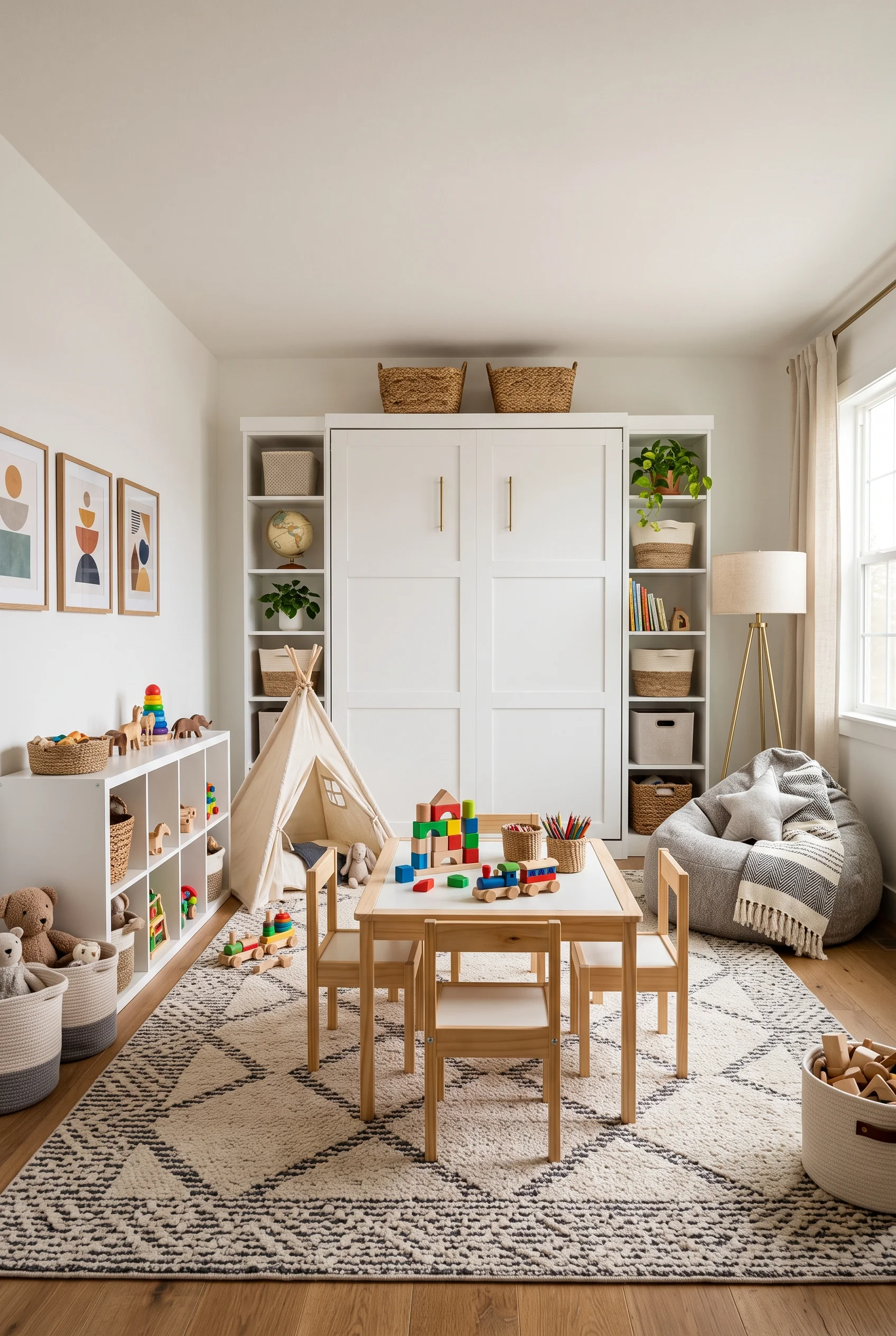
Folded up against the wall, this bed becomes a flat white cabinet with brass pulls, easy to mistake for a closet. Two tall bookshelves flank it on either side, filled with baskets, bins, and a globe, so the storage stays put whether the bed is up or down.
With the bed folded away, the play table, teepee, and bean bag chair take over the full floor, something a standard bed frame could never allow in a room this size. It’s the most dramatic way to reclaim a small room’s square footage, at least until bedtime.
Small Habits That Keep a Room Tidy Without a Fight
The easiest system is the one a child can use without asking for help. A rack low enough to reach, a rug that marks where the blocks belong, a door that sorts toys by type- these small habits do more for daily tidiness than any big furniture purchase.
An Open Rack Lets Little Hands Dress Themselves
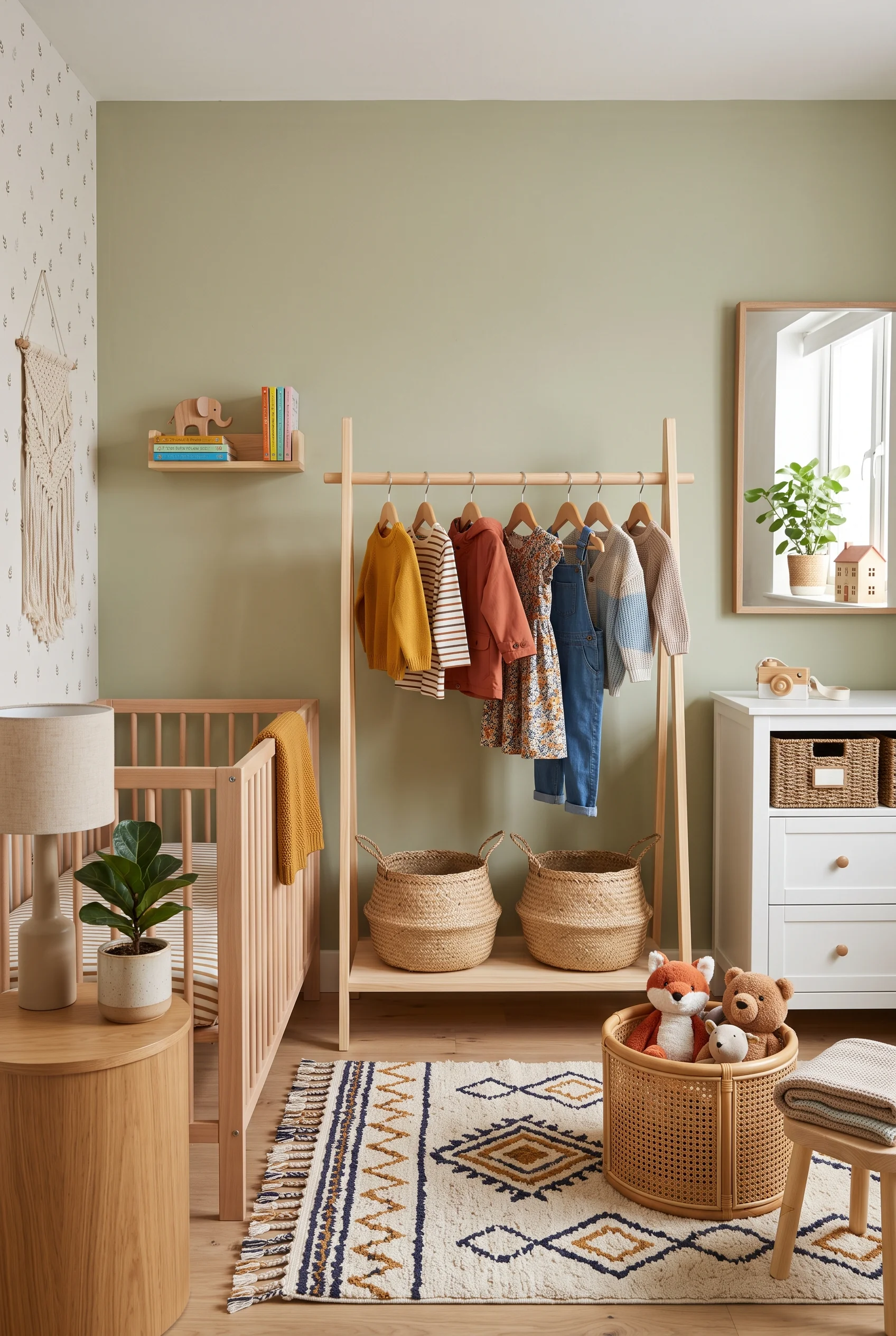
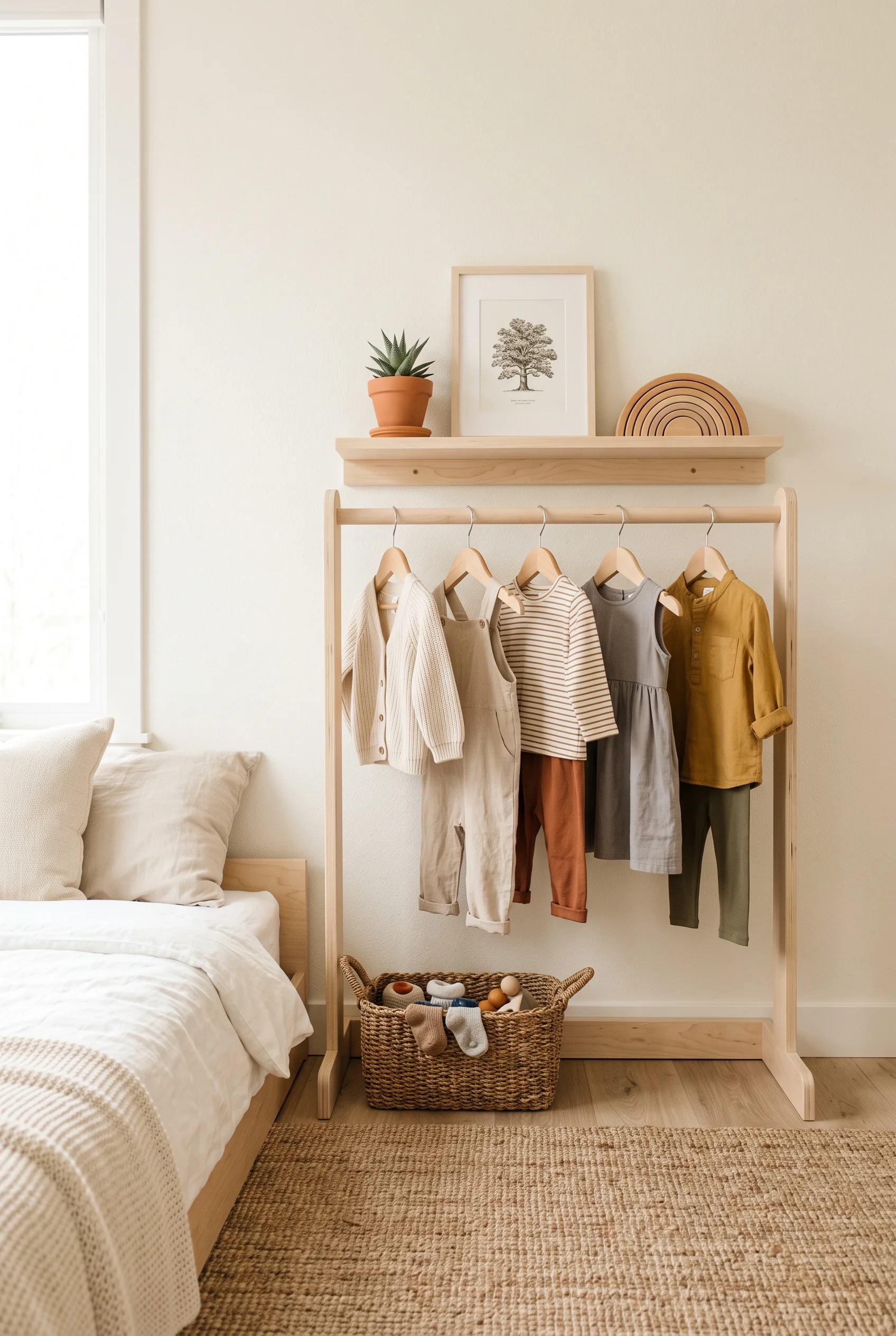
A simple wood clothing rack holds a week’s worth of outfits in full view, from a mustard sweater to a floral dress, all within easy reach of a toddler picking out their own clothes. Two woven baskets underneath catch shoes or extra layers that don’t need a hanger.
Open racks like this work especially well in a nursery or toddler room, where a closet rod is often mounted too high to be useful yet. It also means laundry day ends with clothes back on the rack instead of stuffed into a drawer.
A Patterned Rug Draws an Invisible Line Around Playtime
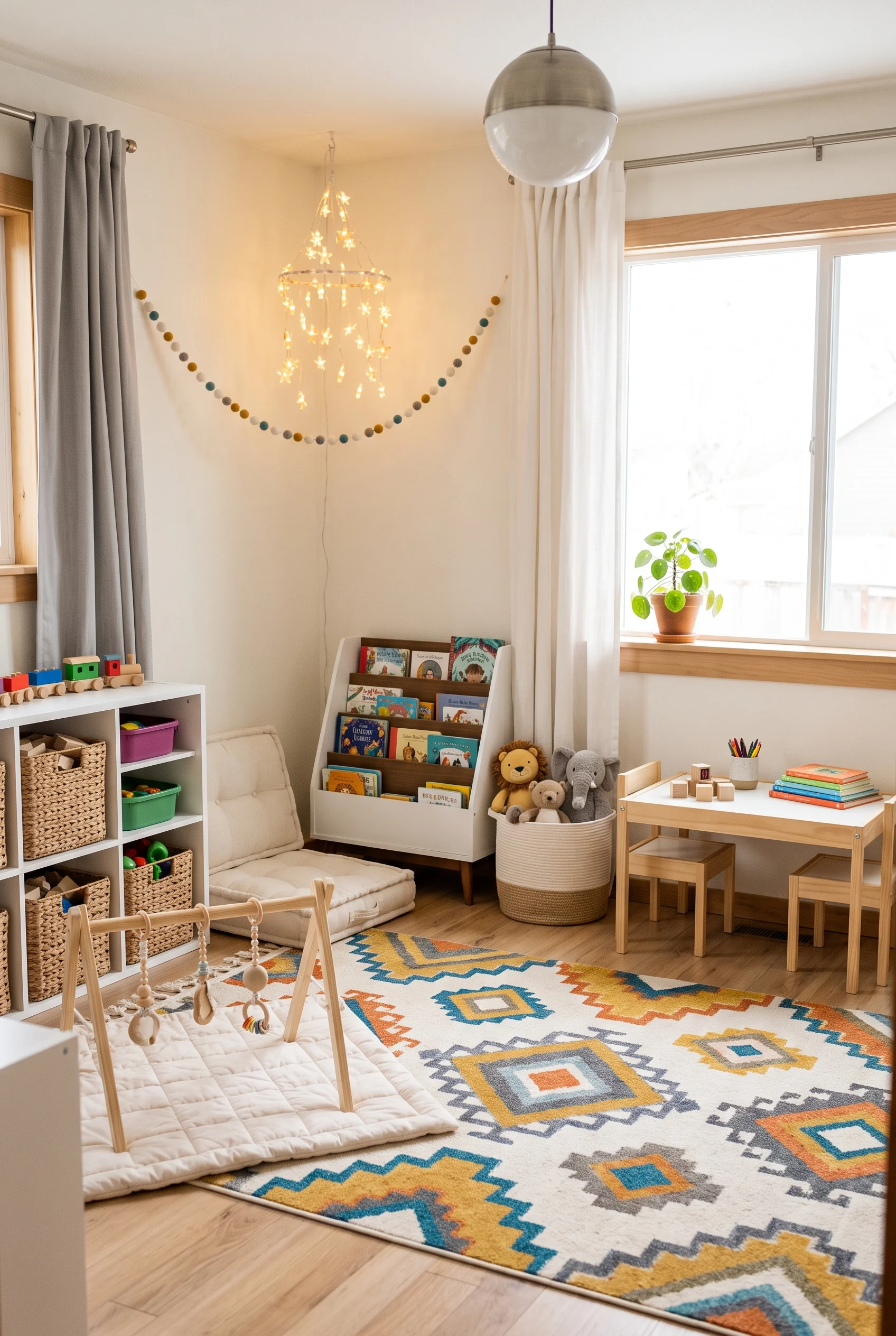
A bold diamond-patterned rug fills the center of this room, and everything on it- the wooden train set, the play table, the teepee- stays contained within its edges. Beyond the rug’s border, the floor stays completely clear.
That kind of visual boundary works especially well for toddlers who don’t yet understand how to keep toys in one room, let alone in one corner. When the rug marks where play happens, cleanup becomes a matter of returning things to the rug’s edge and no further.
A Shoe Organizer Becomes a Sorting Wall for Tiny Toys
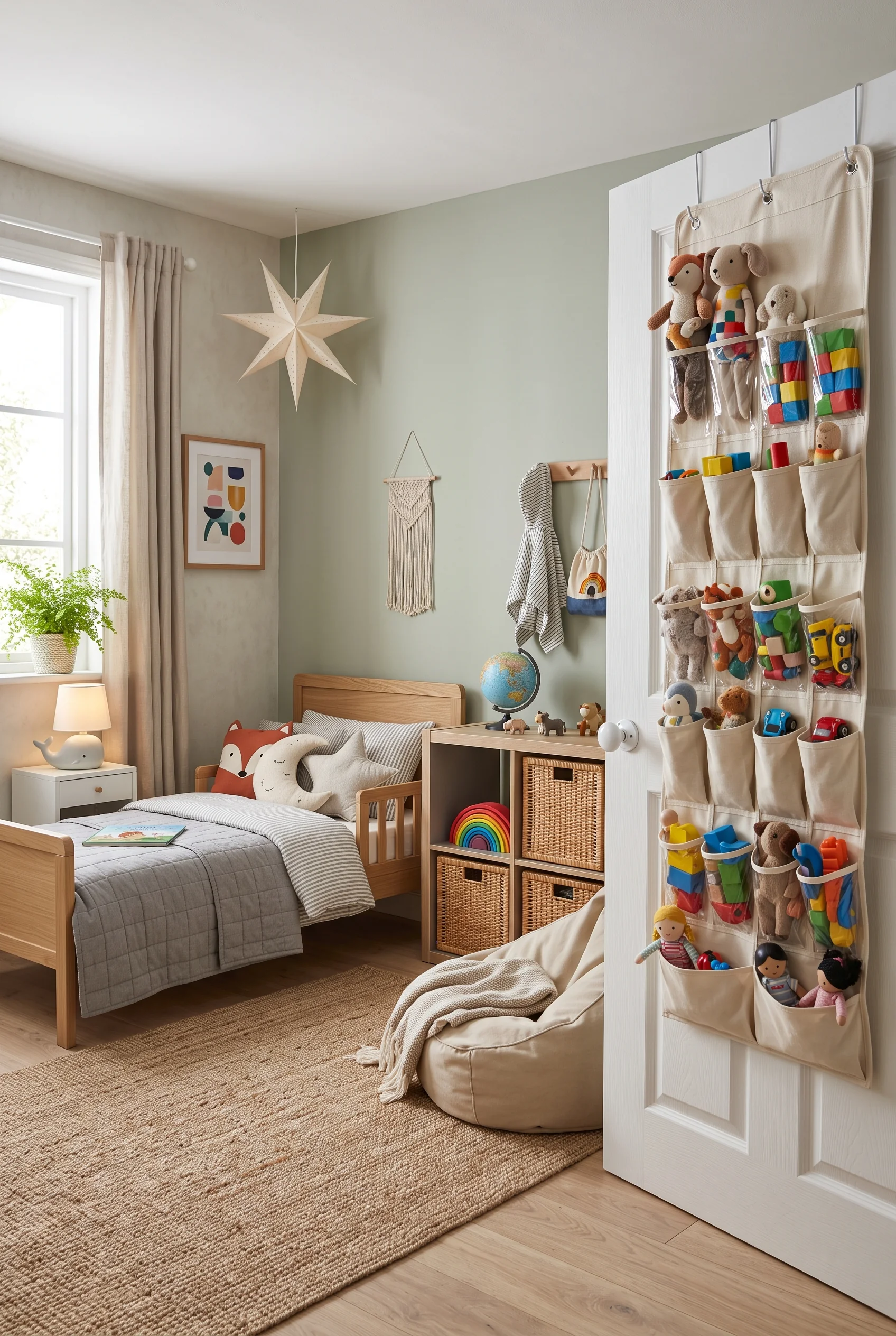
Hung on the back of a bedroom door, this canvas pocket organizer sorts stuffed animals, cars, and dolls into their own rows, each pocket clear enough to see what’s inside without unzipping anything. It’s the same idea as a shoe rack, just repurposed for toys instead of sneakers.
Because every category has its own row, a child can put a lion back in the same pocket every time instead of tossing it into a general bin. Paired with a cube shelf and a cozy bean bag chair, the door becomes one more working wall in a room already full of them.
Details That Make a Small Room Feel Finished
Once the major storage pieces are settled, it’s the smaller finishing touches that make a room feel complete, and ready to grow with a child for years rather than months. A styled shelf, a bed that expands for guests, a soft organizer within a caregiver’s reach, and one wall built purely for creativity round out this list.
A Trundle Bed Keeps Sleepovers Simple
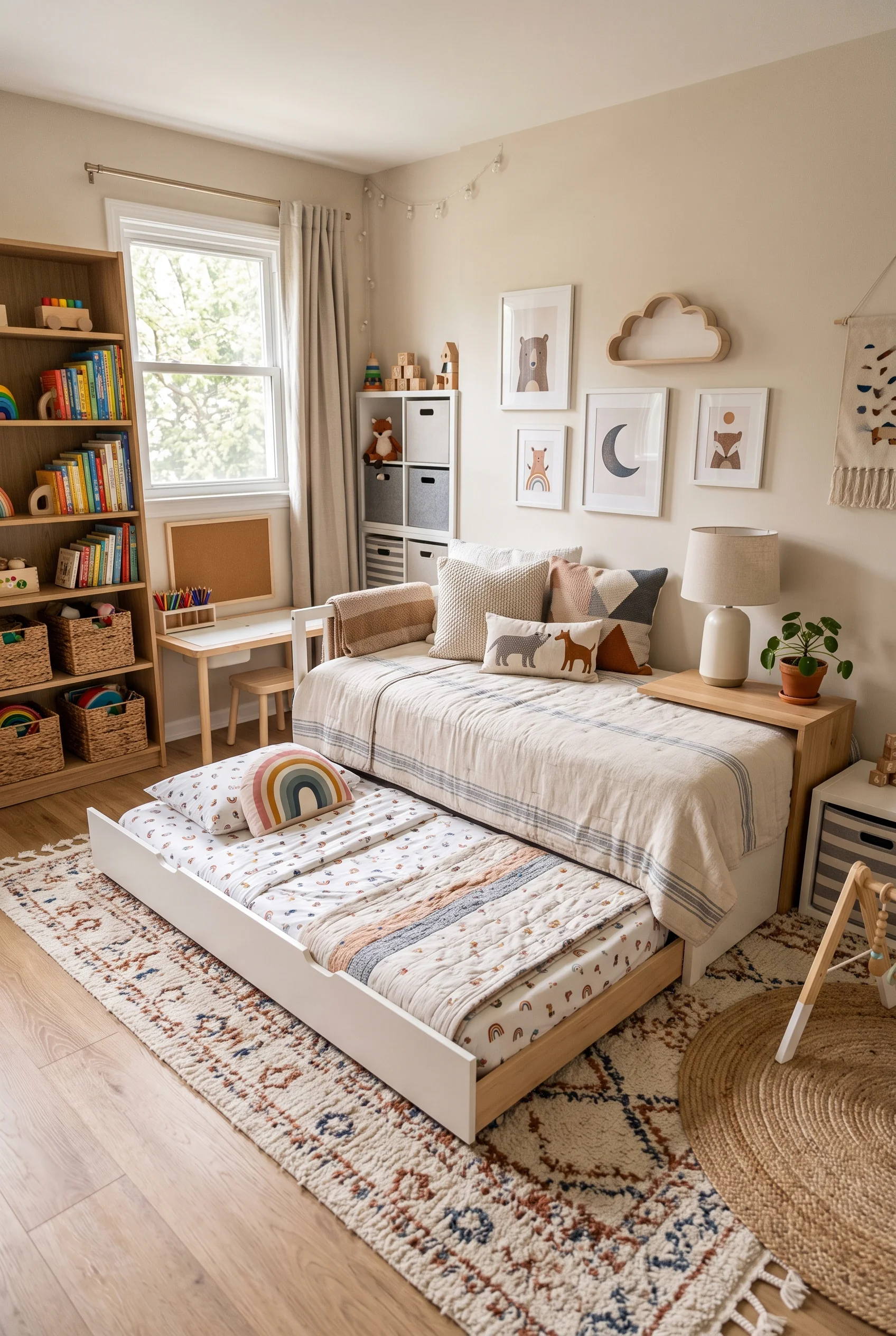
By day, this looks like a single daybed dressed in warm neutral linens. Pull the trundle out from underneath, and a second full mattress appears, already made up in its own rainbow-print sheets and ready for a sibling or a sleepover guest.
The rest of the time, that second bed stays tucked away, so the room reads as a single-bed layout rather than a cramped double, ready to sleep two on the nights it needs to without ever losing the floor space in between.
A Chalkboard Wall Turns One Corner Into a Canvas
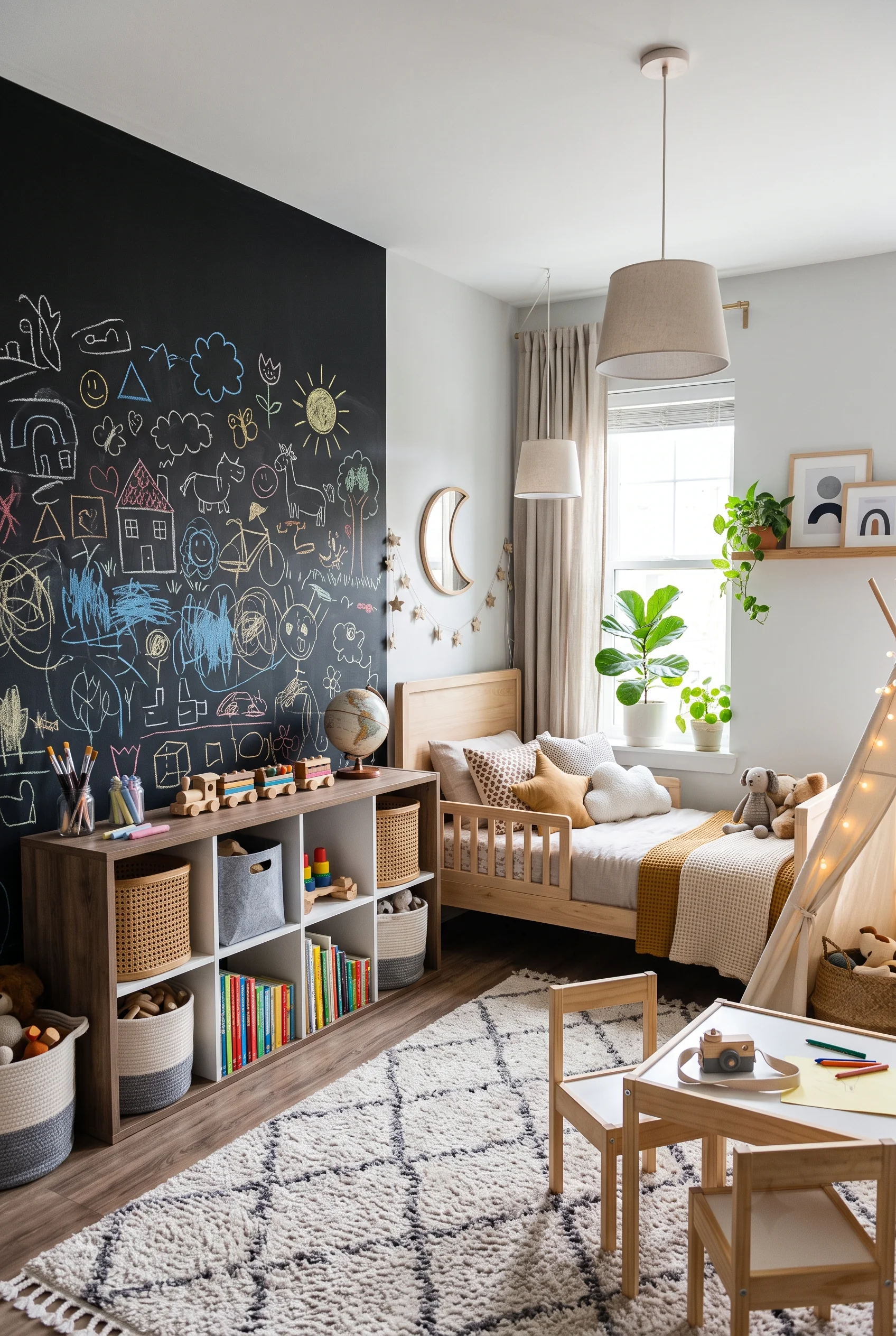
An entire wall painted in chalkboard finish gives this room a canvas that changes daily, currently covered in a child’s drawings of houses, animals, and a bright yellow sun. A low storage unit runs along the base of the wall, holding books and baskets of art supplies close to where the drawing happens.
A cup of chalk sits right on top of the unit, so the wall stays in constant use rather than becoming a one-time mural, ready for a fresh drawing the moment a damp cloth wipes away the last one.
A Room That Stays Organized as Your Child Grows
Look back over these thirty-five rooms, and a pattern starts to emerge: none of them rely on a single big fix. A tall bookshelf, a bin with a picture label, a hook at exactly the right height- each idea is small on its own, but together they add up to a room that actually stays tidy past the first week.
That’s really the heart of good kids’ bedroom storage ideas: matching the system to the child using it, not the other way around. A toddler needs baskets and picture labels within easy reach. A pair of siblings sharing one room needs a bunk bed or a loft frame that gives each of them their own zone. A nursery needs soft, within-reach storage for the middle-of-the-night moments, while a school-age kid’s room might do better with a desk that hides its clutter and a closet zoned by category.
You don’t need to recreate every idea in this list at once, and you probably shouldn’t try. Start with whatever feels the most overwhelming right now; maybe it’s the toy pile on the floor, maybe it’s a closet nobody can close, and build outward from there. Even one well-placed basket or one labeled bin can shift how a room feels by the end of the week.
Our Montessori bedroom ideas for toddlers pair well with several of the storage systems here, especially the child-height hooks and open racks built around independence, for anyone furnishing a room as part of this refresh. Small rooms can absolutely hold everything a family needs. It’s just a matter of letting the furniture do the heavy lifting.