25 Living Room Play Corner Ideas (No Playroom Required)
Living room play corner ideas become essential the moment you accept that a dedicated playroom simply isn’t in the floor plan. Most homes don’t have a spare room to hand over to blocks and stuffed animals, so the living room ends up doing double duty whether you plan for it or not. The good news is that a corner of shared space can hold its own as a real play zone without turning the whole room over to primary colors and plastic bins.
The trick is choosing furniture and storage that quietly serve two purposes at once, one for the kids and one for the adults who still want a living room that looks like a living room. A cube shelf can double as a room divider. A storage bench can seat guests and hide the toy overflow in one fell swoop. Even a rug can draw an invisible boundary that tells a toddler exactly where the play zone starts and ends.
This roundup walks through twenty-five real living room play corners, organized by the design decision behind each one: where to put the corner, what furniture earns its keep, and how to keep the palette calm. It also covers how the space can grow with your kids and what actually keeps it tidy on a Tuesday. If your space skews small, the ideas in clutter-free kids’ room design pair especially well here, and the independence-first thinking behind Montessori-inspired toddler bedrooms shows up again and again in the corners ahead. Start with one idea, not all twenty-five, and the payoff shows up fast.
DISCLOSURE: Some of the links provided on this page are affiliate links. This means if you choose to make a purchase through these links, we may receive a small commission at no extra cost to you.
Where the Play Corner Actually Belongs
Before any bin or bookshelf gets purchased, the play corner needs an address. The right spot has decent light, enough floor space for a rug, and enough distance from the TV that nobody’s blocks end up under the coffee table during a movie. These five living rooms all start from the same question: not what goes in the corner, but which corner deserves the job in the first place.
A Corner With a Clear Job Description
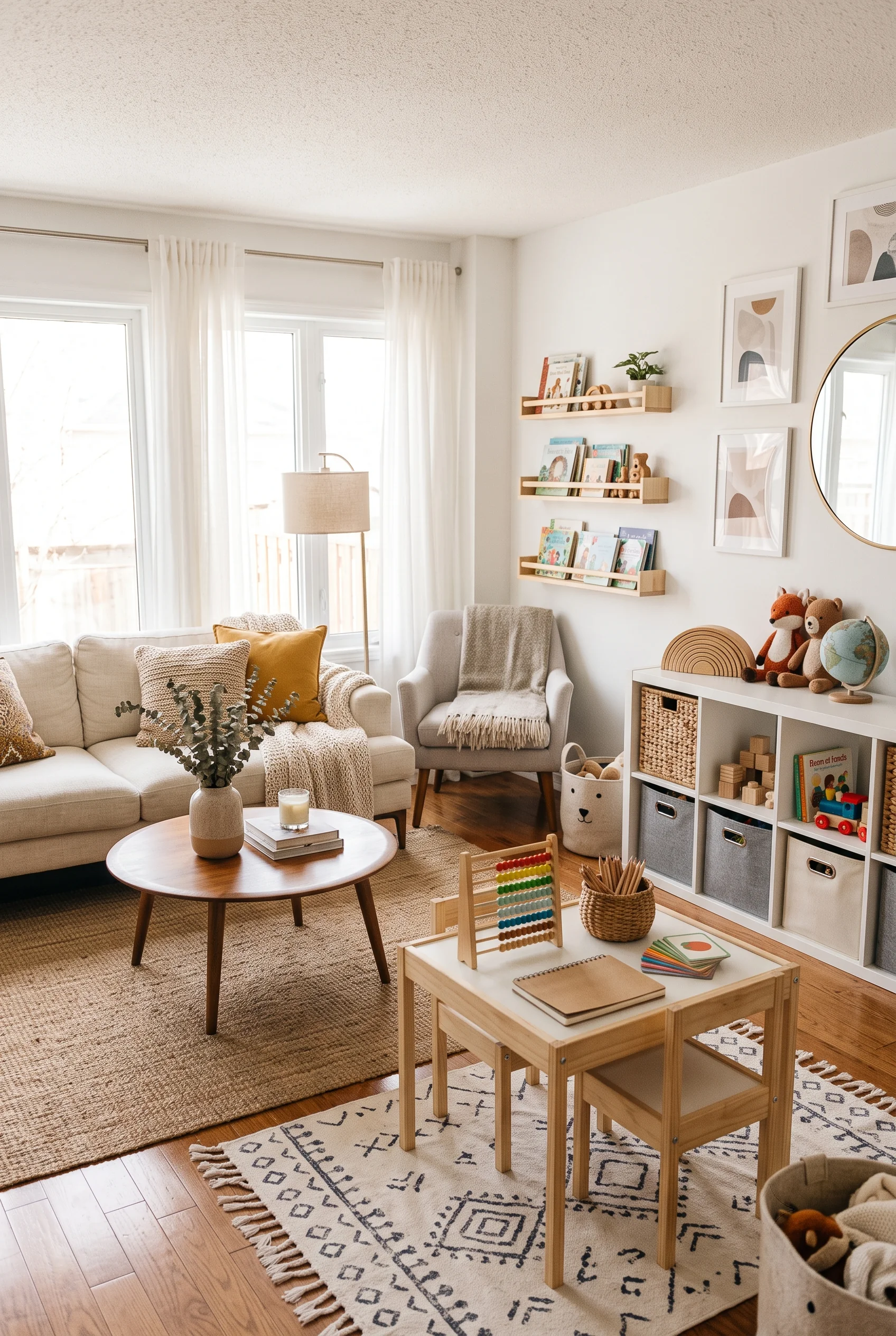
A jute rug anchors the seating area, and a smaller patterned rug marks off the play zone a few feet away, so the two purposes never bleed into each other. Cube storage against the wall holds baskets at kid height, plus books and a soft fox propped on top where they double as decor. A small globe rounds out the display.
A round mid-century coffee table keeps the grown-up side low and uncluttered, while a low wooden table with an abacus and a cup of colored pencils gives the kids their own work surface. Nothing here reads as a toy store. It reads like a room that happens to include one.
Let the Sunniest Corner Win
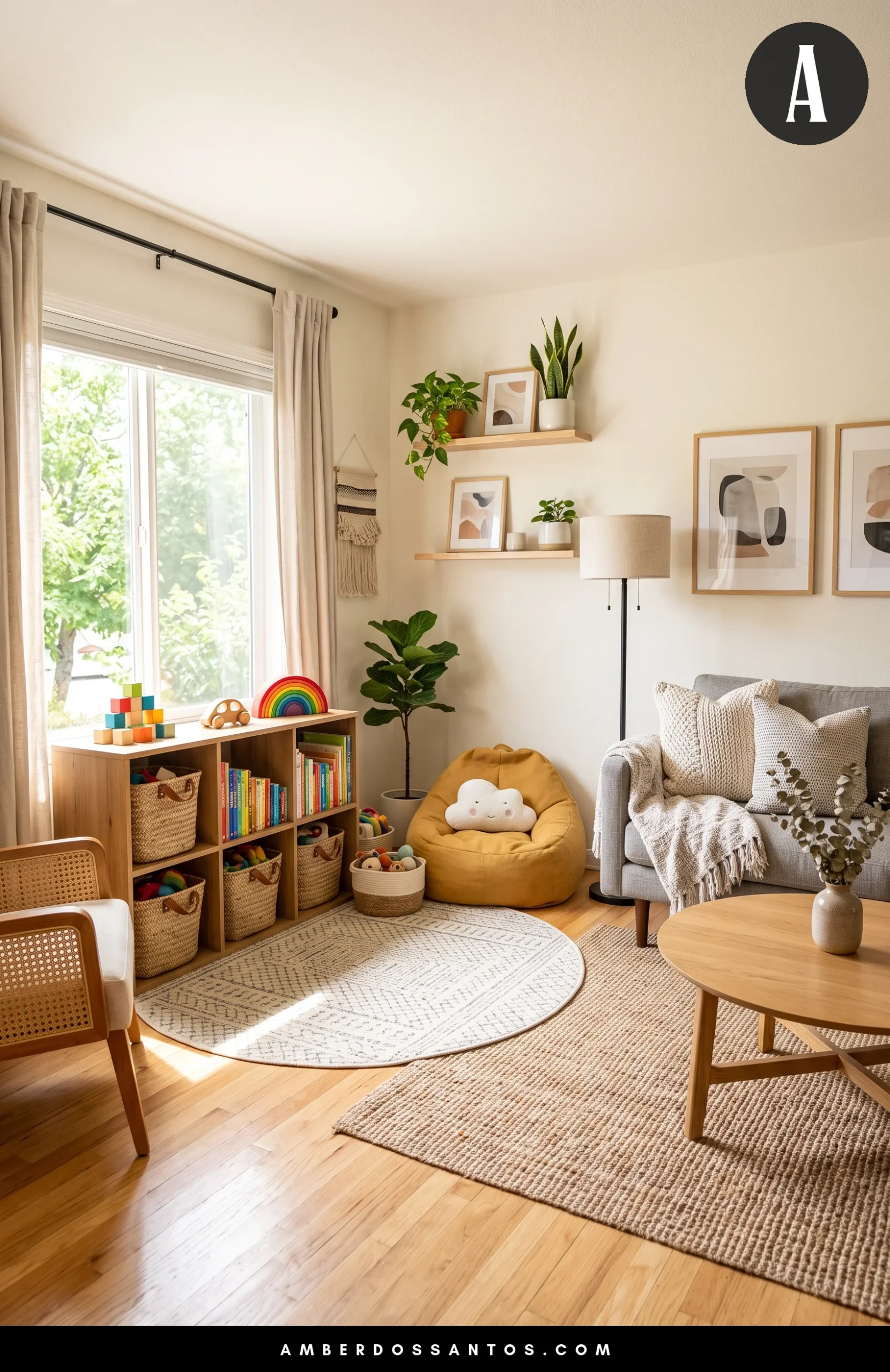
Natural light does more design work here than any single piece of furniture. The play corner claimed the brightest window in the house, and the rest of the layout followed: a mustard bean bag chair for solo lounging, a low shelf of books and wooden toys within easy reach, and a round textured rug layered over a woven one to soften the floor.
Gallery-wall art and potted plants keep the wall behind the shelf from feeling like an afterthought. A cane accent chair pulls the whole corner back toward the rest of the living room’s furniture language, so it never feels like a separate room bolted onto the good one.
No Walls, Still a Room of Its Own
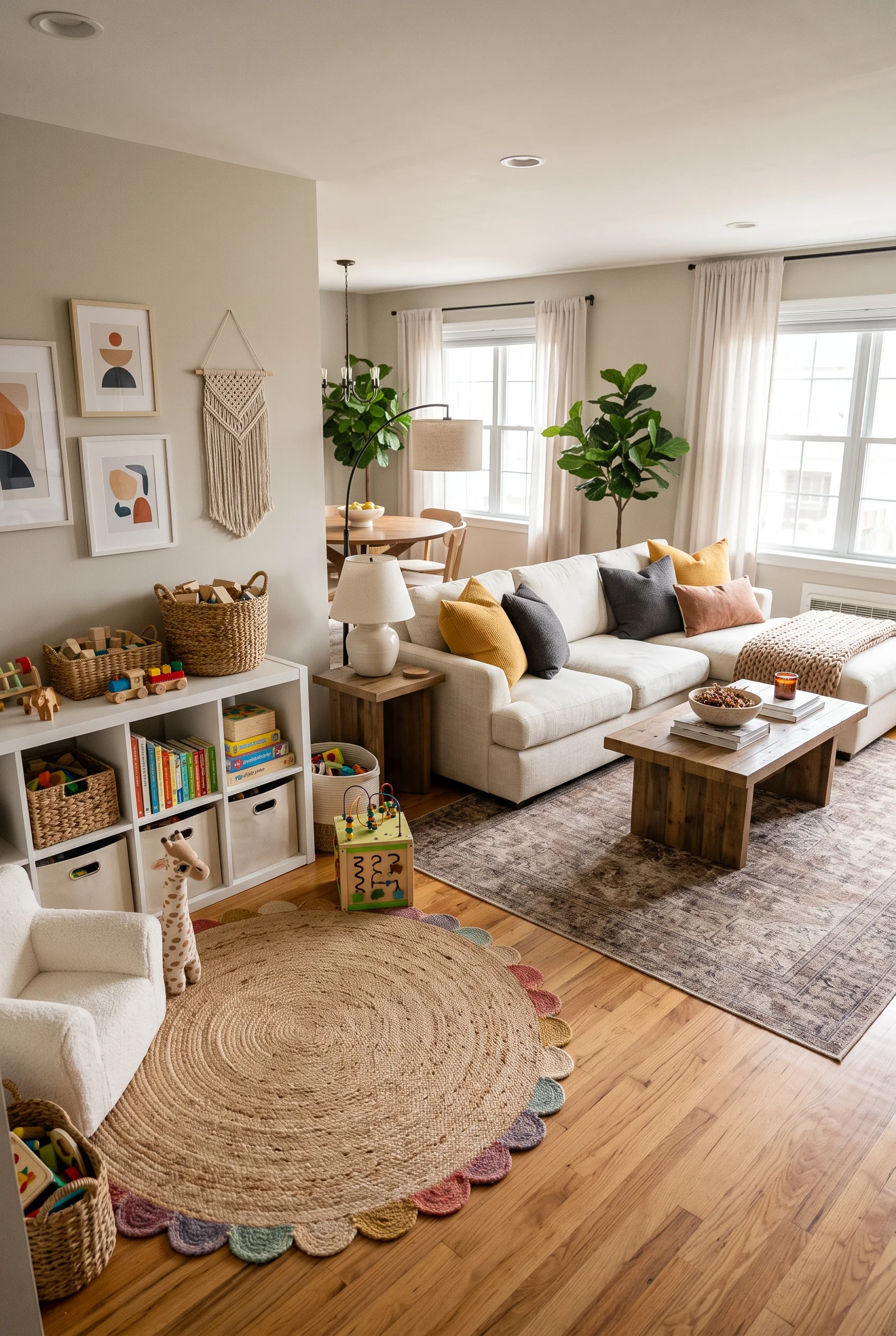
There’s no wall separating this play corner from the rest of the open-concept living space, yet it never reads as an intrusion. A jute rug layered under a smaller patterned one does the boundary work instead, marking exactly where the play zone starts.
A canvas teepee tucked against the storage unit gives kids their own little room within the room, string lights included. Cube storage stays low enough not to block sightlines to the kitchen beyond, which matters more than it sounds in a floor plan where every zone can see every other zone.
One Rug, One Very Clear Boundary
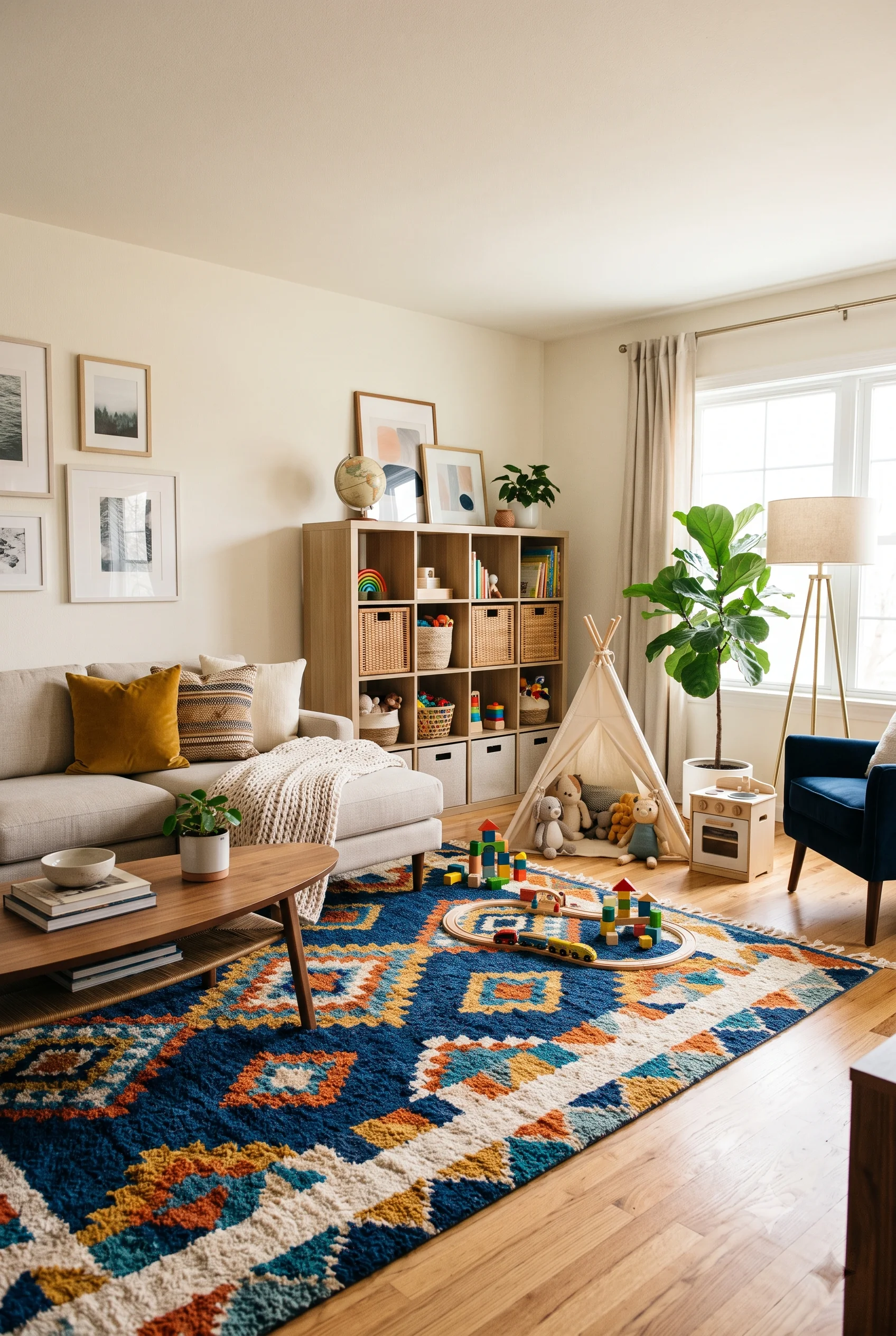
A rug this bold doesn’t need any help announcing where the play corner begins. The navy, mustard, and rust medallion pattern reads as a deliberate design choice, not a compromise made for the kids.
A wooden train loop sits directly on top of it, and the scattered pieces disappear into the rug’s pattern far better than they would on a plain one. The teepee and cube storage behind it stay quiet and neutral, letting the rug do the one job a play corner rug is actually for.
Small Footprint, No Compromise
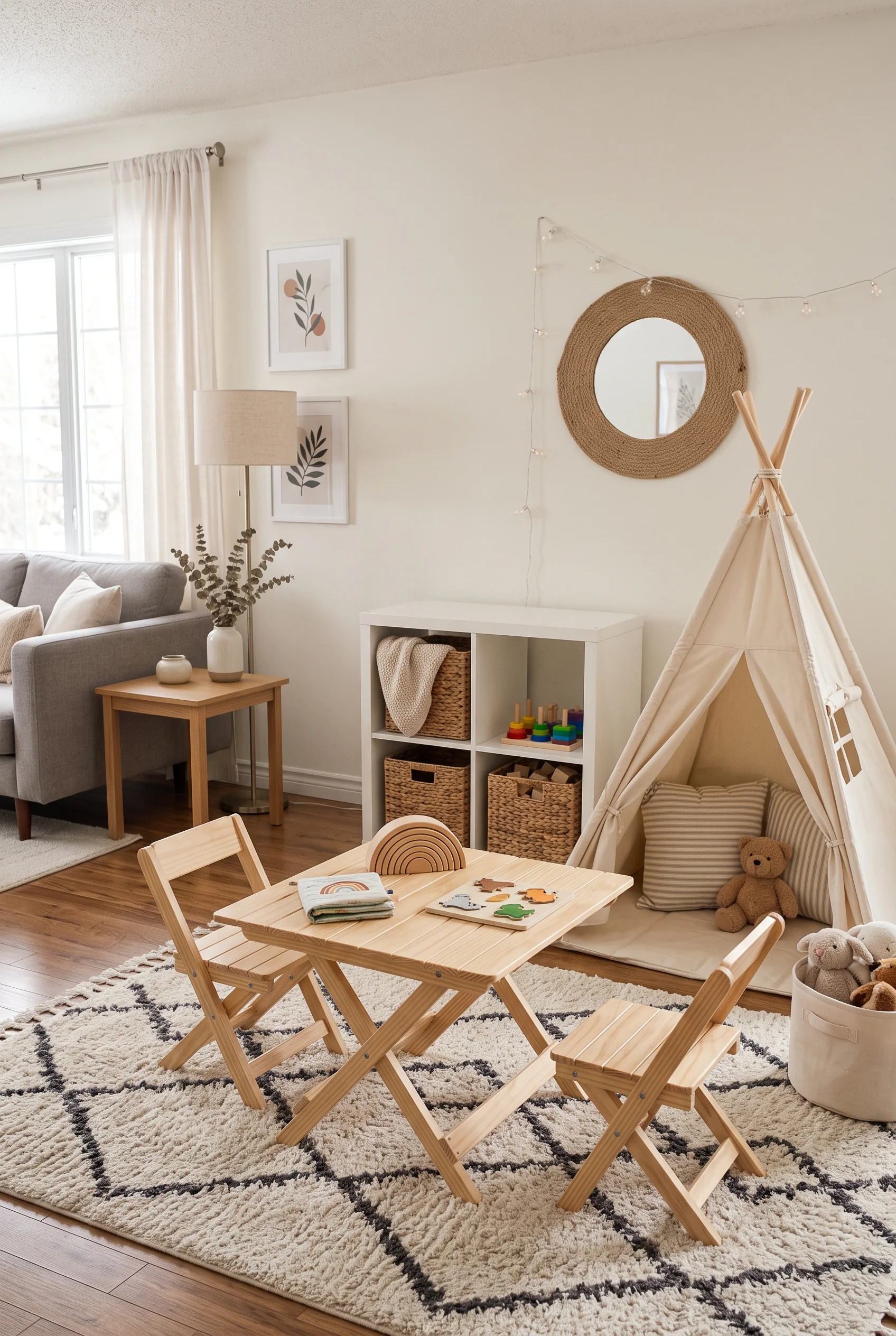
A folding table and chairs are the whole trick in a room this tight. When playtime ends, the set collapses flat and slides behind the sofa, and the corner reverts to looking like any other reading nook.
A small two-cube storage unit holds just enough, not more, and a round mirror bounces light back into a space that doesn’t have room to spare. The teepee stays because it earns its square footage every day, doubling as a reading spot and a quiet-time retreat when the rest of the living room gets loud.
Storage That Doesn’t Look Like Storage
Storage is where most living room play corners either succeed or fall apart by dinnertime. The five rooms below share one instinct: let furniture hide the mess without looking like it’s hiding anything. A bench, a shelf, and a coffee table all pull double duty here. Even a full sectional gets in on it, proving that furniture built for grown-ups and toy storage built for kids can be the exact same piece.
A Bench That Multitasks Without Trying
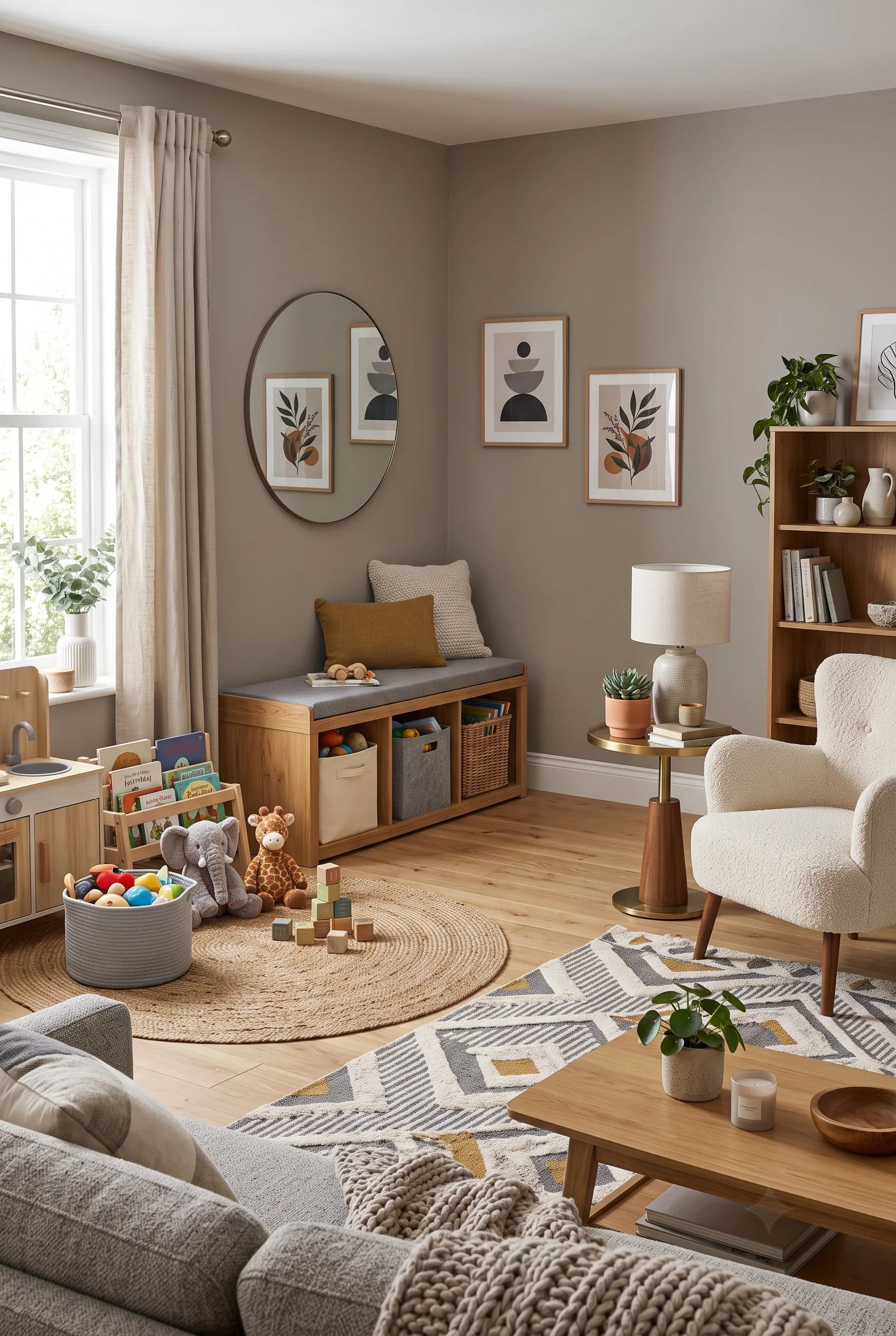
A storage bench usually lives by the front door, but here it’s doing living room duty instead, seating anyone who wants to watch playtime while three cubbies underneath swallow balls, blocks, and stuffed animals. The cushion on top means it never reads as purely functional.
A play kitchen sits just to the side, close enough for pretend dinners but far enough that it doesn’t crowd the seating. A round mirror above the bench bounces light around the corner, and a woven basket catches the giraffe and elephant that never quite make it back to their bin.
Open Shelves for Show, Baskets for the Rest
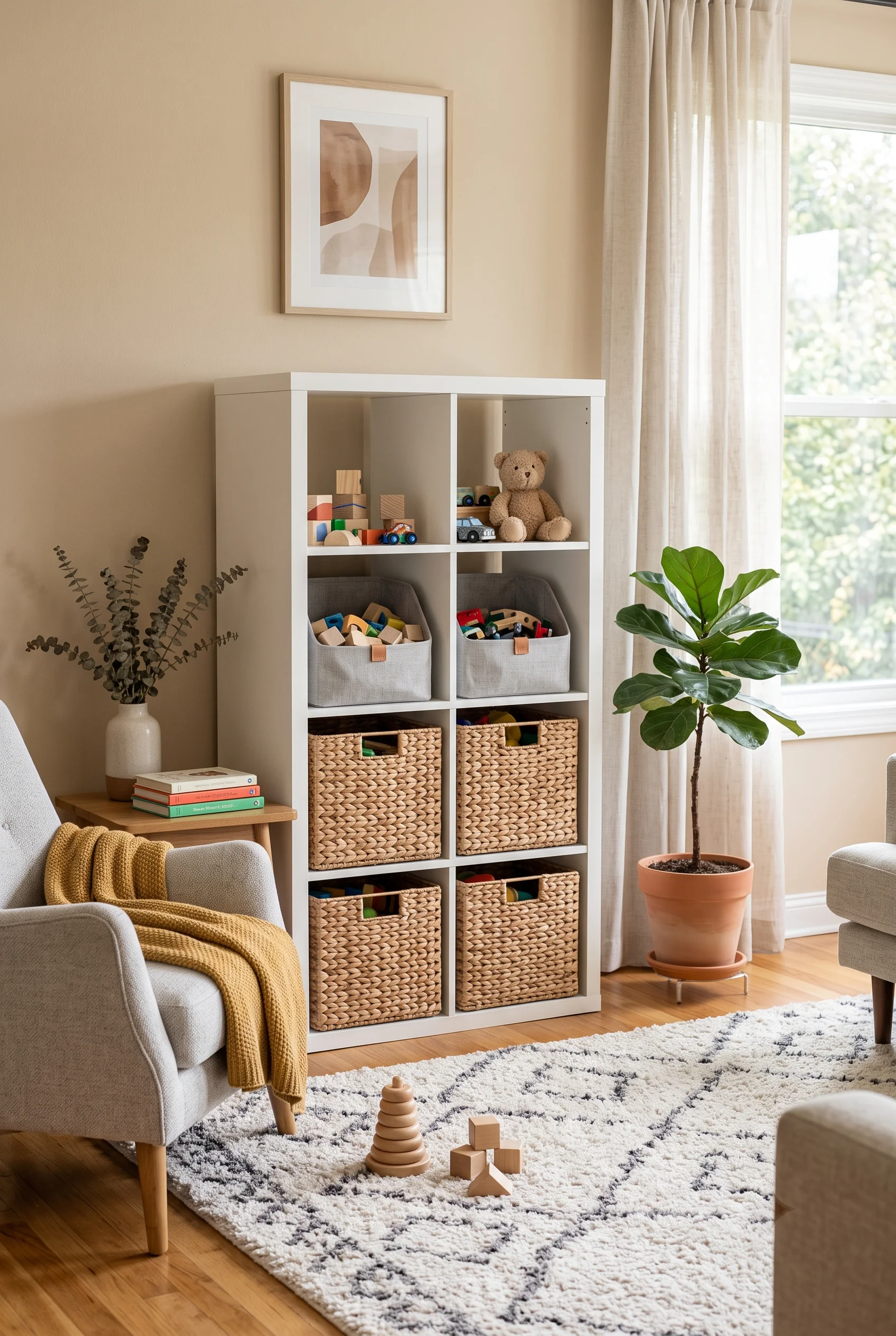
Not every toy needs a lid. The top row of this cube shelf stays open, showing off blocks, a teddy bear, and a little wooden fleet of cars the way a curated shelf would display anything else. It’s the toys worth looking at.
Everything less photogenic drops into the rows below: gray fabric bins for loose pieces, woven baskets for bulkier items. A search for sturdy woven storage baskets is worth it, since well-made ones hold up to daily digging far longer than flimsy ones. Pair that with a calmer, more organized toy storage system and cleanup stops being a fight.
Climbing the Wall Instead of Eating the Floor
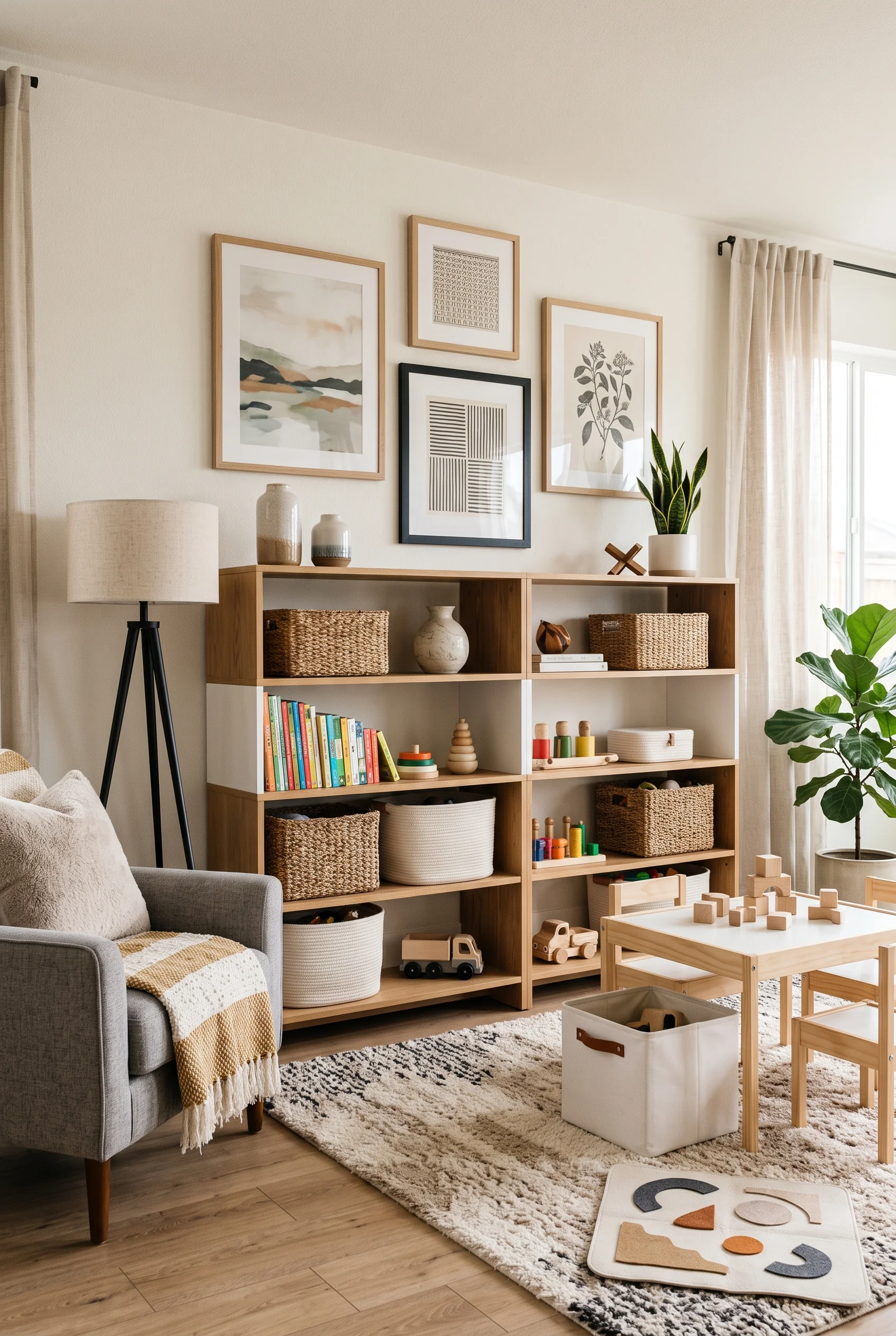
When floor space runs out, the only direction left is up. These twin bookshelves rise higher than a typical kid’s storage piece, turning wall space that would otherwise hold only a picture frame into actual toy real estate.
Rattan baskets on the top shelves keep the highest reaches for adult hands only, while the lower rows stay stocked with books and toys a child can grab solo. A small activity table anchors the floor below, so the vertical storage never feels like it swallowed the walking room a living room still needs.
Rounded Edges, Grown-Up Looks
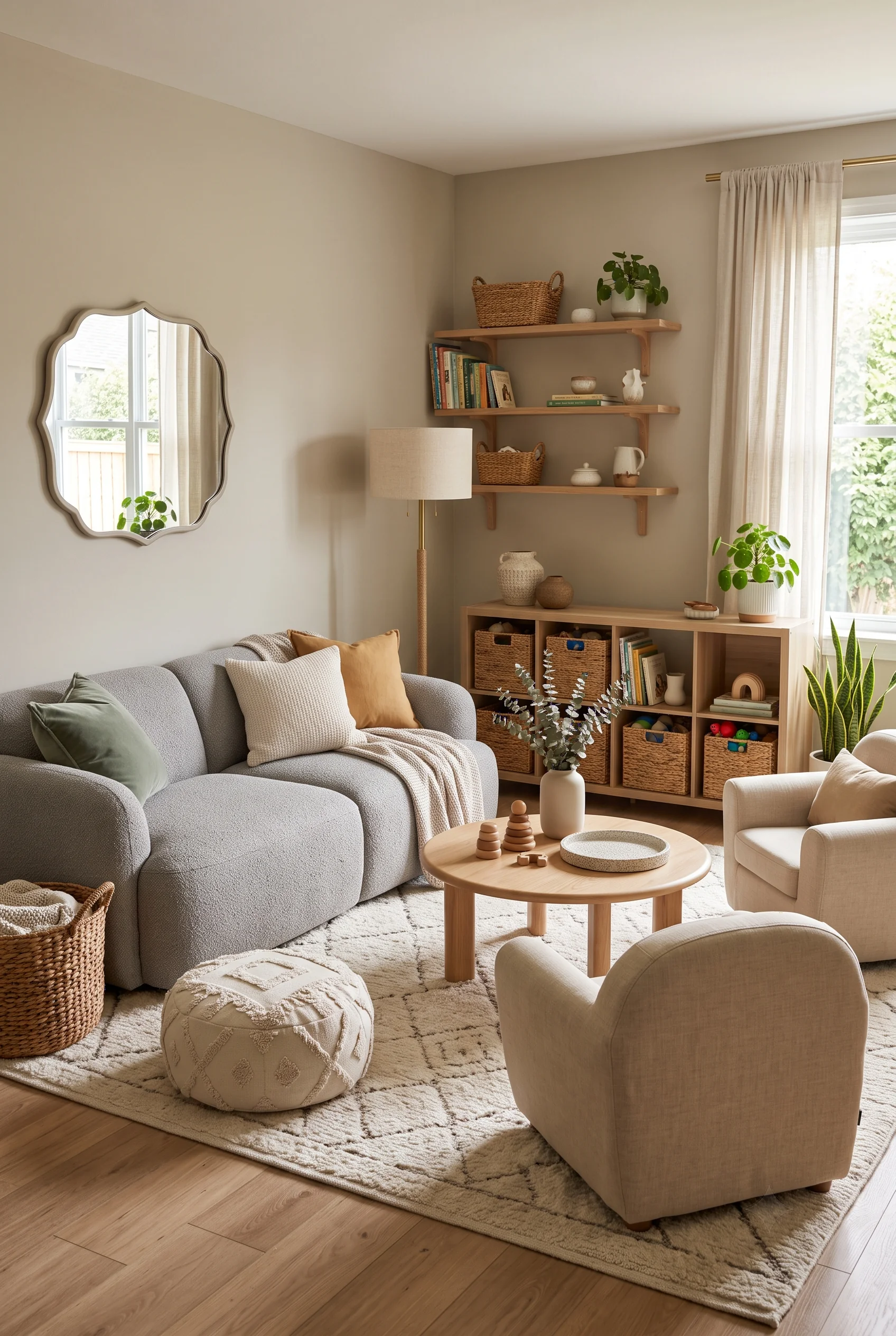
Every hard corner in this room got softened on purpose. The coffee table is round, the ottoman is a pouf with no edges at all, and even the accent chairs curve instead of squaring off, which matters when a toddler is learning to walk before they’re learning to watch where they’re going.
None of it reads as a compromise made for safety. The scalloped mirror and boucle texture keep the room feeling considered, so the rounded furniture reads as a deliberate style choice instead of a childproofing checklist.
The Quiet Confidence of a Neutral Backdrop
A neutral room isn’t a restriction here; it’s a strategy. Keeping walls, sofas, and shelving in soft, muted tones gives busy toys and colorful books somewhere to stand out rather than compete with an already loud backdrop. The five spaces in this group lean into calm on purpose, using warm lighting, gentle color, and a little curated whimsy instead of primary-color overload.
Let the Toys Bring the Color
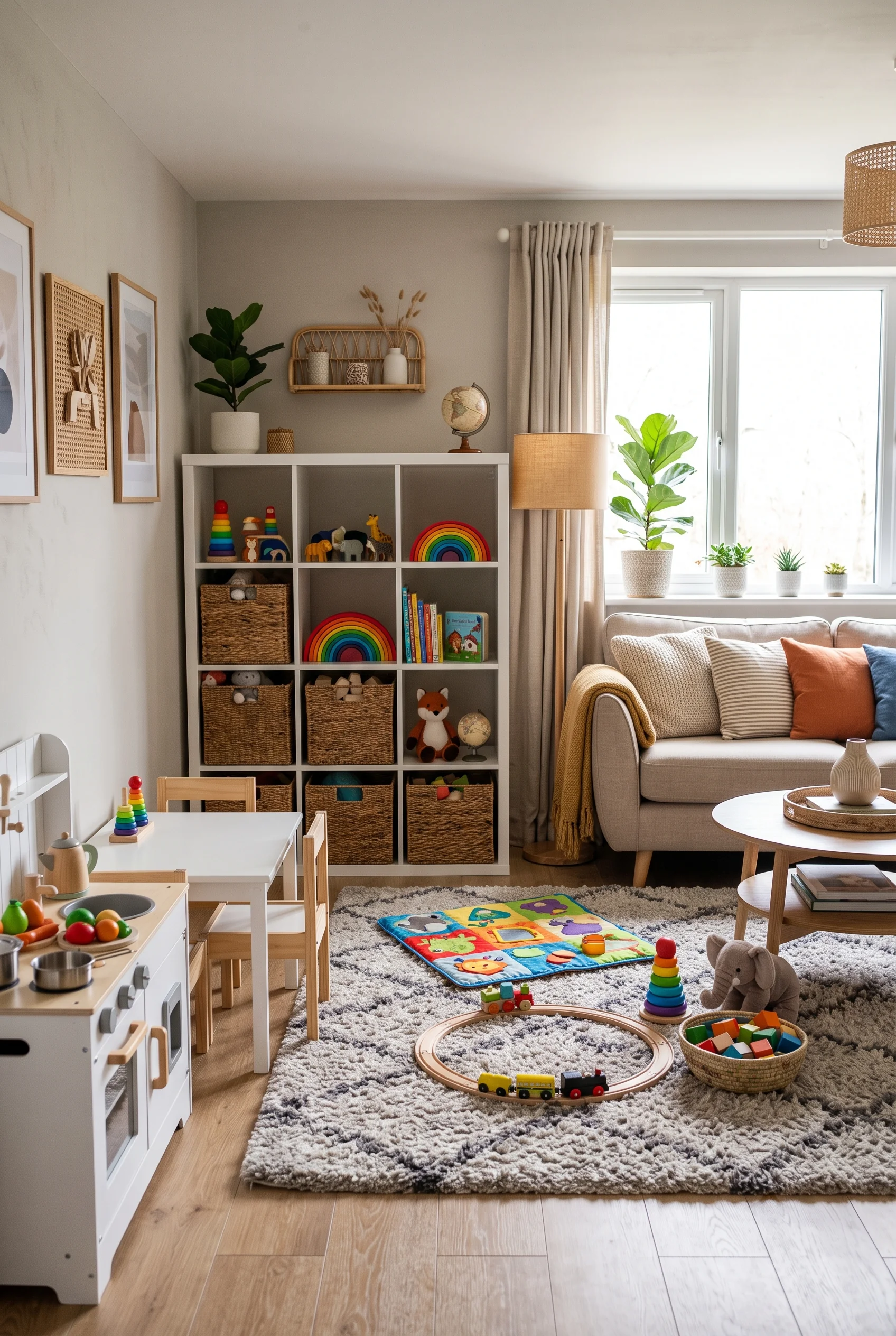
The walls, floor, and furniture in this corner all sit somewhere between beige and gray, and that restraint is exactly what makes the rainbow stacker and stack of colorful picture books pop the way they do. Nothing has to shout when the background stays this quiet.
A play kitchen and a wooden train loop add texture without adding more color, and the sofa’s mixed throw pillows echo the same orange and mustard tones as the nearby toys. The effect feels coordinated rather than color-matched, which is a harder trick than it looks.
A Playroom in Disguise
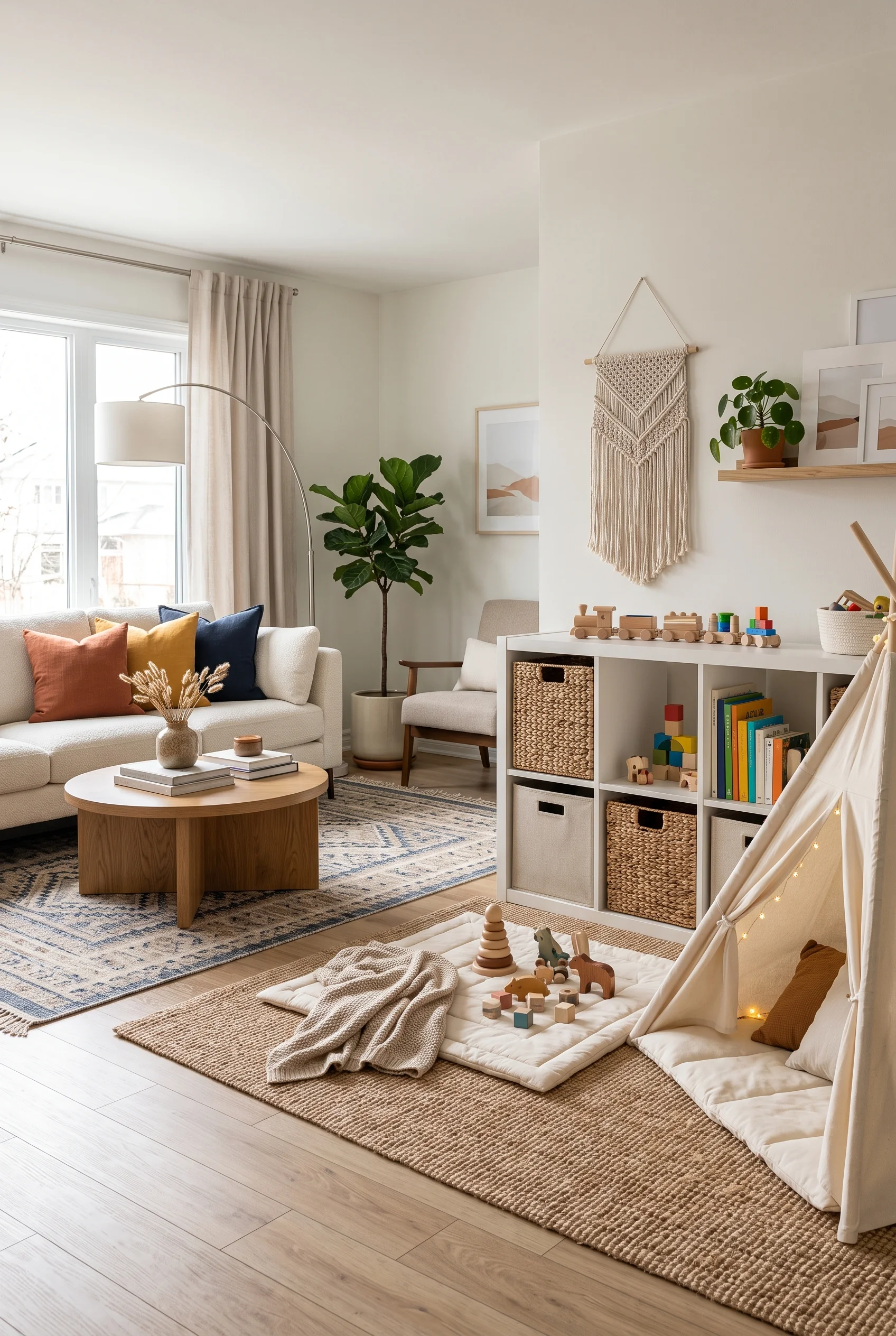
Walk into this room without knowing better, and the play corner might not even register as one. A jewel-toned pillow arrangement on the boucle sectional could belong in any adult living room, and the storage bench along the wall looks more like a media console than a toy chest.
The teepee tucked beside it is the only real giveaway, and even that reads as a cozy nook rather than a kid’s tent thanks to the string lights and neutral canvas. A macrame hanging above ties the whole corner back to the room’s grown-up styling.
The Kind of Calm You Can Actually Maintain
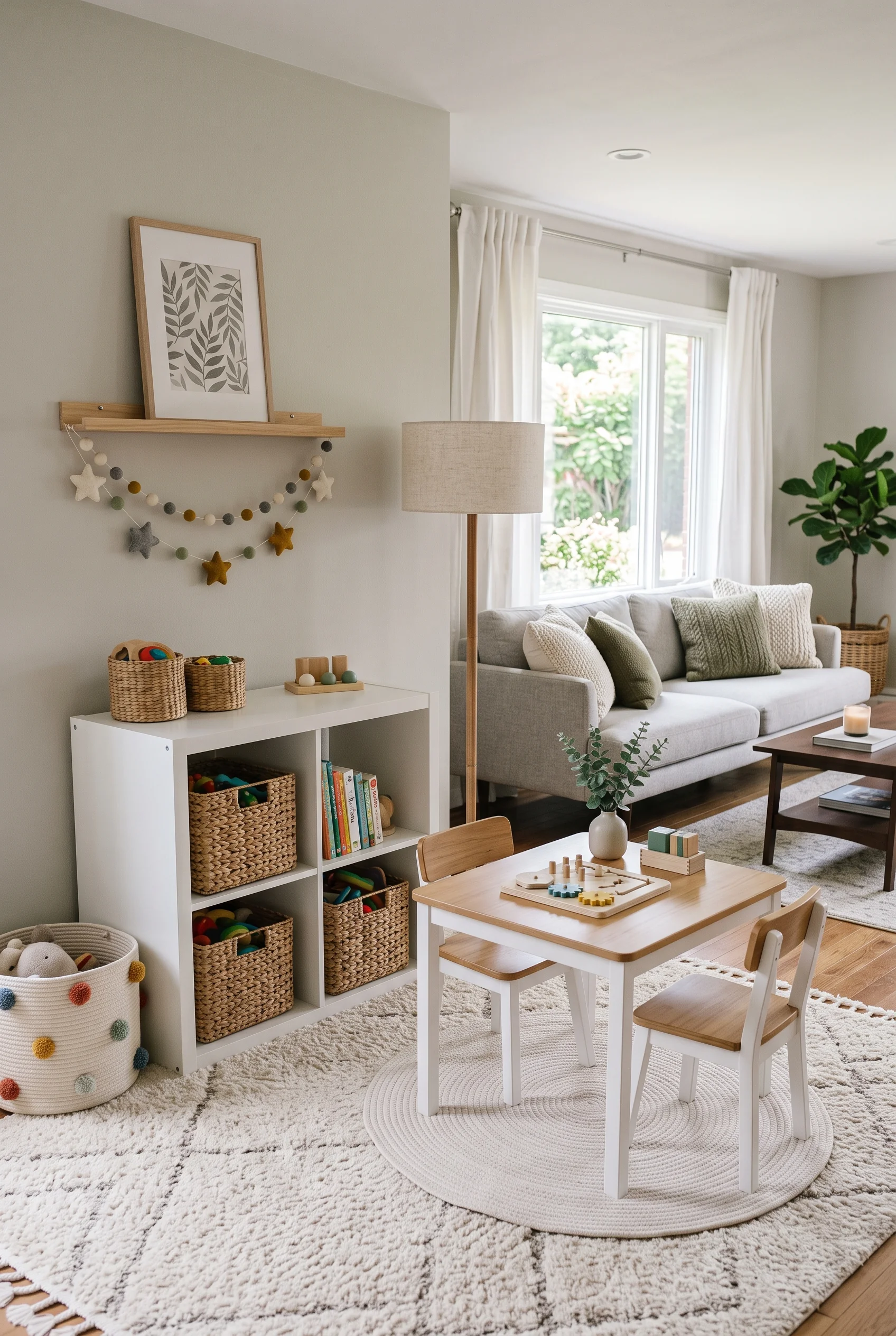
Nothing in this corner is trying too hard, and that’s what makes it easy to keep looking this way. A soft felt garland is the only decoration on the wall, the storage cubbies are simple and half-empty on purpose, and the small table and chair set is sized so nothing towers over the room.
Sage green walls do a lot of the calming work without any special effort day to day. This is a play corner built around not needing constant maintenance, and it shows in how little sits out on the floor.
Wall Art That Skips the Cartoon Cliché
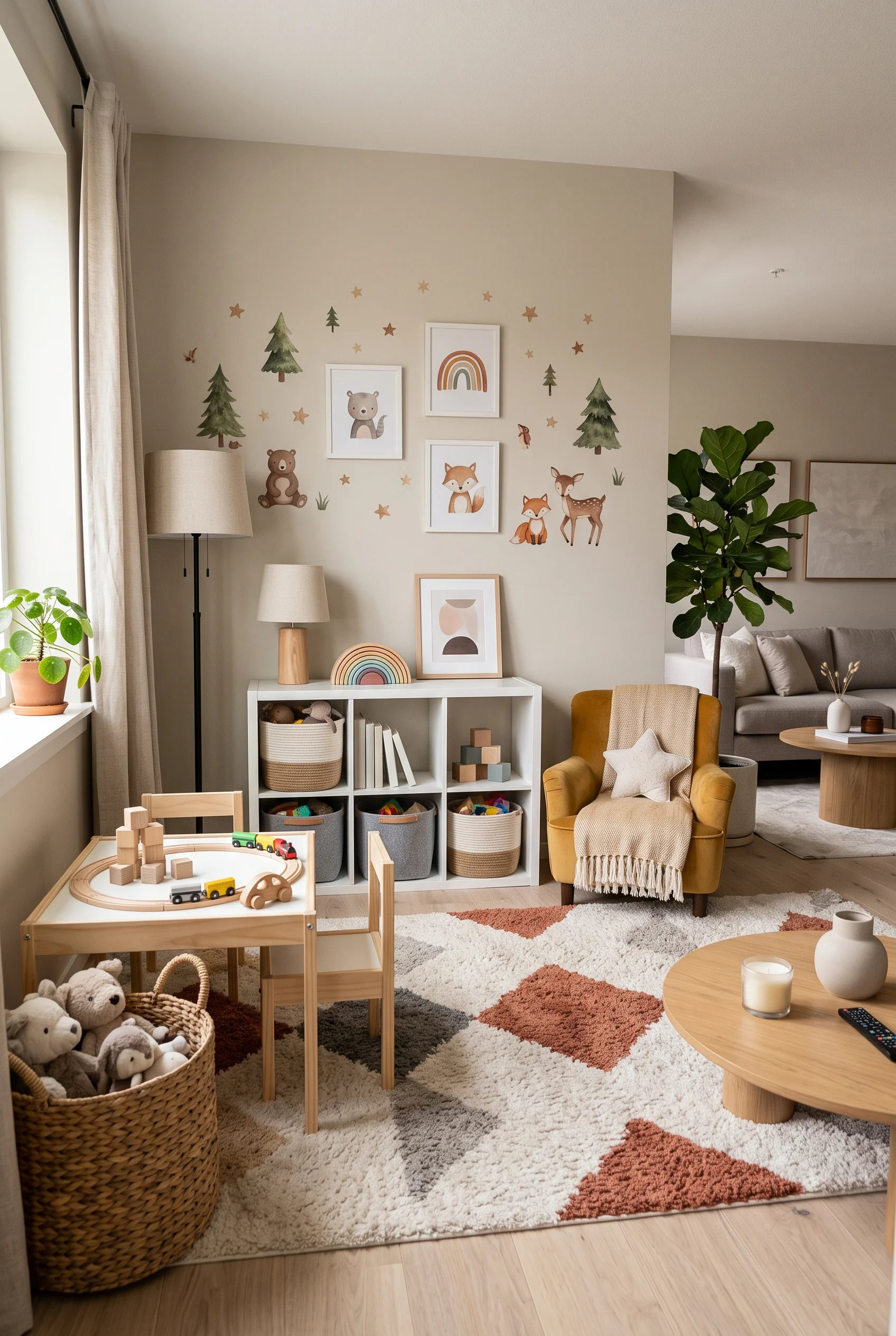
Woodland decals climb the wall here alongside grown-up abstract prints in matching wood frames, and the mix is what keeps it from feeling like a nursery that never got updated. A fox and a spotted fawn sit right next to a framed shape study, and somehow neither undercuts the other.
A mustard velvet chair with a felt star pillow adds one more layer of texture without adding more visual noise. Kid-friendly art doesn’t need cartoon characters to feel playful, just enough restraint to let the sweetness read as intentional.
A Lamp Shaped Like a Hedgehog, and Other Good Decisions
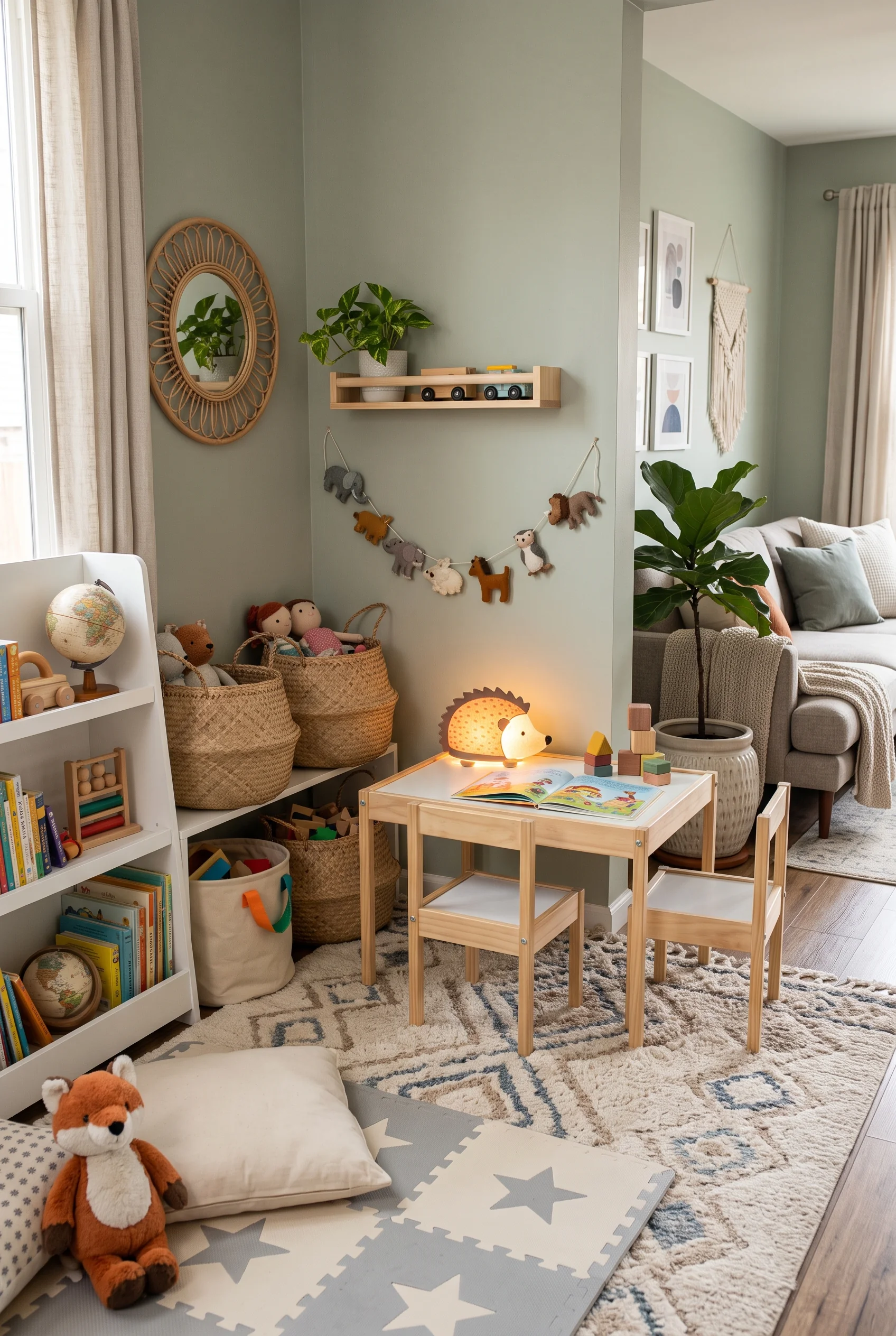
A glowing hedgehog lamp could easily tip a room into twee territory, but here it just adds warmth to a reading-and-blocks table tucked into a quiet corner. The soft light makes the whole nook feel like it’s meant for evening wind-down, not just daytime chaos.
A rattan mirror and a felted animal garland keep the styling gentle rather than novelty-driven. Good lighting in a play corner does more than help kids see their puzzle pieces; it sets the mood for the last twenty minutes before bedtime, and this one gets that balance right.
Where Independent Play Actually Takes Root
A living room play corner works hardest when a child can use it without asking for help every five minutes. That’s the thread running through this group: low shelving, natural materials, and toys pulled out of their packaging and left in plain, reachable view. Reading, building, and quiet solo play all get their own moment here.
Everything Within a Toddler’s Reach
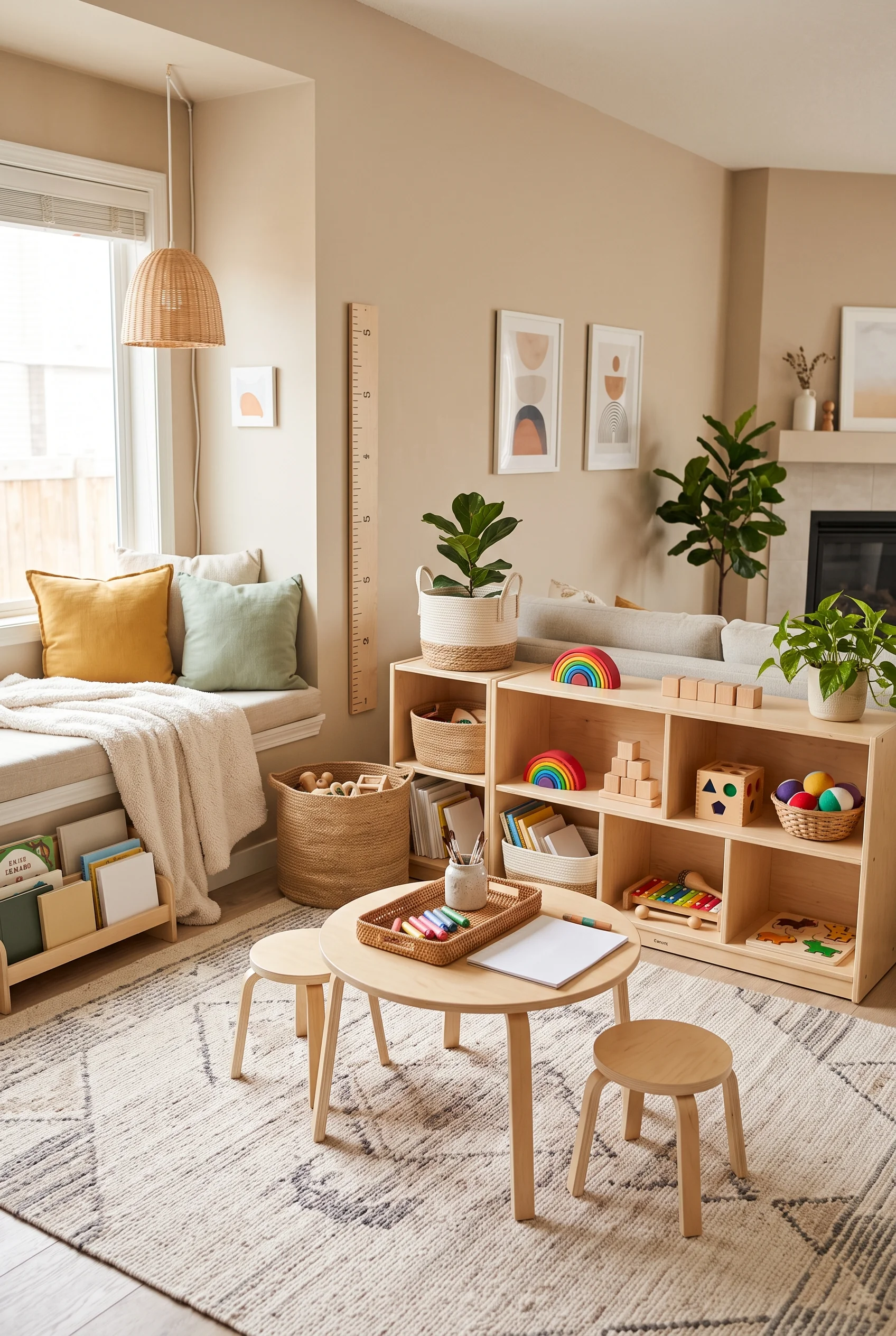
Every shelf in this corner sits low enough for a toddler to reach without climbing, and every toy stays visible rather than buried in a bin, which is the whole idea behind a Montessori-style playroom layout adapted to a shared living space. A rainbow stacker and a set of wooden blocks sit exactly where small hands can find them.
A round table with three low stools gives kids a workspace scaled to their size, rather than a leftover coffee table. A wooden growth chart on the wall doubles as decor and as a running record of how much taller they’ve gotten since the shelf was first hung.
The Room That Borrows From the Backyard
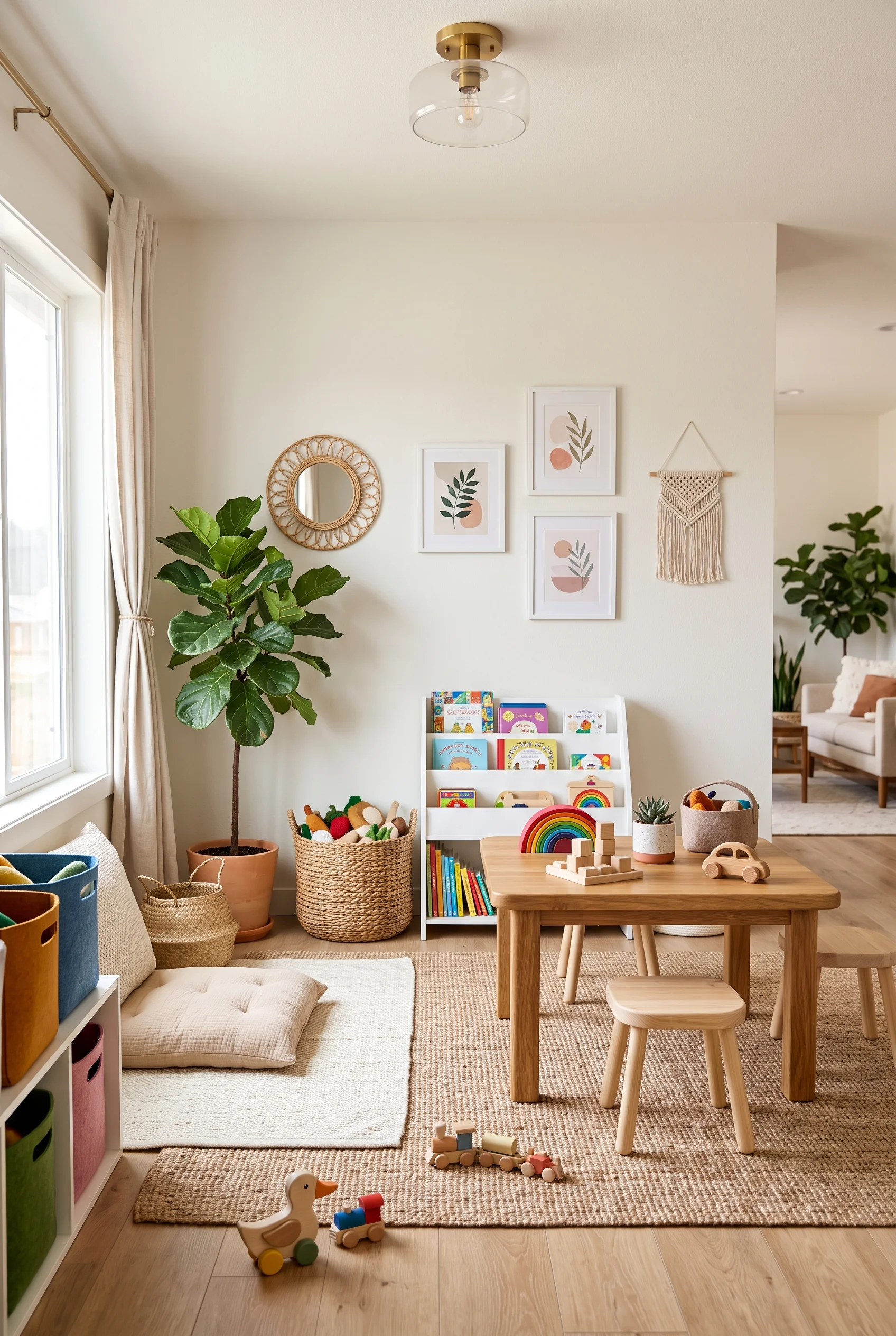
A fiddle leaf fig and a trailing plant on the shelf above do more to soften this corner than any soft good could. Woven baskets and a rattan mirror pick up the same natural texture, so the room feels grounded even with a rainbow of wooden toys sitting right in the middle.
A floor cushion by the window turns an unused patch of sunlight into actual seating. Wooden toys and woven storage share the same warm, unfinished quality as the plants nearby, which is why nothing here reads as plastic even when some of it technically is.
Designed So No One Has to Ask for Help
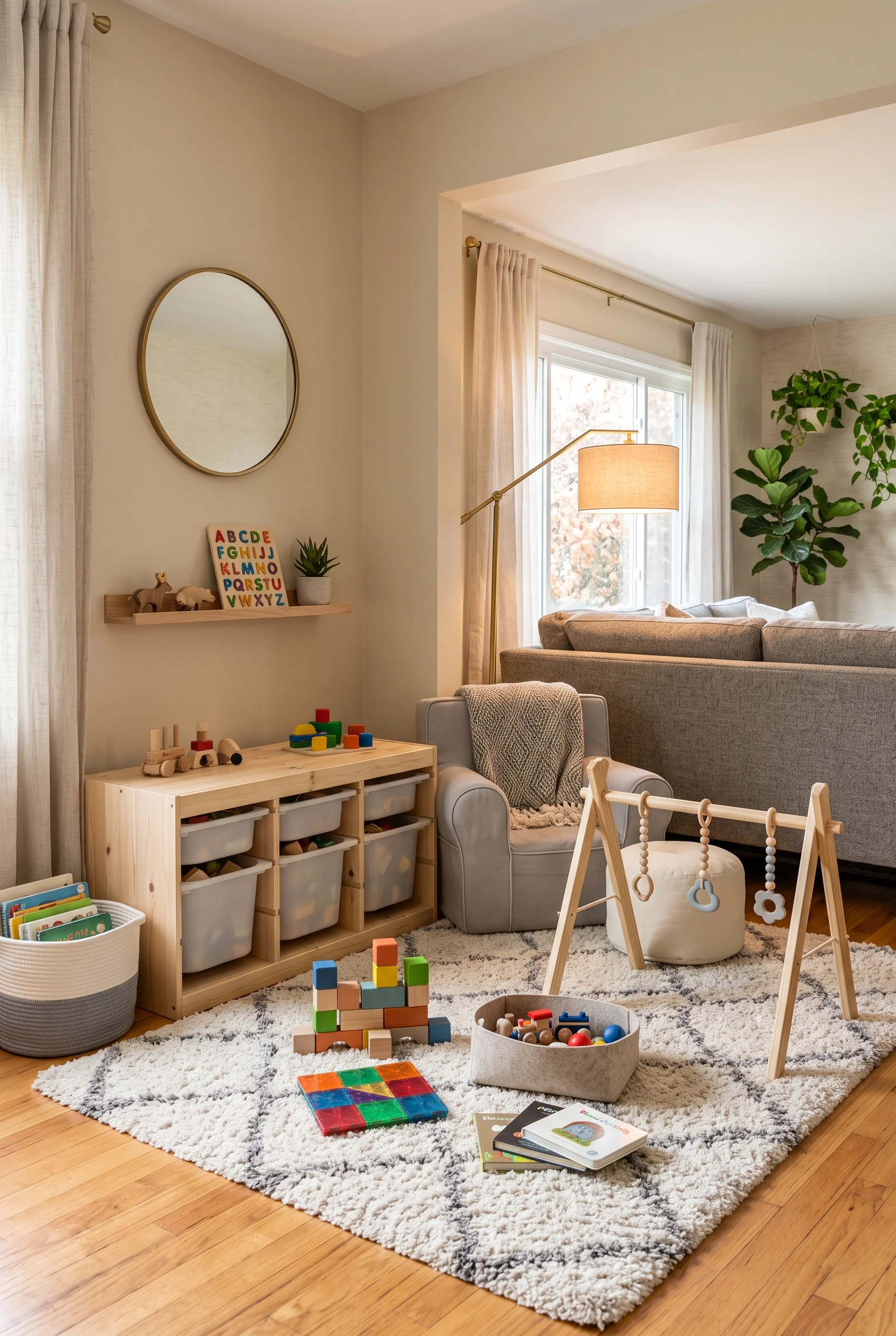
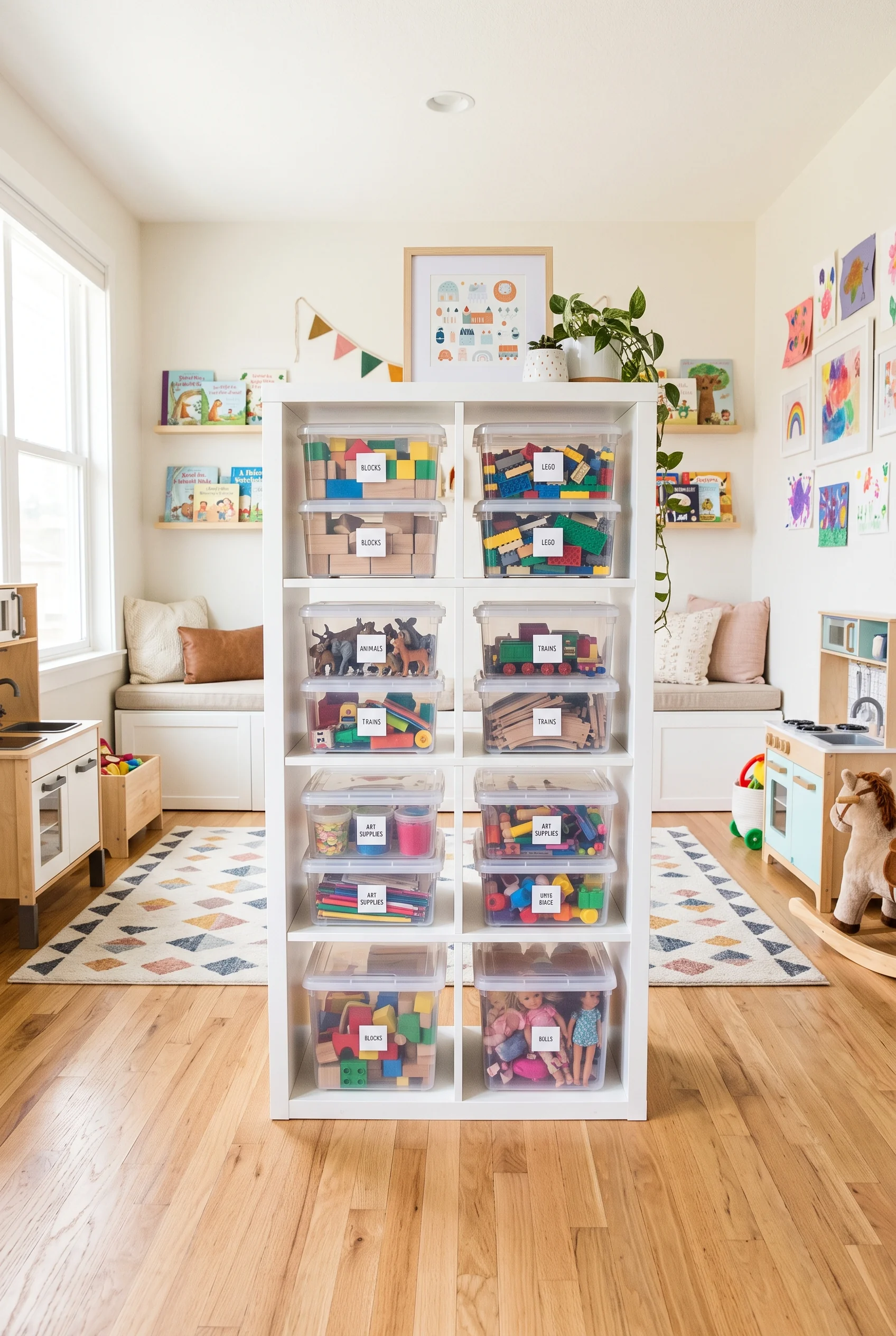
Clear bins are doing more work here than they get credit for. A child can see exactly what’s inside each one without opening every container first, which turns getting a toy into a task they can actually finish alone.
A low wooden play arch nearby gives even younger siblings something to reach for without adult supervision hovering over every attempt. The rest of the room, a tufted chair, a soft pouf, stays deliberately out of the way, letting the open shelving be the one thing in the corner that’s actually built for a child to use solo.
Lessons Disguised as Toys
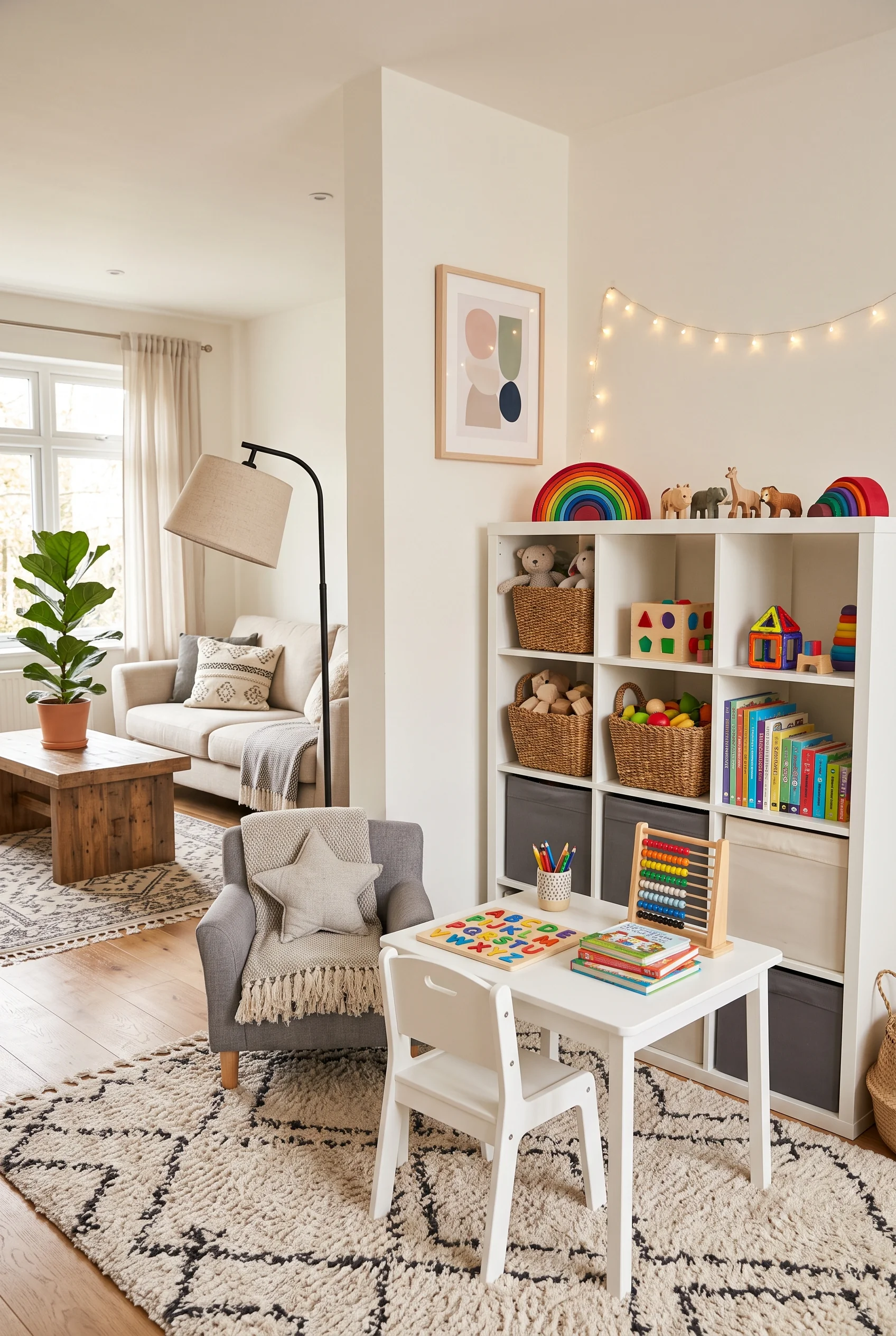
A xylophone, an abacus, and an alphabet puzzle all sit out on the table here, and not one of them looks like a flashcard in disguise. That’s the trick to blending learning and play in a shared living room: let the materials look like toys first and lessons second.
A soft bear and bunny watch over the setup from the shelf above, keeping the whole corner feeling like play rather than a home classroom. The small white table stays clear enough for one activity at a time, which matters more for actual use than for looks.
Shop this pick: White Kids Table and Chair Set, It anchors the learning-and-play stretch and is the most recognizable, easiest-to-source piece in the photo.
The Small Habits That Keep It Running
A play corner only stays useful if it survives daily life, not just the photo taken the day it was styled. This last group covers the unglamorous side of the equation: safety, budget, and seasonal refreshes. Handmade touches and the small daily habits that keep a shared living room from sliding back into chaos by Wednesday round out the list.
A Garland You Could Make on a Sunday Afternoon
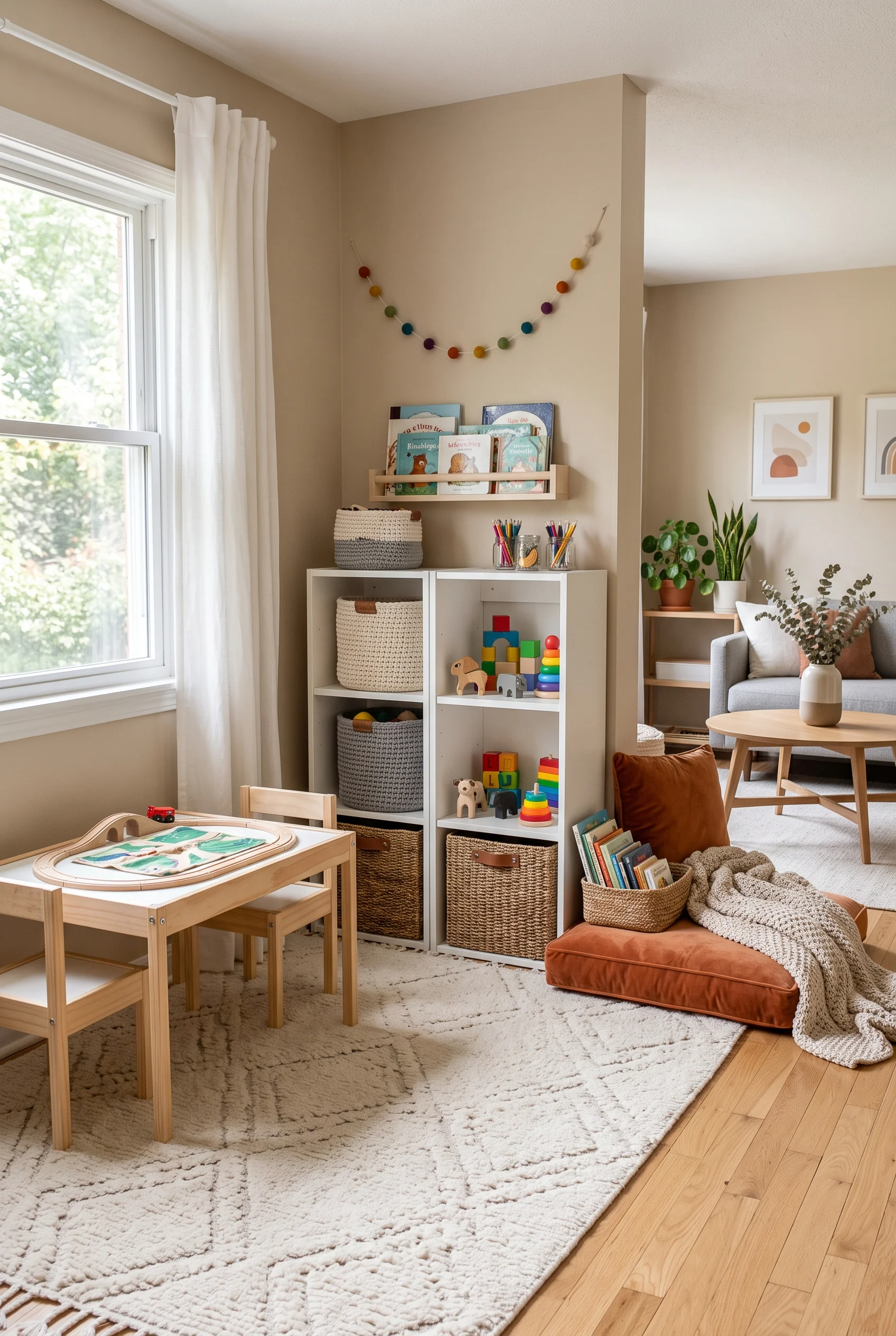
A felt ball garland strung across the wall took an afternoon and almost no money, and it does more for this corner than a framed print would have. Simple, handmade touches like this one give a play corner personality without adding another thing to dust.
Nearby, mason jars hold colored pencils instead of a plastic caddy, and a floor cushion with a basket of books forms a tiny reading nook in the leftover space. None of it required a trip to a specialty store, just a willingness to repurpose what was already sitting in a kitchen drawer.
The Best Art on This Wall Cost Nothing
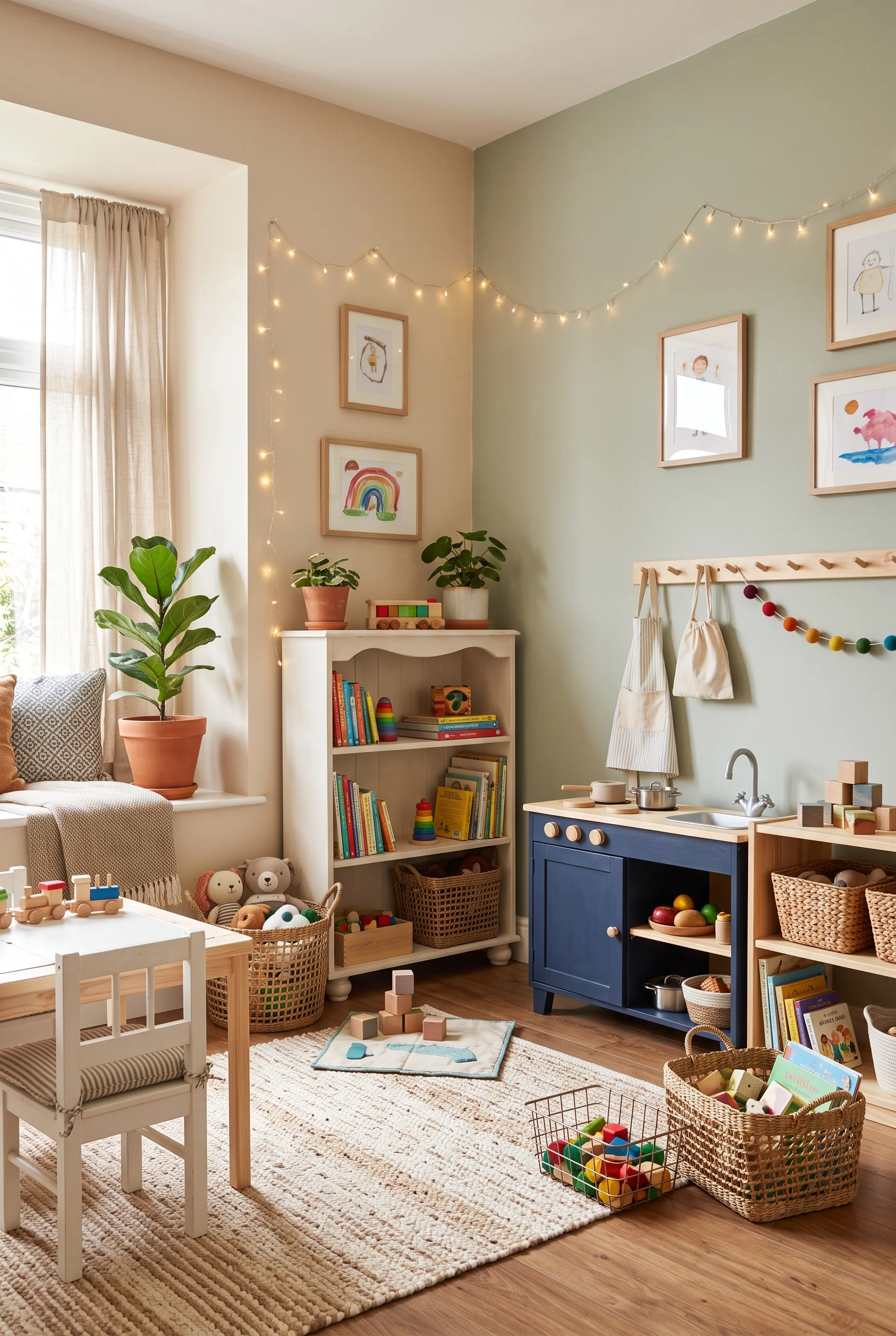
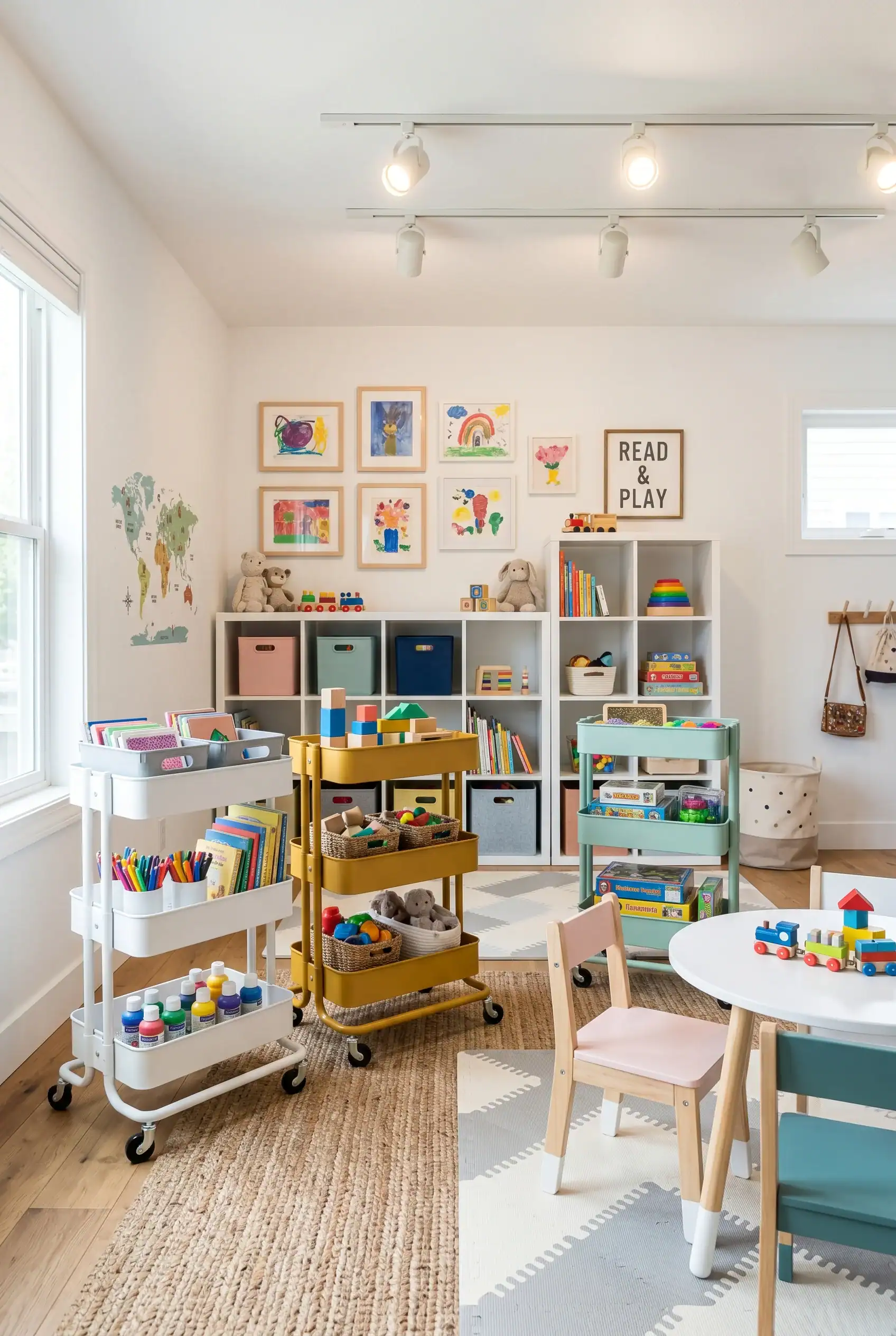
The framed pieces on this wall are a child’s own drawings, a crayon rainbow and a scribbled animal, matted and hung with the same care as store-bought prints. It’s the cheapest, most personal art a play corner can have, and it changes every few months for free.
A secondhand kitchen playset got a coat of navy paint instead of a full replacement, and string lights strung along the ceiling cost less than a single wall sconce would have. Budget-friendly, in this corner, doesn’t look like a compromise. It looks like better taste.
Soft Edges, Anchored Shelves, Zero Second-Guessing
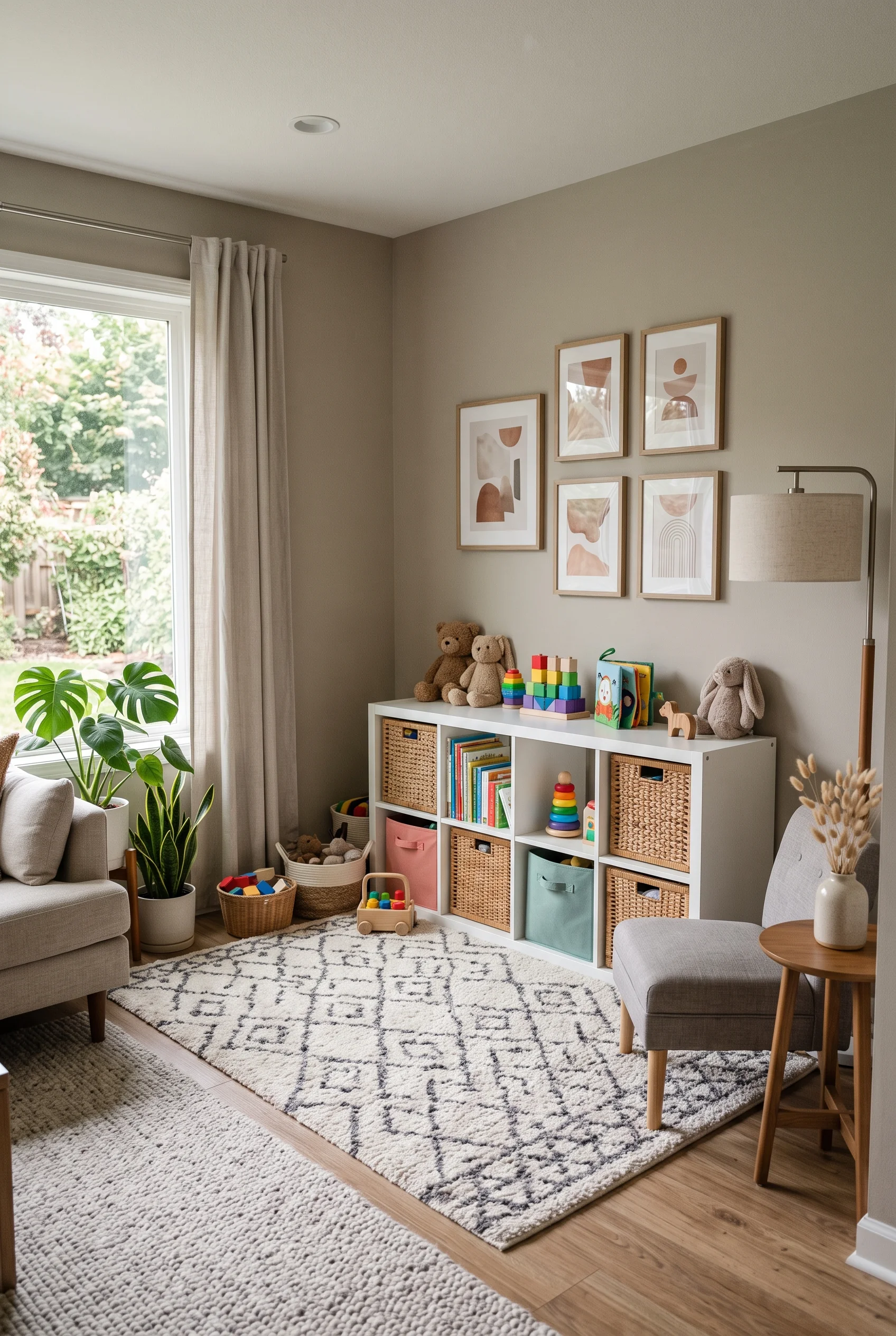
The open shelving unit here is anchored flush to the wall, and every seat in the corner- the tufted chair, the floor pouf- has no hard corners to catch a fall against. None of it looks like a childproofing checklist.
A wooden play arch replaces anything with a motor or a cord, and the round mirror above has a soft rope frame instead of exposed glass edges. Safety here reads as a style decision, soft textures and rounded silhouettes throughout, rather than a set of rules bolted onto a finished room.
A Few Acorns Change Everything
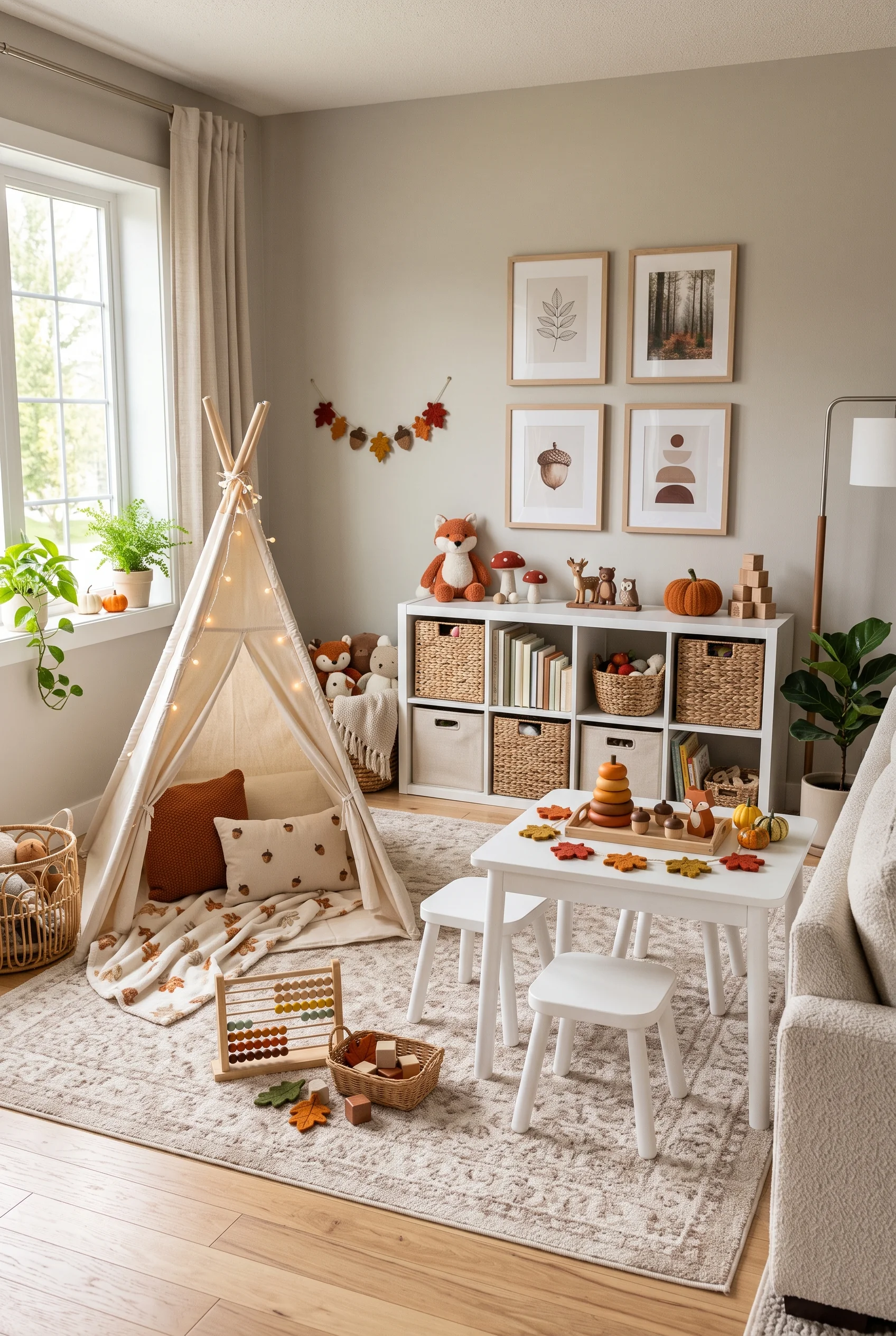
Nothing structural changed in this corner for fall, just a felt leaf garland, a few mini pumpkins, and a stuffed fox that wasn’t there in summer. The teepee, the shelving, the table all stayed exactly where they were.
That’s the real lesson in seasonal decorating for a play space: swap the small, inexpensive layer on top and let the furniture underneath do its job year-round. A rotation of framed nature prints on the wall means the art can shift with the season too, without anyone repainting a thing.
The Five-Minute Reset That Actually Works
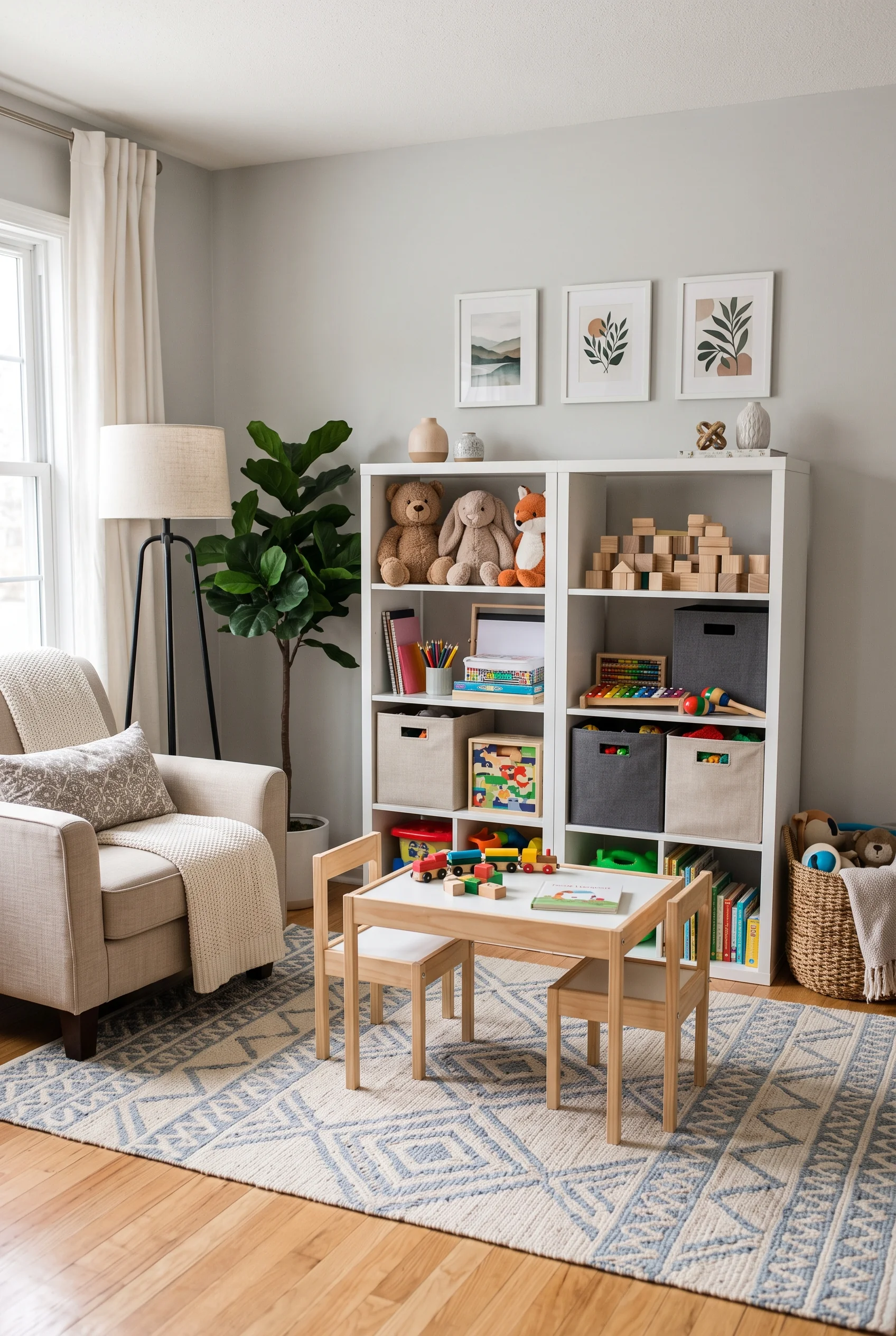
Every toy in this corner has exactly one home, which is the entire secret to a five-minute cleanup instead of a twenty-minute one. Wood blocks stack back into their basket, the plush animals return to the same shelf, and the train set has its own small footprint on the table.
A patterned rug hides the inevitable crumb or stray crayon mark between vacuum days, buying a little grace when the reset doesn’t happen. A few playroom organization habits borrowed from a dedicated playroom translate just as well to a shared corner like this one, and rotating what’s out on the shelf keeps the whole space feeling new without buying anything.
One Corner Beats the Whole List
Twenty-five rooms is a lot to look at in one sitting, and that’s exactly the point. No single living room needs every rug, every shelf, and every teepee shown here. It needs one or two ideas that actually fit the walls, the budget, and the kid currently living in the house.
If there’s a common thread through every one of these living room play corner ideas, it’s that the best versions never look like a separate project bolted onto the room. They borrow the same materials, the same restraint, and often the same color story as everything else nearby, so the corner reads as part of the house rather than an exception to it.
Start small. Move one bench, add one basket, swap a single blank wall for a shelf your kids can actually reach. Watch whether it gets used daily before adding the next layer, because a play corner that survives real life matters more than one that photographs well and gets ignored by day three.
The families in this list solved the same problem in twenty-five different ways: an open floor plan, a small square footage, a preference for neutral over bright. None of them needed a spare room to make it work, and neither do you. Pick the version that looks like your actual living room, not someone else’s, and let it earn its keep one afternoon of play at a time.