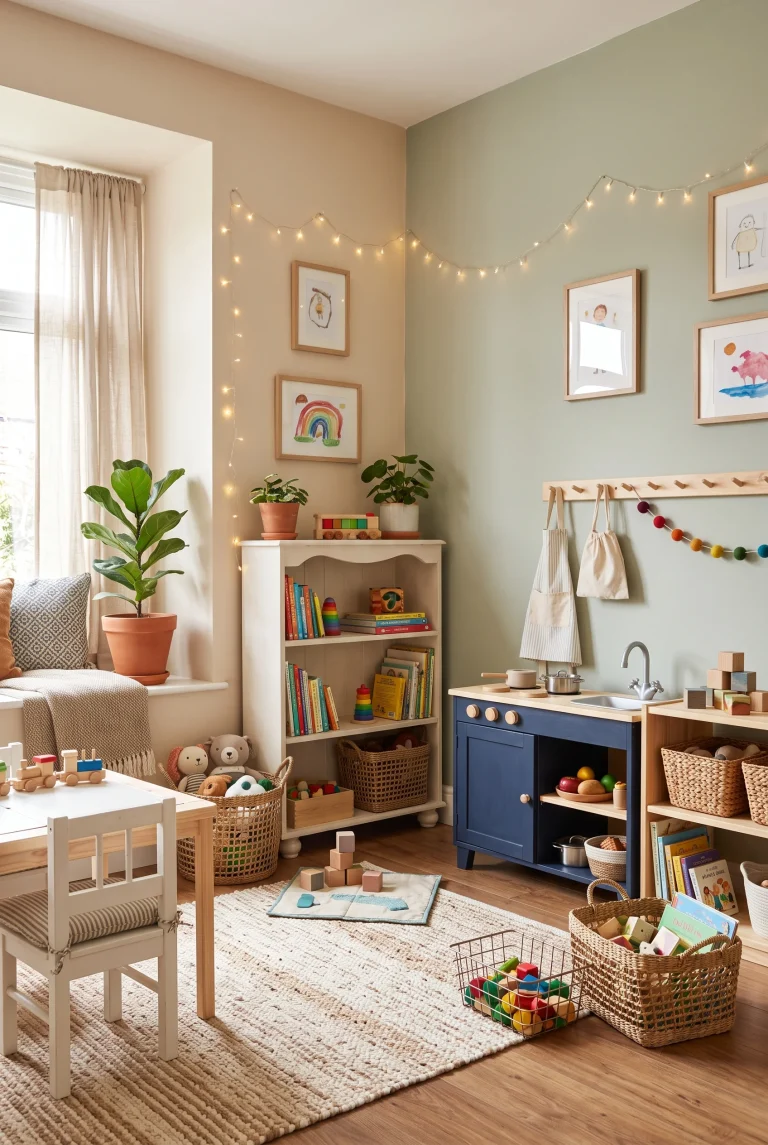
35 Playroom Decor Ideas Both Beautiful and Kid-Friendly
Finding playroom decor ideas that look beautiful in photos and survive actual children can feel like chasing two opposite goals at once. You want a space that blends with the rest of your home, but you also need it to absorb blocks, costumes, and craft supplies without descending into chaos by Tuesday. The good news is that beauty and kid-friendliness are not competing priorities. The most successful playrooms are designed around both from the start.
A well-designed playroom earns its keep every single day. It gives kids a place to spread out, keeps toys from migrating into your living room, and, when it works well, encourages the kind of independent play we explored in our Montessori playroom ideas. None of the rooms below needed a huge budget or a huge footprint, just a handful of smart decisions made on purpose.
In this post you’ll find 35 ideas organized around six themes: storage that hides in plain sight, walls that work hard, and calm palettes. From there we move into activity zones, play features kids adore, and the cozy finishing touches that pull it all together. Many pair beautifully with the pared-back approach from our minimalist kids’ room ideas, and several borrow tricks from our favorite reading nooks for kids. Pick the ones that fit your home and your children, and leave the rest.
A quick note before we dive in: this post contains affiliate links, which means I may earn a small commission if you purchase through them, at no extra cost to you. I only share pieces I’d happily put in my own home.
Storage That Disappears Into the Design
Storage is the difference between a playroom that photographs well once and one that stays lovely all year. The trick is choosing systems that read as decor rather than equipment: shelving that displays as much as it hides, baskets that soften the room, and furniture with a hollow center. When storage looks like it belongs, kids are far more likely to use it, and you stop noticing it altogether.
A Library Wall That Turns Toys Into Decor
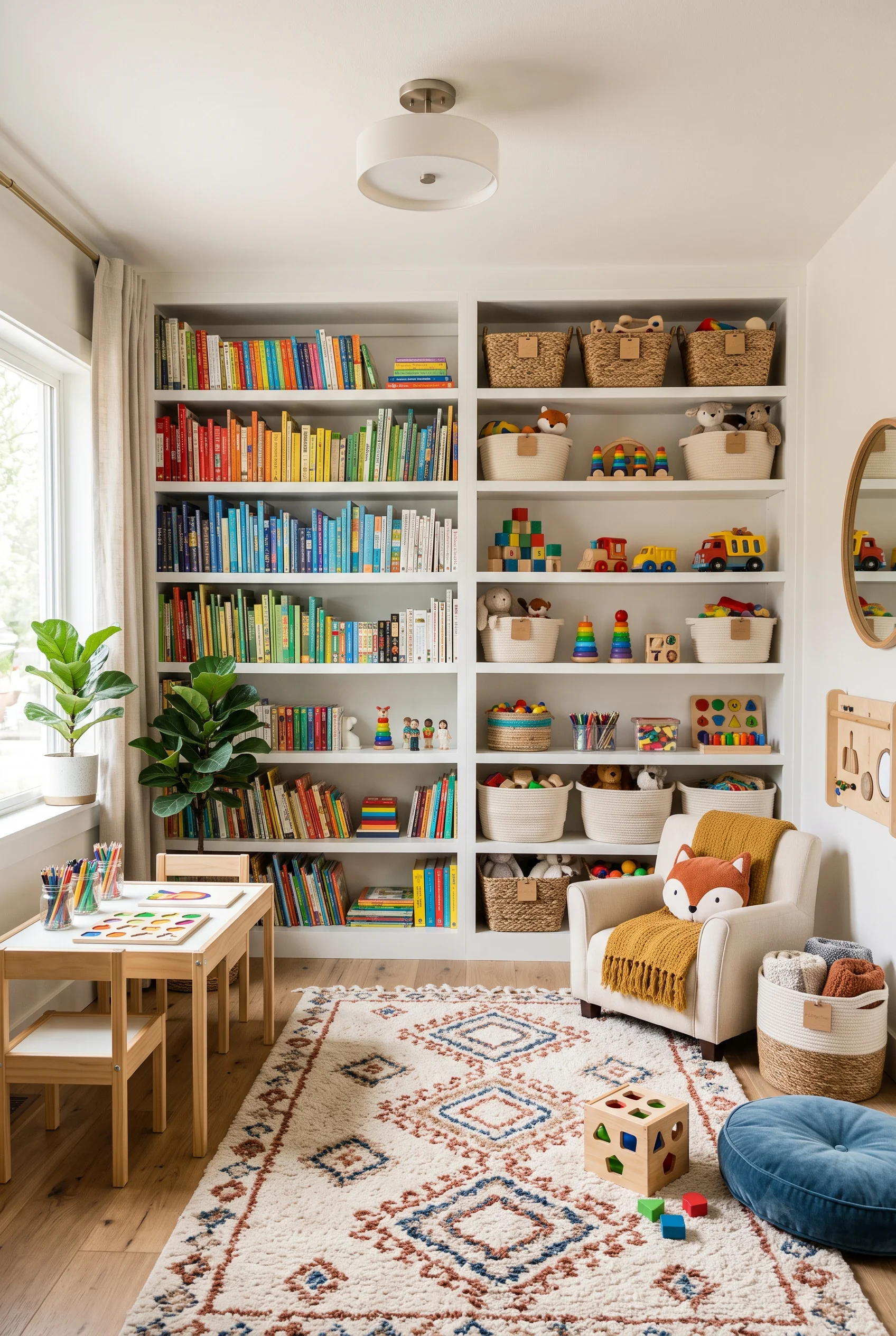
Rainbow-ordered books do half the decorating in this room. Arranged by color across white floor-to-ceiling shelves, they become the artwork, while wooden cars and stacking toys sit between them like little sculptures.
The bottom row tells the practical story. Wicker bins catch everything that doesn’t display well, kept low where small hands can reach and messes can vanish fast. Everything pretty lives at eye level, everything chaotic lives at knee level.
A white modular sofa and a round shag rug keep the seating soft and simple, so the shelf wall stays the undisputed focal point.
The Case for Seeing What’s Inside
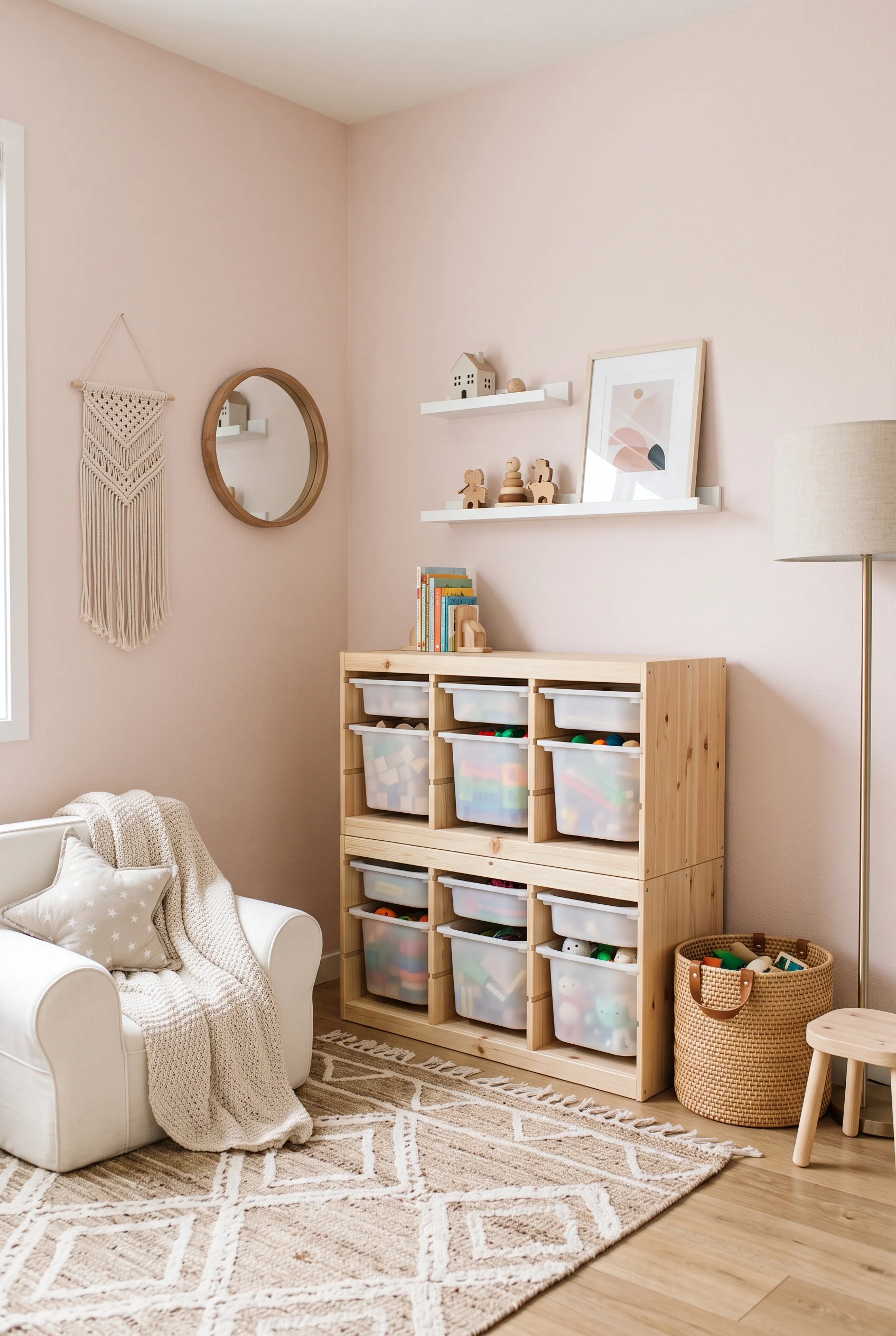
Clear bins end the nightly excavation. When blocks, animals, and stuffed friends are visible through the front of each container, kids can find what they want and, more importantly, see exactly where it goes back.
Stacked on a low white cube unit against soft pastel stripes, the bins feel intentional rather than utilitarian. The striped wall does the decorating so the storage doesn’t have to.
A pom-pom basket of teddies and a little mushroom lamp on the side table warm up what could otherwise read as pure organization.
Less Out, More Played With
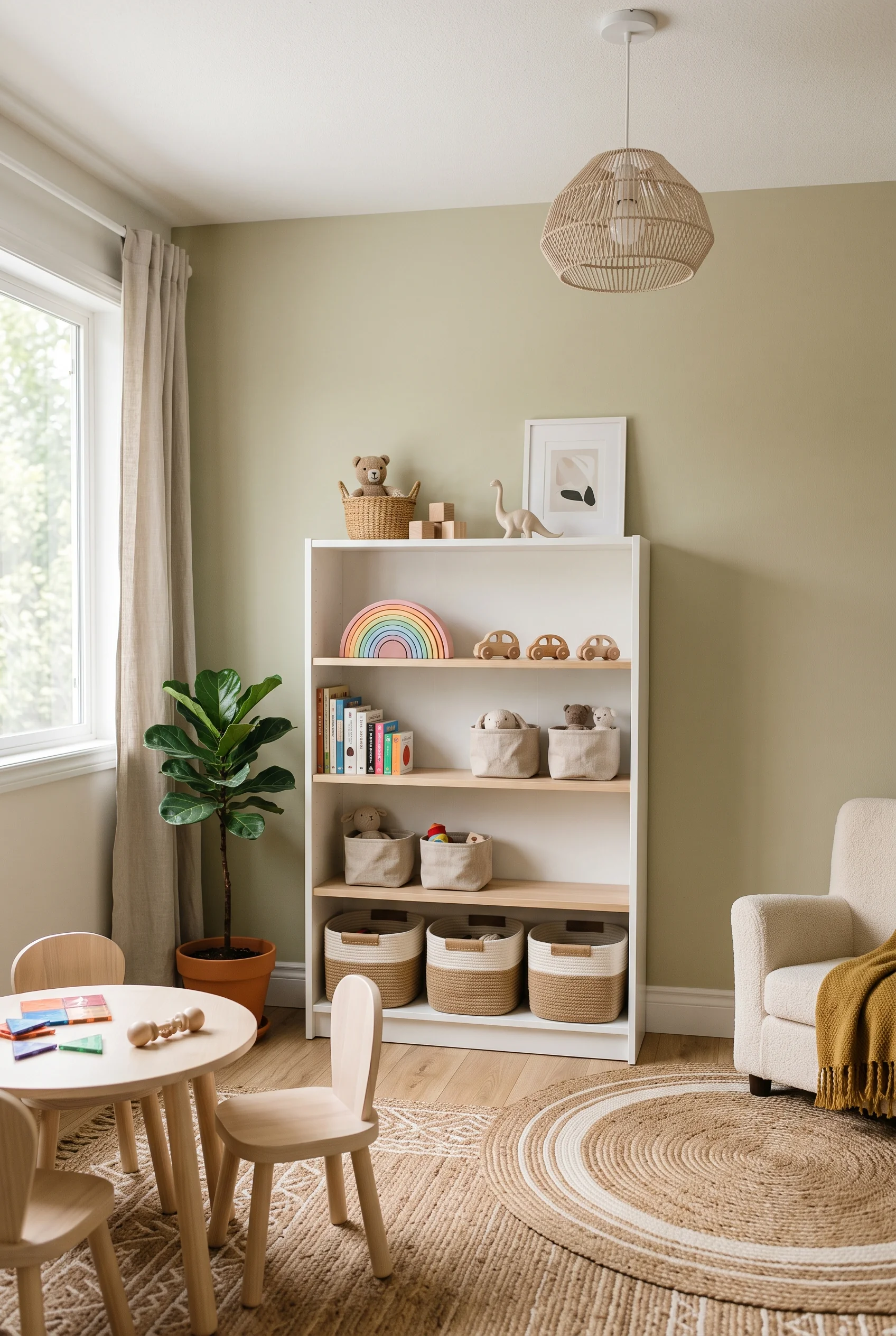
Five woven bins and a handful of wooden toys. That’s the entire visible inventory of this room, and it’s a deliberate choice, not a staging trick.
Toy rotation keeps a small selection in reach while the rest waits its turn elsewhere. Kids play longer and more deeply with fewer options, and cleanup takes minutes because there simply isn’t much to put away.
The macrame hanging and warm taupe walls carry the room visually, so even with almost nothing out, the space feels finished rather than empty.
Furniture With a Secret Second Job
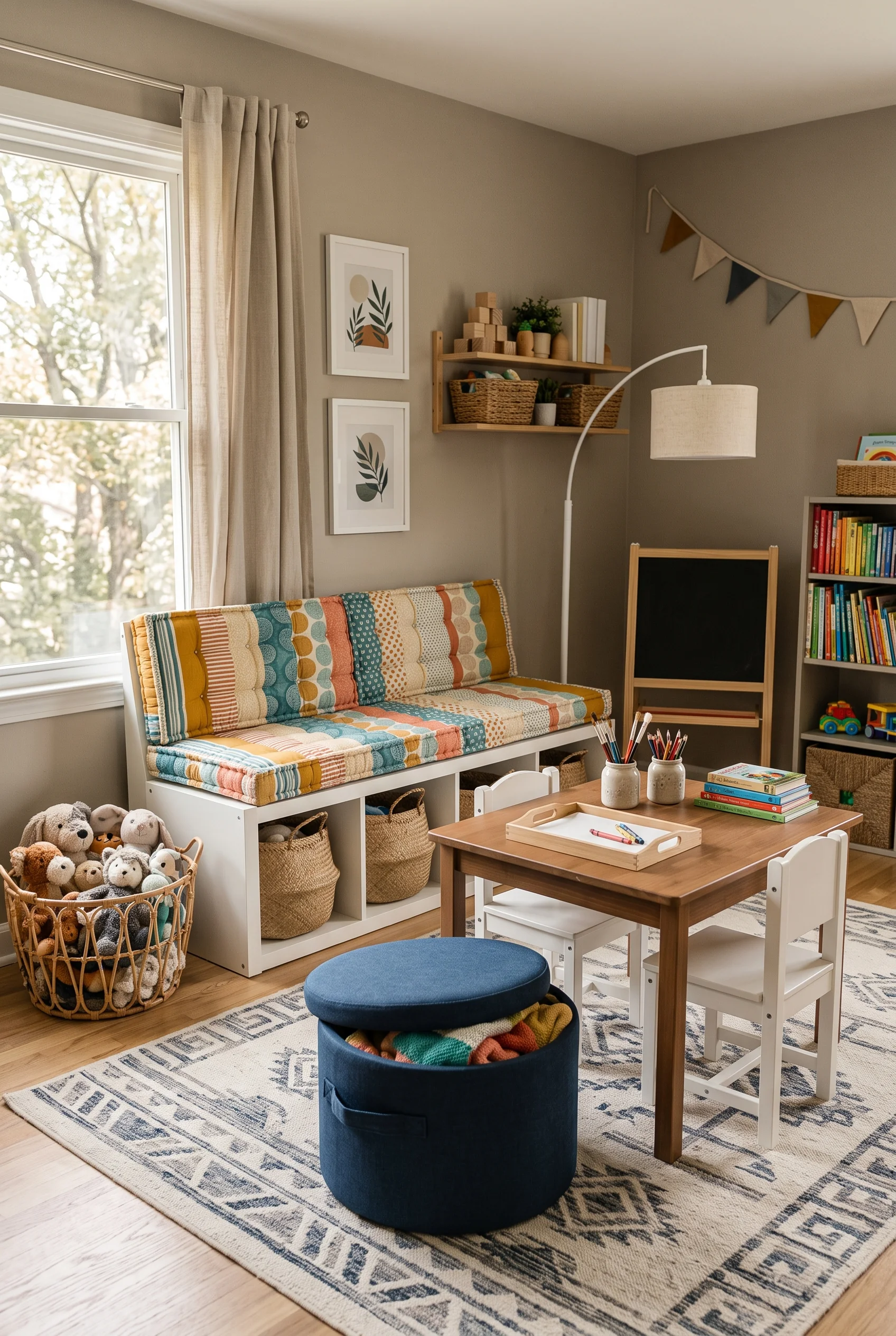
Every seat in this room is hiding something. The window bench holds a fleet of wicker baskets beneath its cushions, the wooden activity table pulls open to reveal a drawer of blankets and toys, and the tufted ottoman lifts its lid on even more.
That’s three layers of storage without a single piece that announces itself as storage. Guests see a cheerful bench piled with mustard and blue pillows. You see a room that can swallow an afternoon’s worth of play in ninety seconds.
Shop this pick: Kids Wooden Activity Table with Storage Drawer, The flip-top activity table is the clear focal piece of the multifunctional furniture image, and storage play tables are a high-price-point item with strong, sustained search demand from parents.
Storage That Reads as Architecture
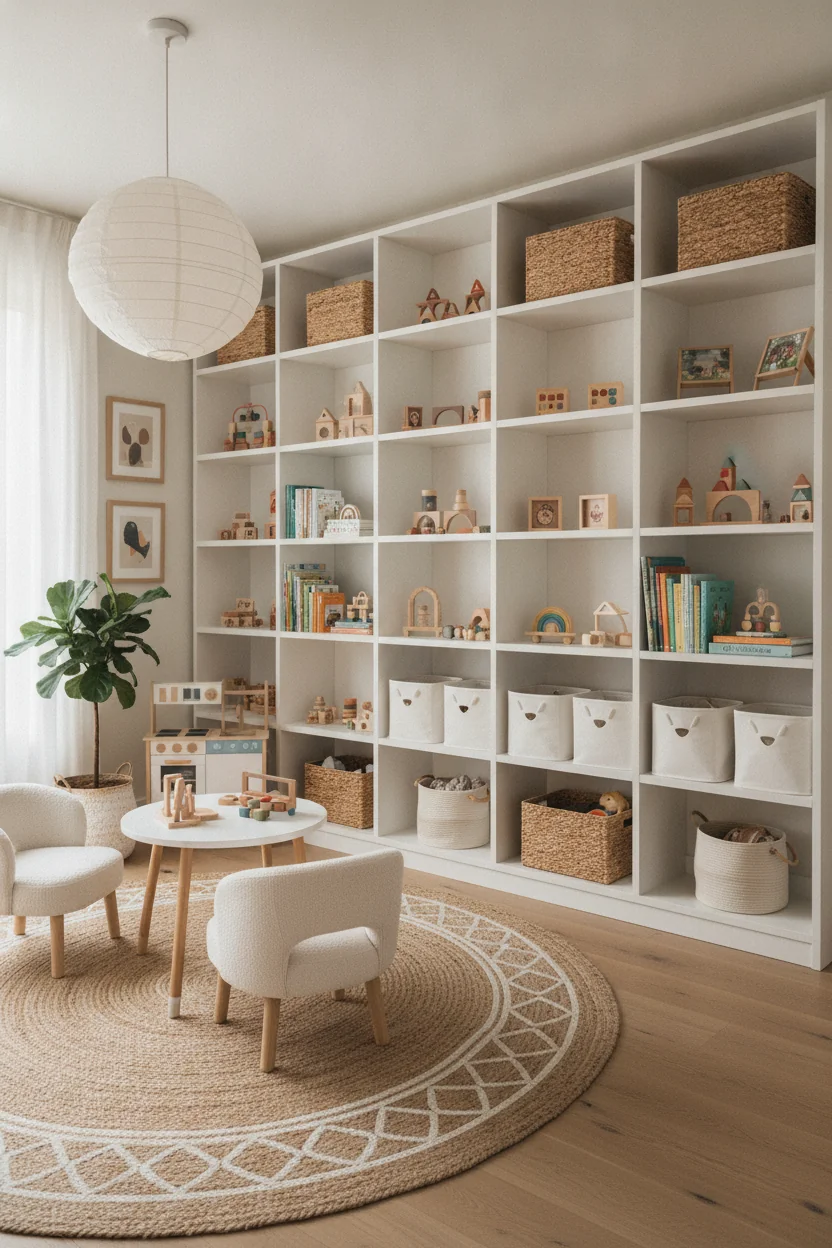
Built-ins change how a playroom feels the moment you walk in. This white grid runs floor to ceiling, and because it’s part of the wall rather than furniture pushed against it, the whole room reads as designed rather than furnished.
Woven baskets anchor the top and bottom rows while books, wooden toys, and a couple of well-loved bears fill the middle at reaching height. The mustard and gray rug picks up the warmth of the baskets so the wall of white never feels cold.
Cleanup Measured in Seconds, Not Battles
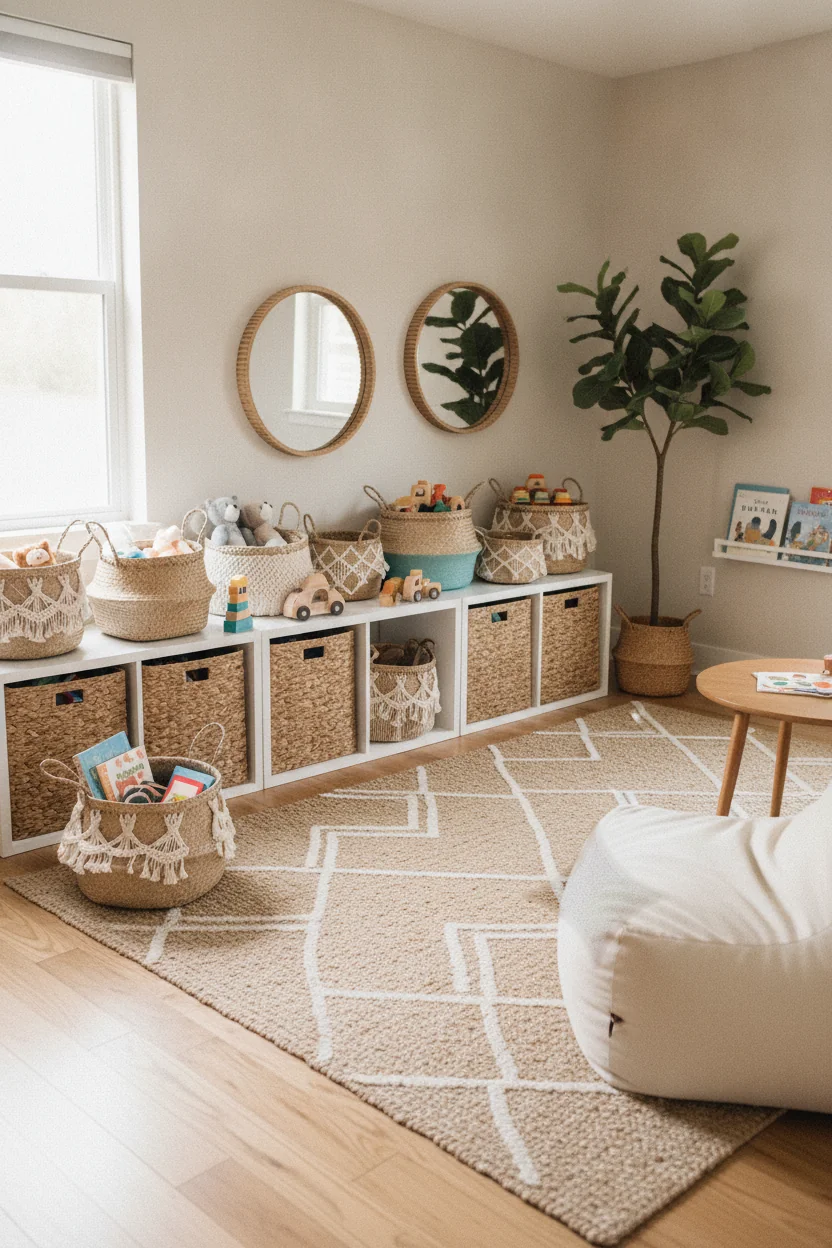
Tidying up goes fastest when nothing needs sorting. Here, a corner of low white shelving holds a fleet of seagrass baskets, one per category, plus a big open basket for stuffed animals that gets filled by the armload.
A three-year-old can run this system alone. Toys sweep into baskets, baskets slide into cubbies, done. No lids to match, no drawers to jam.
The all-natural texture is the bonus. Even fully loaded, the corner looks like a styled vignette instead of a toy dump.
A Rainbow That Doubles as a Sorting System
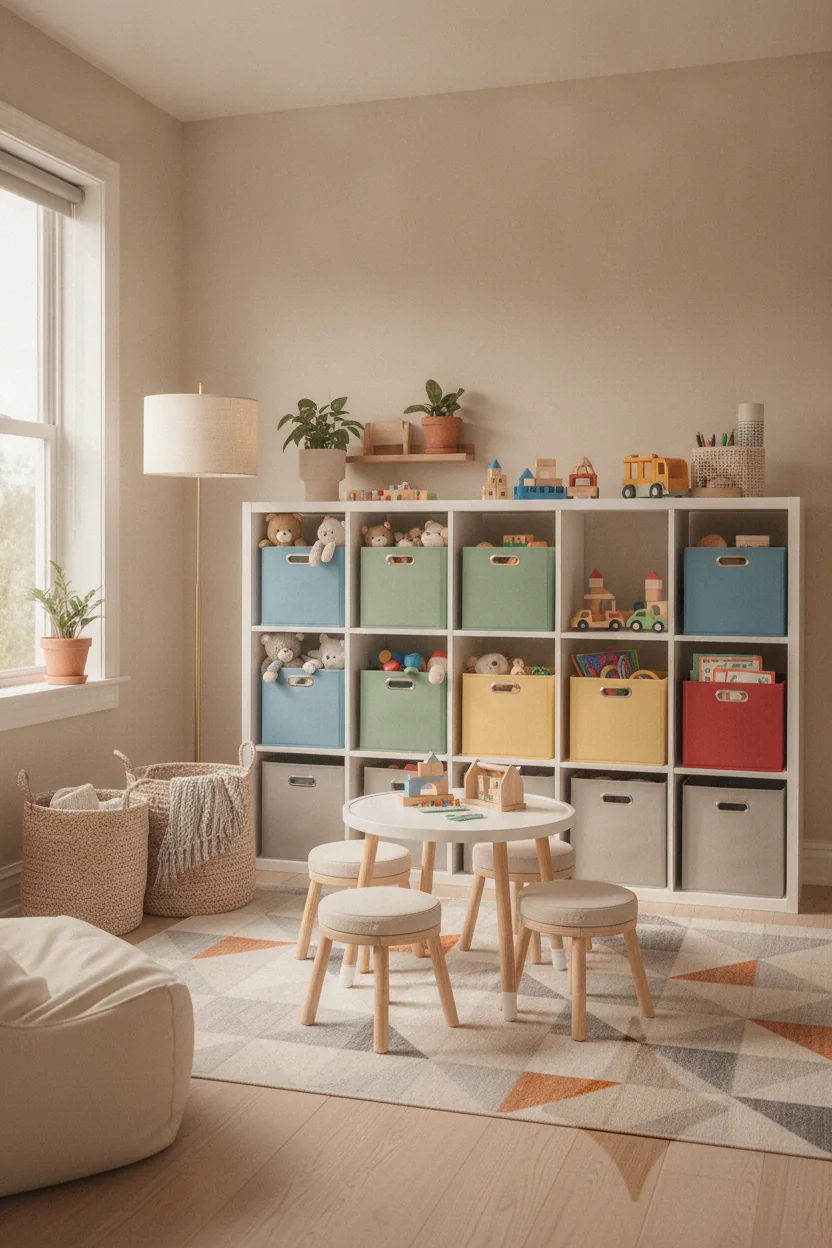
Color-coding turns organization into a game kids actually want to play. Red bins for one toy family, teal for another, purple and yellow for the rest, all lined up across white cube units in a loose rainbow sweep.
Young kids who can’t read labels yet can absolutely match a dinosaur to the green bin. The system teaches sorting without a single lesson, and the bins themselves supply all the color the room needs.
Dinosaurs and plush friends perched along the top keep it playful rather than regimented.
Shop this pick: Cube Storage Organizer with Fabric Bins, The color-coded cube system is the entire idea of this section, and cube organizers with bins are one of the most frequently purchased playroom storage products on Amazon.
Walls That Earn Their Keep
Floor space is precious in a playroom, but the walls usually sit there doing nothing. These five rooms put them to work holding art supplies, hosting chalk masterpieces, and reflecting light into dim corners. One even keeps busy hands occupied all on its own. Vertical thinking is especially valuable in a small playroom design, where every square foot reclaimed from storage is a square foot returned to play.
An Art Supply Wall That Frees Up the Floor
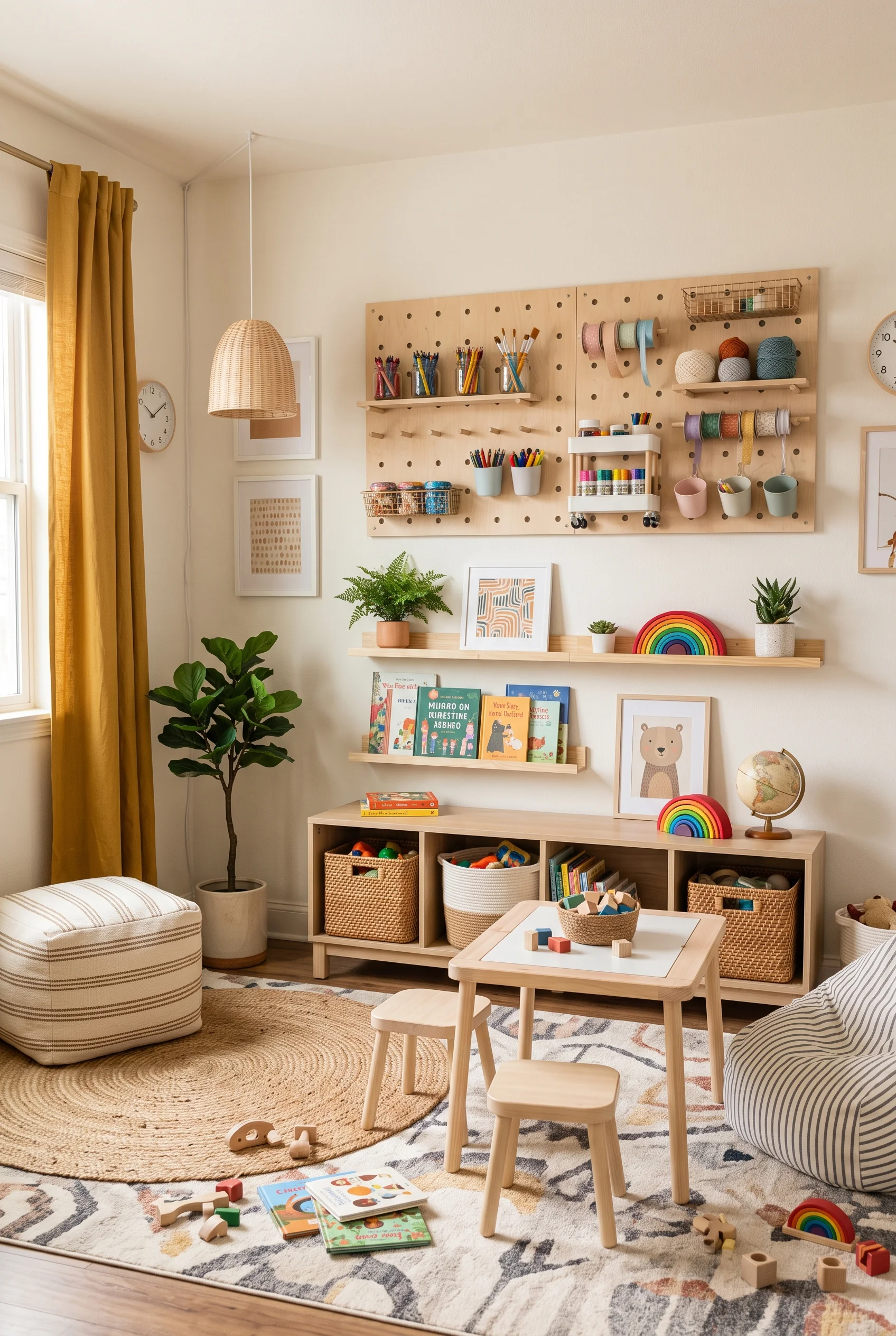
Markers in wire baskets, a roll of paper ready to tear, cups of colored pencils clipped within reach. This wooden pegboard puts the entire craft arsenal on the wall, right above a low storage bench that catches everything else.
Overhead, a wall-mounted cube shelf in teal, mustard, and rust holds the overflow, stacked well out of toddler range. The floor below stays completely open for the little white table where the actual creating happens.
Not one bin sits on the ground, yet nothing is more than a step away.
A Wall They’re Allowed to Draw On
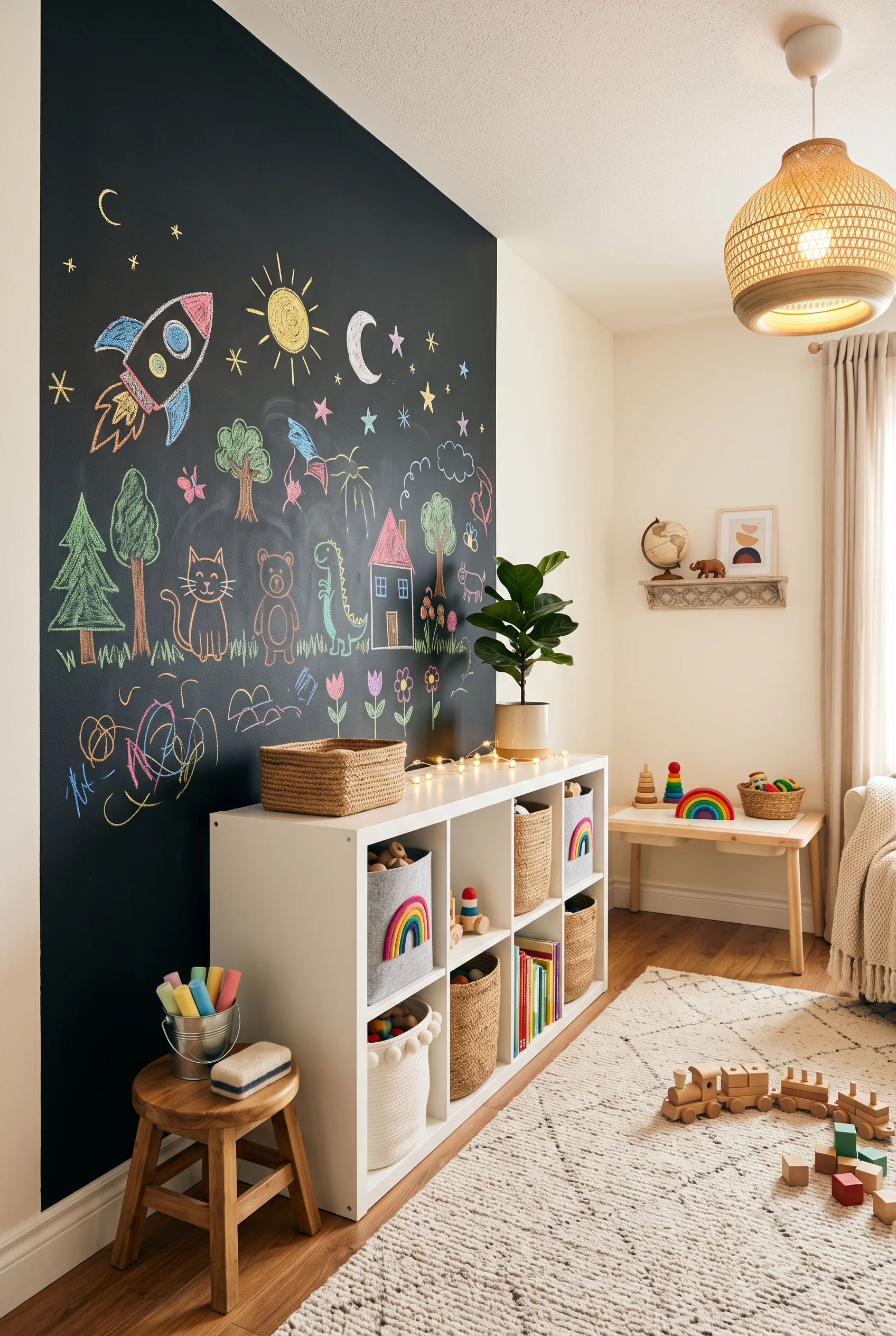
Chalk castles, a blue dinosaur, a forest of triangle trees. This floor-to-ceiling chalkboard wall wears its artwork proudly, and tomorrow it can wear something entirely new.
A copper bucket of chalk sits on the rug like an open invitation, with a camel bean bag and belly baskets pulled close for spectators. The deep charcoal backdrop also does something unexpected for the decor, grounding all the light wood and jute around it.
Few playroom decor ideas deliver this much daily use for the price of a can of paint.
Pegboard Storage That Rearranges Itself as They Grow
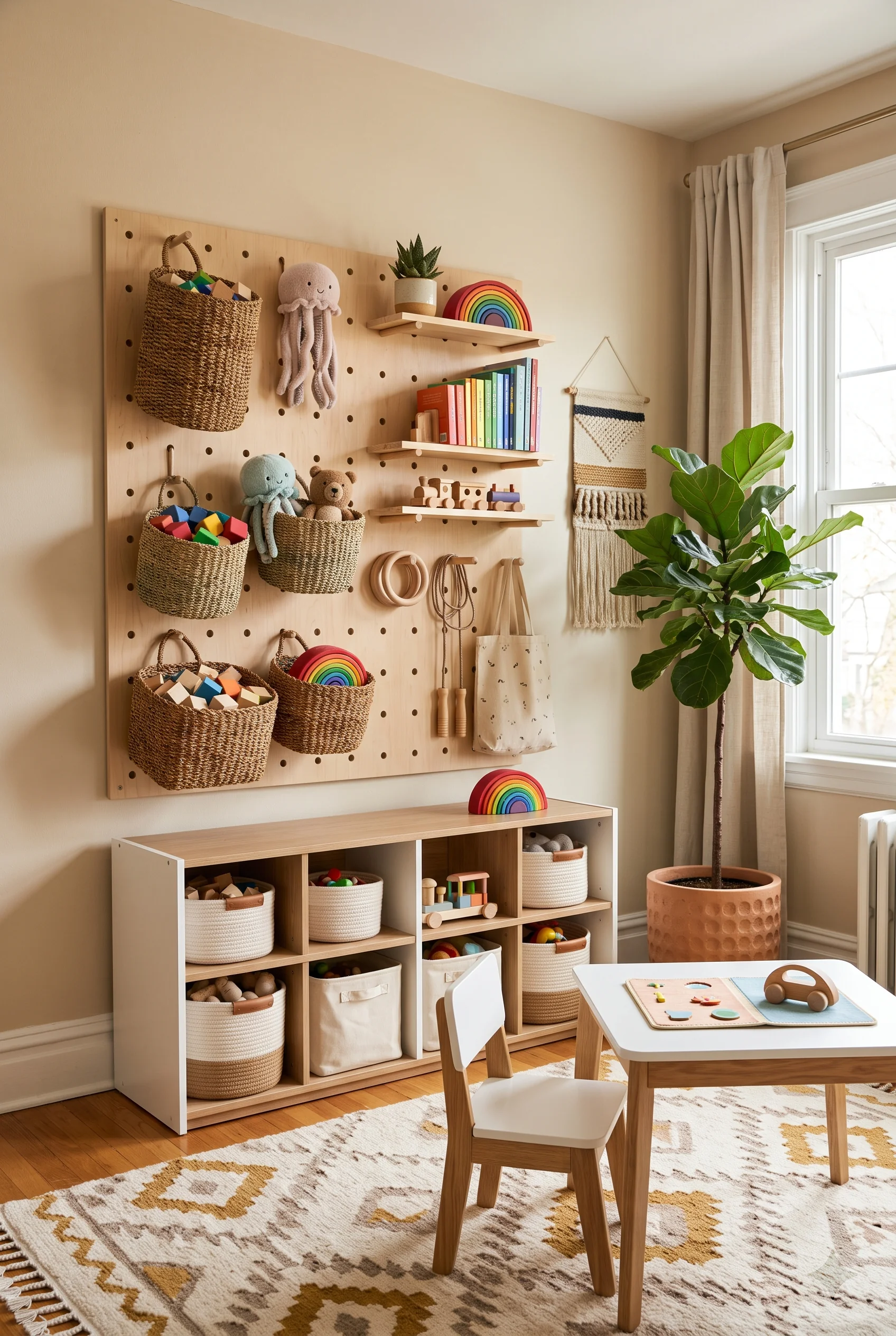
Plywood pegboard is the rare storage solution that evolves with your child. Today this oversized panel holds woven baskets, tiny shelves of picture books, and a dangling plush or two. Next year the hooks can shift up, the baskets can swap for headphones and homework supplies, and nothing needs replacing.
Below it, two white cube benches with rope bins keep heavier toys grounded. The warm wood tone of the panel turns the whole arrangement into a texture moment on an otherwise plain white wall.
Shop this pick: Wooden Pegboard Wall Organizer Panel, The oversized wood pegboard dominates this stretch of images and is a distinctive, recognizable product readers will specifically want to source rather than DIY.
The Mirror Trick Small Playrooms Swear By
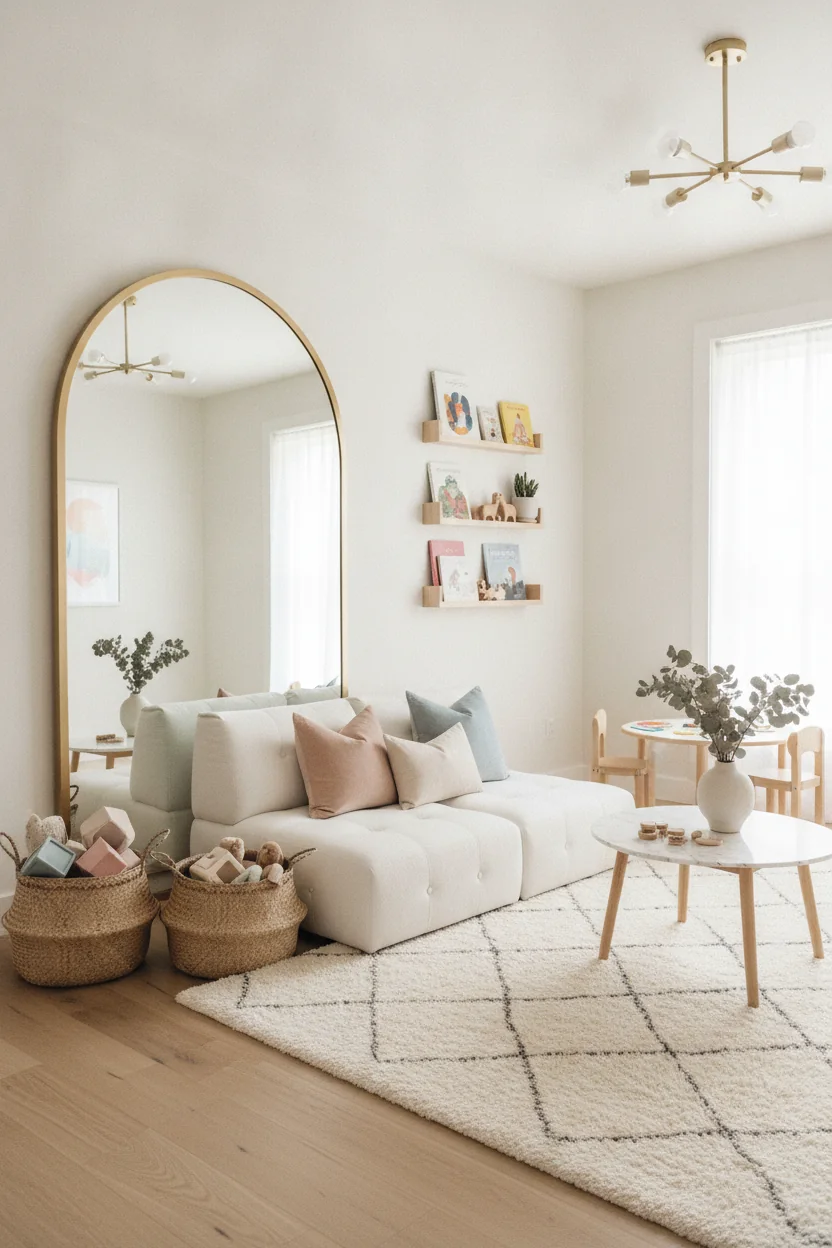
One arched brass mirror, leaned against the wall, and suddenly the room looks twice its size. It bounces window light into the far corners and gives kids that endlessly entertaining second version of themselves to perform for.
Pom-pom baskets of toys cluster at its base, and a gray armchair with a blush throw keeps a parent comfortable nearby. For any playroom, a shatterproof acrylic version delivers the same effect with none of the worry.
Of all the ways to open up a tight space, this one asks the least of your budget and your walls.
A Magnet Wall That Keeps Little Hands Busy
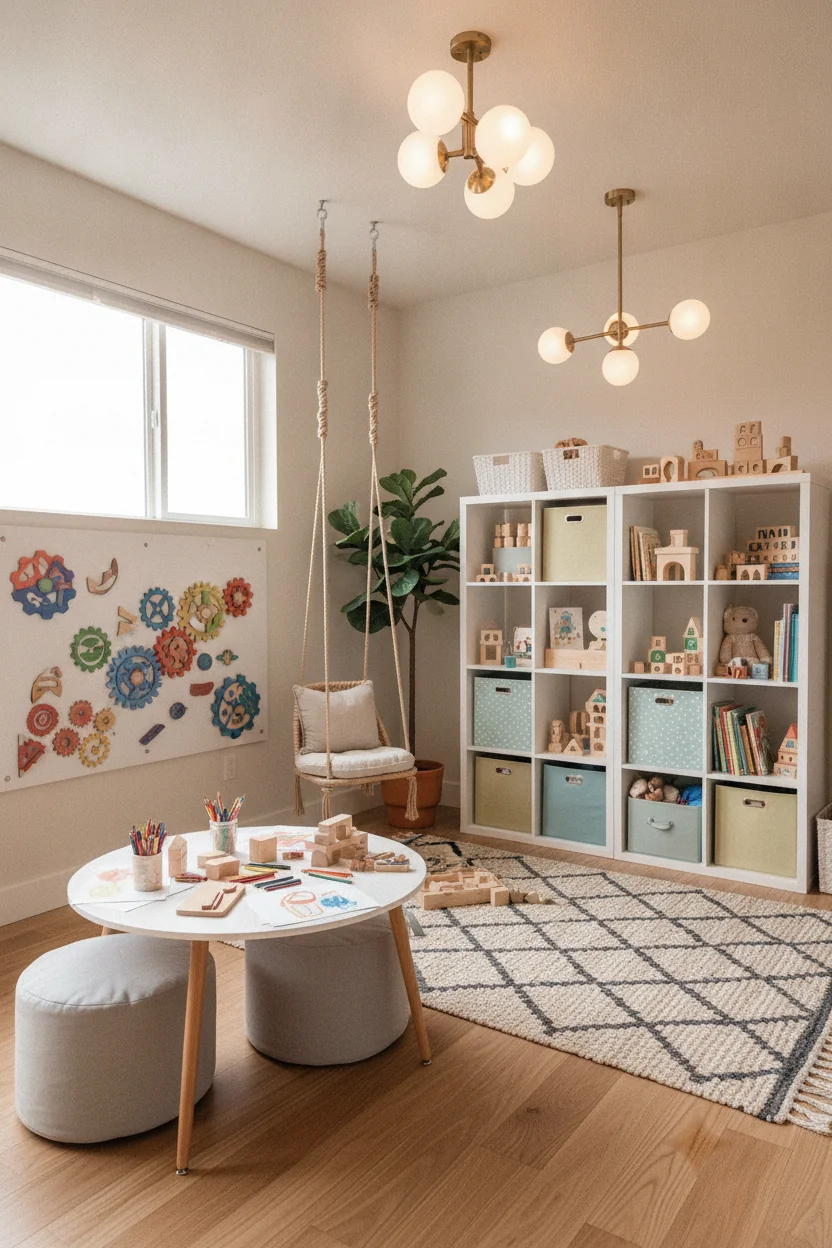
Rainy afternoons meet their match here. A large gray magnetic board hangs at kid height, scattered with wooden gears, triangles, and shapes that snap on, spin, and rearrange endlessly.
The craft table below extends the invitation with pots of pencils and loose wooden pieces, while a pink bean bag waits for whoever needs a break. It’s hands-on learning disguised as a wall feature, and unlike a bin of toys, it never ends up scattered across the floor.
A Palette of Calm, Light, and Well-Placed Color
Color decides whether a playroom feels frantic or peaceful before a single toy comes out. The rooms in this group start from quiet foundations, the same philosophy behind our neutral home decor ideas, then let toys, textiles, and art supply the brightness. Add generous natural light and plenty of softness underfoot, and you get a beautiful playroom that soothes parents as much as it delights kids.
Neutral Walls, So the Toys Do the Talking
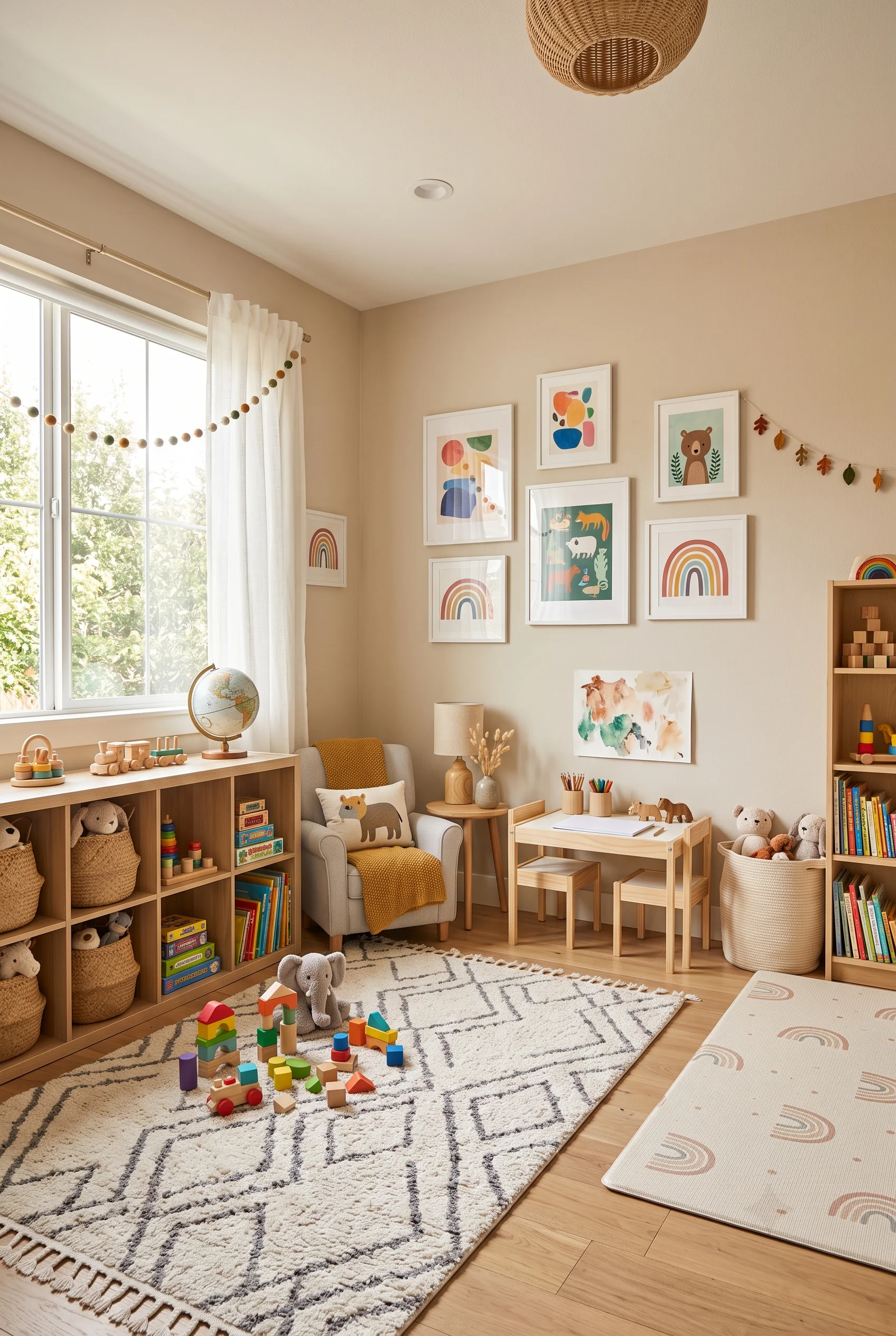
Beige walls, cream rug, light wood floors. On paper it sounds like a hotel lobby, but look what happens when the toys arrive: pastel bins of blocks, a plush lion, and front-facing picture books suddenly pop like confetti against the quiet backdrop.
Toys are already colorful. When the room competes with them, everything blurs into noise. When the room steps back, the playthings themselves become the decor, and they change as often as your child’s interests do.
Two soft abstract prints above the bookshelf keep the walls from feeling forgotten.
Softness You Can Feel From the Doorway
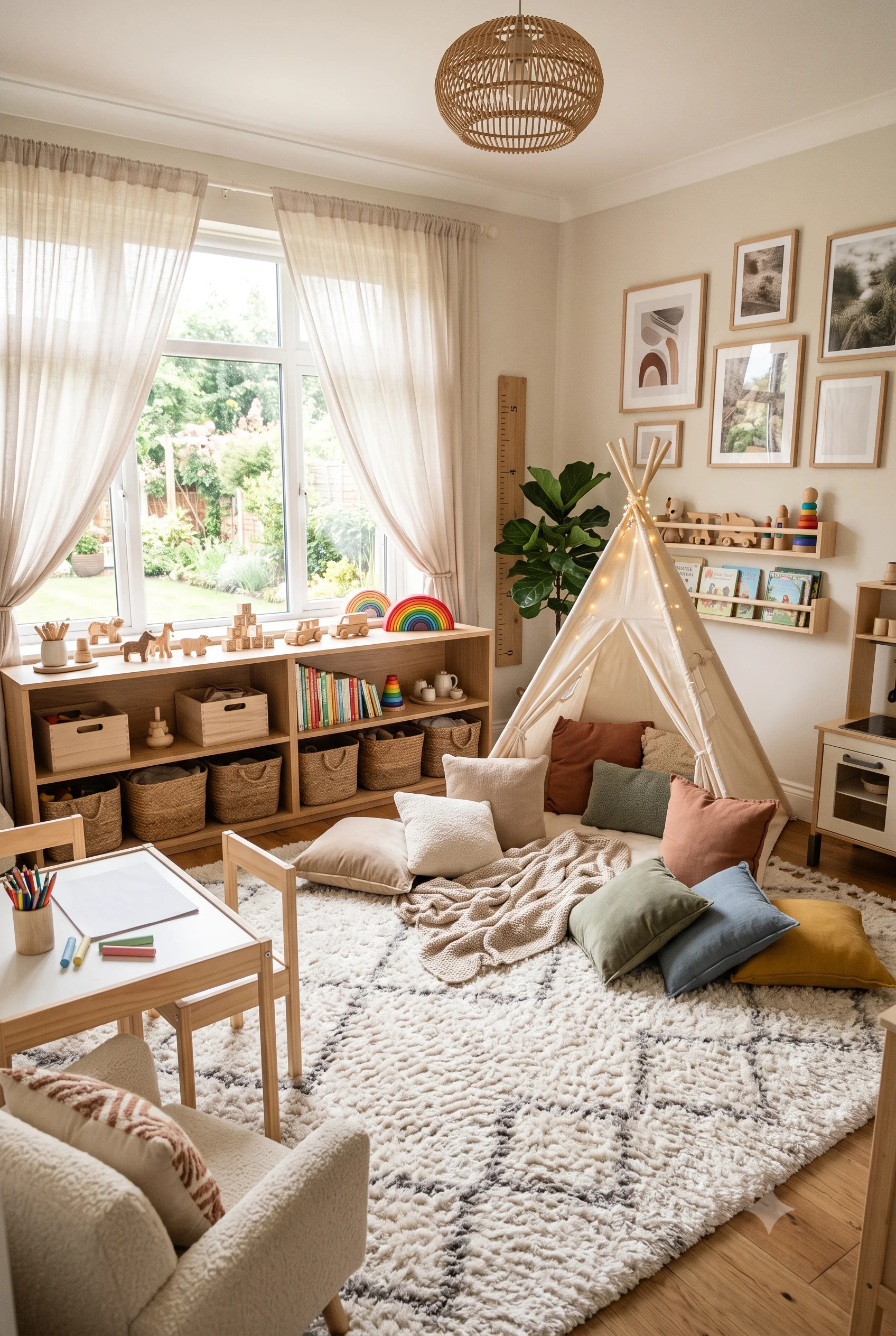
Everything in this room asks to be touched. Velvet floor cushions in blush and dusty blue pile up on a deep cream rug, a boucle armchair curves in the corner, and sheer curtains filter the window light down to a glow.
A gauzy tent strung with fairy lights adds one more layer of softness, this time overhead. Kids gravitate to texture the way adults gravitate to coffee, and every plush surface here doubles as crash padding for enthusiastic play.
Washable covers on the cushions mean all this softness survives real life.
Wall Art That Isn’t Afraid of a Phase
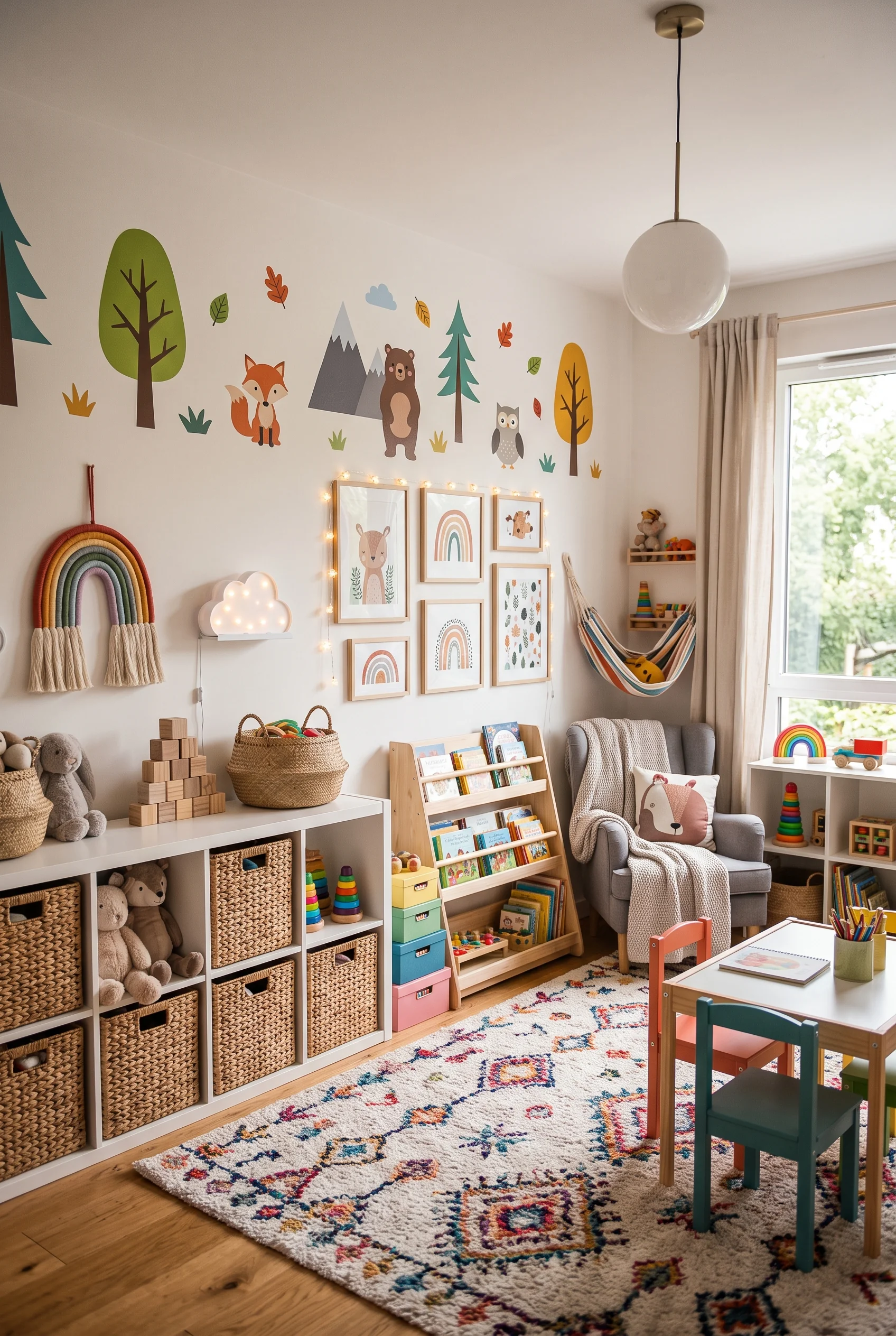
Clouds, stars, and hot air balloons drift across this gray wall, and every one of them peels off without a trace. Removable decals let a playroom commit fully to whimsy while the framed rainbow and lion prints anchor the arrangement with a little polish.
When the balloon obsession gives way to dinosaurs or planets, twenty minutes and a new sheet of decals refresh the entire room. The two little blue armchairs and pastel geometric rug will still work with whatever comes next.
Sunlight as the Main Decor Decision
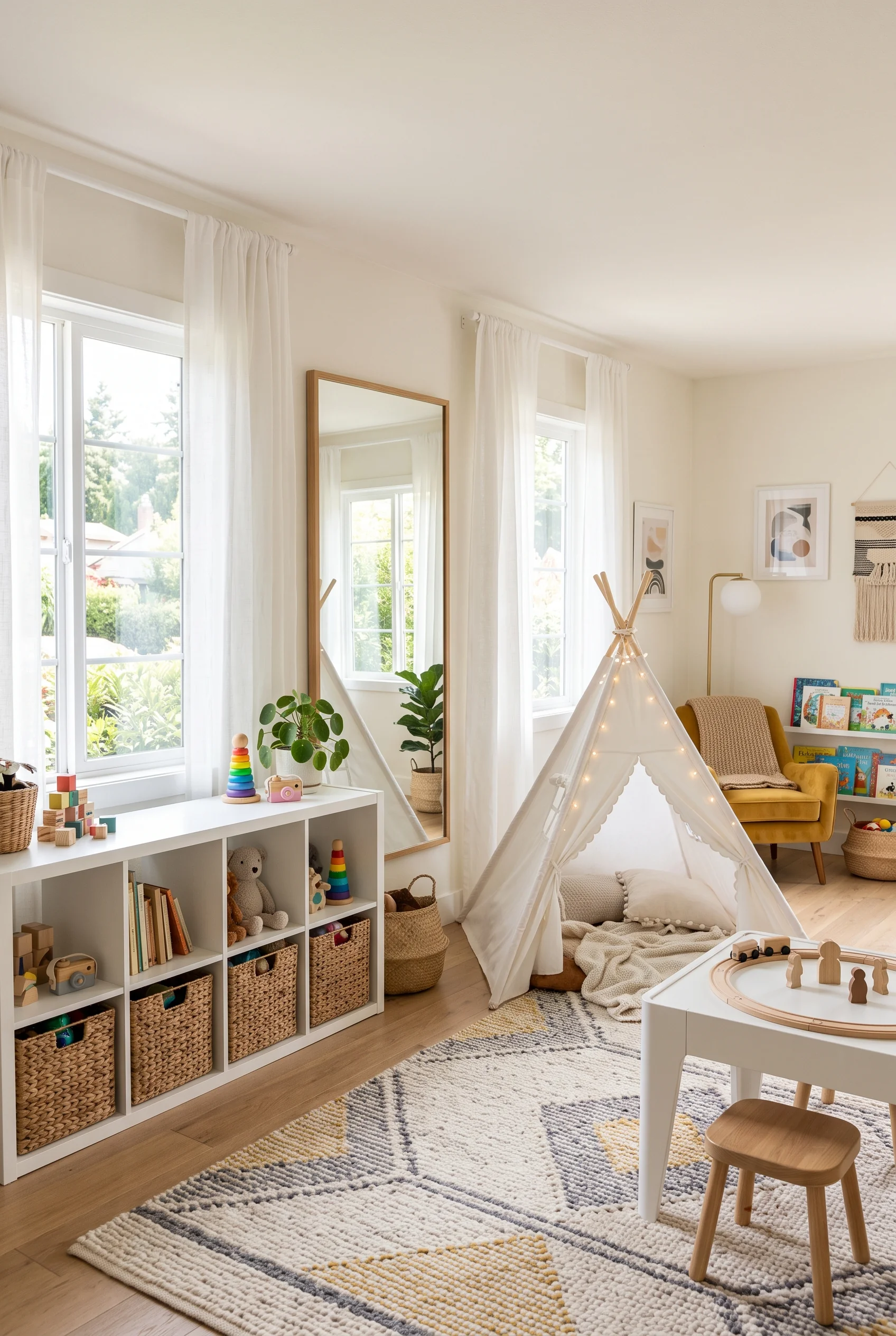
Light does the heavy lifting in this room. Floor-to-ceiling sheer curtains turn a big window into a wall of soft brightness, and three round brass mirrors catch it and throw it deeper into the space.
With that much glow, the furnishings can stay minimal: a rattan table and chairs, a long low shelf of fabric bins, a couple of belly baskets. Nothing bright, nothing busy, and yet the room feels anything but plain.
Kids play noticeably longer in daylight, which makes the window the most valuable feature in the room.
Primary Colors, Used Like Punctuation
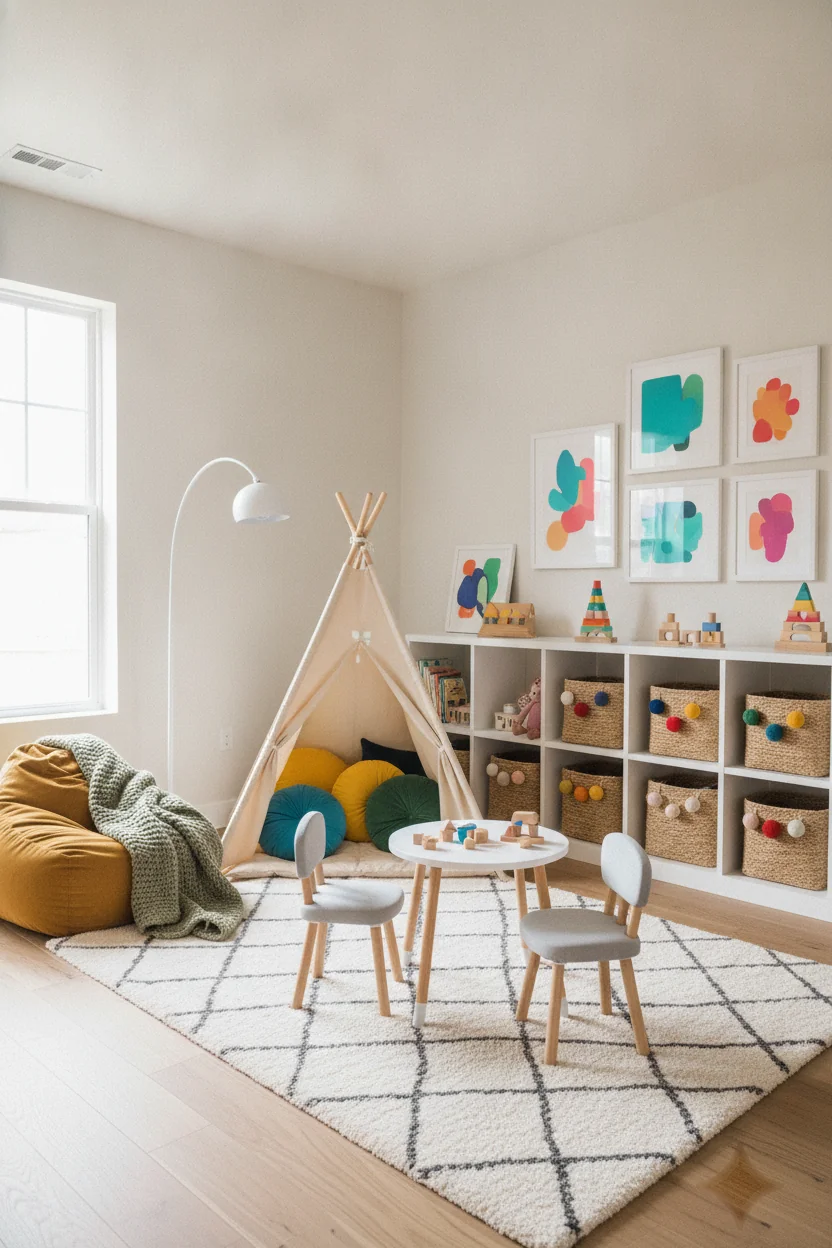
Yellow, blue, and orange poufs land on this rug like three exclamation points. Everything else stays hushed: greige walls, a soft gray armchair, wood-and-white storage along the floor.
The abstract prints on the wall echo the same bold hues, so the color feels planned rather than scattered. That’s the discipline that separates cheerful from chaotic. A few saturated accents against a neutral base give kids the brightness they love while the room keeps its composure.
Swap the poufs and prints in a few years, and the whole space grows up with almost no effort.
A Place for Every Kind of Play
Kids don’t play one way, so a functional playroom shouldn’t be one undifferentiated space. Zoning gives building, reading, crafting, and quiet time each a home of their own, which reduces conflict between siblings and makes cleanup logical. You don’t need walls to do it, just rugs, furniture placement, and a little intention. The approach works even in tight quarters, as our Montessori ideas for small spaces show.
One Room, Three Invitations to Play
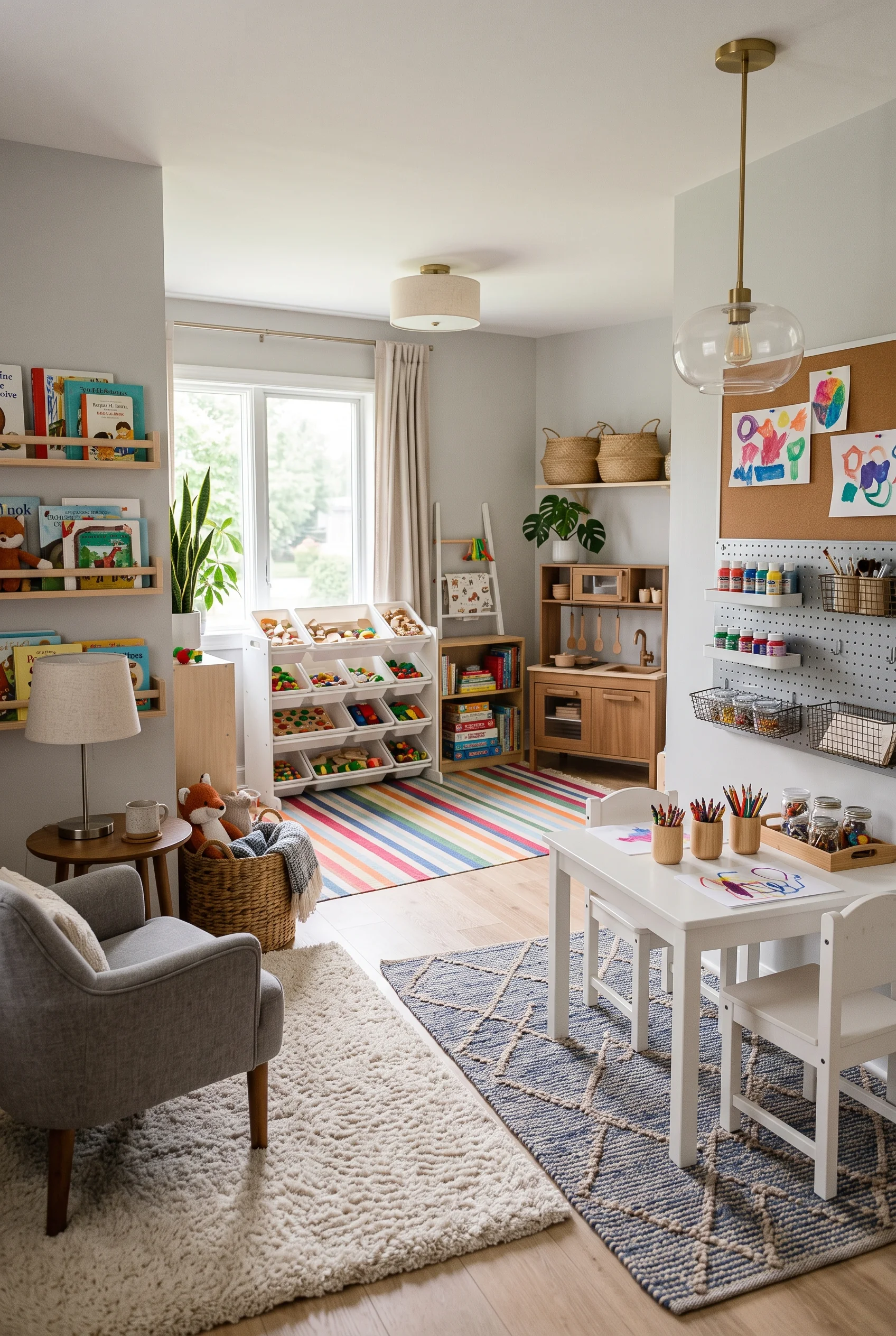
Walk into this room and the choices announce themselves. A bookshelf and armchair claim the reading corner, a craft table with four little chairs owns the center, and a fairy-lit teepee glows in the far corner for pretend play.
Each zone has its own rug and its own supplies within reach, so a child can move between activities without asking for help. Siblings can occupy different zones without colliding, which every parent knows is worth more than any single piece of furniture.
Boundaries Drawn in Wool, Not Walls
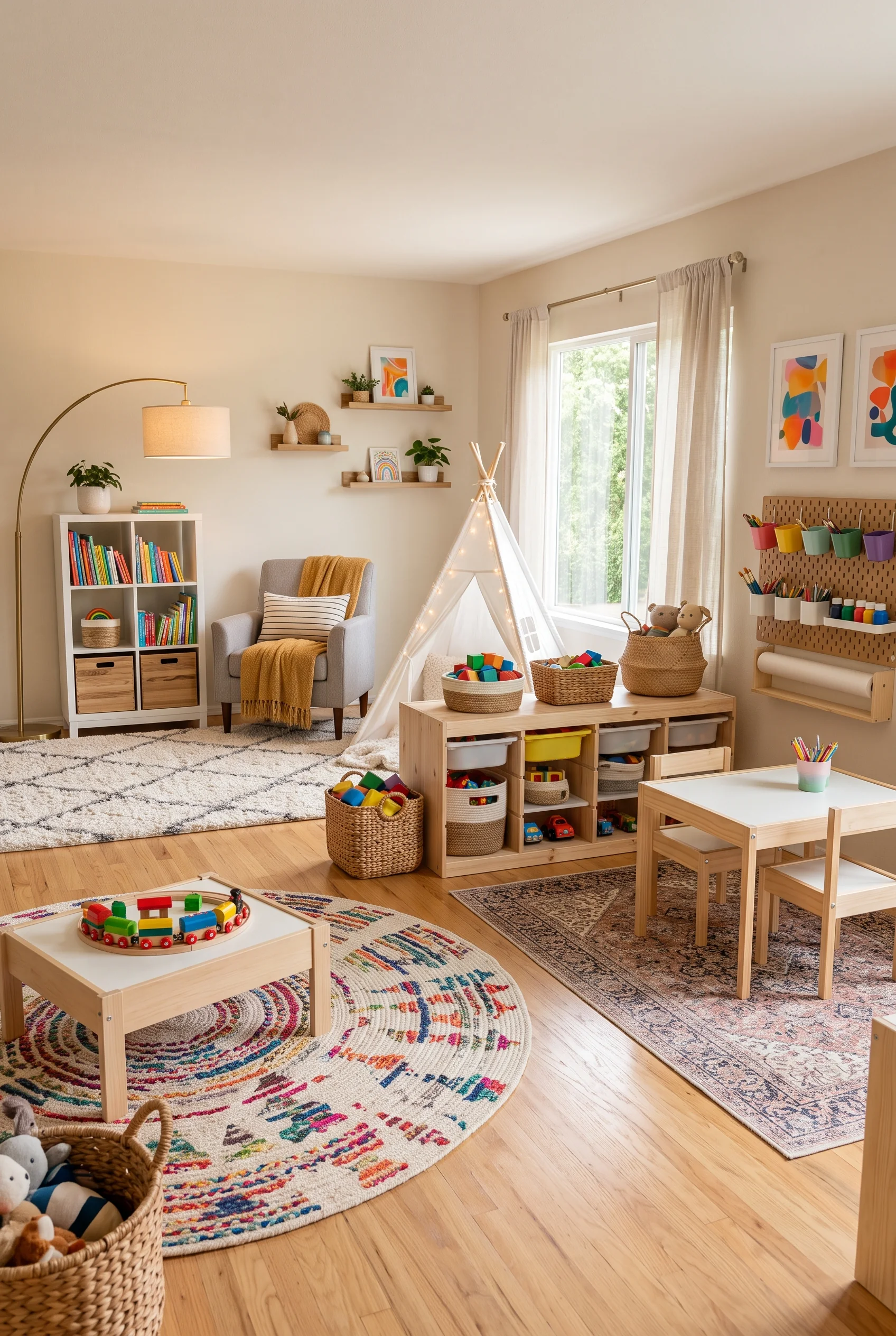
Three rugs, three territories. A round radial-pattern rug gathers the craft table and stools, a jute layer under the green armchair marks the reading spot, and a colorful geometric runner near the easel claims the art zone.
Kids read these boundaries instinctively. Blocks stay on the block rug, paint stays near the easel, and the room organizes itself through nothing more than what’s underfoot.
Layering different textures and patterns also gives the room depth that a single wall-to-wall rug never could.
An Art Station With a Gallery Above It
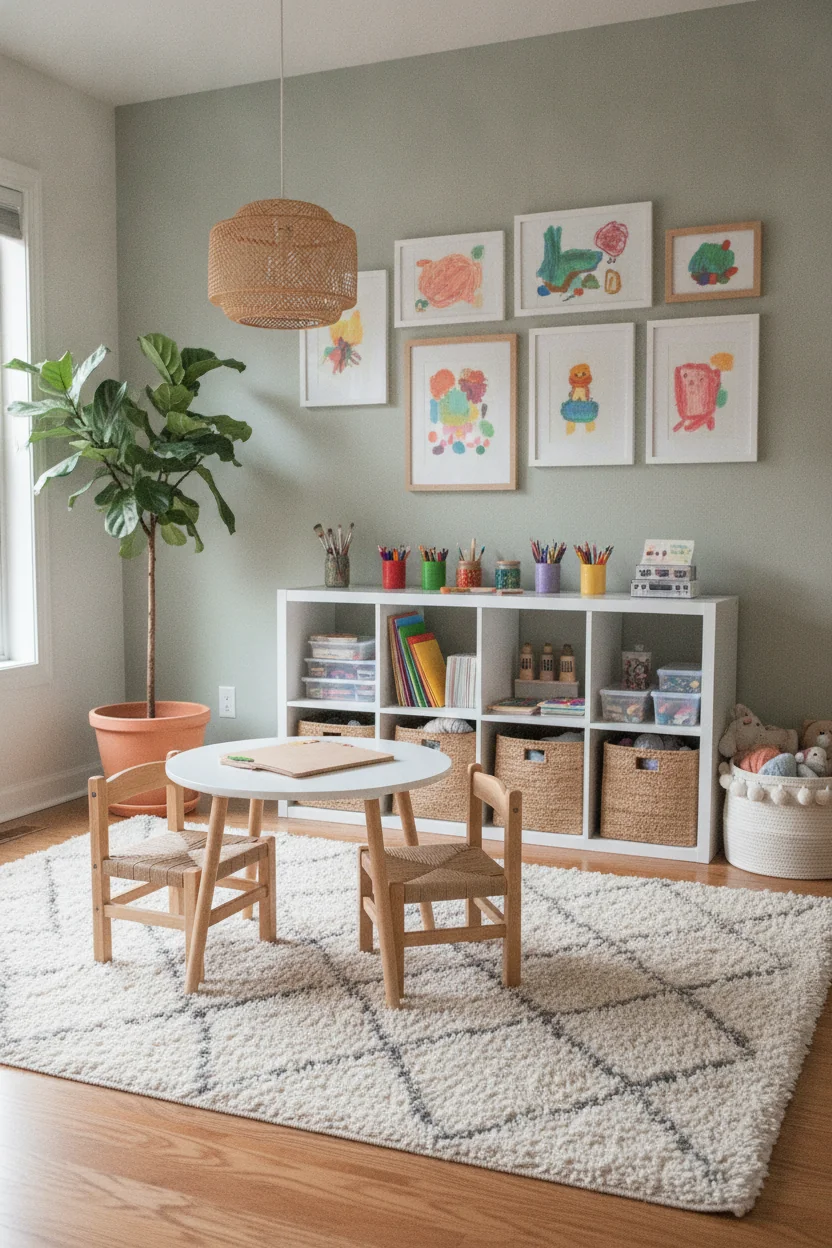
Paint cups, markers, and paper wait on the table. Above them, a sage-green wall displays the finished work: a framed rainbow, cheerful abstracts, art that looks suspiciously like it was made at that very table.
That gallery is the genius of this setup. Kids who see their work framed and hung take the making seriously, and the rotating collection keeps the wall alive in a way store-bought prints never quite manage.
Wicker baskets on the console below keep refills sorted and the table surface clear for tomorrow’s masterpieces.
Where the Mess Is Allowed to Happen
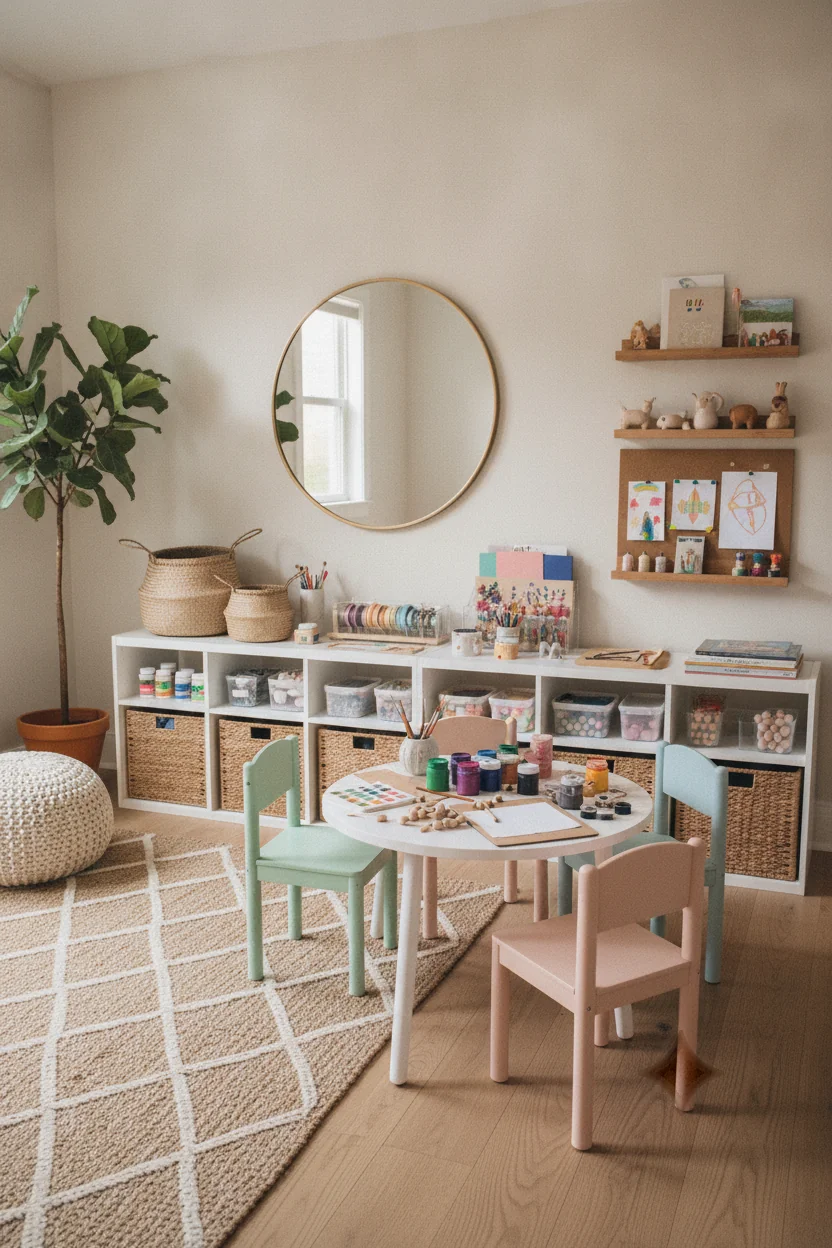
Every home needs one surface where glue and glitter are welcome. Here it’s a small white round table with two cane-back chairs, parked on a layered jute rug that shrugs off spills and crumbs of dried paint.
The supporting cast makes it work long-term. Cube storage holds fabric bins of supplies, and a slim wire shelf keeps jars of beads and buttons visible but up out of reach. Containing the mess to one well-equipped corner protects the rest of the house, and honestly, the rest of your sanity.
Learning That Hangs Quietly on the Wall
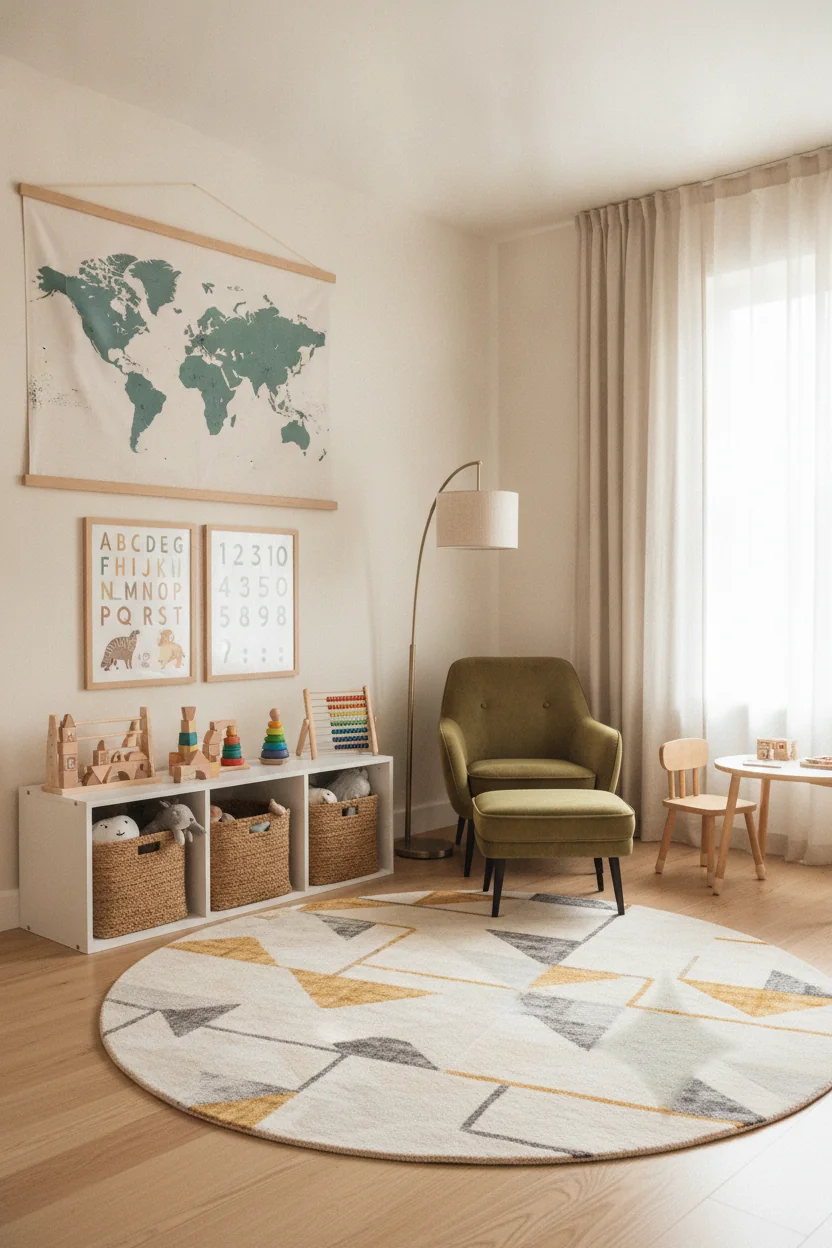
A copper-toned world map spreads across the dusty blue wall, flanked by four alphabet posters in soft, earthy tones. Nothing about it screams classroom, yet a child in this room absorbs geography and letters just by looking up.
The cube shelves below continue the theme with an abacus, stacking toys, and wooden blocks arranged at self-serve height. Educational decor works best exactly like this, woven into a room kids already love rather than presented as an assignment.
A Corner That Slows Everything Down
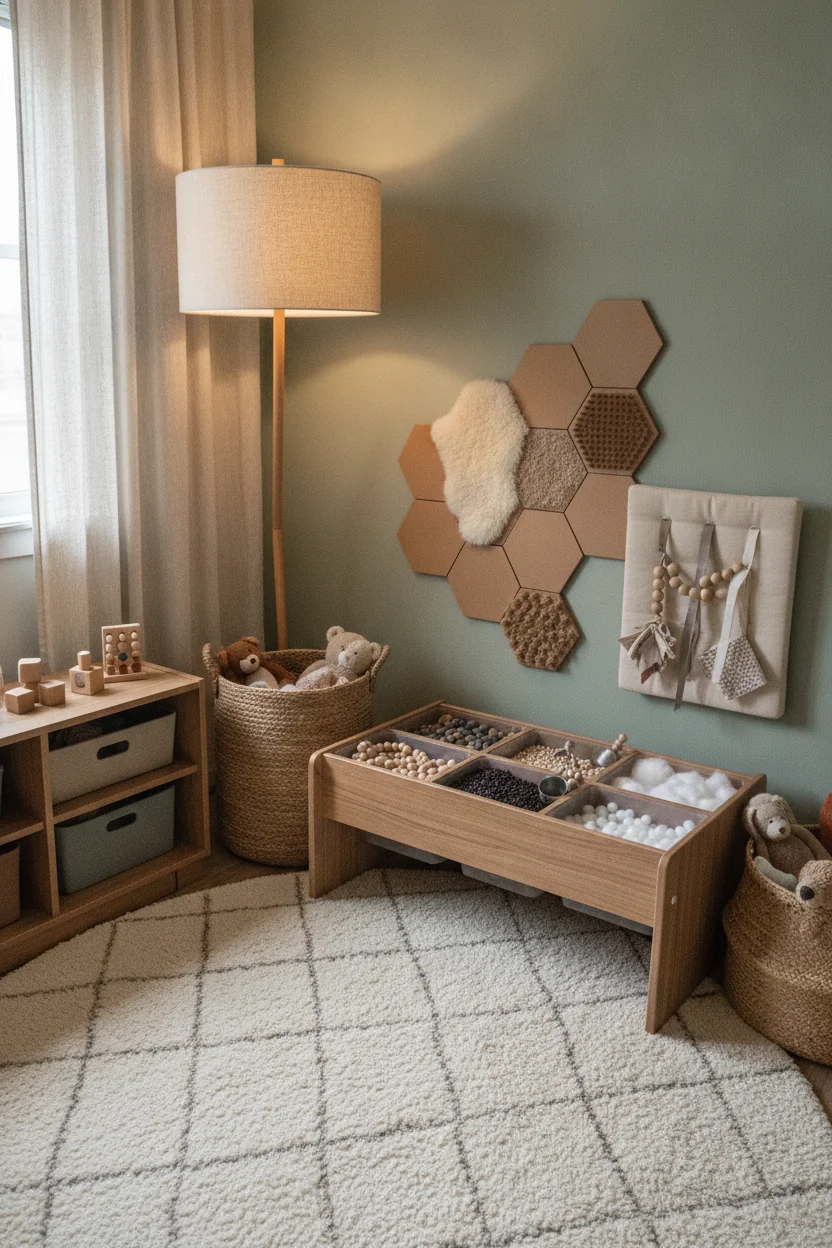
Quiet has a station of its own here. A wooden sensory table divided into compartments of pebbles, felt balls, and textured treasures invites slow, focused exploration, the kind of play that settles a wound-up child better than any screen.
The wall art continues the theme with panels of cork, wool, and wood you’re meant to touch, and a little cloud lamp adds a gentle glow. Warm lamplight, a soft sofa nearby, textures everywhere. Even standing in the doorway, you can feel your shoulders drop.
Shop this pick: Wooden Sensory Table with Storage Bins, The compartmented sensory table is the unmistakable hero of the image and a specialty item parents actively search for by name, making it a strong affiliate anchor for the activity-zones section.
Pieces Built for Big Imaginations
Some playroom features exist purely to make kids’ eyes go wide: a stage, a climbing wall, a tent to disappear into. The best ones are also sized and built for children to use independently, no adult required, the same principle behind our Montessori bedroom ideas for toddlers. These seven rooms show how to add real wow-factor without sacrificing the room’s good looks.
Seating Sized for the People Who Use It Most
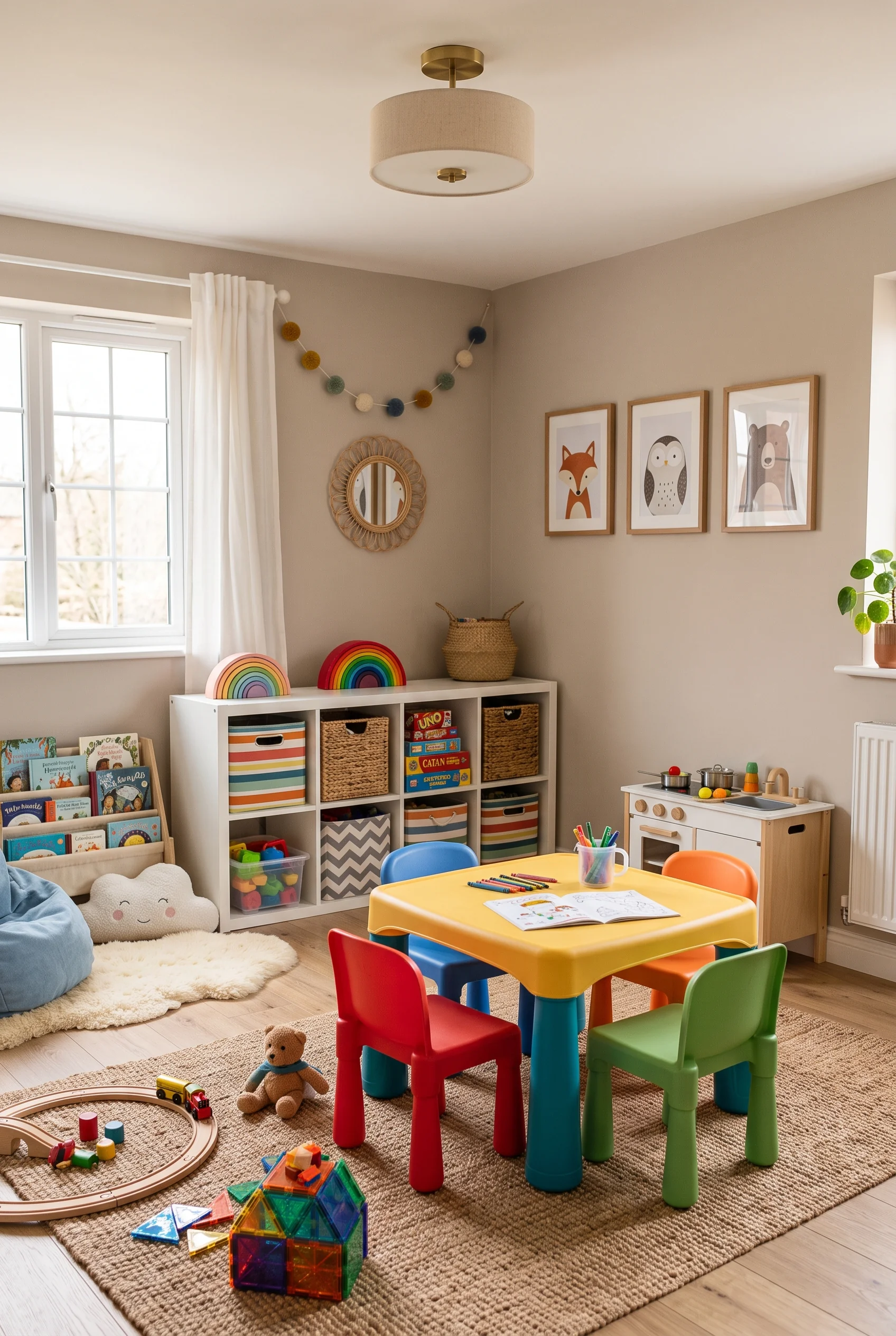
A teal table with sunny yellow and orange chairs sits dead center, and every piece is scaled so a preschooler can pull out a seat, climb up, and get to work without help. Rounded edges on all of it mean the inevitable tumbles end in shrugs, not tears.
The arched windows and sheer curtains give the bright furniture a gallery-white backdrop, and a matching teal armchair lets a grown-up join at their level. Furniture kids can manage themselves quietly builds the independence everything else in the room depends on.
A Teepee Worth Lingering In
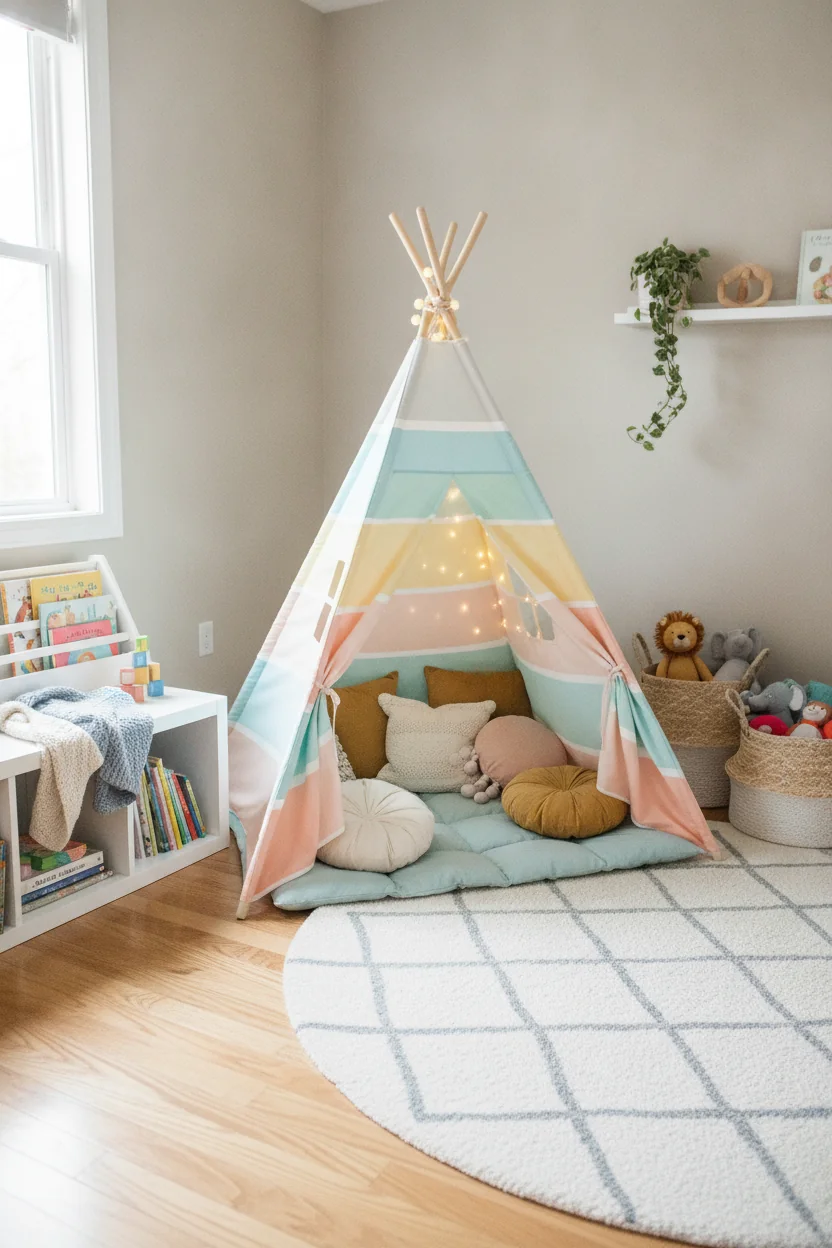
String lights trace the poles of this triangle-print teepee, and inside, a pink quilted mat and a heap of mustard and blush cushions make it genuinely comfortable, not just cute. This is a hideout a child will actually stay in with a stack of books.
Its pastel triangles echo the framed prints on the sage wall, which is why it reads as decor instead of equipment. When it’s time to rearrange, the whole thing folds flat and moves in one trip.
A Climbing Wall That Burns Energy Before Dinner
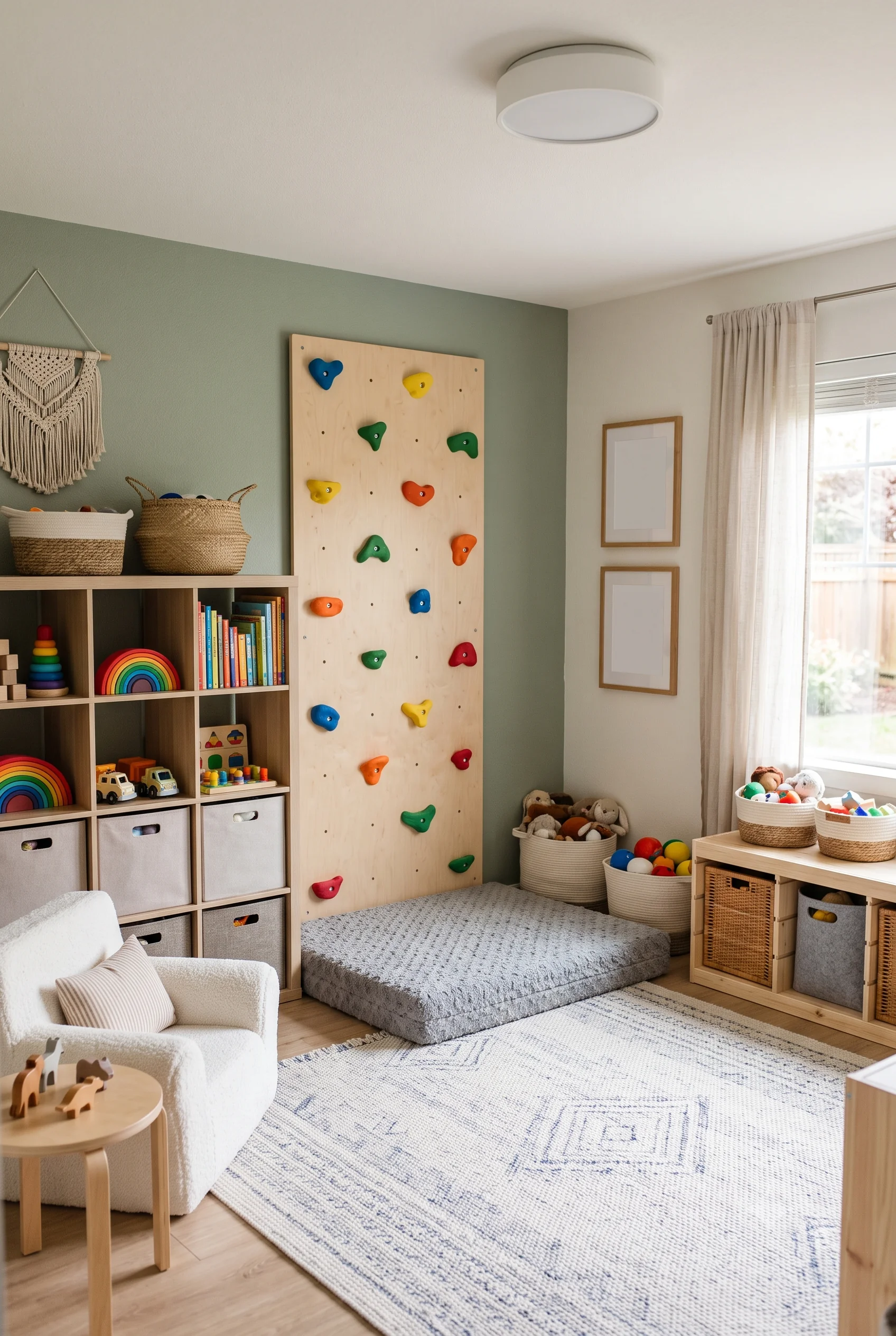
Winter afternoons and rainy weekends need somewhere for the wiggles to go. This narrow panel of colorful climbing holds turns a sliver of wall into a workout, with a thick folding mat below to catch every dismount, planned or otherwise.
What’s clever is how gracefully it shares the room. A cream armchair, a round mirror, and a picture ledge of art sit right beside it, and the bright holds read almost like a wall sculpture against the white panel. Big physical play, zero rec-room energy.
A Stage With Real Velvet Curtains
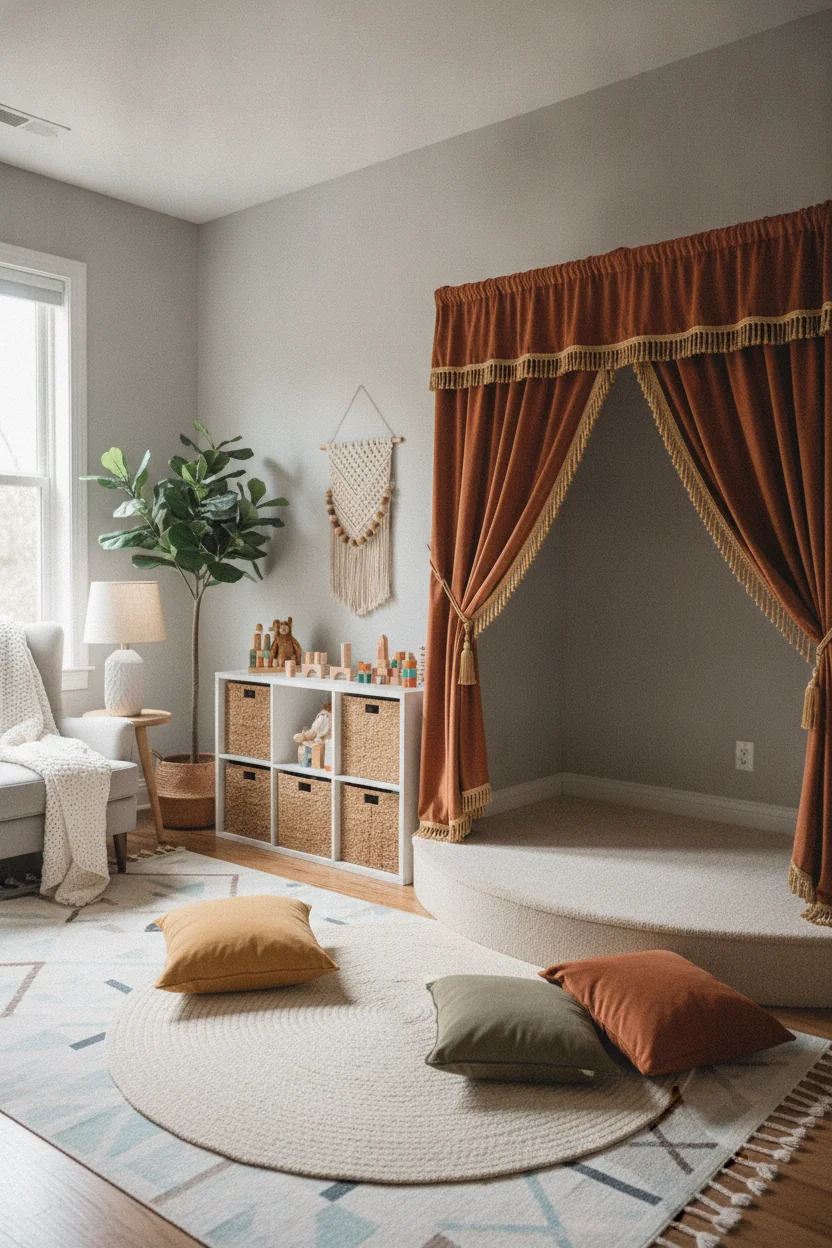
Emerald velvet curtains, tied back with matching sashes, frame a low wooden platform built into the corner. For a kid with a song to perform or a story to act out, this is the difference between playing pretend and putting on a show.
The platform is just tall enough to feel important and low enough to be safe, with a round rug marking center stage. Confidence grows fast when there’s a dedicated spot to be seen, and the deep green against sage walls happens to be gorgeous.
Seating That Weighs Less Than the Kids
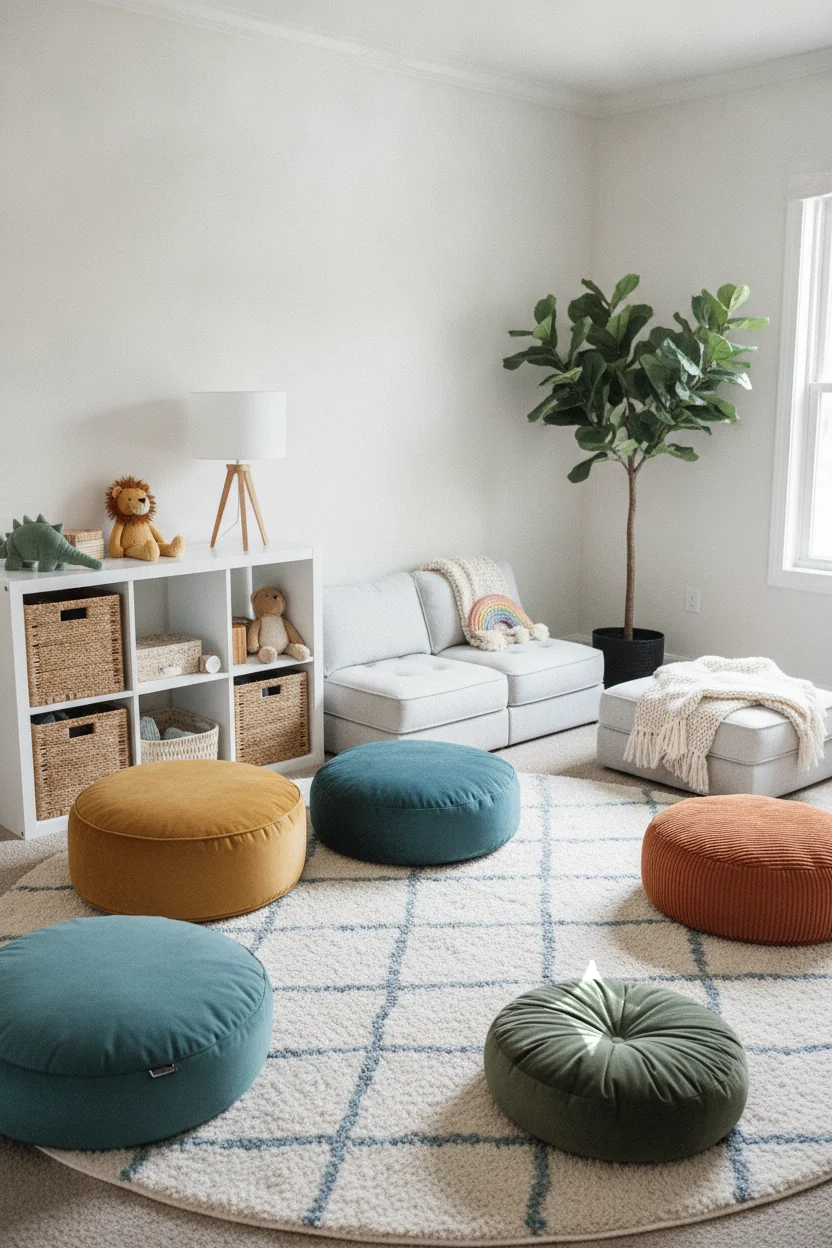
Jewel-tone velvet poufs in sapphire, ruby, and emerald scatter around a low white table like oversized gemstones. Each one is light enough for a child to drag wherever the action is, which means the seating plan changes ten times a day and nobody minds.
Two hanging rope swings by the window and a hot-air-balloon pendant push the room into storybook territory. Floor-level seating keeps everything accessible, cushioned, and impossible to break.
Costumes Treated Like a Boutique Display
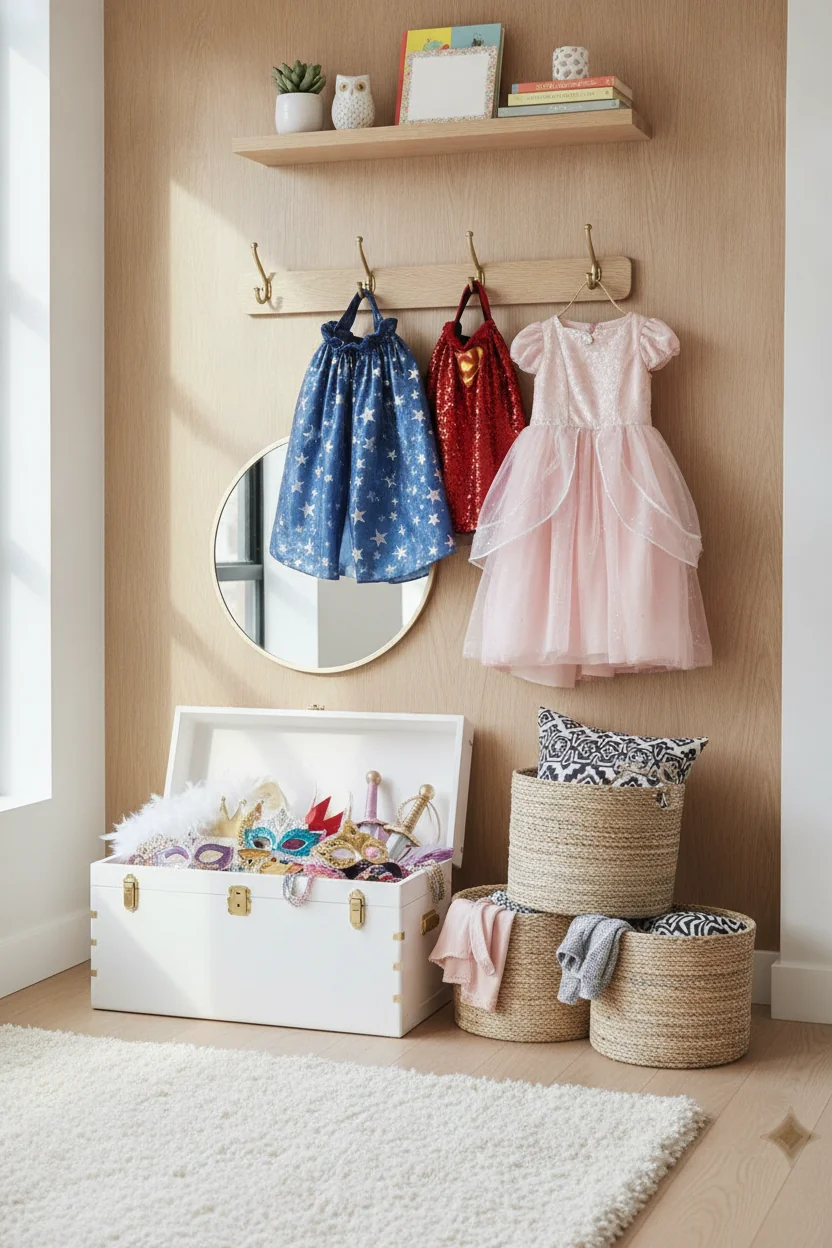
A tulle dress, a lion suit, and a purple cape hang from brass hooks on a white peg rail, displayed like a tiny boutique instead of stuffed in a bin. When costumes are visible and reachable, dress-up happens daily rather than only when someone digs for it.
A navy velvet trunk below spills over with necklaces, crowns, and sunglasses, and a round mirror hangs at exactly the right height for admiring the transformation. Fairy lights strung along the rail make every costume change feel like an occasion.
A Sofa Built to Be Taken Apart
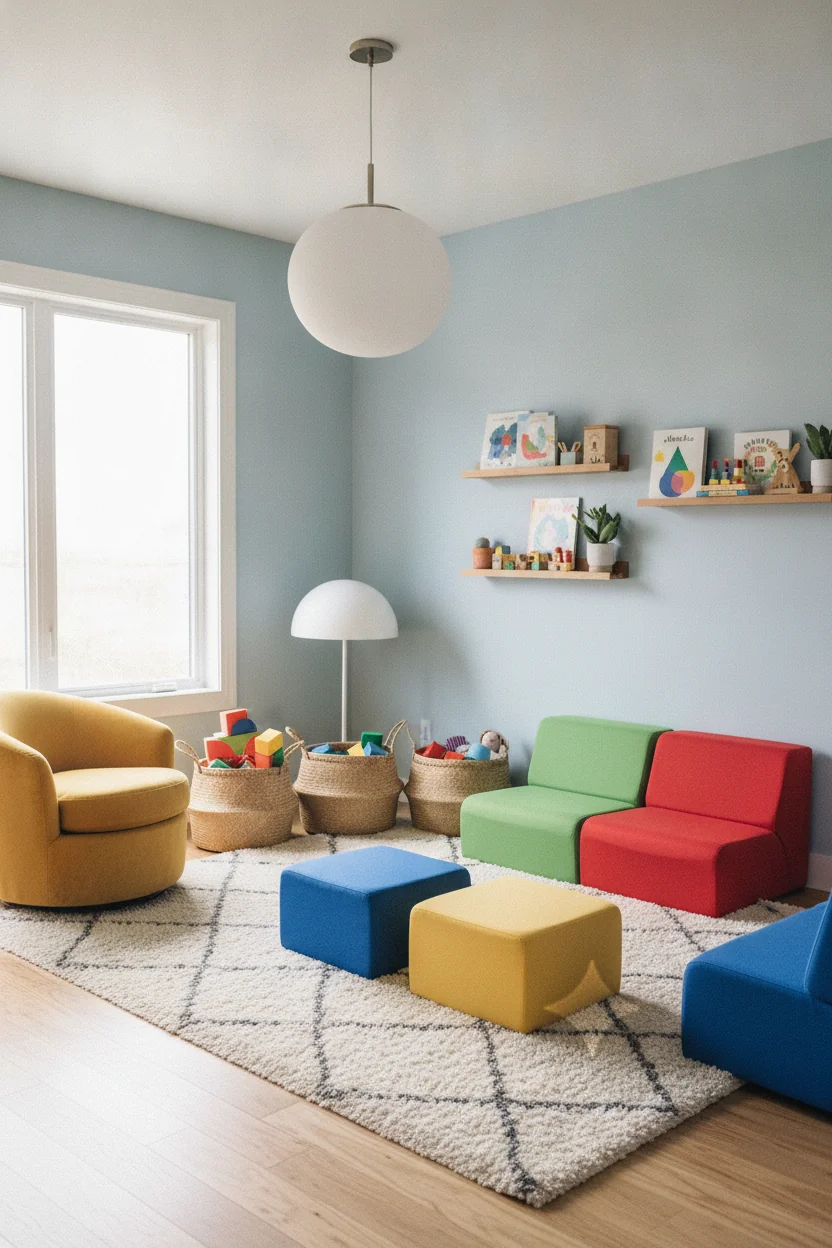
By morning it’s a tidy sofa in yellow, blue, and red. By afternoon those same blocks have become a fort, an obstacle course, and a landing pad, then they stack back into a sofa before dinner.
Modular foam furniture takes the roughest play a playroom sees and turns it into part of the design. The pieces wipe clean, weigh almost nothing, and rearrange to match whatever game is underway.
Against pale blue walls with a cheerful yellow barrel chair alongside, the primary colors feel styled rather than loud.
Shop this pick: Modular Kids Play Couch, The modular foam play couch is the highest-value hero product in the entire post, an exact visual match to the image, and a category with proven affiliate conversion among parents.
The Corners That Make It Feel Like Home
The last layer of a kid-friendly playroom is the one that makes everyone want to stay: a proper reading chair, some greenery, shelves that display the good stuff. Then come the photos that say this room belongs to this family. These finishing touches cost less than the furniture but do more for how the space feels. They’re also the details you’ll appreciate most during the hundredth hour you spend in there.
A Reading Chair Good Enough to Fight Over
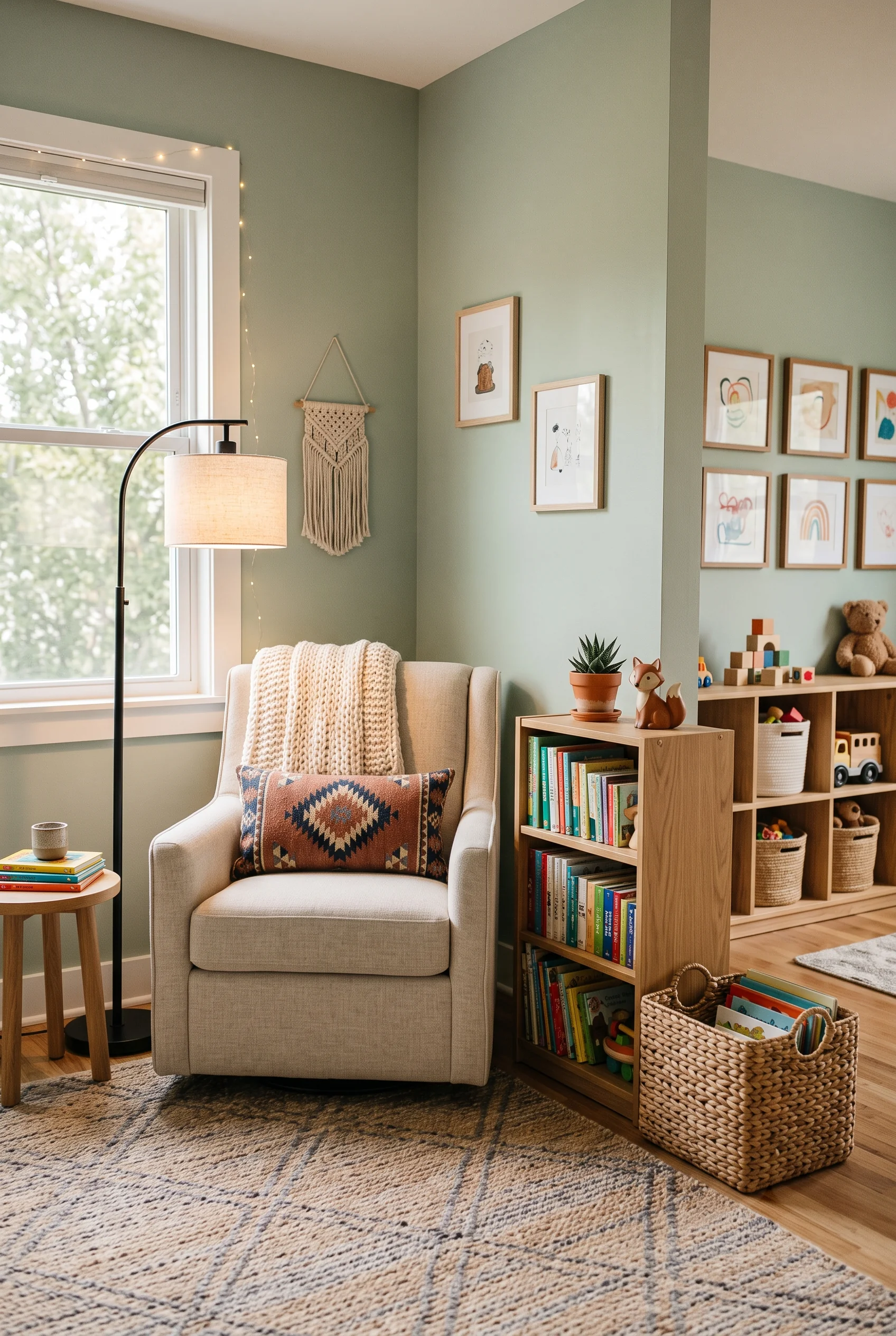
Late-afternoon light pours through the arched window onto a white boucle swivel chair draped with a rust knit throw. Adults claim this sort of chair for themselves, which is exactly why kids will curl up in it with a book.
The supporting pieces keep the corner kid-first. A low white book bin displays covers face-out for easy choosing, pom-pom baskets hold plush reading companions, and a brass floor lamp handles cloudy days.
Moody forest artwork and a fiddle leaf fig give the corner a calm that outlasts bedtime negotiations.
Display Shelves That Keep the Floor Clear
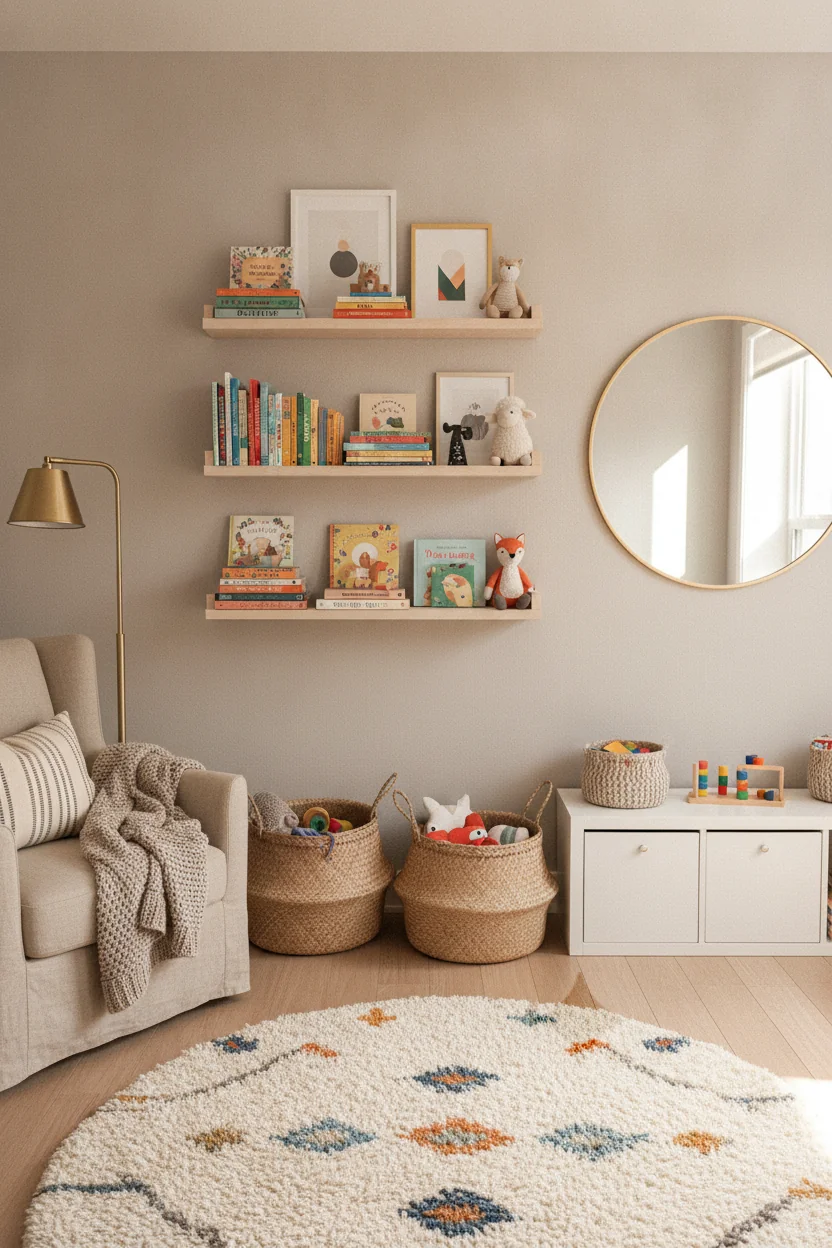
Four white picture ledges climb the wall, holding a mix of front-facing storybooks, framed black-and-white photos, and a few favorite toy animals. Books at the lower rows for small readers, breakables up top where only tall people reach.
Because everything lives on the wall, the floor below stays open except for two low white chairs and a pair of belly baskets. Rotating the display takes five minutes and makes the room feel new every season.
Greenery Hung Safely Out of Reach
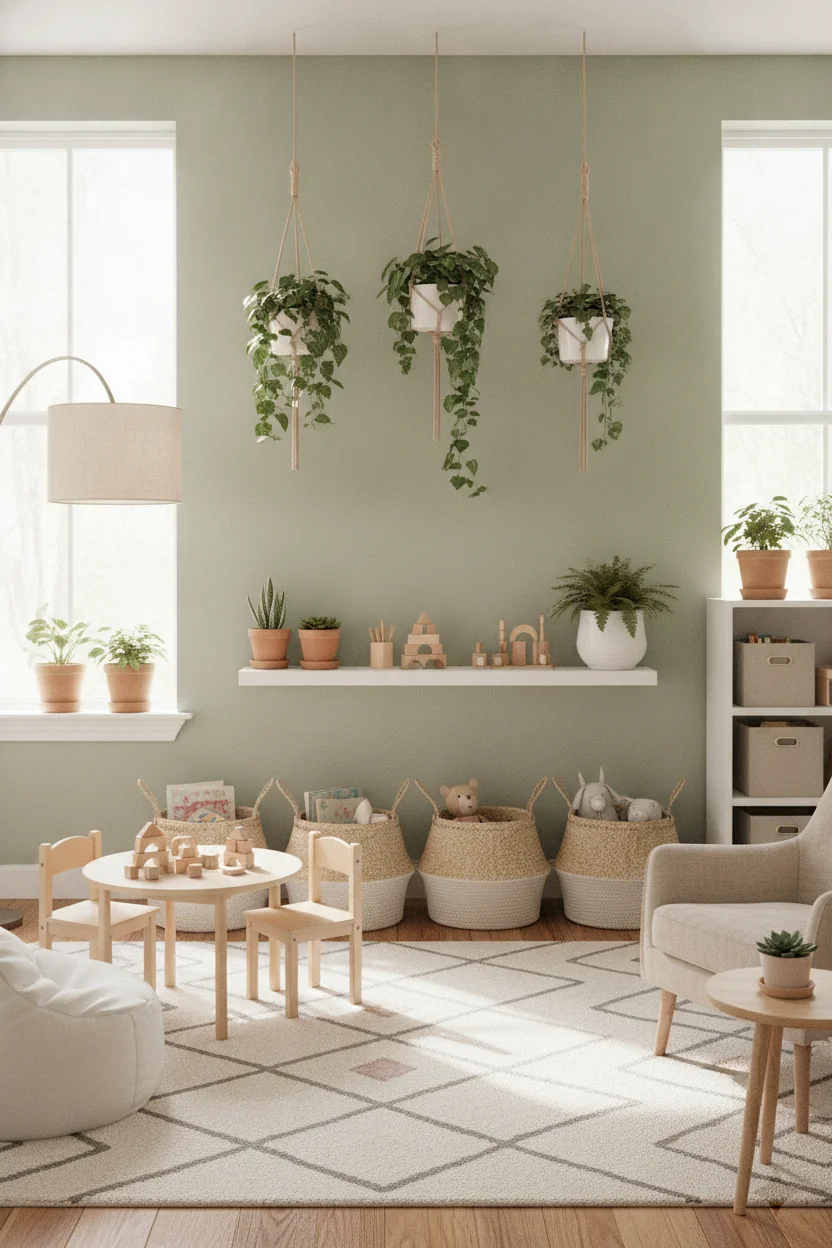
A fern spills from a macrame hanger by the window while three woven basket planters climb the wall like living art. Every plant sits above toddler altitude, which solves the classic playroom greenery problem before it starts.
The trailing pothos and glossy leaves bring a freshness that no throw pillow can fake, softening all the white and wood below. With non-toxic varieties like spider plants and ferns, the whole arrangement stays as kid-safe as it is pretty.
The Nook That Teaches Kids to Read Alone
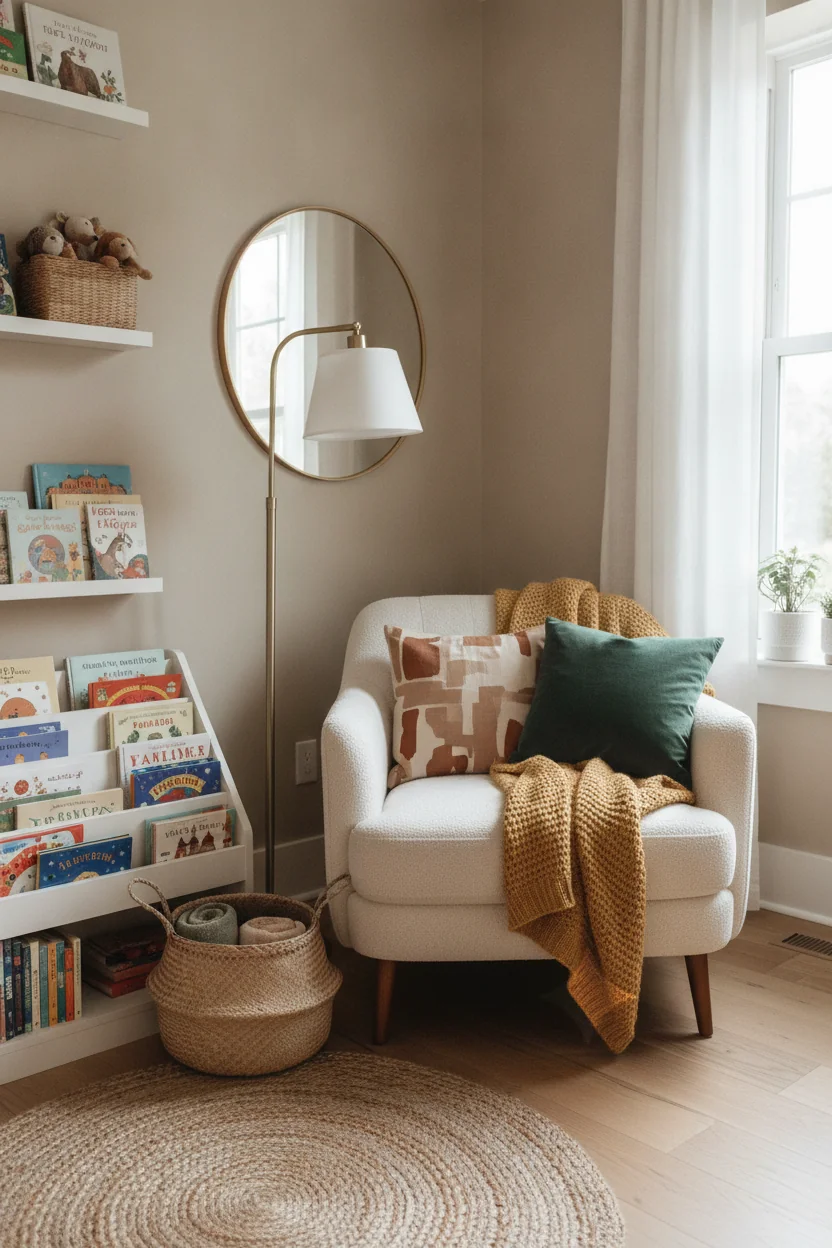
Sunlight falls across a plush white lounger parked directly beside a wall of cube shelves packed with picture books, covers facing out like a bookstore display. A child can choose a book, flop into the seat, and start reading without a single adult intervention.
That adjacency is the whole design. Seat and library within arm’s reach of each other removes every excuse between a kid and a story.
A fringe throw, a small wood side table, and an adjustable reading lamp finish the corner against a soft olive wall.
Shop this pick: Kids Reading Nook Lounge Chair, The plush lounger is the focal purchase of the reading nook stretch and pairs naturally with the book-display and cozy-corner items readers will want to recreate.
Their Art, Framed Like It Matters
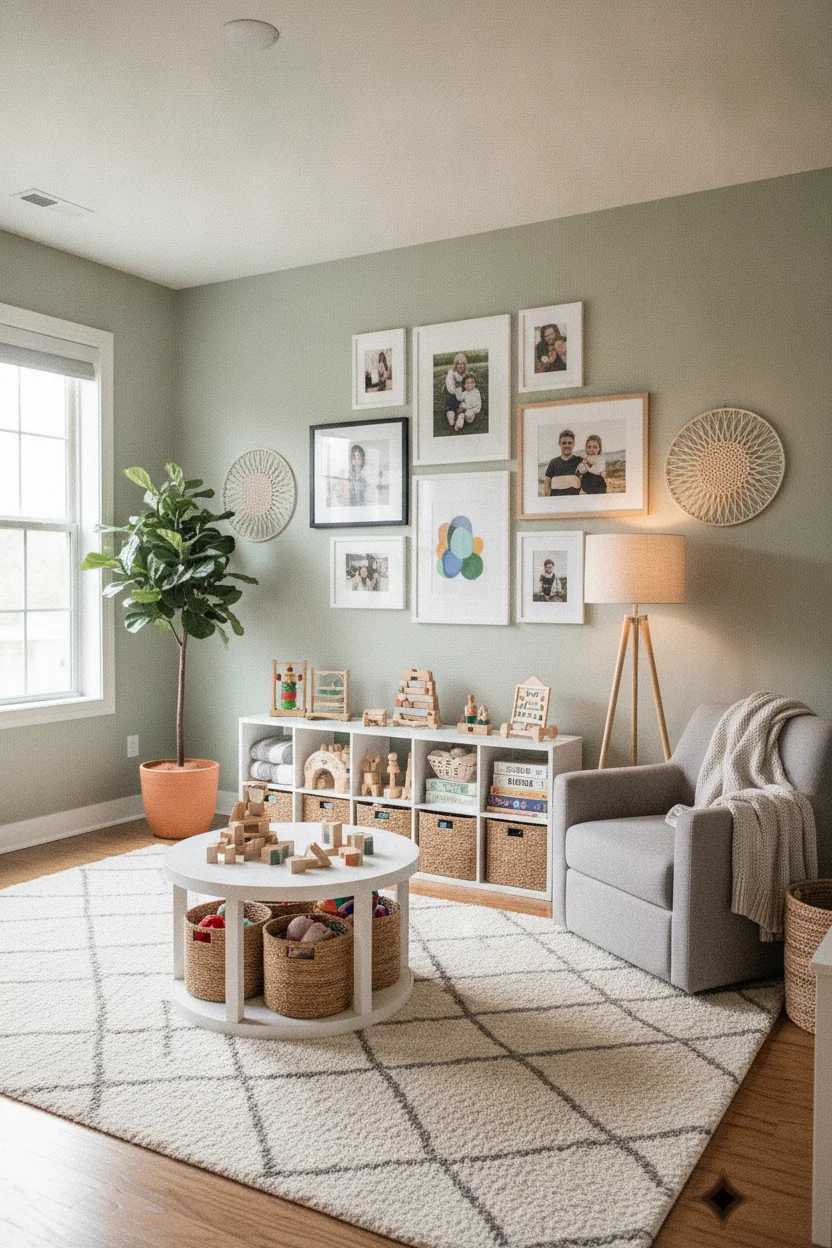
Family photos and crayon drawings share this gallery wall as equals, matted and framed with the same care. A child who spots their scribbled rainbow hanging beside a family portrait learns something no decor magazine can teach: their work belongs here.
A sage armchair with a chunky knit throw sits below, close enough for storytime under the gallery. Frames make swapping easy, so the wall keeps pace as the artists improve.
Of every idea in this post, this is the one kids notice first and remember longest.
A Playroom That Works as Hard as It Charms
Look back across these 35 rooms and a pattern emerges. None of them chose between beautiful and practical. The calm palettes make the toys shine, the storage doubles as decor, the play features earn their place in the design, and the personal touches make everything feel like it belongs to the family who lives there.
You don’t need to attempt all of it at once. Start with the one idea that solves your loudest problem. If toys are swallowing the floor, begin with baskets and a cube unit. If the room feels chaotic, repaint in a quiet neutral and let the playthings carry the color. If your kids wander off after five minutes, add a zone or a feature that pulls them back in, whether that’s a teepee, a chalk wall, or a stage with velvet curtains.
The habits transfer, too. The same instincts that keep a playroom tidy work everywhere kids shed belongings, which is exactly the thinking behind our entryway organization ideas.
Most of all, remember who the room is for. The best playroom decor ideas are the ones your children actually use: the chair they fight over, the wall they’re allowed to draw on, the basket they can empty and refill a hundred times. Choose for your family, start small, and let the room grow alongside them.