31 Basement Playroom Ideas for a Fun and Organized Family Space
Basement playroom ideas start feeling a lot less overwhelming once you accept that a finished basement doesn’t have to look like an unfinished one. Low ceilings, no natural light, concrete underfoot- all of it can still add up to a room your kids beg to spend the afternoon in. The trick is to treat the space with the same intention you’d bring to any room upstairs, not to toss a bean bag and a bin of toys down there and call it finished.
A playroom carries more weight than its square footage suggests. It’s where drawings turn into gallery walls, where a rainy Tuesday becomes a puppet show, where a four-year-old and a ten-year-old somehow share the same floor without a meltdown. Getting the layout, storage, and mood right pays off every single day, not just on decorating day.
This roundup walks through 31 basement playrooms, organized by the design decision that makes each one work, whether that’s a playroom layout built for independent play, a toy storage system that actually gets used, or a reading nook cozy enough to compete with a screen. Expect a shortlist of changes to make this weekend, plus a few to save for later. For keeping the whole system tidy long after the paint dries, this playroom organization guide pairs well with everything below.
DISCLOSURE: Some of the links provided on this page are affiliate links. This means if you choose to make a purchase through these links, we may receive a small commission at no extra cost to you.
The Bones of a Beautiful, Functional Playroom
Before the fun stuff gets added, a basement playroom needs its skeleton figured out: where storage lives, how zones get defined, what colors keep the whole thing from feeling chaotic. Get these decisions right first, and everything added later- the rugs, the art, the theme- has somewhere solid to land. The five rooms below show what that groundwork actually looks like once it’s built out.
Vertical Shelving Turns Toy Chaos Into a Styled Display
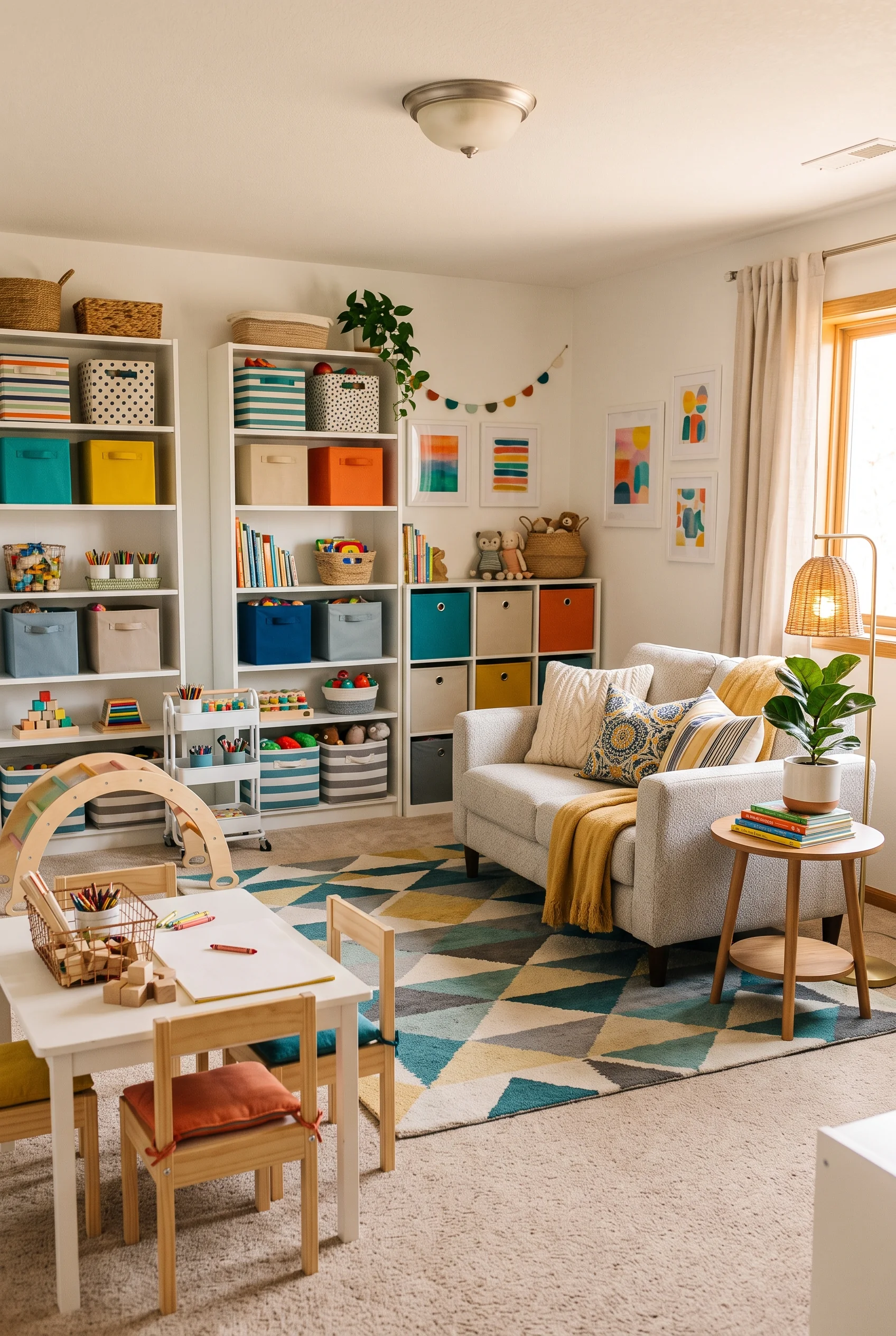
Two floor-to-ceiling shelving units anchor this playroom, and neither one eats into the floor space where kids actually play. Fabric bins in teal, mustard, and coral fill the lower shelves, while wicker baskets and a trailing plant soften the top.
Books get their own row, spines out and loosely color-grouped, which makes them as easy to browse as to reshelve. A geometric rug in the same teal-and-gold palette ties the storage wall back to the cozy loveseat across the room, where the family actually sits to read what gets pulled off those shelves.
Zones That Give Every Kind of Play Its Own Address
A gray bean bag and a low book rack claim one corner, no rug required to signal that this is where reading happens. Across the room, a wooden train table holds its own little world of tracks and blocks, while a two-seat art table sits under natural light with paint bottles and a paper roll ready to go.
Nothing here is walled off. The zones read clearly just from what’s grouped together and what’s within arm’s reach, which means a toddler and a grade-schooler can occupy the same room without competing for the same six inches of floor.
A Neutral Backdrop Lets the Toys Be the Color
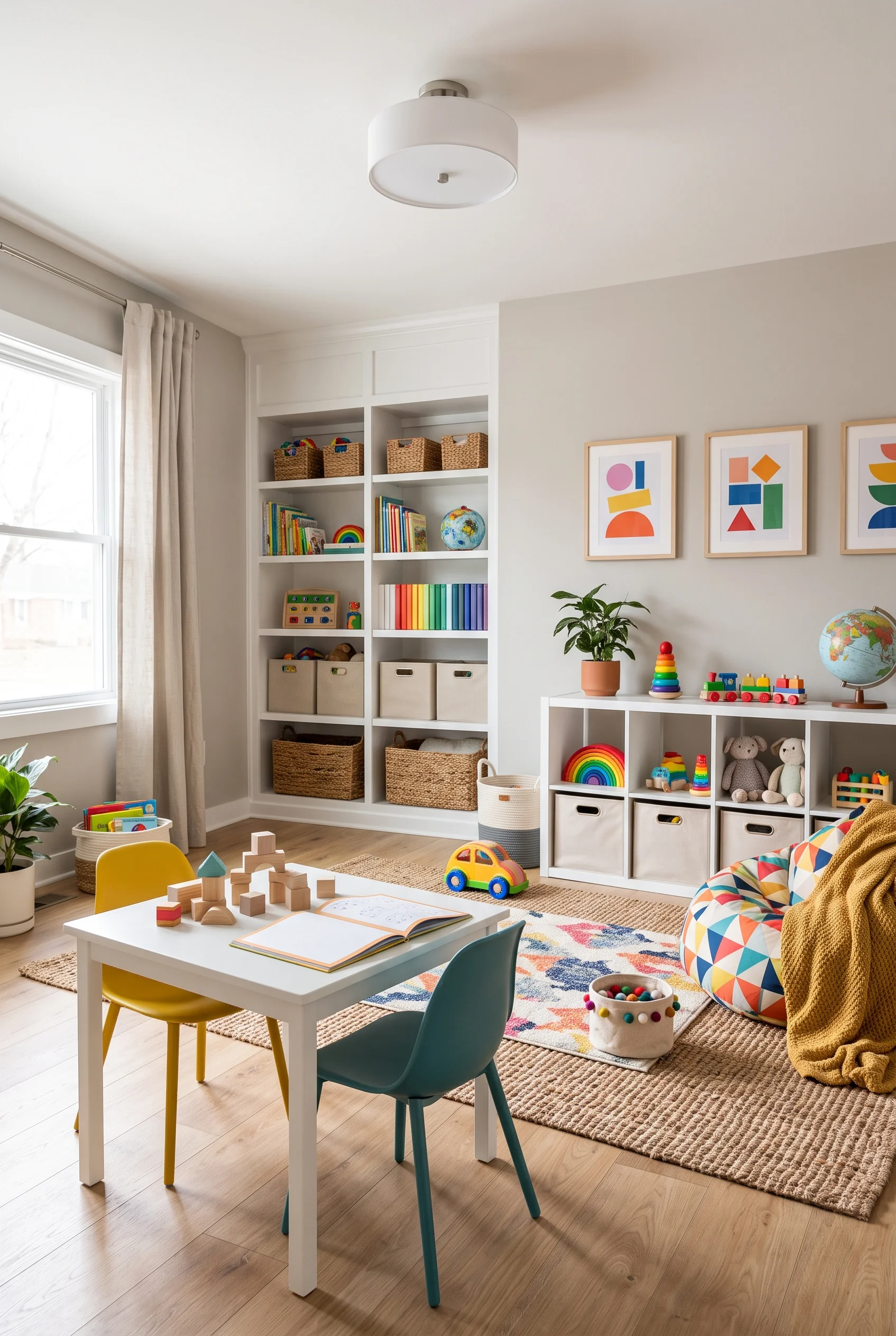
Soft gray walls and white built-in shelving do the quiet work here, staying out of the way so a rainbow of storage bins, graphic art prints, and a mustard-yellow chair can carry the personality. It’s a palette built to flex: swap the bins in a few years, and the bones of the room barely change.
A geometric bean bag chair and a pom-pom storage basket add texture without adding more color to keep track of. The room reads considered rather than curated within an inch of its life, built to survive daily use rather than just look good in photos.
Washi Tape and Little Hands Make the Best Wall Art
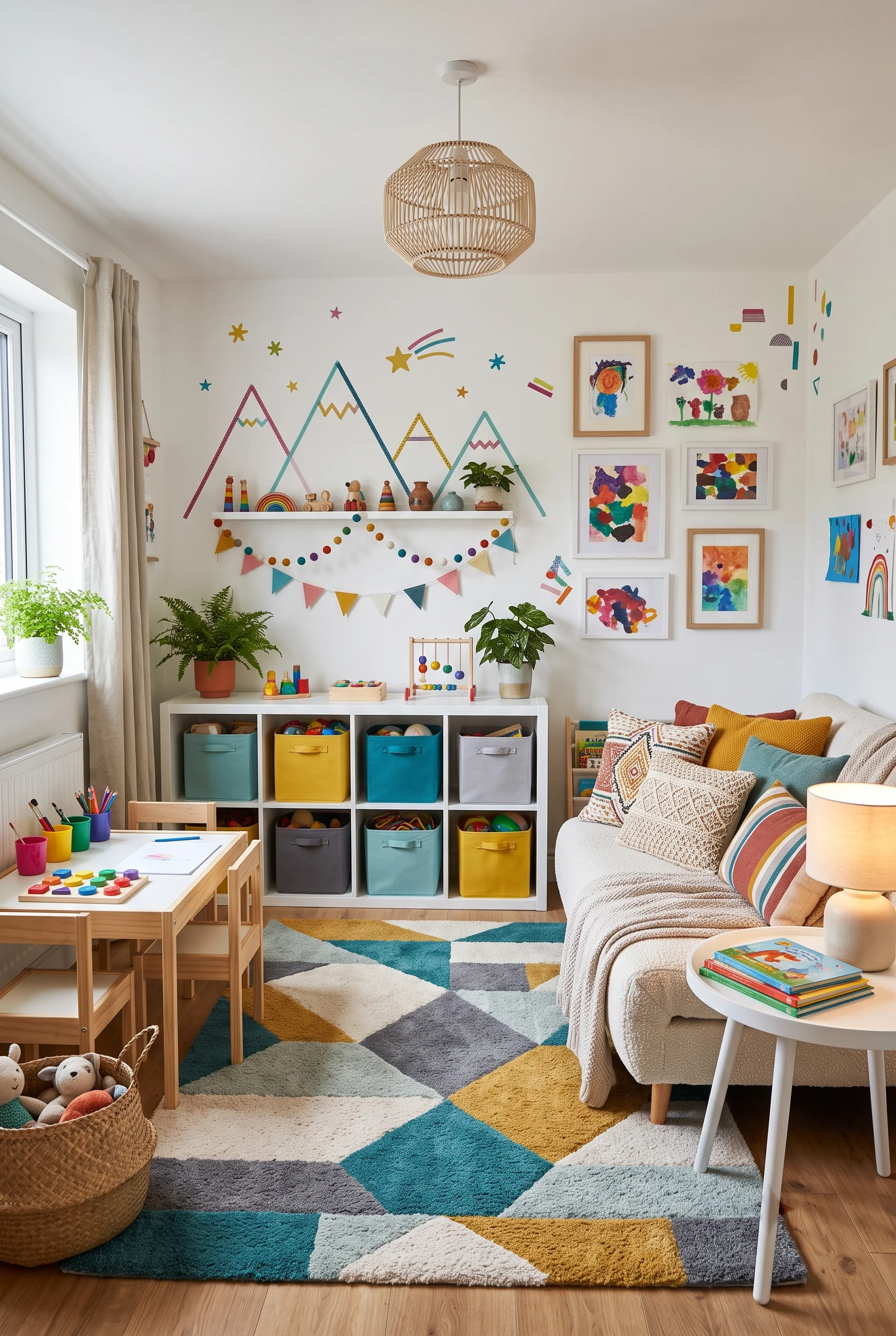
Strips of colorful washi tape form a mountain range across a plain wall, anchored by a floating shelf of wooden toys and topped with a felt garland. It costs almost nothing and comes down just as easily when the next idea comes along.
On the opposite wall, actual kids’ artwork fills a loose grid of frames, unframed drawings tucked in alongside the framed ones. Between the two, this corner runs almost entirely on tape, paper, and whatever’s already stuck to the fridge.
Furniture That Multitasks as Hard as the Room Does
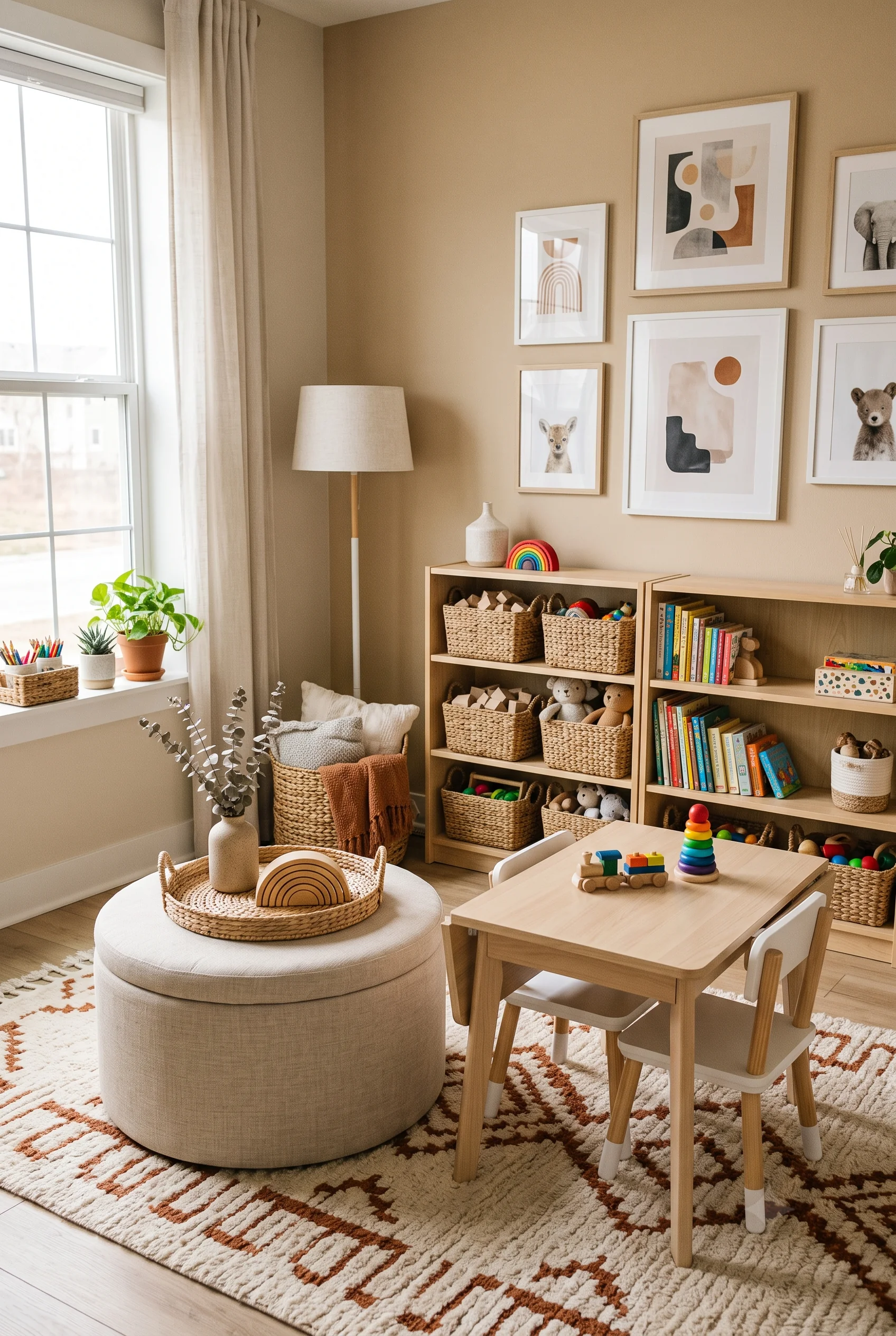
A round storage ottoman does triple duty here: extra seating, a hidden bin for overflow toys, and a tray-topped surface for a vase and a wooden rainbow when it’s not being sat on. Woven baskets on the shelving behind it keep books and stuffed animals equally accessible.
A wooden kids’ table with two-tone chairs sits nearby, ready for puzzles or snacks. None of it is precious. All of it works at least two jobs, which is exactly what a shared family space needs.
Corners and Considerations for Every Age and Stage
Not every part of a playroom needs to be colorful or clever. Some of it just needs to work quietly in the background: a corner for slowing down, a station for making things, furniture that fits a four-year-old and an eight-year-old equally well, and safety details nobody notices until they’re missing. These four rooms handle that job well.
A Reading Corner Built for Sinking In
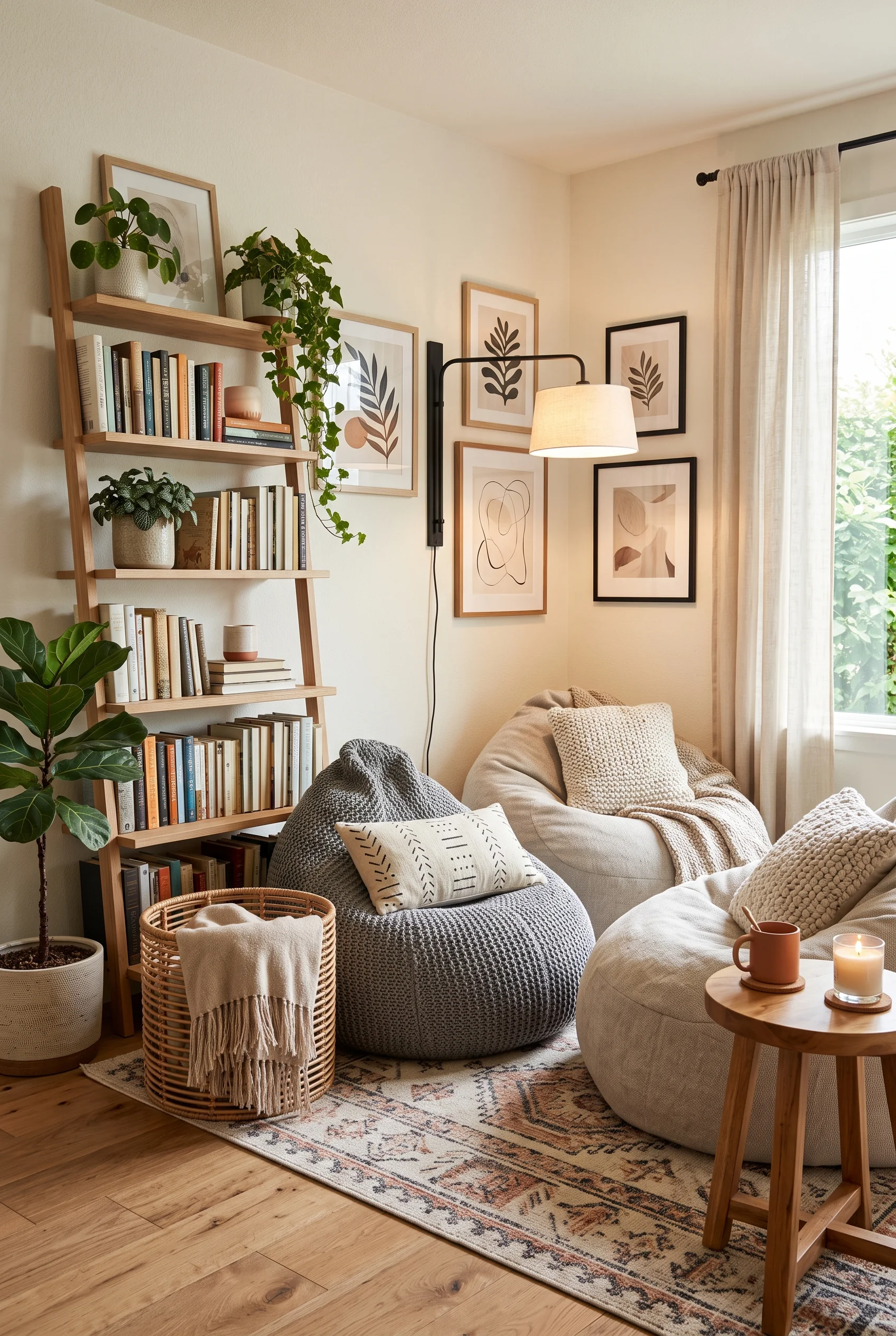
A gray knit pouf and an oversized cream bean bag chair share a corner with a ladder bookshelf stacked with books, plants, and a single framed print. A wall-mounted sconce casts warm light downward without taking up floor space for a lamp.
A round side table holds a candle and a mug within reach, a small detail that signals this reading nook is for the grown-up curling up here too, not just the kids. Layered rugs underfoot finish the softness this kind of corner depends on.
Shop the Room
One Room, Every Age, No Outgrowing It
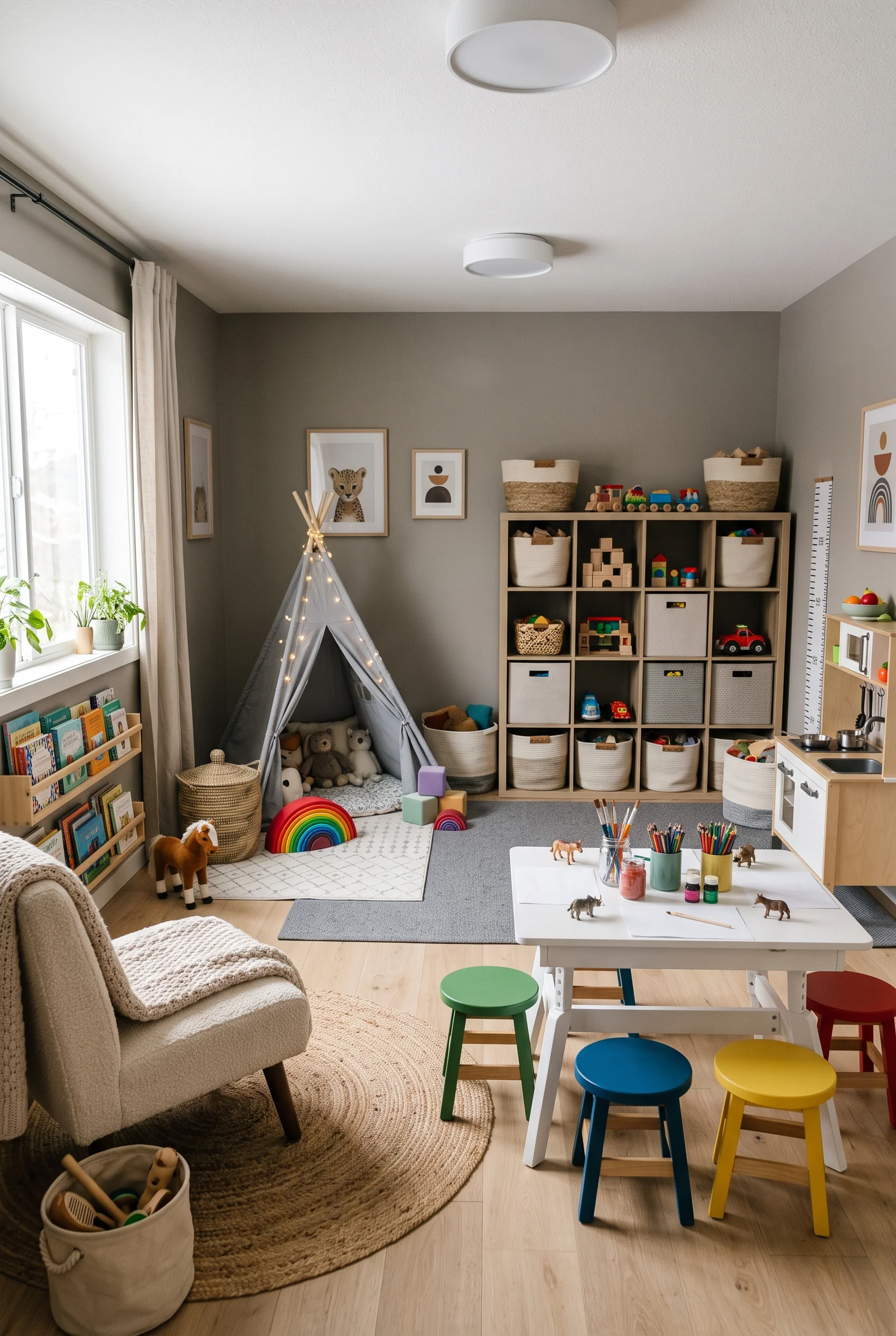
A fairy-lit teepee tent gives a toddler somewhere to hide with stuffed animals, while a cluster of stools in different colors surrounds a craft table sized for older kids drawing with markers and animal figurines. A growth chart on the wall tracks who’s using which zone this year.
Cube storage with labeled bins sits between the two areas, holding everything from wooden trains to play food from a toy kitchen. Nothing about this layout assumes the room stays the same for long, which is exactly the point when siblings are years apart, the way shared kids’ bedrooms often have to plan around too.
The Safety Details That Let You Relax While They Play
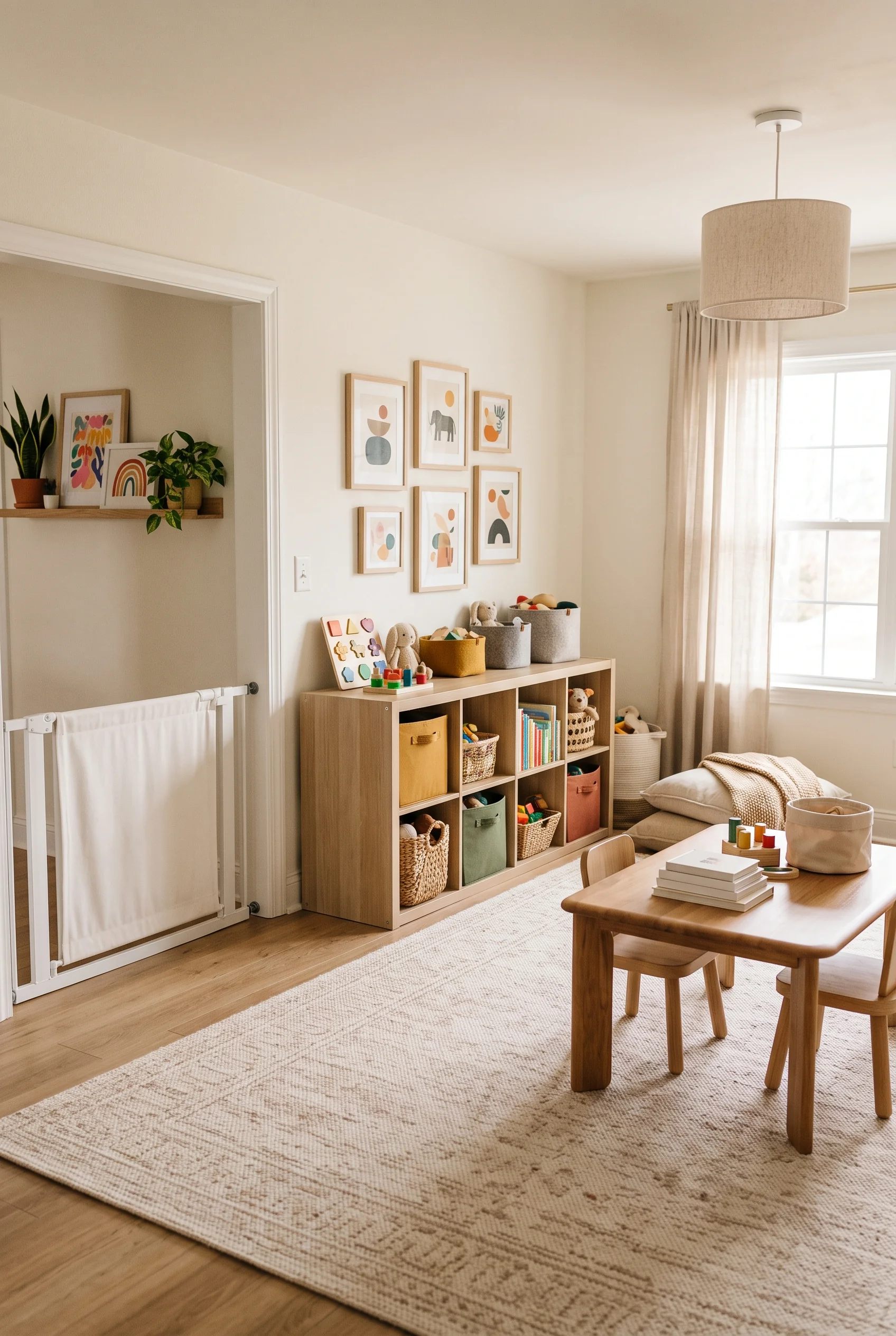
A white safety gate spans the doorway to the stairs, the kind of detail that’s easy to skip when the basement playroom otherwise feels finished. Behind it, a cube storage unit sits flush against the wall, secured rather than left free-standing where a climbing toddler could tip it.
None of this shows up in a photo the way a rainbow rug does, but it’s the reason a parent can actually sit down while the kids play instead of hovering by the stairs. A calm, neutral rug and a simple wood table keep the room feeling like a playroom rather than a childproofed bunker.
Light, Texture, and a Calmer Way to Play
A basement starts at a disadvantage: less natural light, more concrete, sometimes an odd layout leftover from whatever the space used to be. The right lighting, the right rug placement, and a few grounding, screen-free choices close that gap fast. These five rooms make a basement feel like less of a basement.
Layered Light That Makes a Basement Feel Above Ground
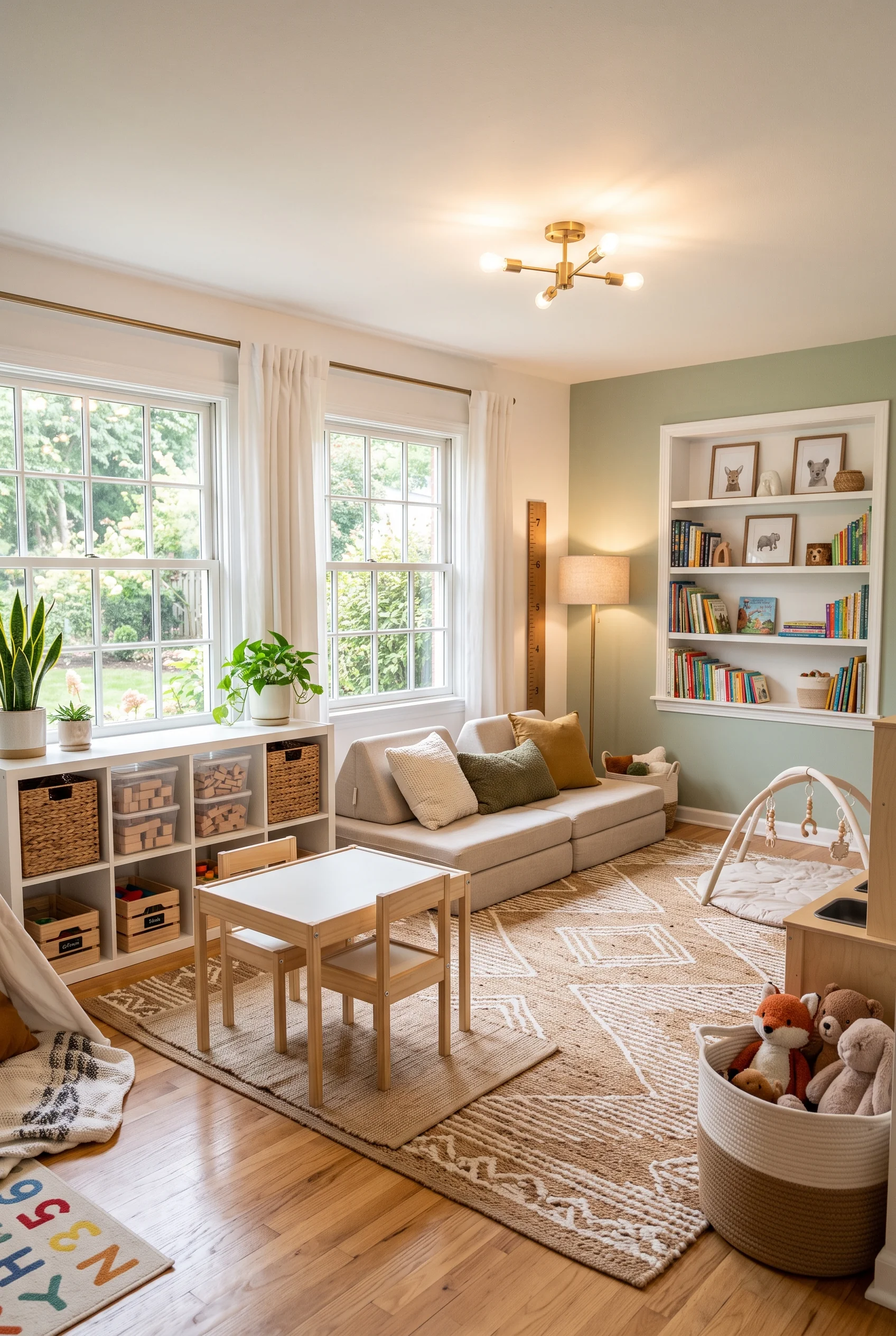
Two oversized windows do the heaviest lifting in this room, but a woven-shade floor lamp and a fabric pendant fill in once the sun moves. Layering light sources this way means the room never has that flat, single-bulb basement look, even on a gray afternoon.
A sage green accent wall and a built-in bookshelf catch the warm light beautifully, which is really the test of good lighting: does the room look inviting at every hour, not just at noon.
Rugs Do the Zoning Work Walls Can’t
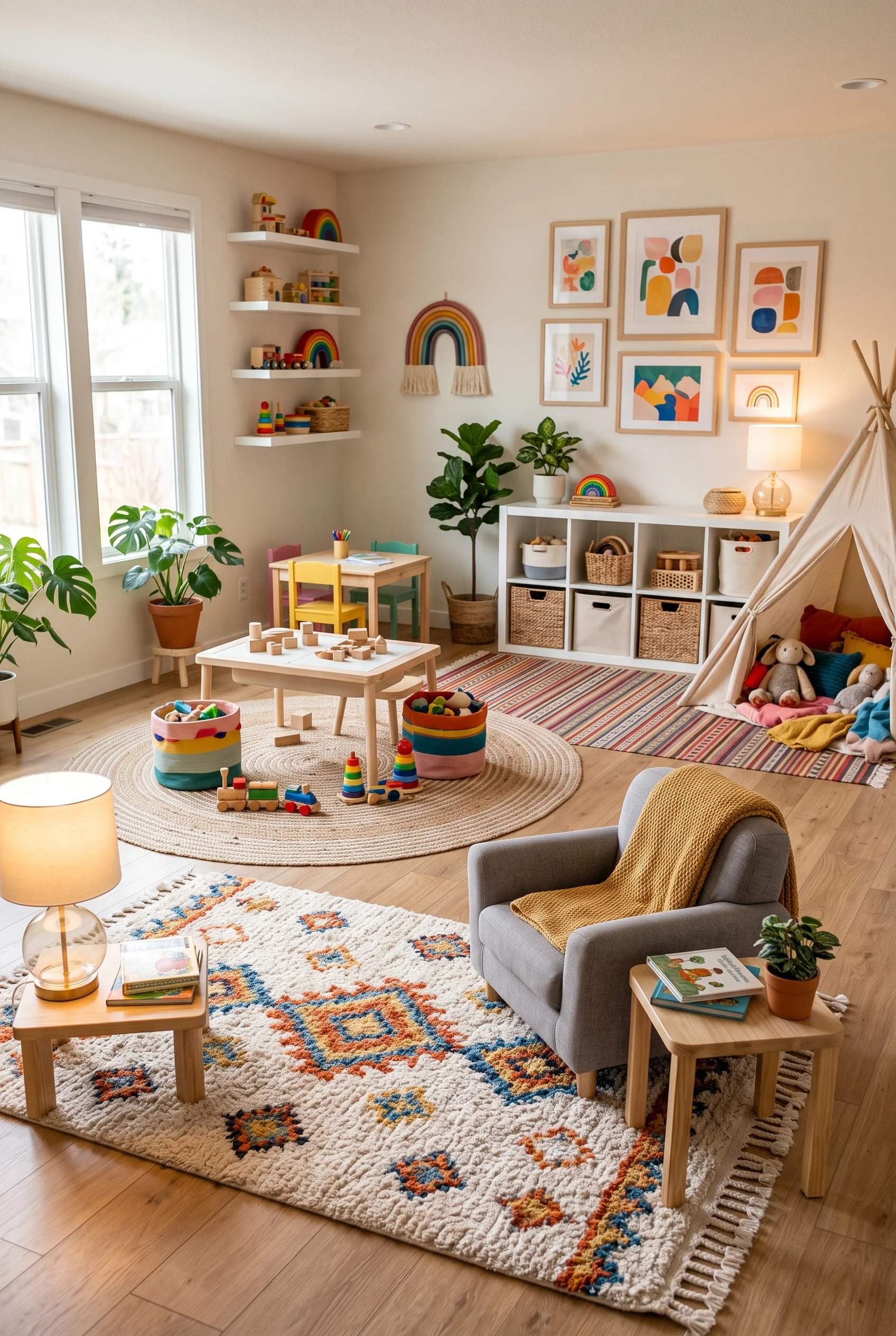
Three different rugs cover this floor, and each one marks a different kind of play, with not a single wall in sight. A round woven rug holds the block table, a striped kilim runs alongside a fairy-lit teepee, and a patterned washable area rug anchors the reading chair in the corner.
Each rug gives the eye a place to land before moving on to the next one, a layering trick that costs less than furniture and does just as much visual organizing.
A Green Corner That Makes the Basement Feel Like Outside
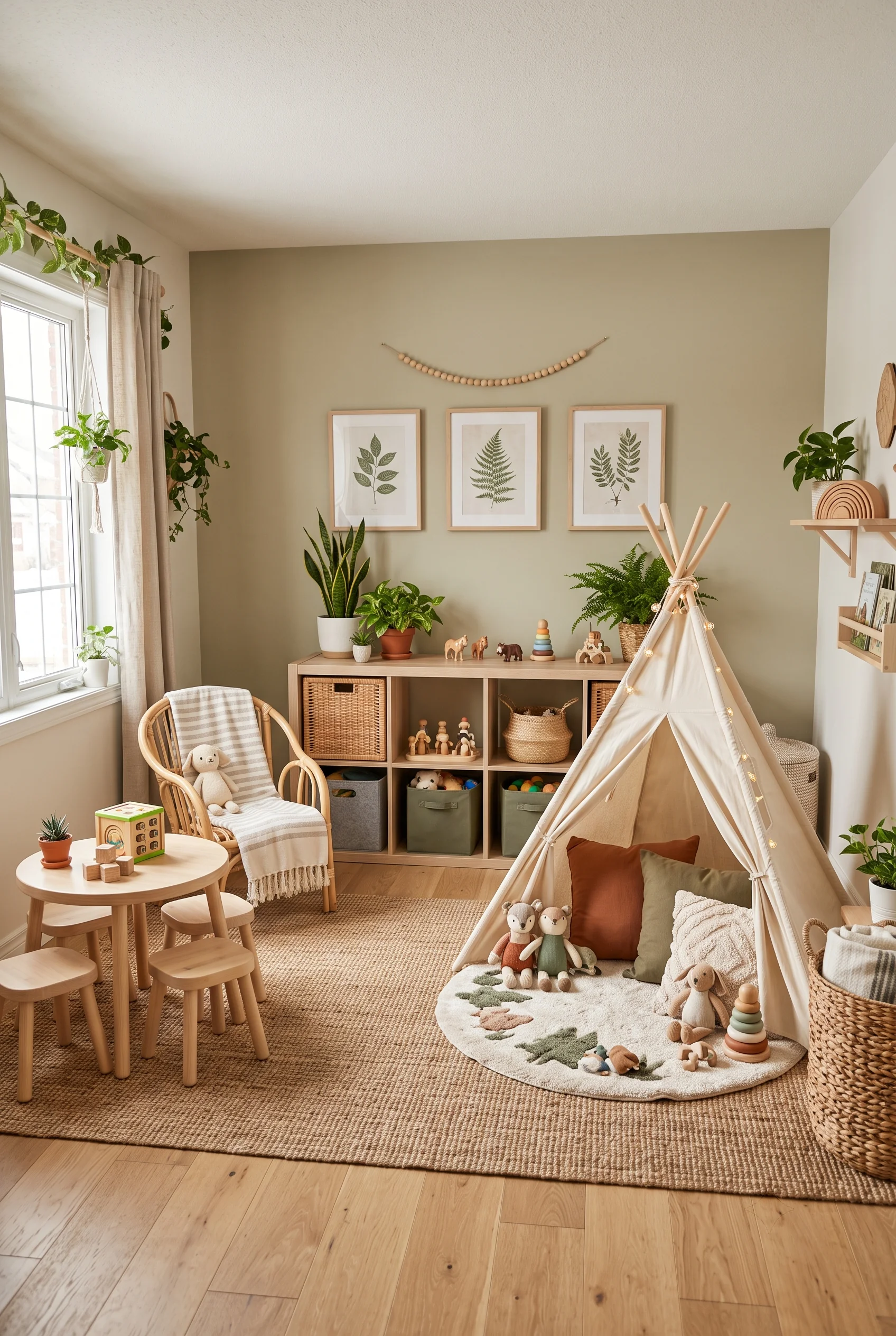
Hanging pothos, a potted fern, and a tall snake plant fill the window ledge and shelving in this sage green corner, softening what could otherwise feel like a plain basement wall. Botanical prints above the shelving echo the greenery without adding another pattern to the mix.
A canvas teepee and jute rug keep the materials warm and natural, which matters most in a room with no windows of its own. Plants and wood tones do a lot of quiet work convincing a body that it’s not actually underground.
A Corner Built for Slower, Screen-Free Afternoons
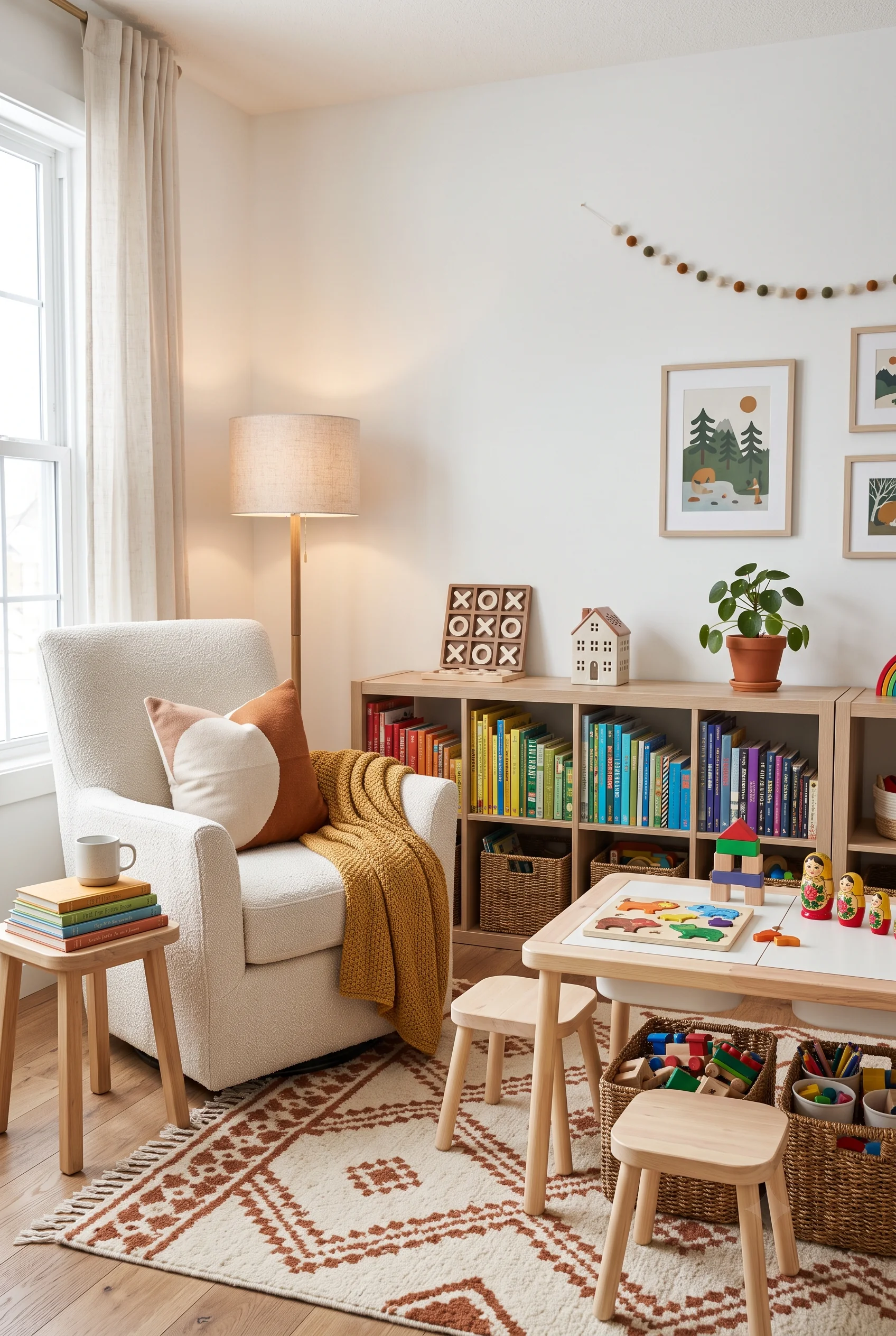
A wooden tic-tac-toe set and a small ceramic house sit on a low bookshelf stacked with rainbow-spiny books, the kind of open shelf that invites browsing more than a closed cabinet ever could. A boucle armchair with a mustard throw waits nearby for whoever finishes first.
At the kids’ table, a wooden puzzle and a set of nesting dolls sit ready, with no screen in sight. Nothing here needs batteries, which tends to be exactly what makes it get played with longest.
Open Shelving That Keeps Cleanup Honest
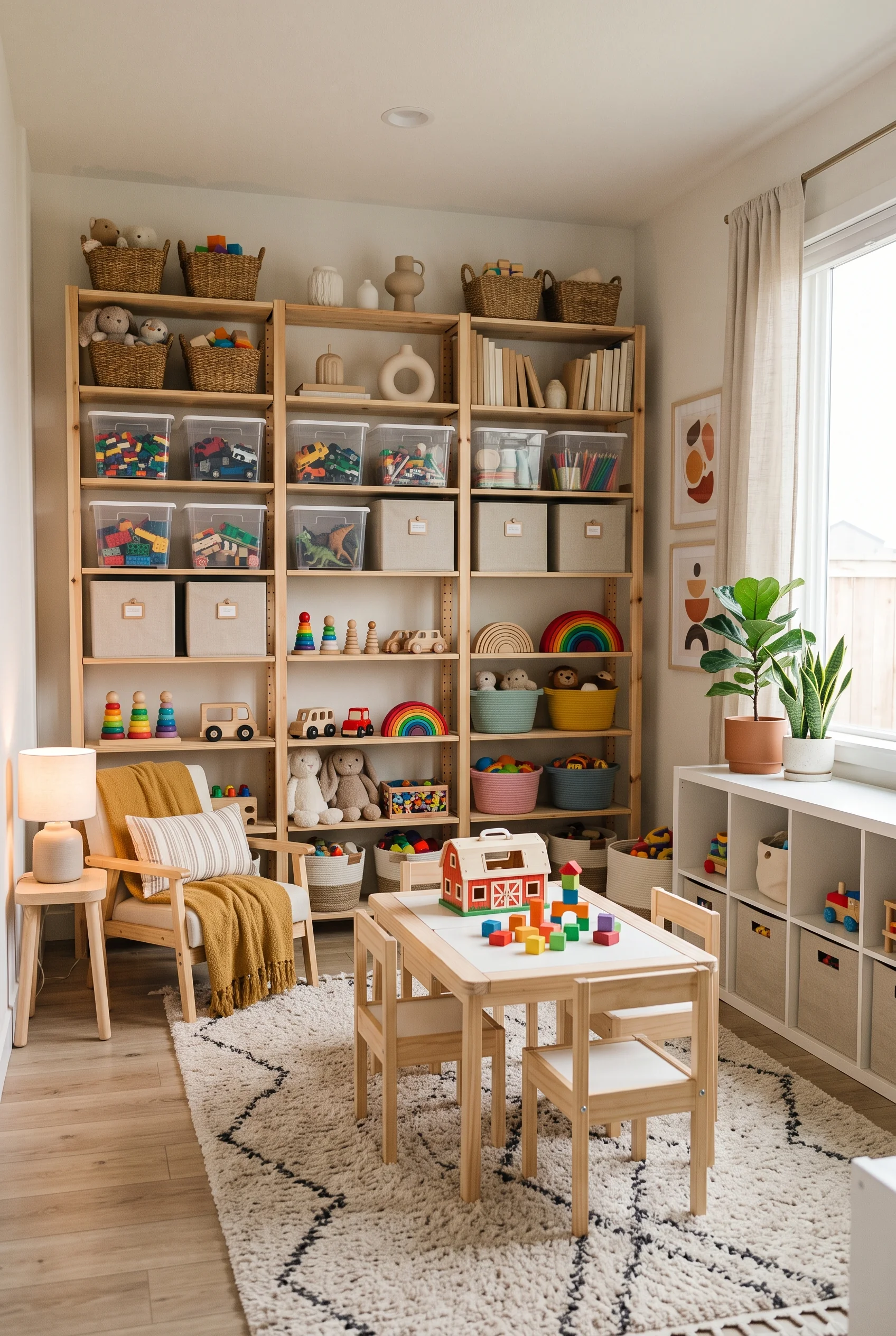
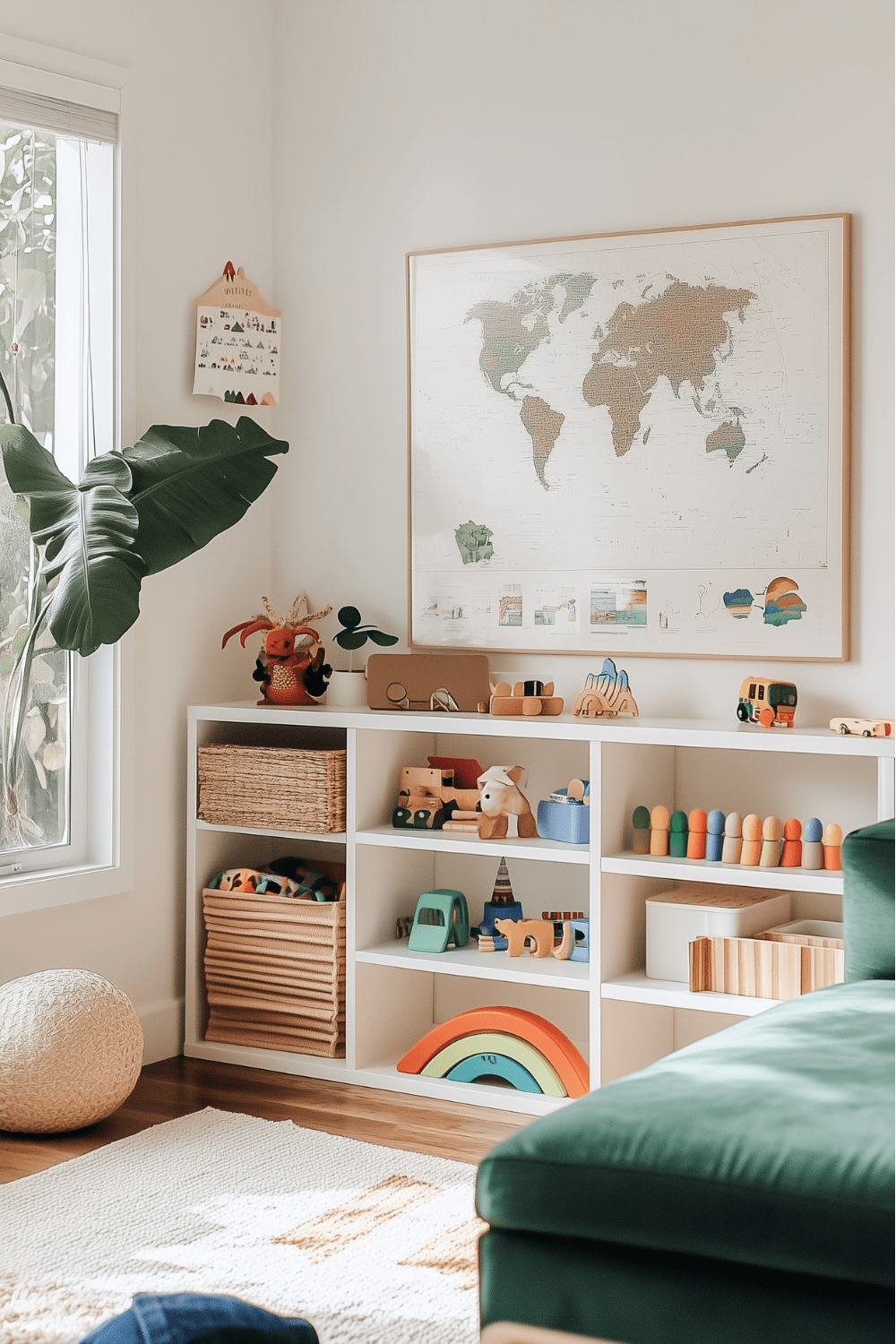
Three tall wood shelves hold an entire toy collection in clear view: labeled bins for building blocks, baskets sorted by toy type, a wooden rainbow displayed rather than tucked away. Nothing requires opening a drawer to find out what’s inside.
That visibility is the whole strategy. When a kid can see exactly where the cars live, putting them back becomes a much smaller ask than when everything disappears into one deep, mystery bin.
Spaces Built Around What Kids Love Most
Some corners of a playroom exist for one specific kind of joy: a stage for a concert nobody asked for, a spot to burn off energy on a rainy day, a fully committed theme, or a wall that holds the family’s actual life. These four rooms each chase one idea and follow through on it completely.
A Stage Small Enough for Big Performances
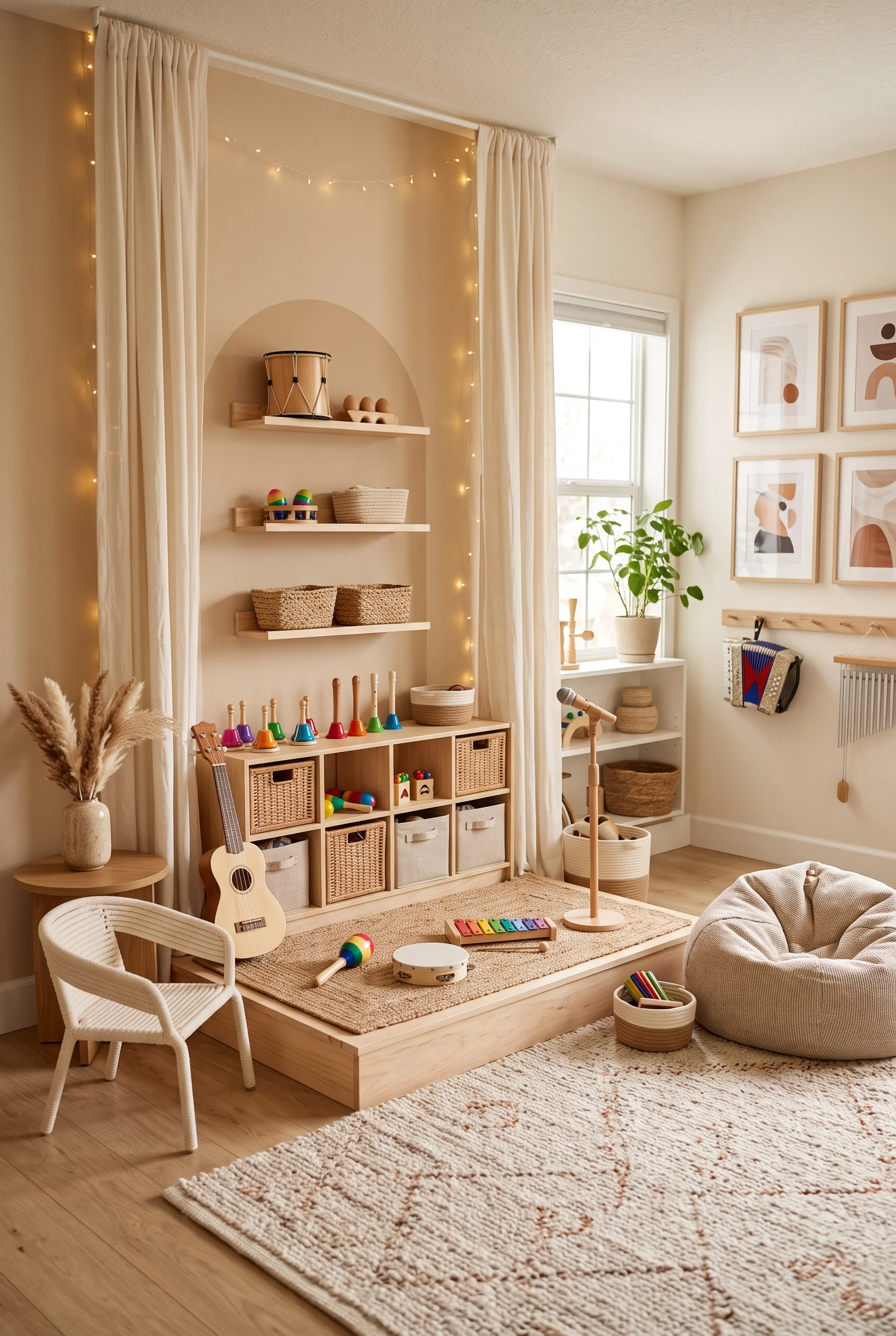
A raised wooden platform tucked behind fairy-lit curtains gives this music corner its own sense of occasion. A ukulele leans against a low shelf stocked with hand bells, a tambourine, and a xylophone, all within easy reach of a seated performer.
A cream bean bag chair sits close enough for an audience of one or two, and the soft materials throughout- the woven rug, the curtain fabric- help absorb some of the noise a room full of instruments inevitably makes.
Indoor Movement for Days the Backyard’s Off Limits
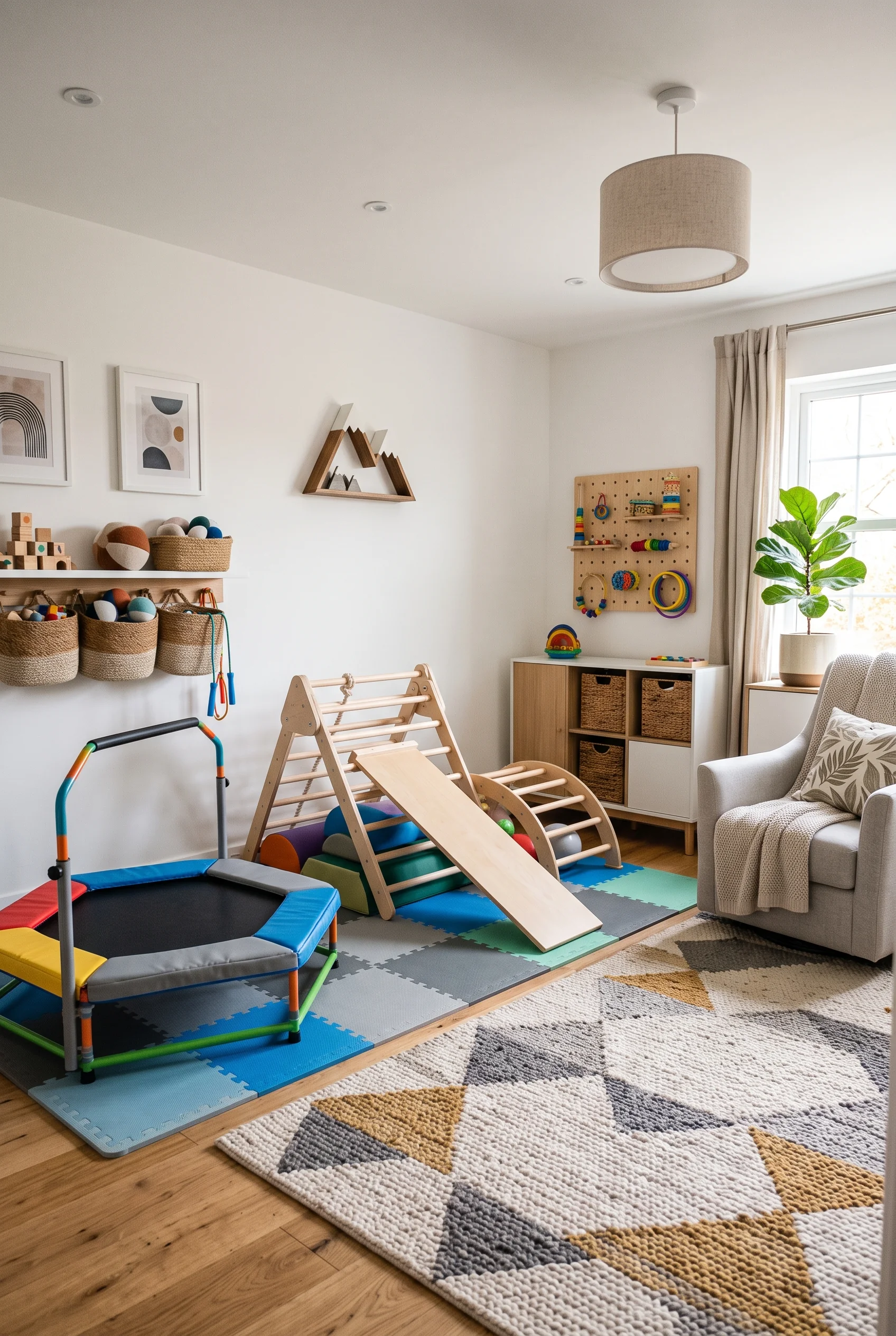
A wooden climbing triangle with a ramp slide sits on interlocking foam mats, paired with a mini indoor trampoline and a wall-mounted pegboard strung with rings and rope. It’s a full gross-motor setup that fits in a single corner.
Jump ropes and balls sit in baskets along the wall, easy to grab and just as easy to put back. On the days a basement is the only option for burning off energy, this corner earns its floor space many times over.
A Theme Committed to Down to the Last Star
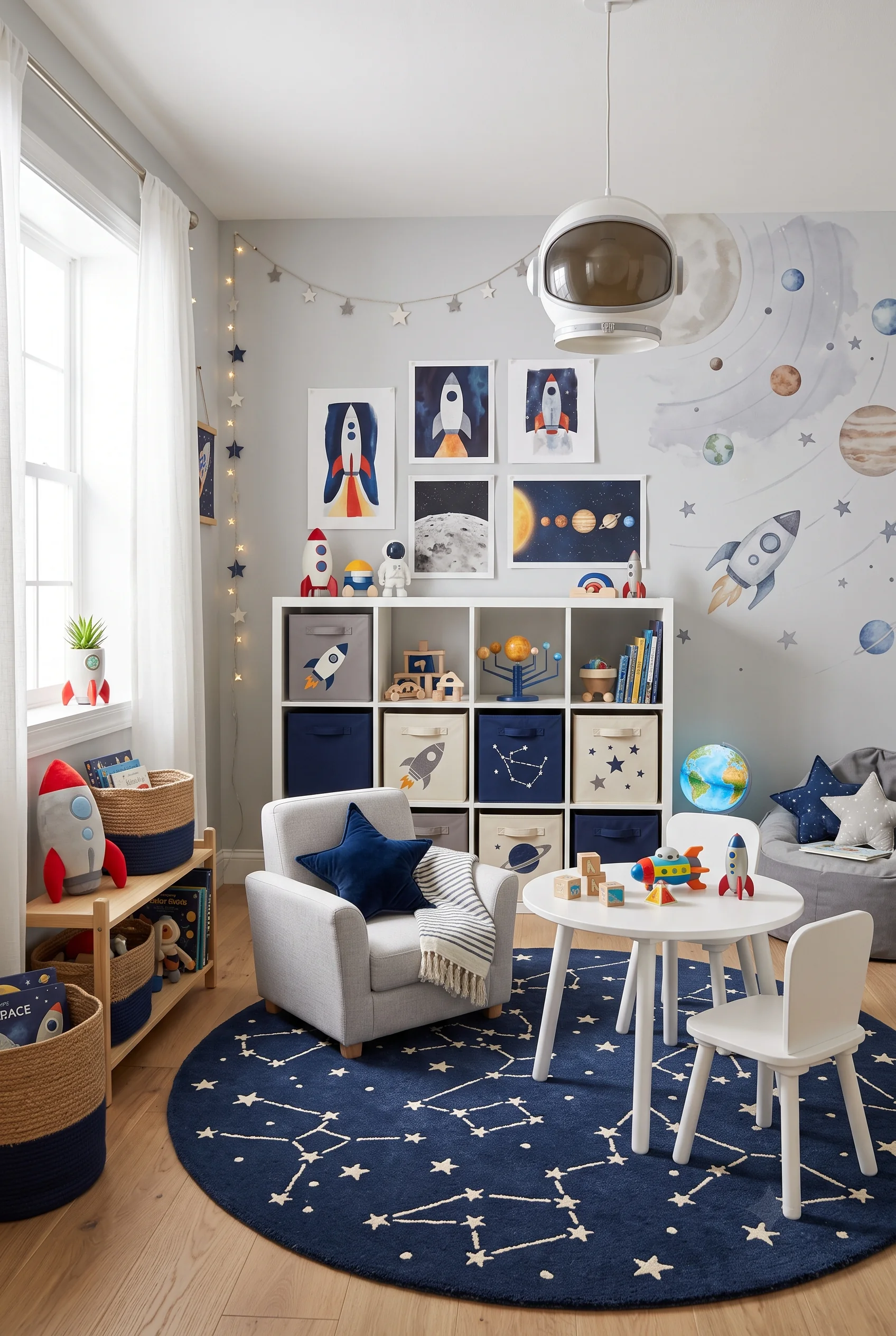
An astronaut helmet pendant light hangs over a round white table set on a navy constellation rug, while a painted mural of planets and a rocket stretches across the wall behind it. Rocket and star-print storage bins keep the theme consistent all the way down to the toy boxes.
Committing fully to a theme like this one works because nothing feels like an afterthought. Even the globe and the astronaut figurine on the shelf earn their spot rather than reading as random add-ons.
A Gallery Wall That Mixes the Everyday With the Handmade
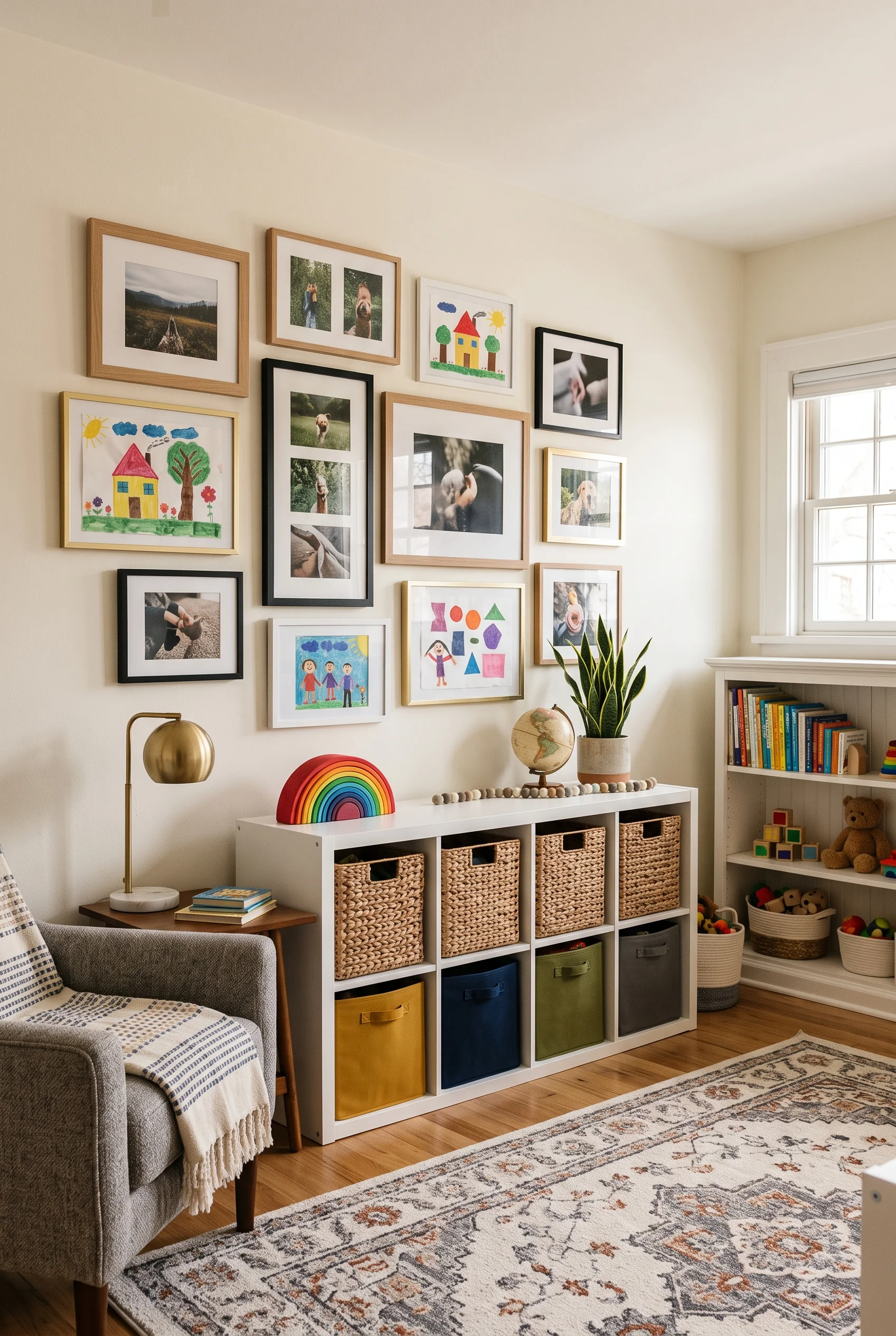
A dense grid of frames mixes black-and-white family photos with a child’s crayon drawing of a house, hung at the same scale and given equal weight on the wall. Gold, black, and natural wood frames sit side by side rather than matching.
It’s a small decision with a big effect: the artwork on this wall says the family lives here, plays here, and made half of what’s hanging on it. A storage cabinet with woven and colored bins underneath keeps the wall from feeling like the only intentional part of the room.
Small Touches That Make a Big Room Feel Finished
A playroom doesn’t need a full renovation to feel pulled together. Sometimes it’s a secondhand find with good bones, a seasonal swap that takes twenty minutes, a mirror placed with intention, or a table set up for one specific kind of mess. These four rooms make the case for small moves over big budgets.
Good Bones Matter More Than a Big Budget
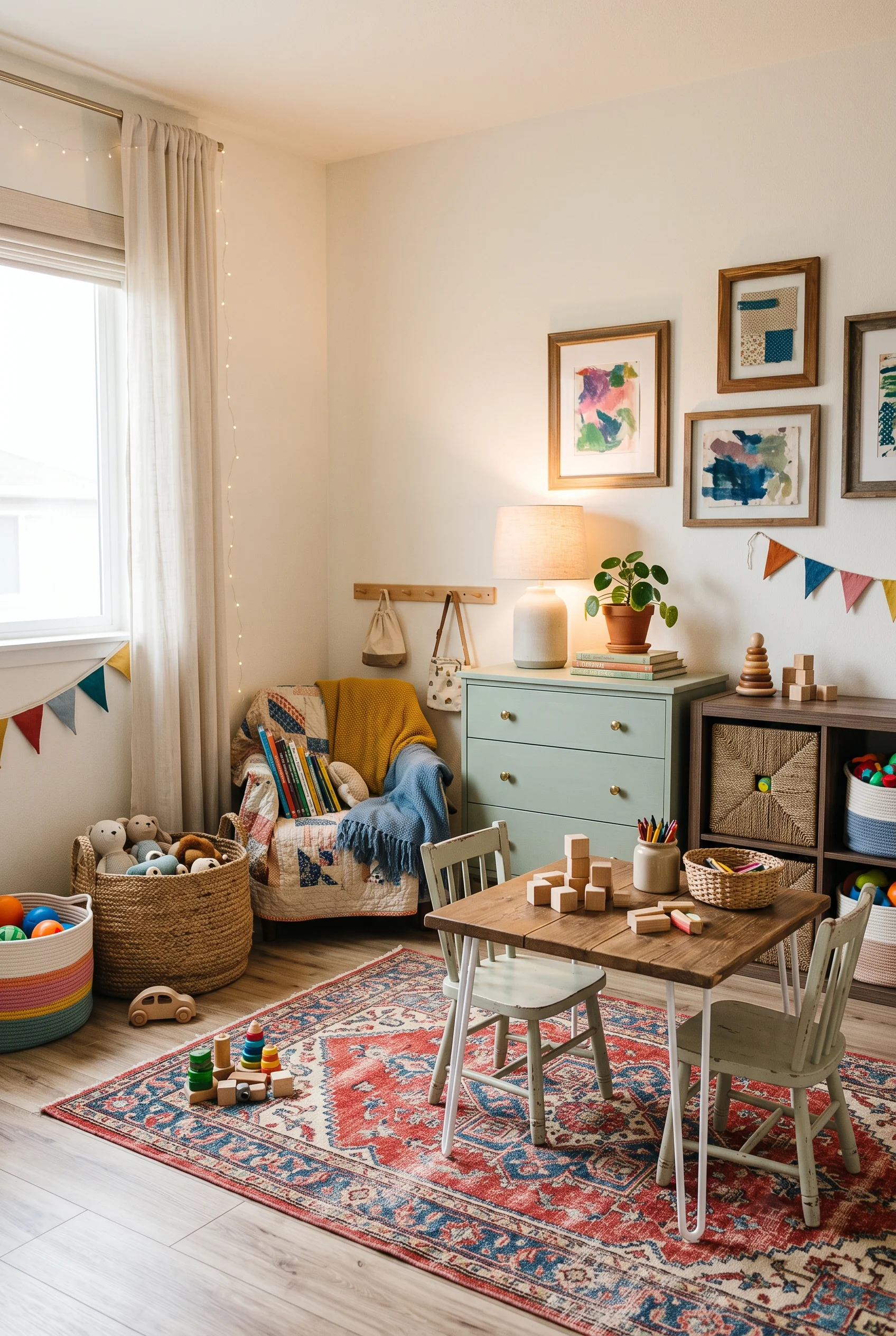
A pair of vintage painted chairs, slightly mismatched on purpose, pull up to a hairpin-leg table that looks thrifted and well-loved rather than brand-new. A patchwork quilt draped over the armchair and a mustard throw add warmth that no amount of spending could fake.
None of the furniture here matches perfectly, and that’s what makes it feel collected rather than purchased all at once, closer to the kind of clutter-free, considered kids’ spaces that grow with a family rather than against it. A budget playroom built this way tends to age better than one filled with matching new pieces anyway.
Decor That Changes With the Season, Not the Whole Room
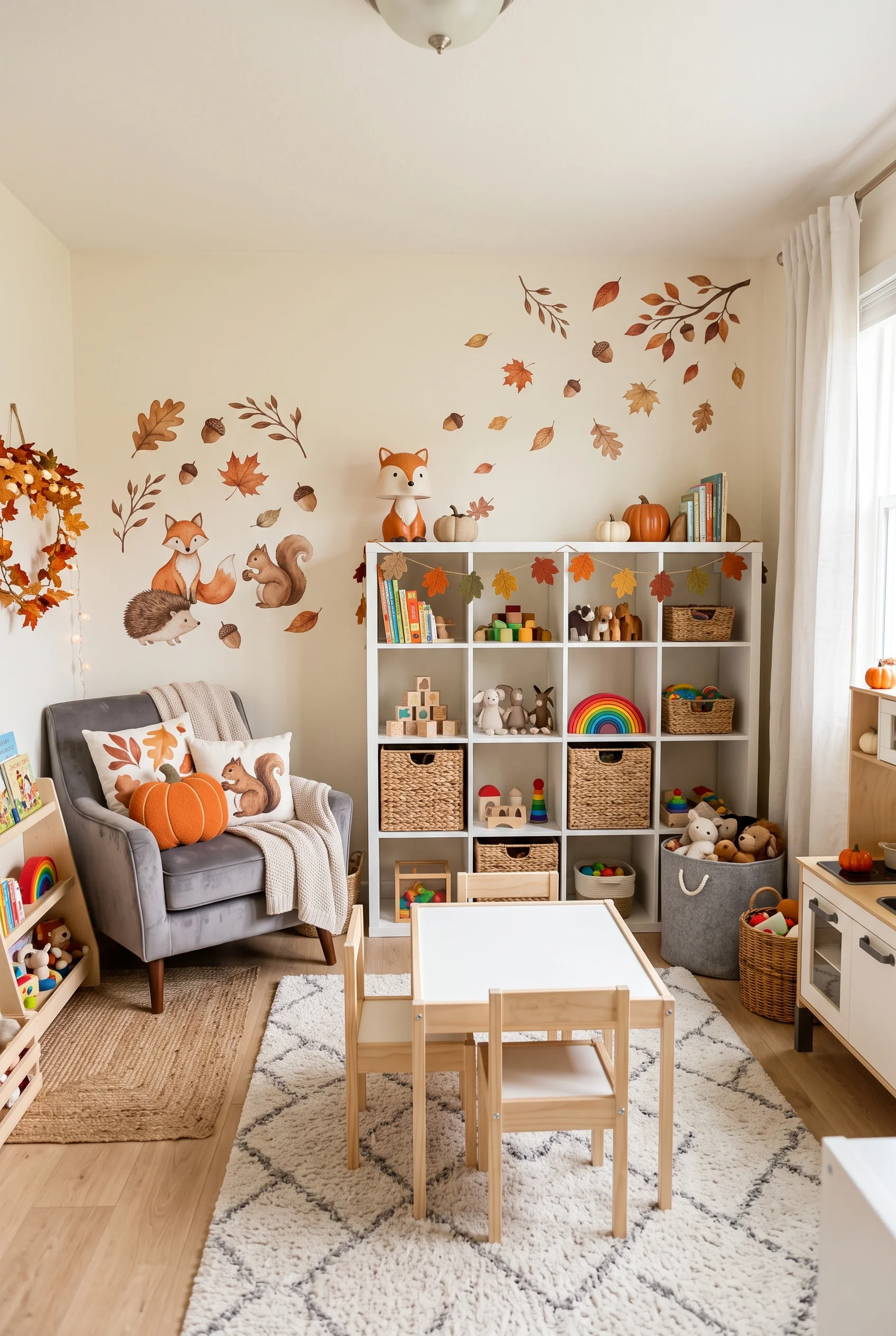
Removable leaf and woodland-creature decals turn a plain wall into an autumn scene without a drop of paint, while a pumpkin-shaped pillow and a fox-print cushion carry the season onto the armchair. A dried leaf wreath by the door finishes the look.
Everything here can come down in an afternoon when the next season rolls around. That’s the appeal of seasonal decor over a full theme: the storage cubes, the shelving, the actual furniture underneath never has to change.
Mirrors Borrow Light and Square Footage
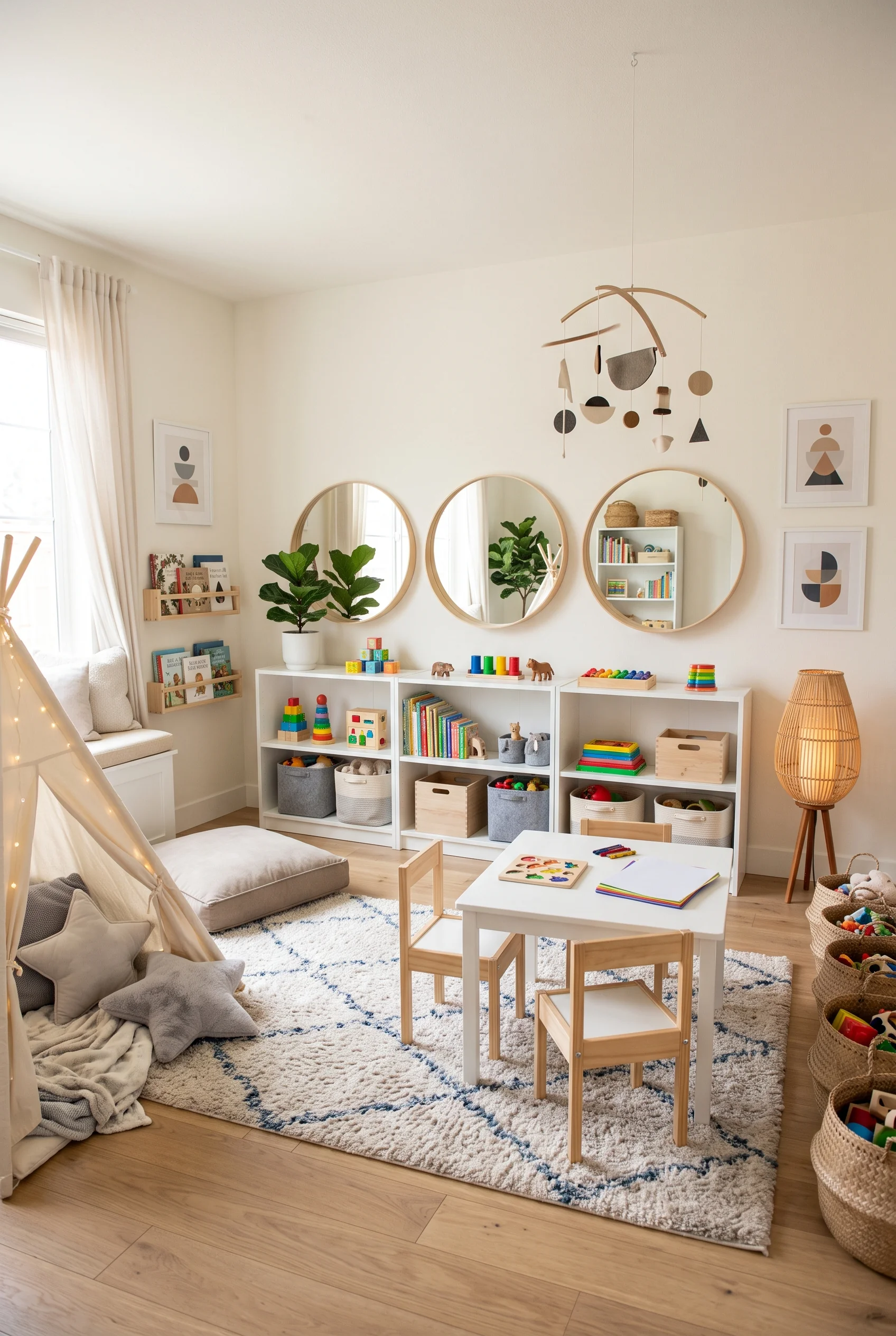
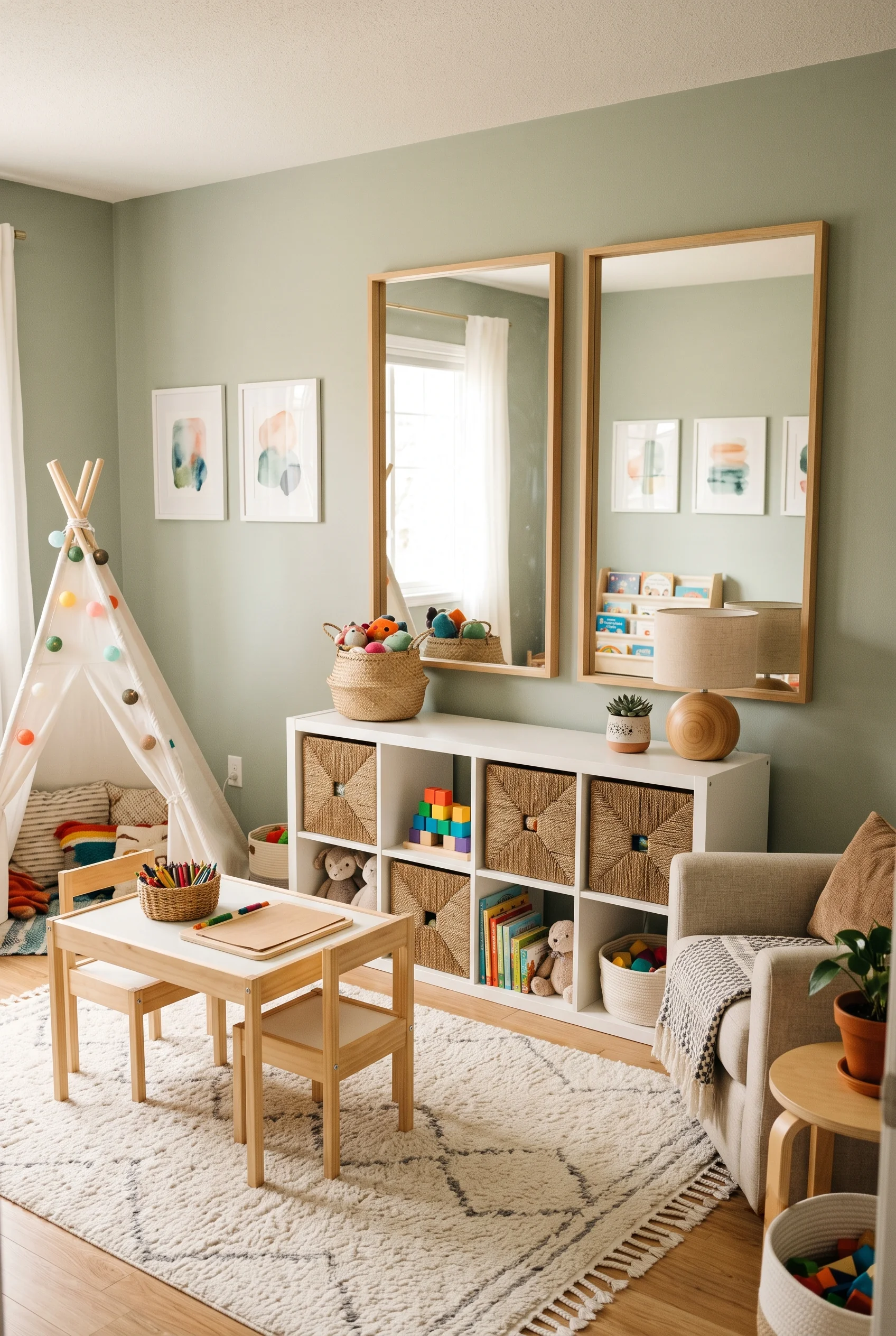
Three round mirrors in matching wood frames hang above a low console, bouncing light from the window back across the room and doubling the visual depth of a teepee and a cluster of plants on the opposite wall. A paper mobile floats above, adding movement without clutter.
In a basement especially, where natural light is often limited to begin with, a grouping like this does real work. The room reads larger and brighter than its actual dimensions, no construction required.
A Table Built for Hands-On, Messy Discovery
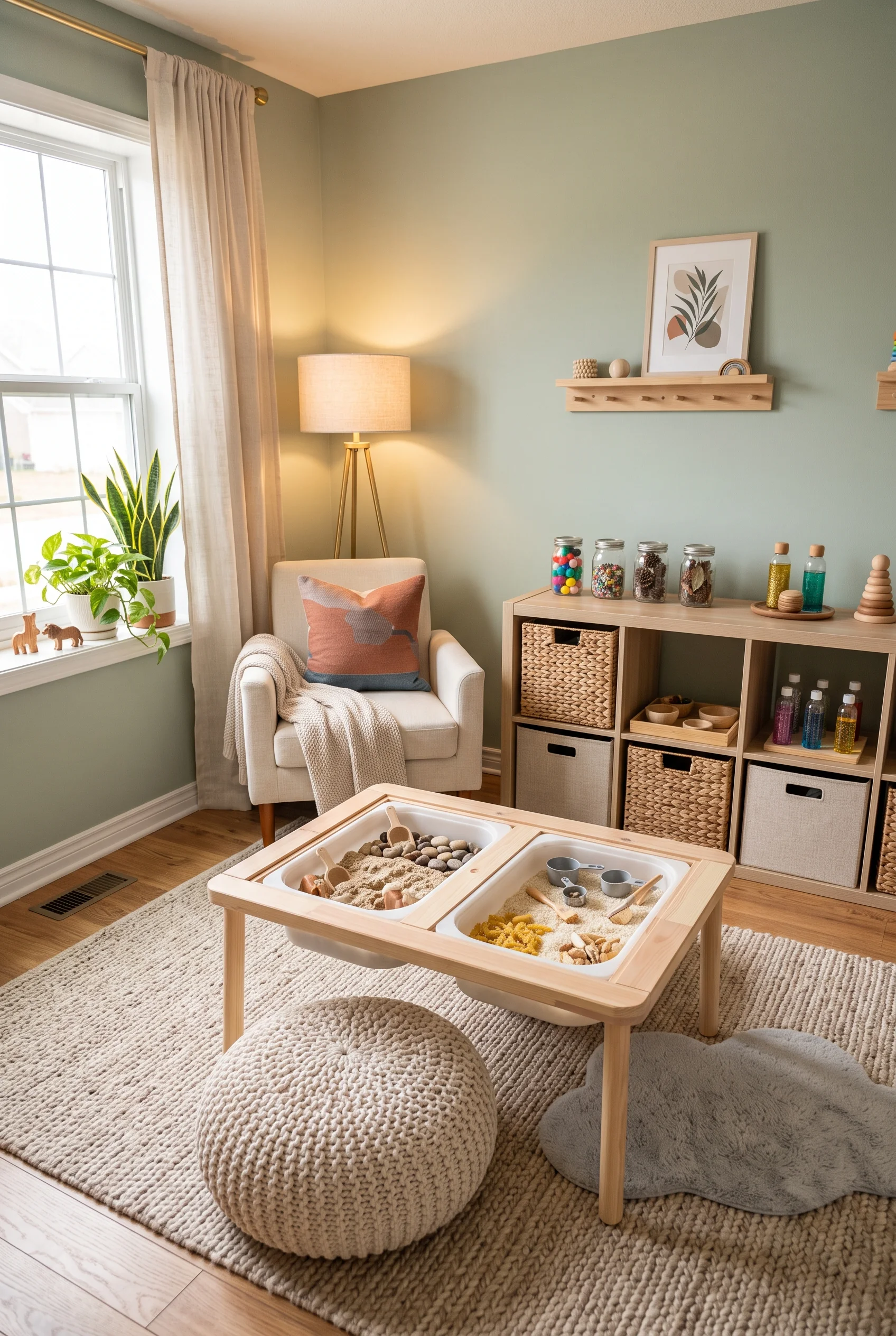
A wooden two-bin table holds sand and river stones on one side, dried pasta and rice on the other, with small scoops and measuring cups tucked in for good measure. A knit pouf pulls up alongside for whoever wants to sit and dig in.
Glass jars of pom-poms and pinecones line the shelf behind it, ready to rotate in once the current bin loses its novelty. It’s a setup built entirely around touch and texture, which asks nothing of a screen and everything of curious hands.
Dedicated Stations for Independent, Focused Play
Certain kinds of play need their own real estate: a stage, a shelf of books at exactly the right height, a table that stays mid-build for days. These four rooms carve out that focused space, and the payoff is kids who occupy themselves a little longer without needing anyone to referee.
A Wall That’s Always Ready for the Next Masterpiece
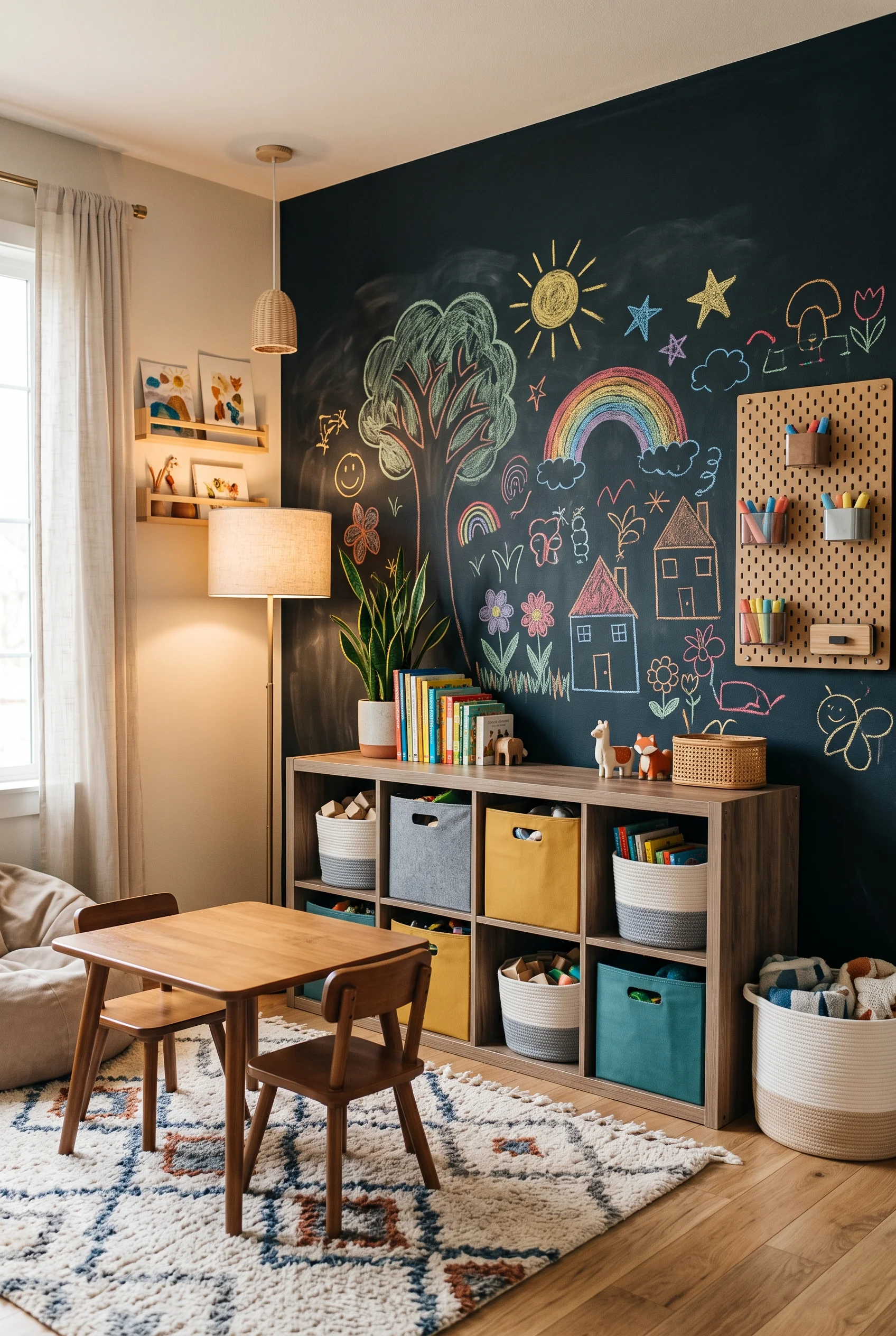
An entire wall painted in chalkboard black holds a rainbow, a lopsided house, and a smiling sun, all drawn in colored chalk that wipes away in seconds. A wooden pegboard beside it keeps the chalk organized in small cups rather than rolling underfoot.
A wall this size means nobody has to share a single sheet of paper or worry about running out of room mid-drawing. It resets in under a minute, which makes it one of the lowest-maintenance creative outlets in the whole house.
A Stage That Turns Stuffed Animals Into Characters
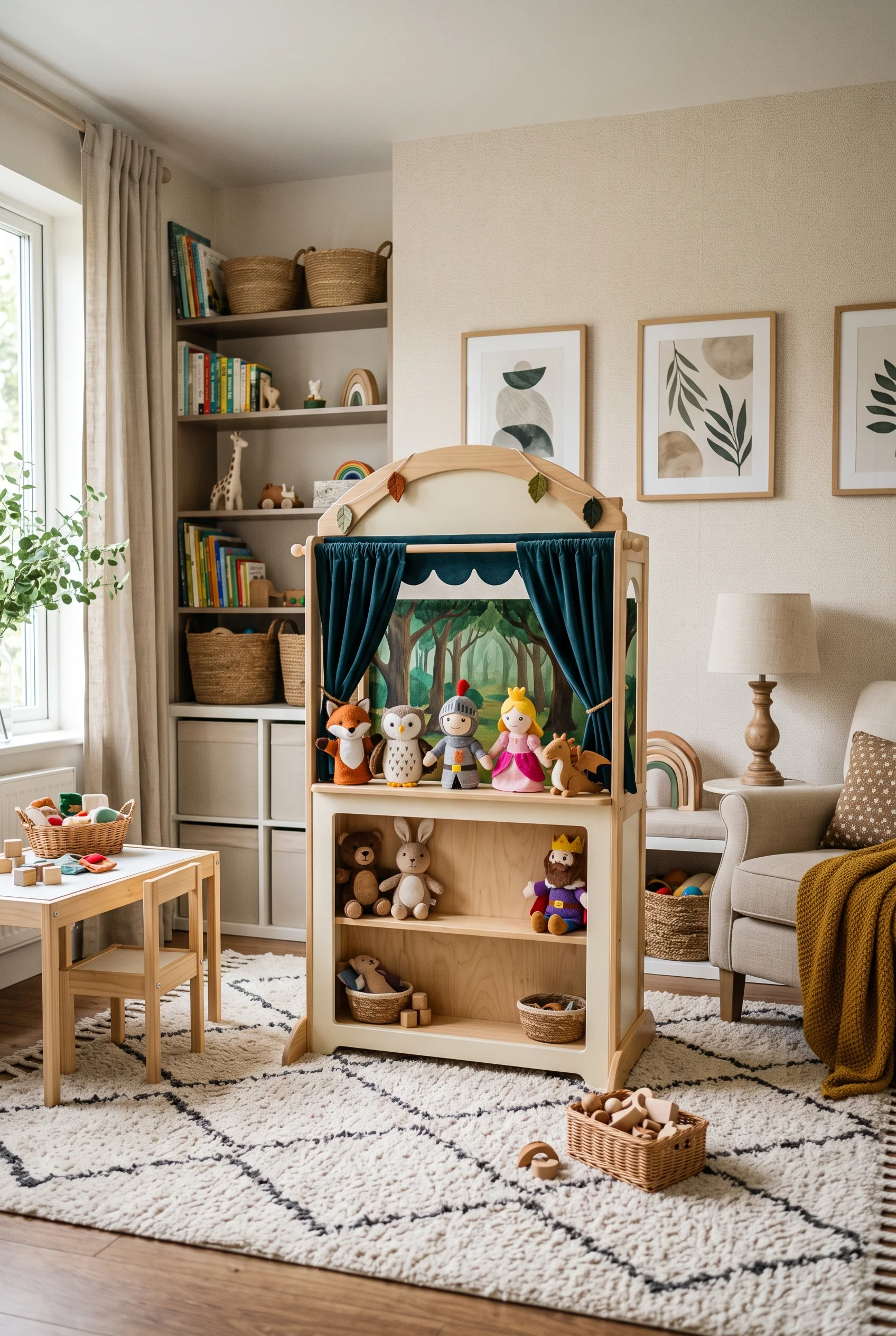
A wooden puppet theater with deep teal curtains and a painted forest backdrop gives a fox, an owl, and a felt princess somewhere to perform. Shelves built into the base store a rotating cast of stuffed animals and puppets so the show can change daily.
A piece of furniture like this might seem like a one-trick investment, but it does exactly what it promises: turning a shy performer into a confident one, with a curtain to hide behind until they’re ready.
A Library Sized for Little Readers
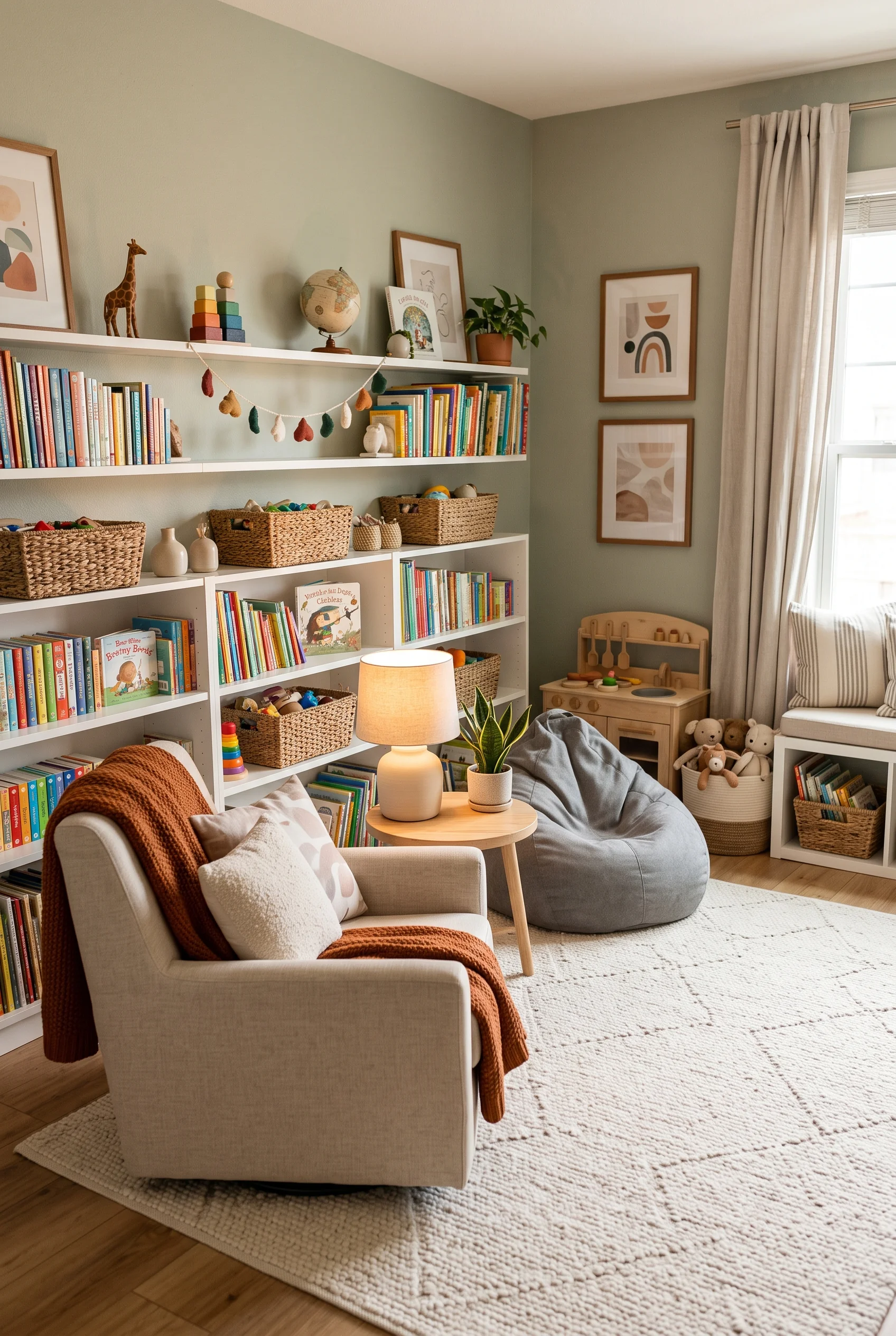
Floor-to-ceiling shelves hold what looks like a full classroom’s worth of books, organized loosely by color and size rather than alphabetically, which makes browsing feel like part of the fun. A rust-colored armchair and a gray bean bag chair sit close enough to grab a stack and settle in immediately.
A warm lamp on the side table means this corner works just as well after dinner as it does mid-afternoon. With this much shelf space dedicated to books alone, reading stops being a special activity and just becomes the default one.
A Building Station Where Every Creation Gets Displayed
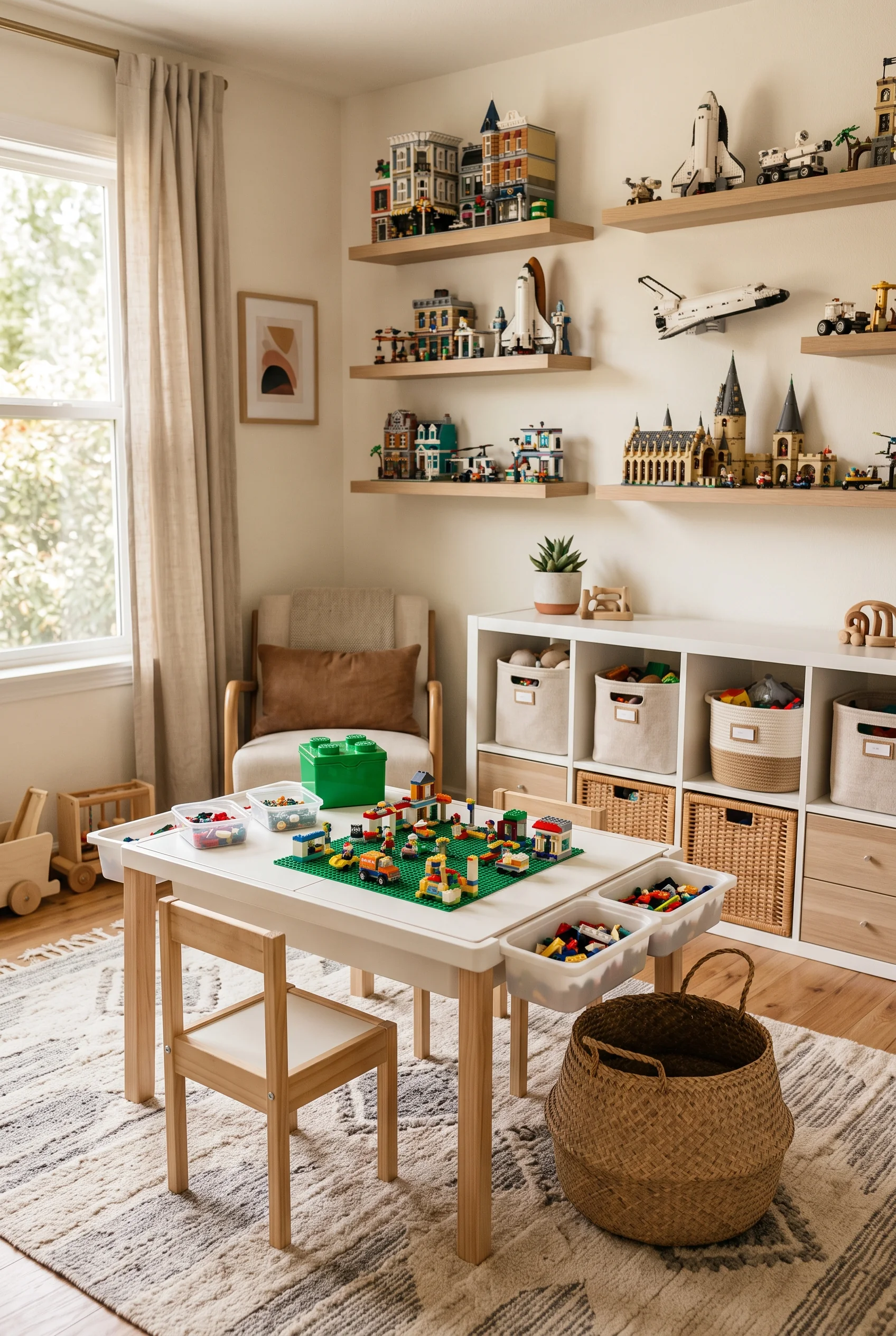
A low table topped with a green baseplate holds an entire in-progress city, while floating shelves above display finished builds, a space shuttle, a castle, a row of storefronts, like a gallery of completed work instead of a pile waiting to be dismantled.
Clear bins built into the table’s sides sort loose pieces so building doesn’t grind to a halt over a missing brick. Displaying the finished sets rather than boxing them away also gives a kid a reason to keep building instead of tearing down.
A Playroom That Flexes for Every Mood and Age
The best basement playrooms don’t ask a family to choose one purpose and stick with it. A single room can host a sleepover, a pretend restaurant, a science lab, and a quiet afternoon alone, sometimes all in the same week. These five rooms show how much range one space can actually hold.
Ready for a Sleepover Without Rearranging a Thing
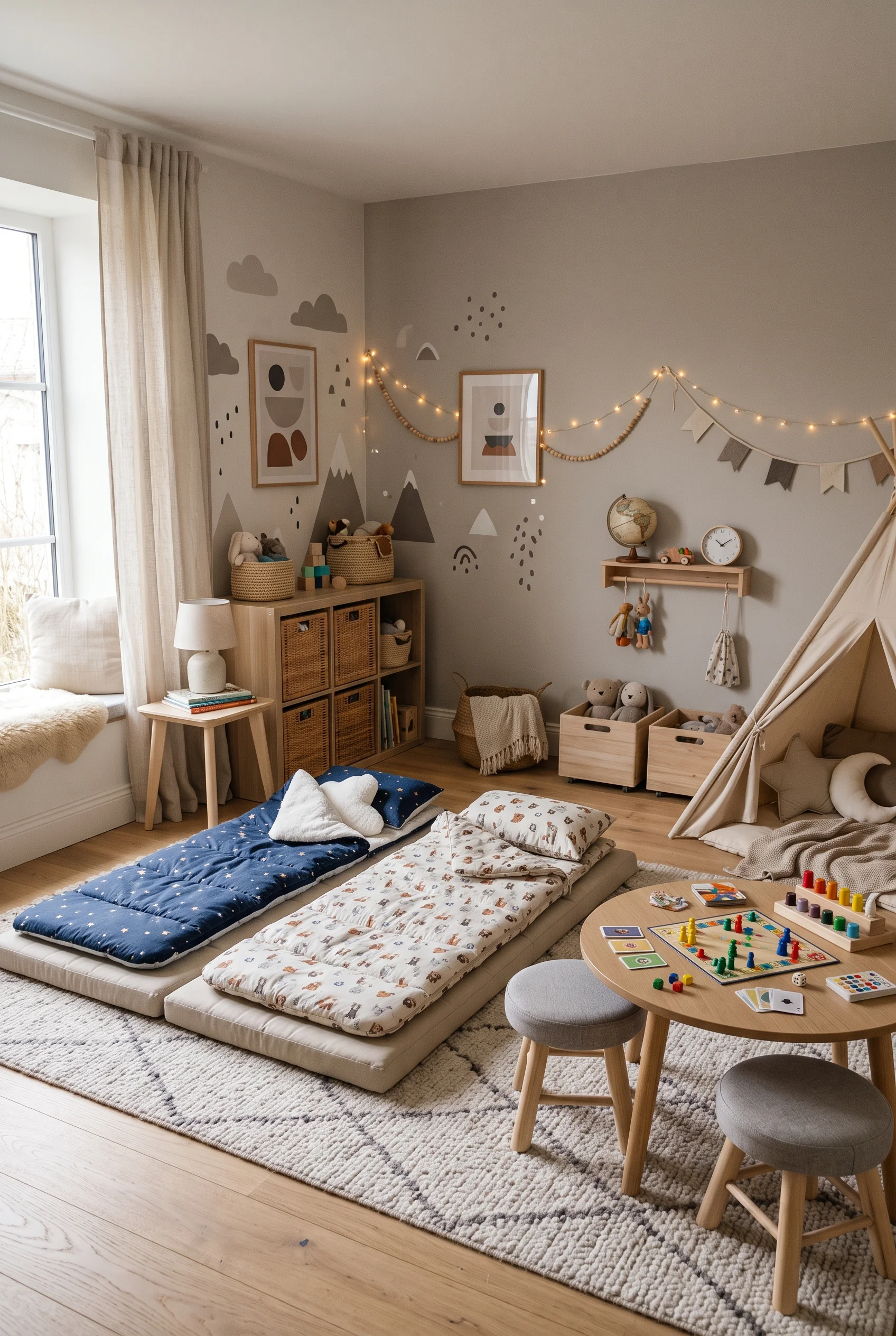
Two floor mattresses dressed in a star-print and an animal-print sleeping bag sit ready for a sleepover that could happen on any given Friday, no air mattress inflation required. A round table nearby stays set up with a board game and a stack of cards for whenever the energy shifts from sleeping to playing.
String lights along the wall keep the mood soft once the overhead light goes off. Because the mattresses live here full-time, a sleepover stops being a production and just becomes something that happens on a whim, the same easy flexibility that makes shared kids’ bedrooms work for siblings night after night.
A Kitchen Scaled Down for Big Imaginations
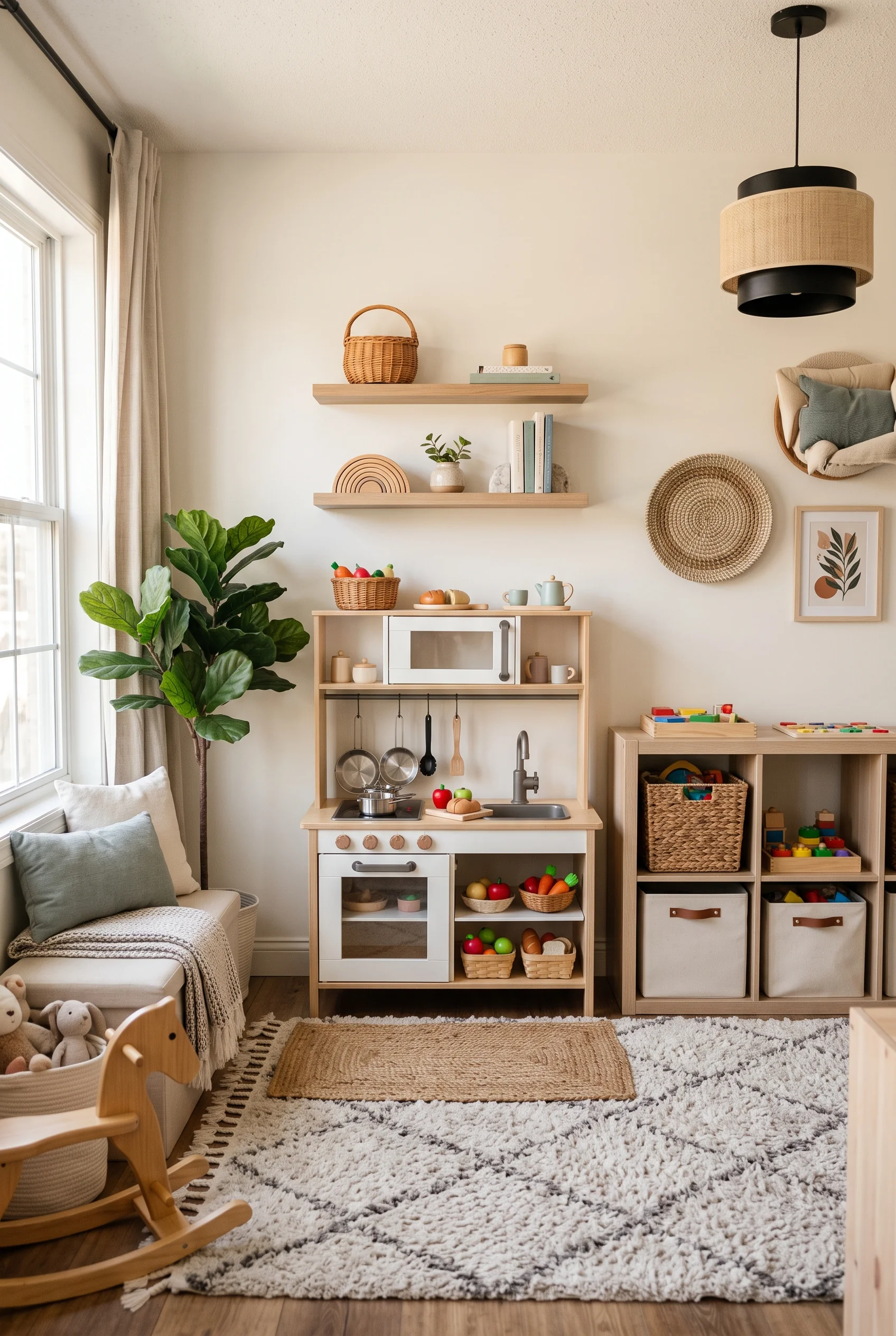
A wooden play kitchen holds its own tiny pantry: baskets of felt vegetables, a basket of play bread, miniature pots hanging within reach of a stovetop just the right height for small hands. Floating shelves above hold a woven basket of extra produce and a stack of books.
A cushioned bench with a plant beside it gives a parent somewhere to sit and place an order. Play kitchens tend to get more use than almost any other single piece in a playroom, precisely because the script changes every time.
Decals Teach Without Anyone Noticing They’re Learning
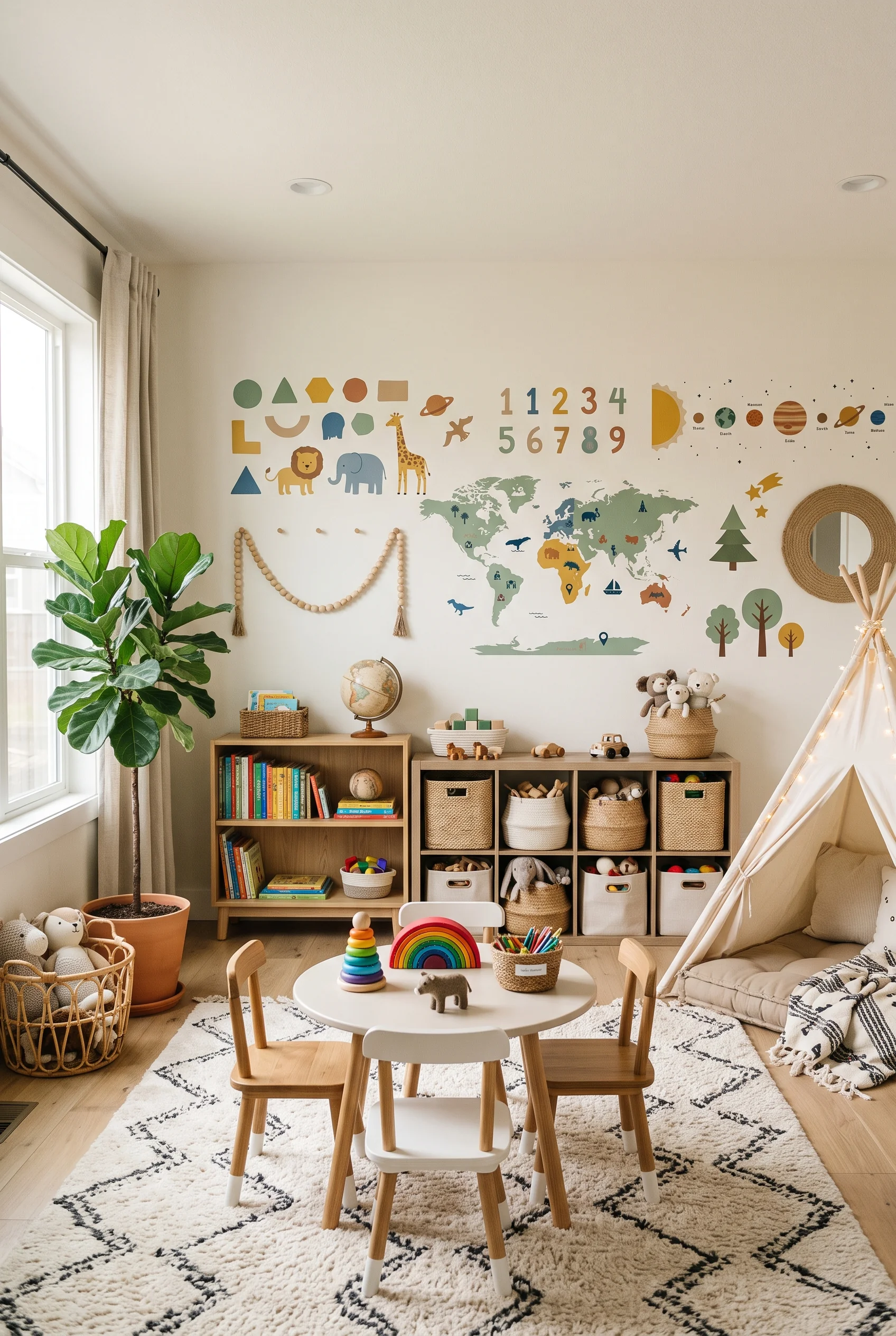
A world map, a row of numbers, and a lineup of shapes and animals cover this wall as removable decals, turning a plain stretch of white into something a kid studies without realizing it’s educational. A giraffe and an elephant stand in for a geography lesson nobody assigned.
Because decals peel off cleanly, the wall can grow up alongside the room, swapped for something else entirely once the map and numbers no longer hold interest. A canvas teepee and round mirror nearby keep the rest of the corner just as playful.
A Soft Landing Spot for the Days That Need Quiet
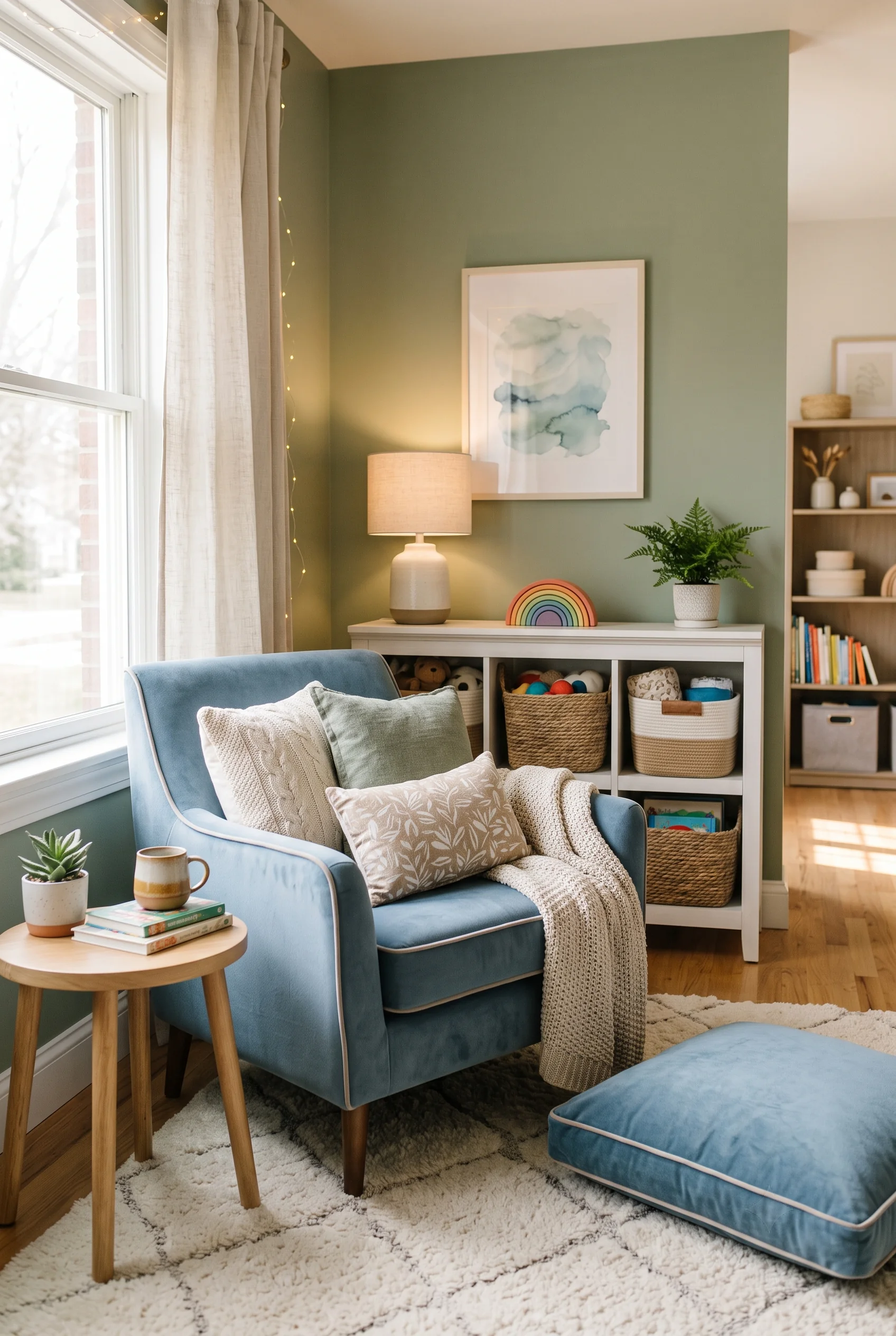
A dusty blue velvet armchair piled with pillows sits against a sage green wall, with a matching floor cushion nearby for whoever wants to sit lower. String lights and a fern further soften the corner, and a low storage console keeps toys close without cluttering the seating area.
Not every moment in a playroom needs to be loud or collaborative. A corner this soft gives a kid somewhere to decompress after a big day, which matters just as much as the trampoline or the Lego table elsewhere in the house.
A Lab Corner for Curious Minds
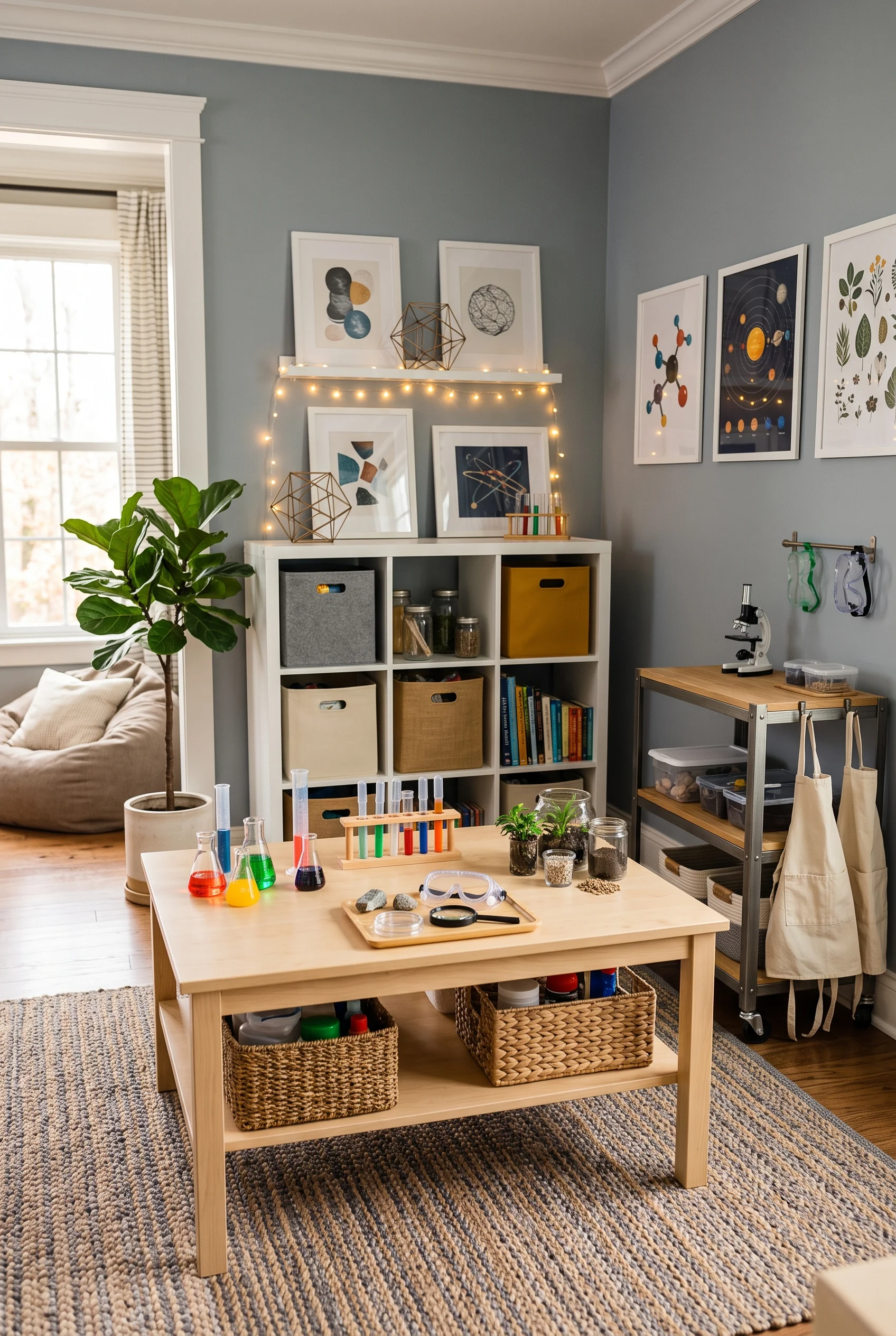
A wooden table holds a lineup of beakers filled with colored liquids, a rack of test tubes, and a small tray of rocks, all waiting under a magnifying glass. A microscope sits on a cart nearby, next to jars of seeds and a pair of child-sized safety goggles hanging within reach.
It’s a setup that treats a kid’s curiosity as if it deserved real tools, not just a plastic-toy version of a lab. Framed prints of molecules and the solar system tie the corner together, making it clear this space is for asking questions, not just killing time.
A Basement Playroom Your Family Actually Uses
Thirty-one rooms in, a few things keep repeating: storage that stays visible, light that’s layered rather than single-source, and furniture willing to do more than one job. None of it requires knocking down walls or spending a full renovation budget. Most of these basement playroom ideas are additions: a rug, a shelf, a curtained stage, layered onto a space that was probably already serviceable.
What matters most is picking the handful of ideas that solve the actual problem in your own basement. A family drowning in loose Legos needs the building station and the labeled bins before it needs a puppet theater. A family with one shy performer and zero interest in board games might skip the sleepover setup entirely and go straight for the music stage. Not every idea here belongs in every home, and that’s fine.
Start with whatever feels most overdue, whether that’s finally anchoring the bookshelf for safety, adding a second light source, or claiming one corner for nothing but quiet reading. A basement playroom gets better in layers, not all at once, and the family living in it will let you know which layer to add next.
These basement playroom ideas aren’t about chasing a photo-ready room. They’re about a space that gets used every single day, cushions flattened, chalk dust on the floor, exactly what a room built for real play should look like.