31 Toddler Room Ideas That Are as Practical as They Are Cute
A toddler’s room has a lot of jobs to do. It needs to be a comfortable place to sleep, a safe place to play, and a place where they can start doing little things on their own. And because toddlers come with plenty of toys, books, clothes, and tiny treasures, good storage definitely matters too.
These toddler room ideas offer practical ways to create a space that works for this busy stage without sacrificing style. You’ll find low beds, easy-to-reach book displays, smart toy storage, cozy corners, and plenty of simple ideas you can borrow whether you have a small bedroom or plenty of room to work with.
If you want to give kids a little more independence in their space, these Montessori bedroom ideas for toddlers are worth exploring too. You can also borrow storage ideas from these kids bedroom storage ideas or create a special spot for books with one of these cozy reading nooks for kids.
Keep scrolling for 31 toddler rooms that are cute, practical, and designed for the way little kids actually live.
DISCLOSURE: Some of the links provided on this page are affiliate links. This means if you choose to make a purchase through these links, we may receive a small commission at no extra cost to you.
A Foundation of Calm Color and Hardworking Storage
Every good toddler room starts with the same quiet decisions: the wall color, the anchor furniture, and where all the stuff will actually live. Get those three right and the cute layers almost style themselves. The rooms in this first group share a soft, neutral base and storage that was planned from day one instead of squeezed in later, which is why they stay calm even with a full toy collection in residence.
A Soft Neutral Backdrop That Outlasts Every Phase
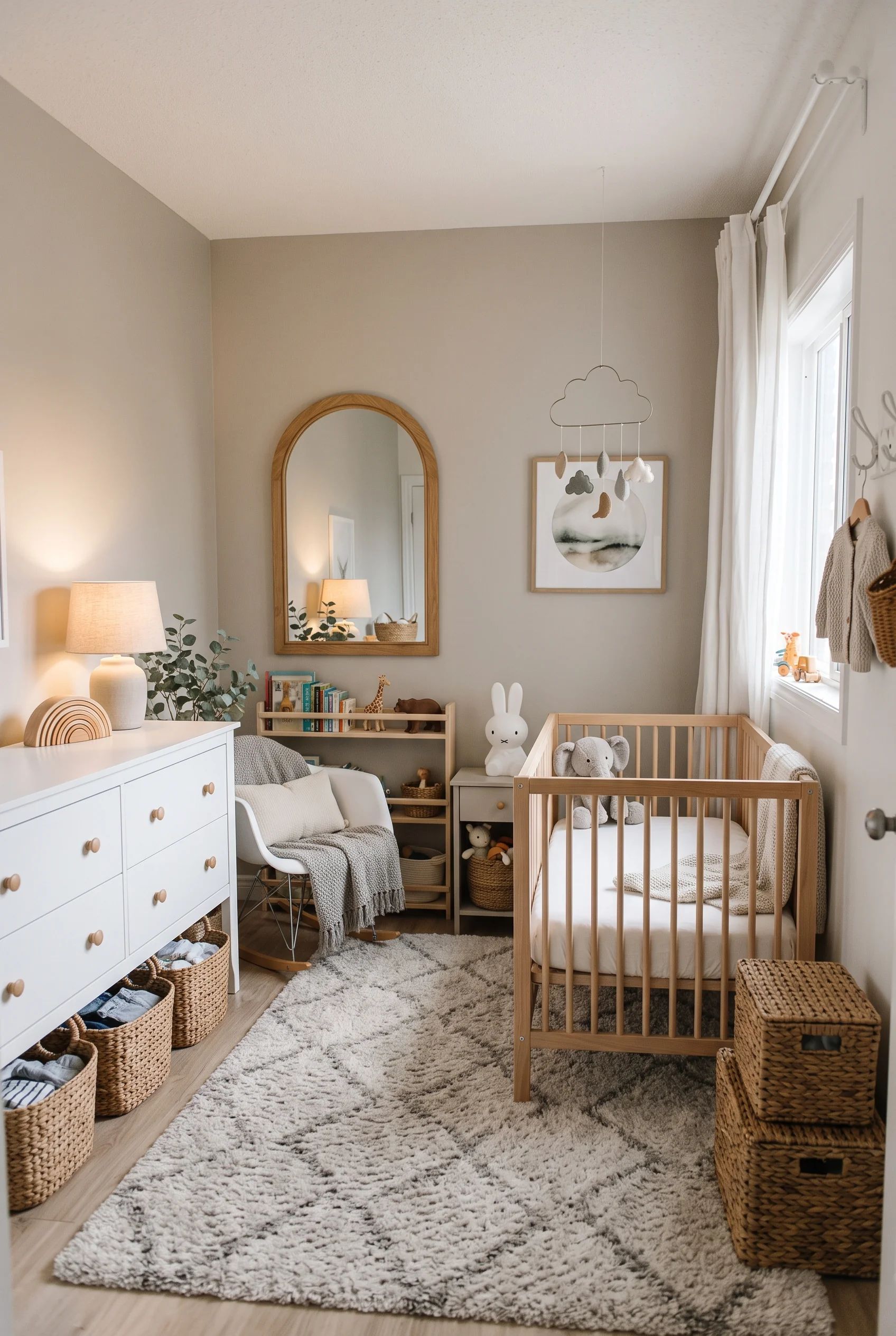
Warm greige walls, a white dresser, and a natural wood crib give this room a palette that will still work when the crib becomes a big-kid bed. Nothing here screams baby, so you won’t need to repaint in two years.
Texture keeps the neutrals from going flat. A shaggy diamond-patterned rug, woven baskets tucked beneath the dresser, and an arched wood mirror each add depth without adding color.
When the toddler obsessions arrive, and they will, dinosaur sheets and rainbow art can slide right into this backdrop without a fight.
Furniture That Grows Up Alongside Them
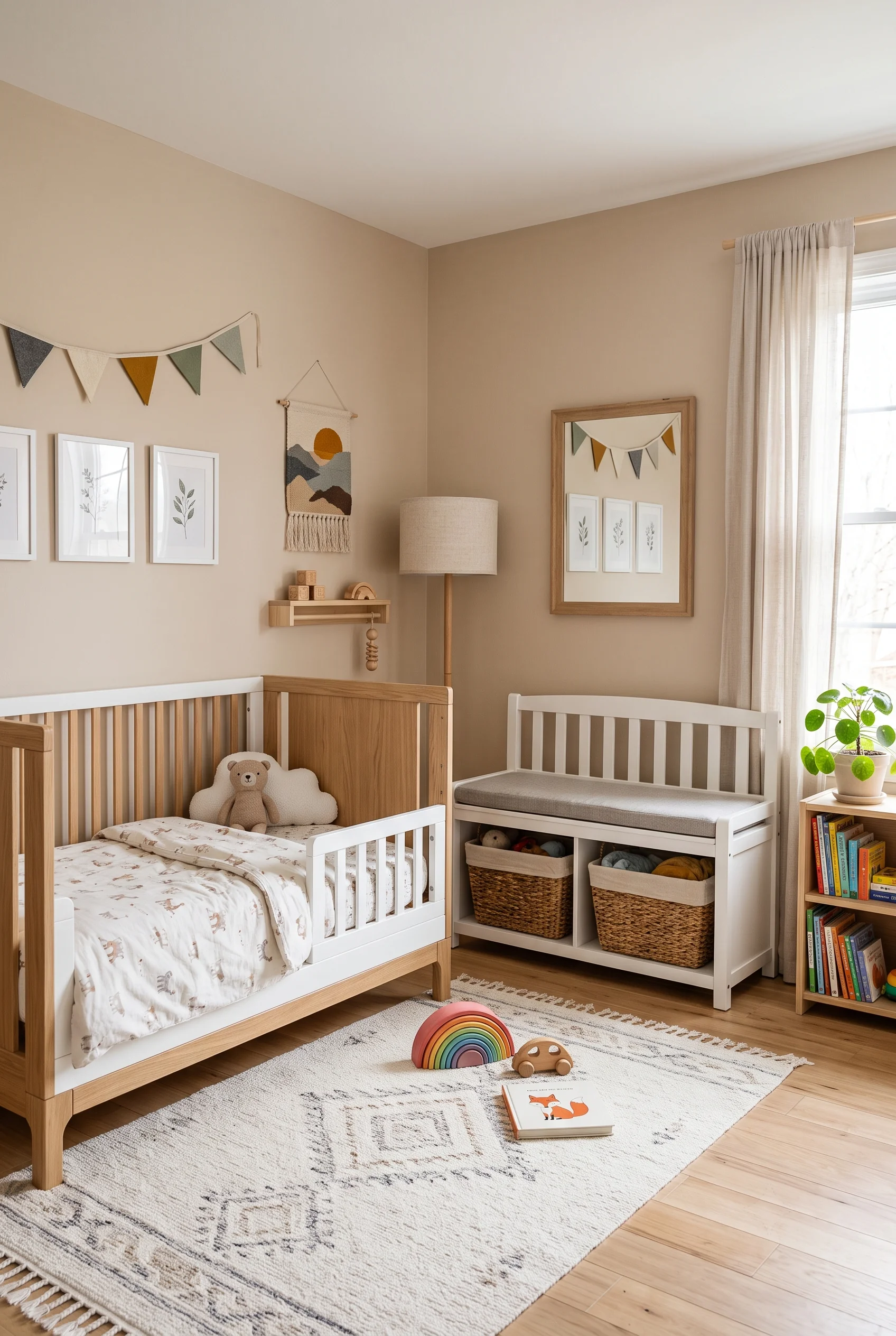
Already converted to toddler-bed mode, the crib here has its rails on and its mattress low, ready for a newly confident climber. Buying the piece once and converting it as they grow is one of the smartest budget moves in kids’ design.
The white storage bench under the window pulls similar double duty. Baskets below hold toys, while the padded top handles shoe-tying lessons and bedtime stories.
Felt bunting and a soft mountain wall hanging keep the mood playful while the big pieces stay sensible.
A Library Wall That Uses Every Vertical Inch
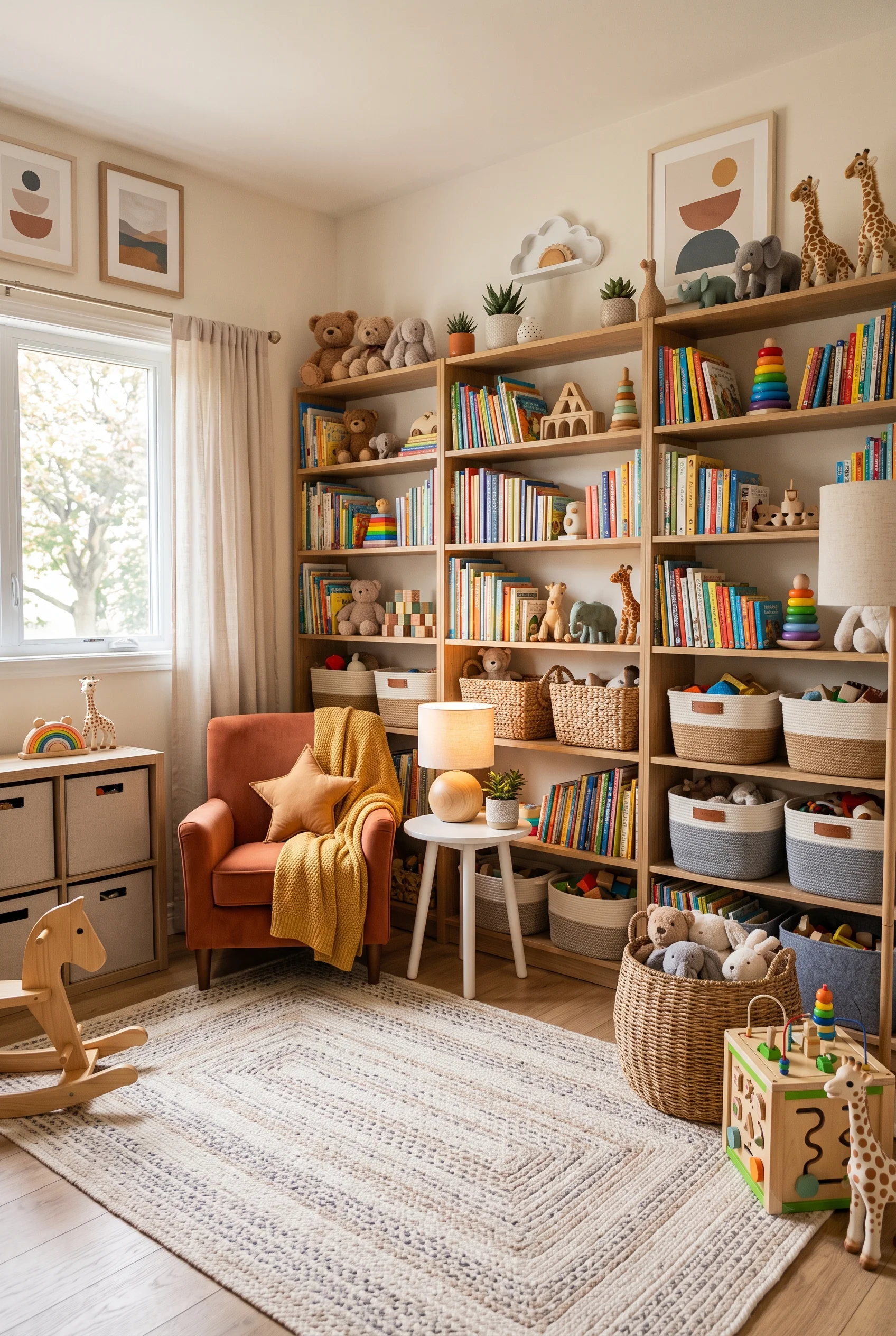
Floor-to-ceiling shelving turns an ordinary wall into the room’s hardest-working surface. Picture books and bins sit on the lower shelves where small hands can reach, while teddy bears and potted plants take the high ground as decor.
An orange armchair and a mustard throw warm up all that wood, and a floor basket beside it catches the stuffed animal overflow.
Rooms rarely run out of wall before they run out of floor. Building upward is how a modest bedroom absorbs a growing library without feeling crowded.
See-Through Storage That Ends the Toy Hunt
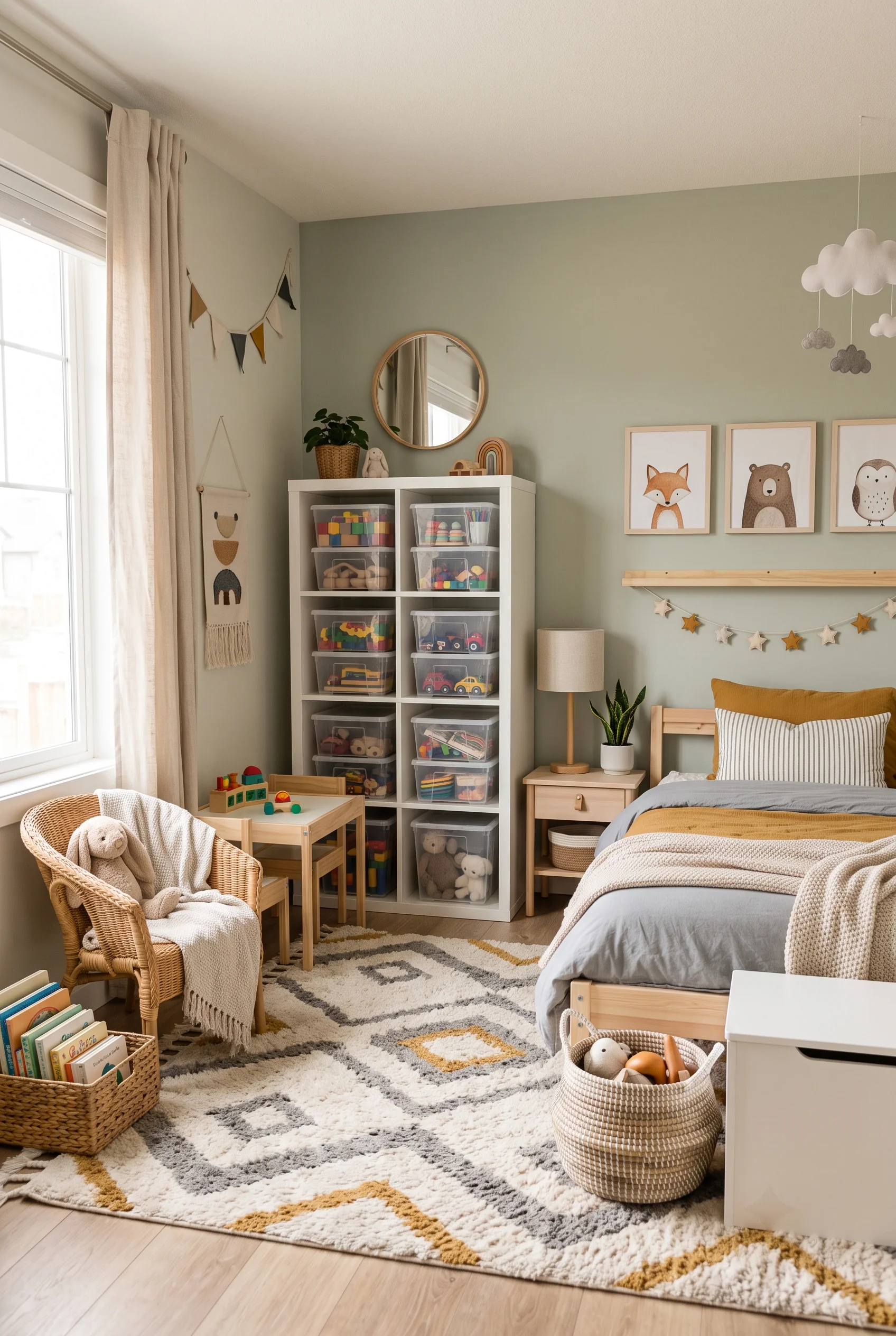
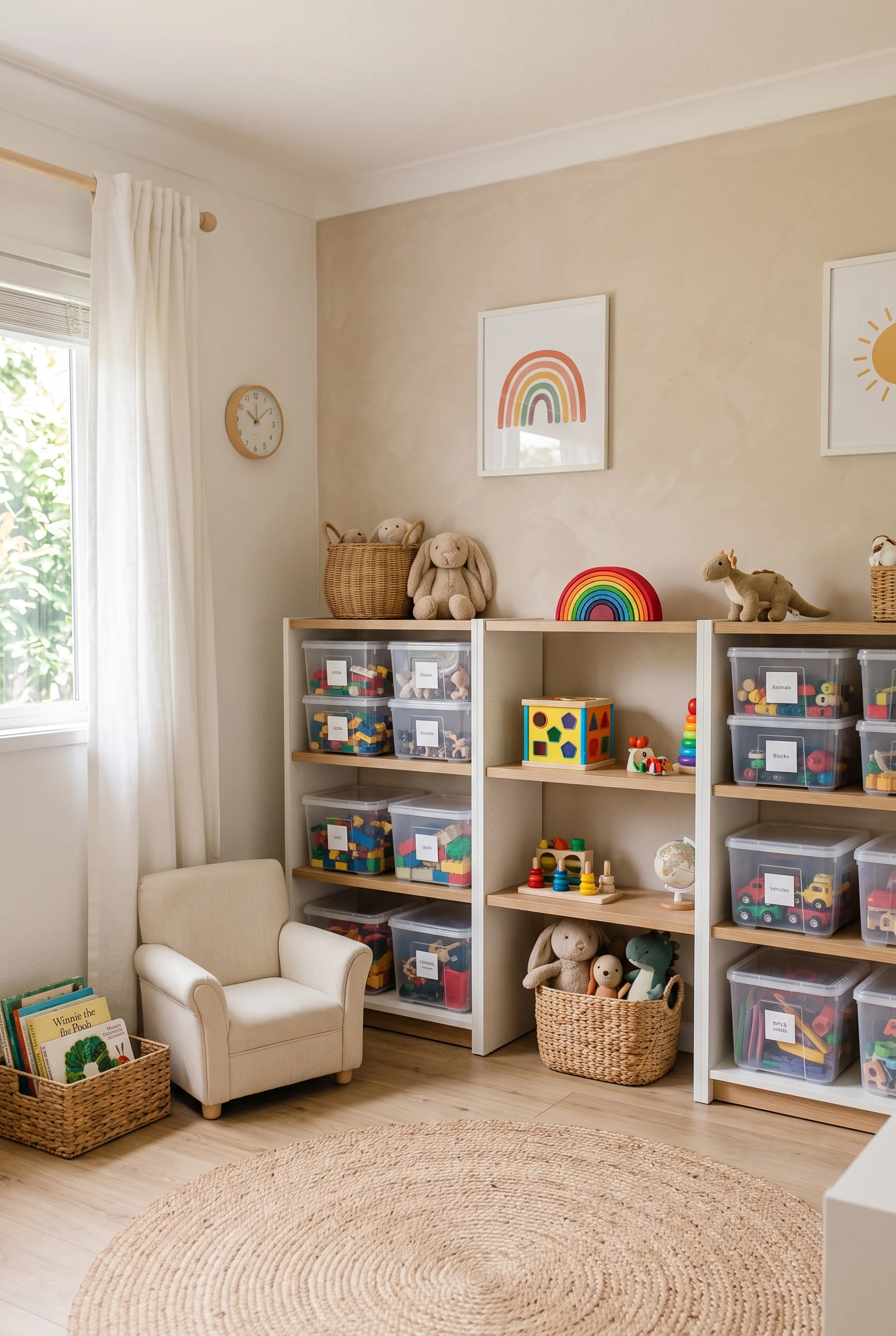
Clear stackable bins solve a problem every parent knows: the toy you dump out is usually the one they were looking for. When cars, blocks, and animals are visible at a glance, toddlers pull one bin instead of five.
The white shelf unit keeps the plastic looking tidy, framed by sage green walls and woodland prints that soften all that practicality.
Cleanup gets easier too. A two-year-old can match a toy to the bin where its twins are already visible, which is about as close to self-cleaning as this age gets.
Function That Hides in Plain Sight
Toddlers generate an astonishing amount of stuff, and the difference between a room that feels chaotic and one that feels calm usually comes down to where that stuff goes. The five rooms in this group solve the mess differently: furniture scaled to the child, a rug that defines the play zone, fewer toys in circulation, walls put to work, and storage you never see at all.
Furniture Scaled for Small Hands and Big Confidence
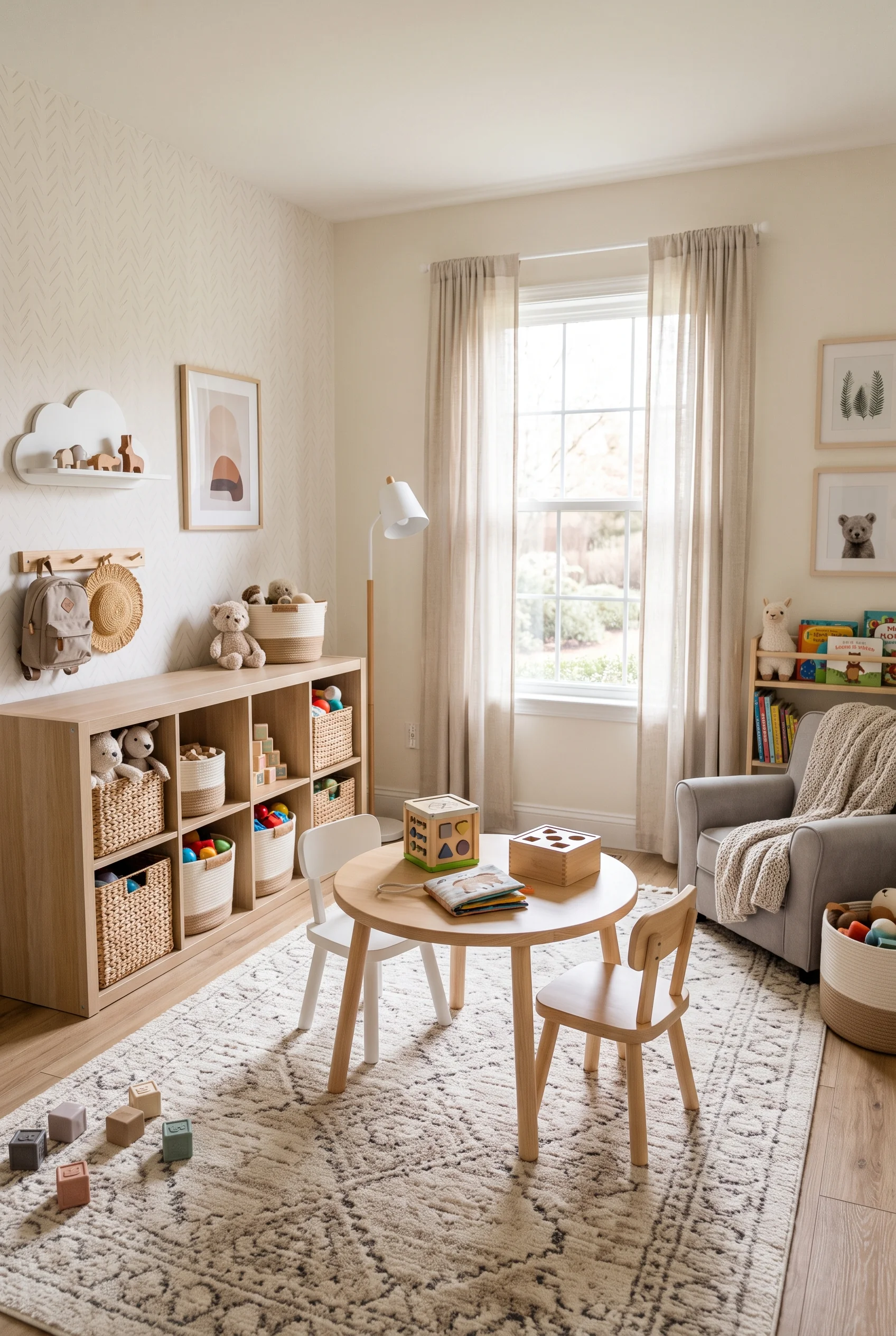
Everything a toddler actually uses in this playroom sits below hip height. A low round table with softly curved chairs, a cubby console with baskets at floor level, and a cloud shelf just above it all send the same message: you can do this yourself.
Rounded edges matter as much as the height. New walkers lead with their foreheads, and furniture with soft corners forgives the wobbles.
A full-size armchair in the corner keeps a spot for the grown-up, because rooms designed only for the child rarely get used together.
A Rug That Draws the Map for Play
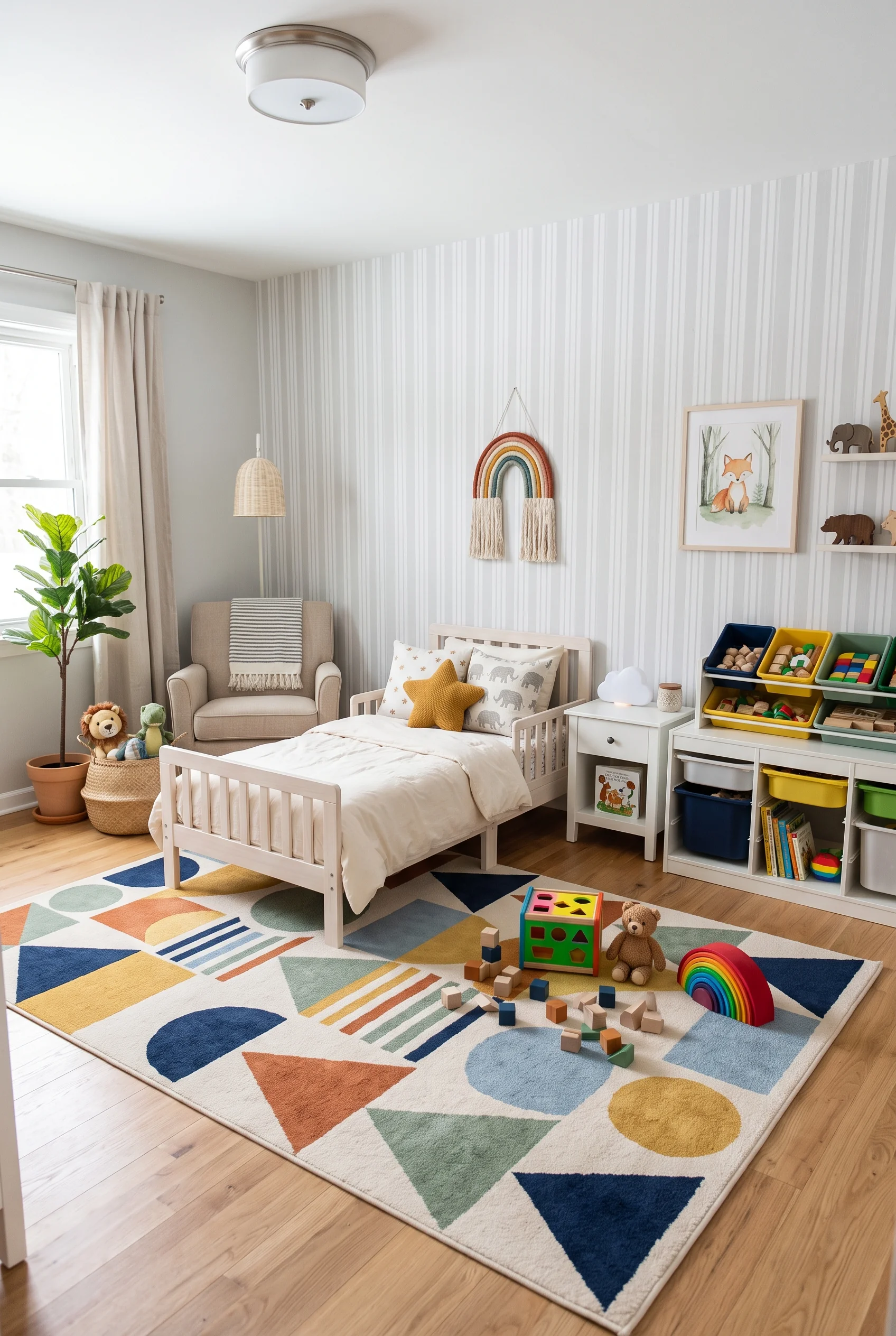
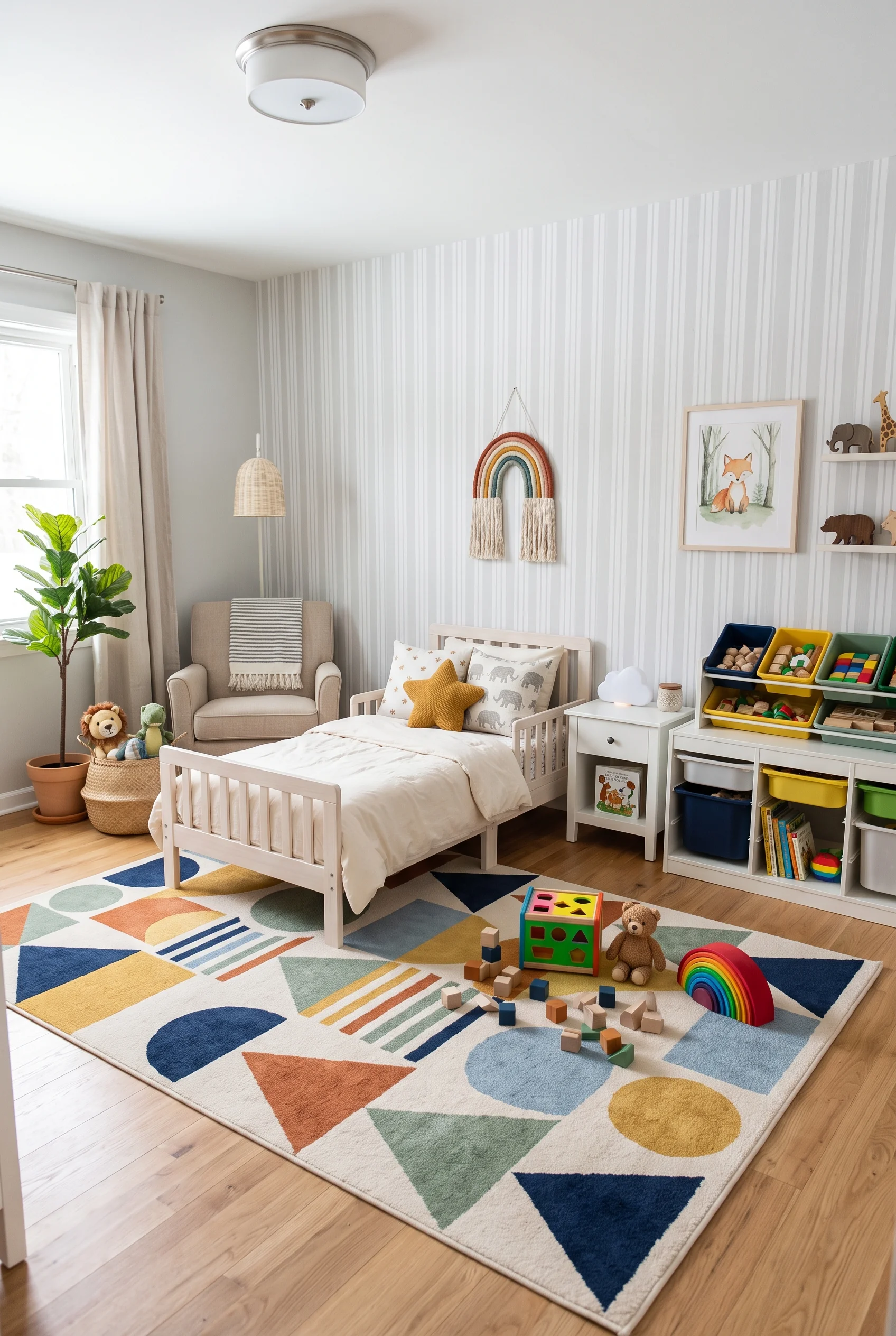
Primary colors land on the floor instead of the walls here, and the room is better for it. The geometric rug marks out the play zone as clearly as painted lines on a gym floor, while striped wallpaper and a white toddler bed stay quiet above it.
Circles become parking spots, and triangles become mountains. A graphic rug is half toy, half decor.
Machine-washable versions of rugs like this exist now, and they matter more in a toddler room than anywhere else in the house.
Fewer Toys Out, More Play Happening
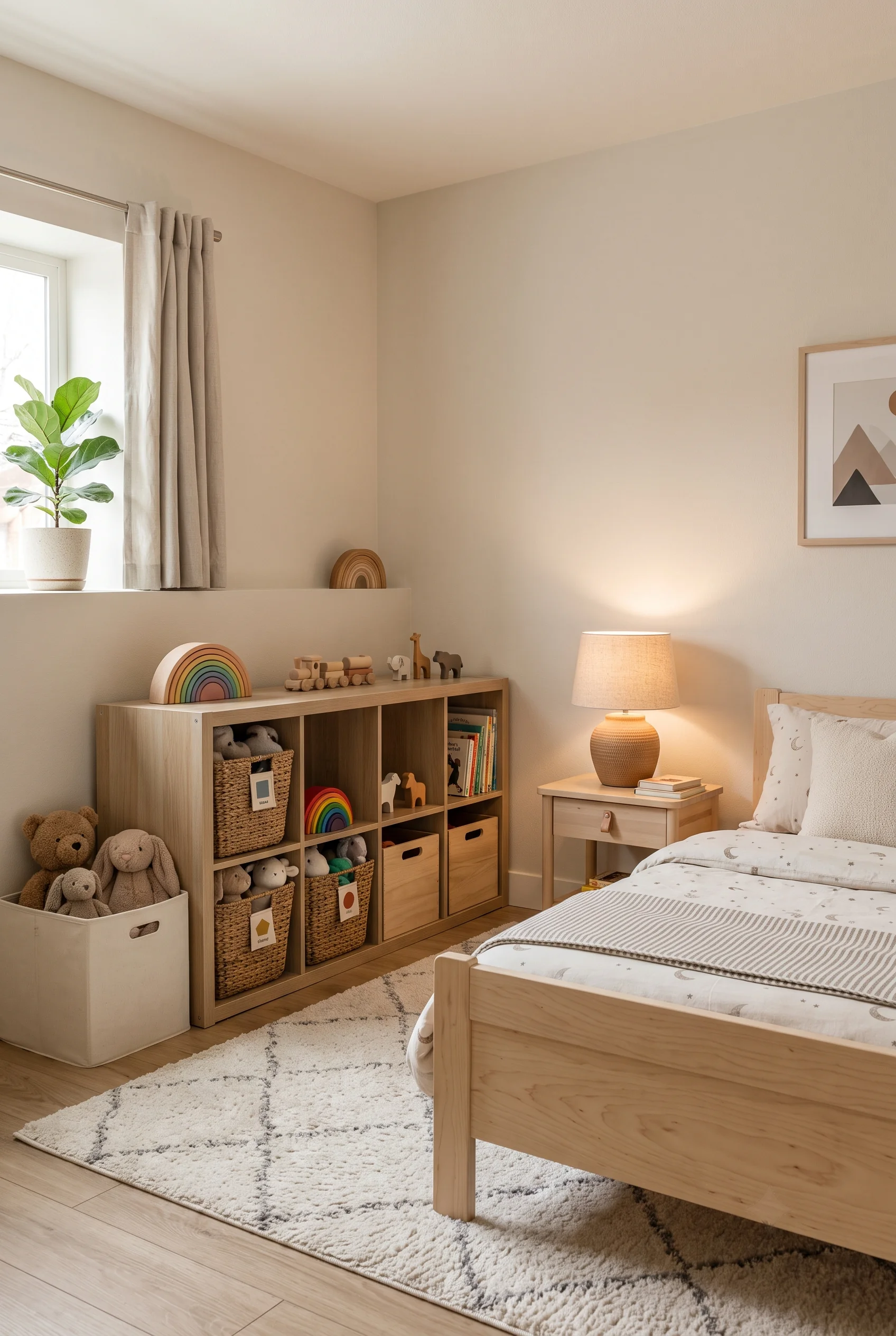
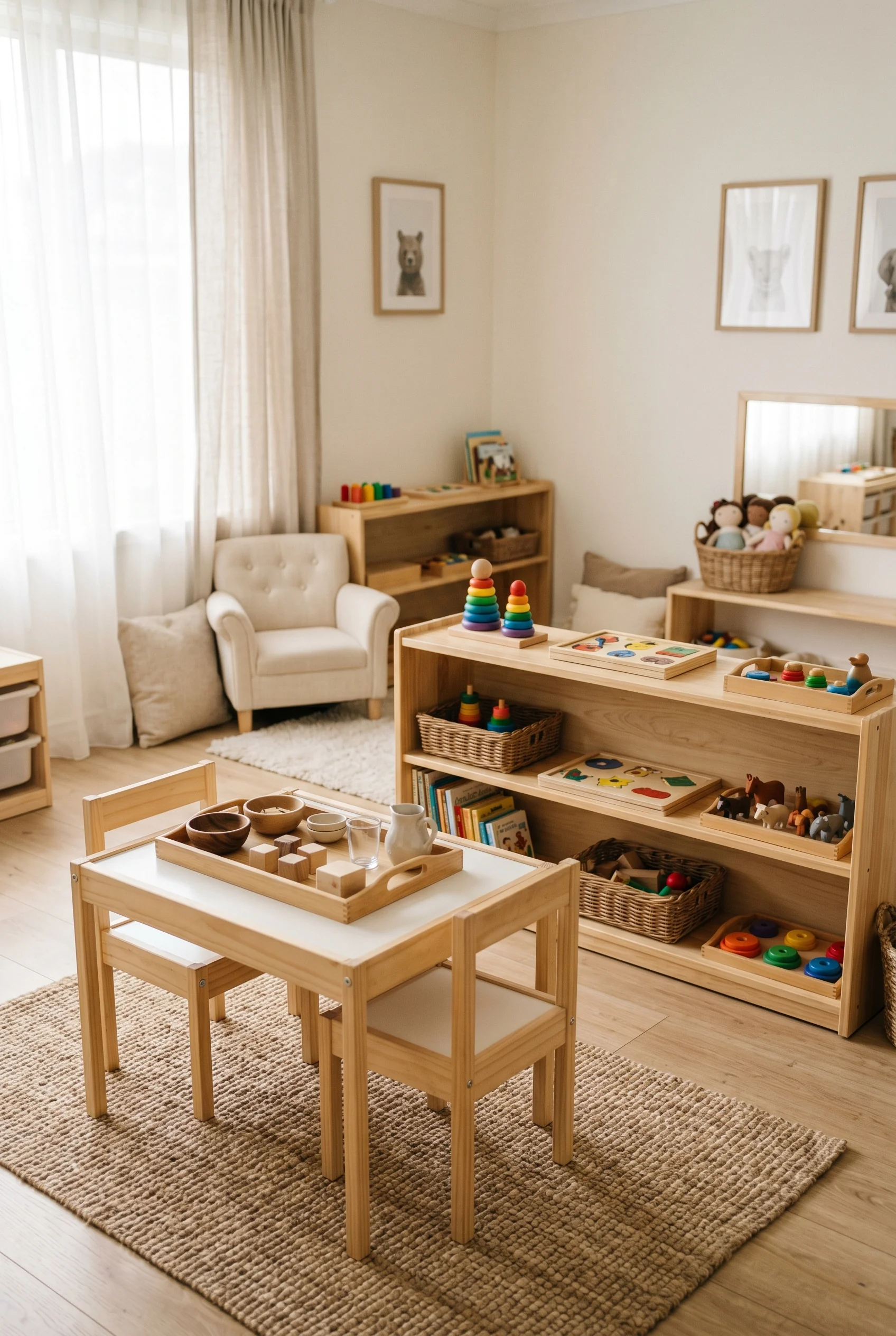
Sparse shelves are the whole strategy in this bedroom. A wooden cubby unit holds a rainbow stacker, a few favorite baskets, and plenty of breathing room, while the rest of the collection waits its turn in bins elsewhere.
Toy rotation sounds like extra work, but it usually means less. Toddlers play longer and deeper with six choices than with sixty, and cleanup shrinks to minutes.
If the concept is new to you, my guide to Montessori toy storage covers how to store and rotate the off-duty toys.
Walls That Earn Their Keep
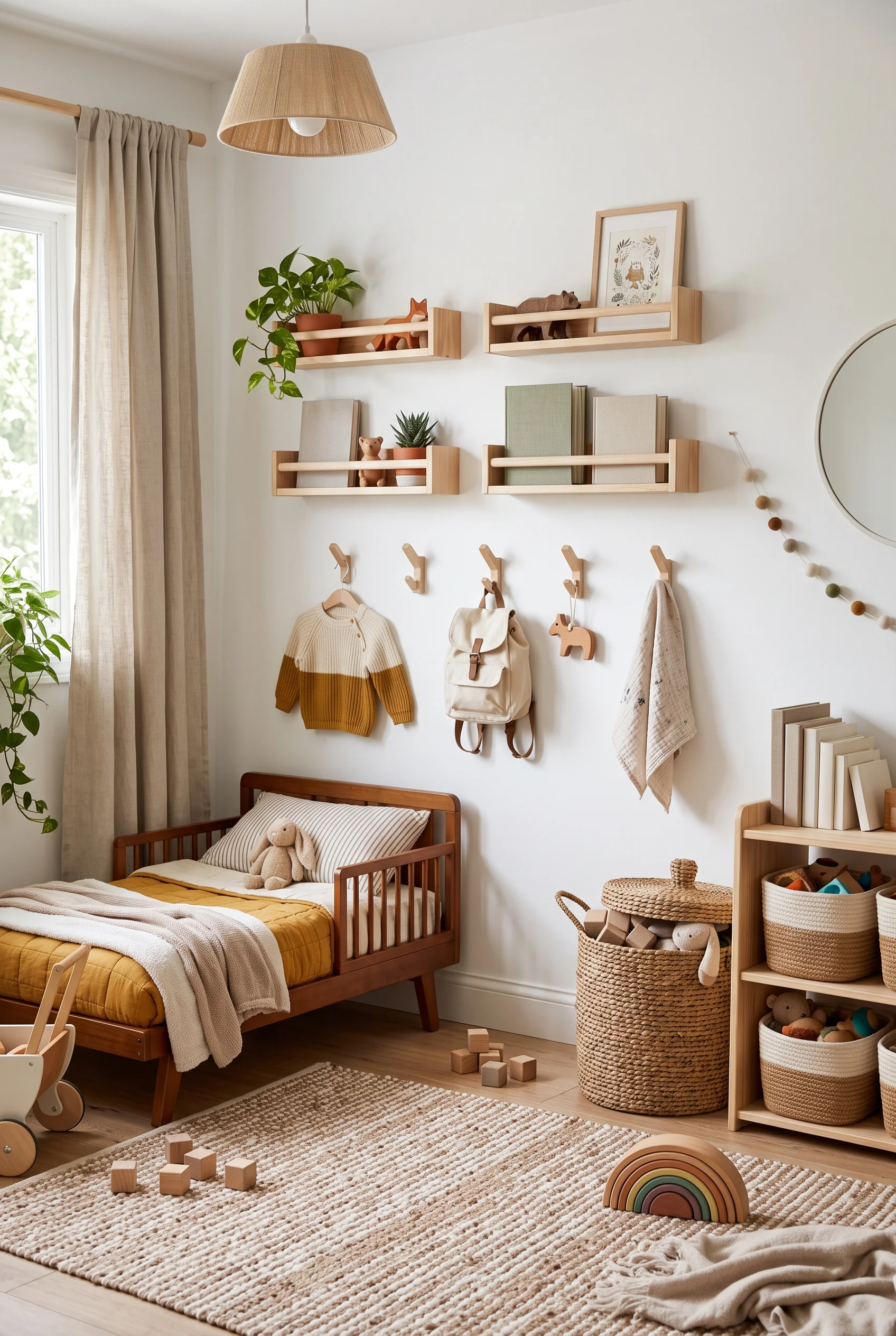
Peg hooks at toddler height hold a tiny cardigan, a canvas backpack, and a linen towel, which means a two-year-old can hang up their own things. That single habit, started early, pays off for years.
Above the hooks, wooden ledge shelves carry books, plants, and framed art safely out of grabbing range. The floor below stays open for the toddler bed and a basket-lined bookcase.
Between the pegs and the ledges, an entire storage system lives on one wall without claiming a single square foot of play space.
The Mess You Never Have to See
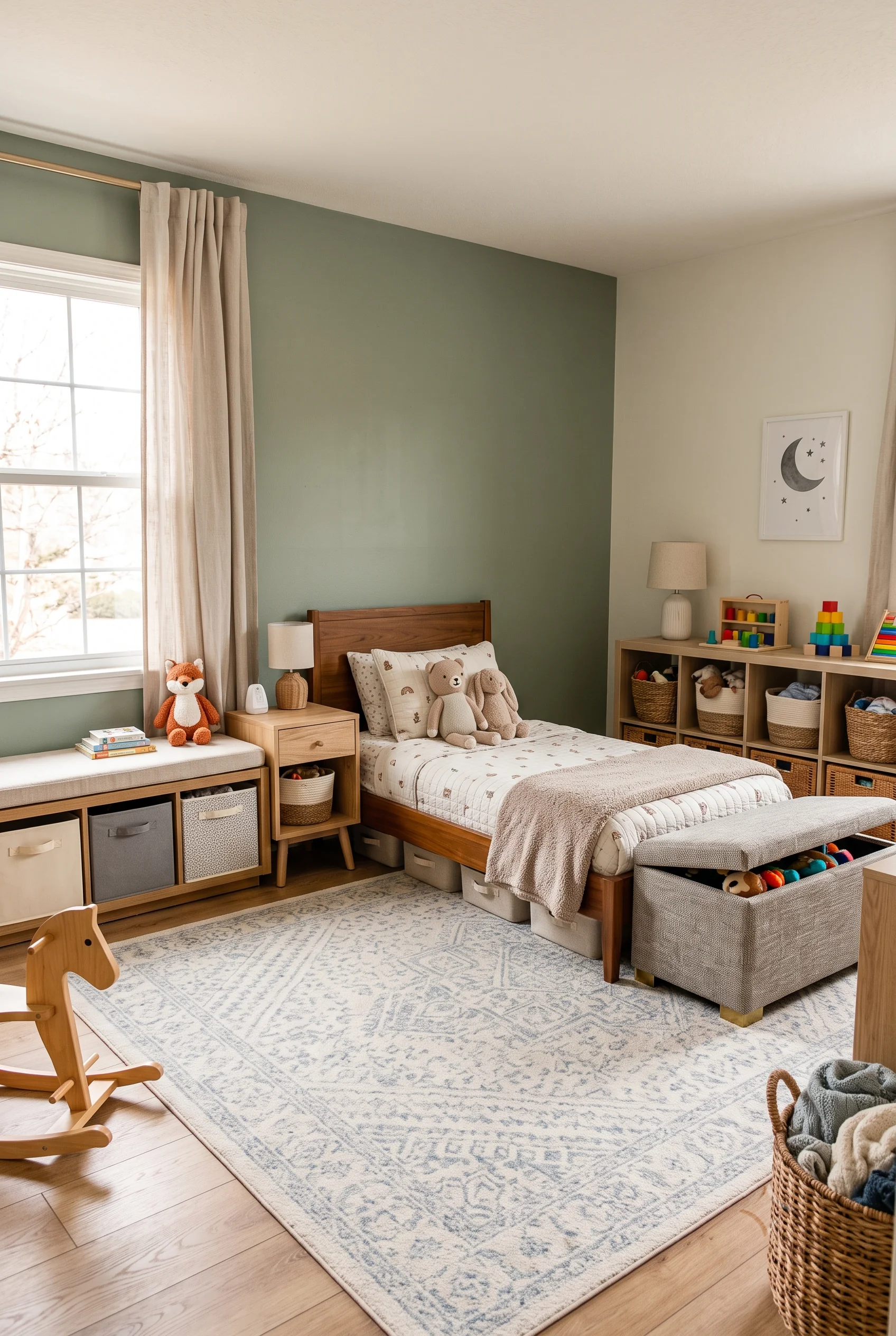
Rolling drawers under the bed, a cushioned window bench with baskets beneath, and an upholstered ottoman that opens to swallow a whole bin of balls. Three hiding spots, zero visual clutter.
The sage accent wall and pale blue rug get to be the story because the storage refuses to compete. Even the fox and the teddy bear on display feel curated, not left out.
Hidden storage is what lets a toddler room read as a bedroom first and a toy warehouse never.
Built to Last, Made to Feel Like Theirs
Safety and sentiment are rarely mentioned in the same breath, but in a toddler room they belong together. Sturdy, non-toxic materials keep small explorers safe through years of climbing and chewing, while personal details- their photos, their height marks, their first scribbles- make the room unmistakably theirs. The five spaces that follow show how substance and personality can layer over each other without either one giving ground.
Solid Wood That Shrugs Off the Toddler Years
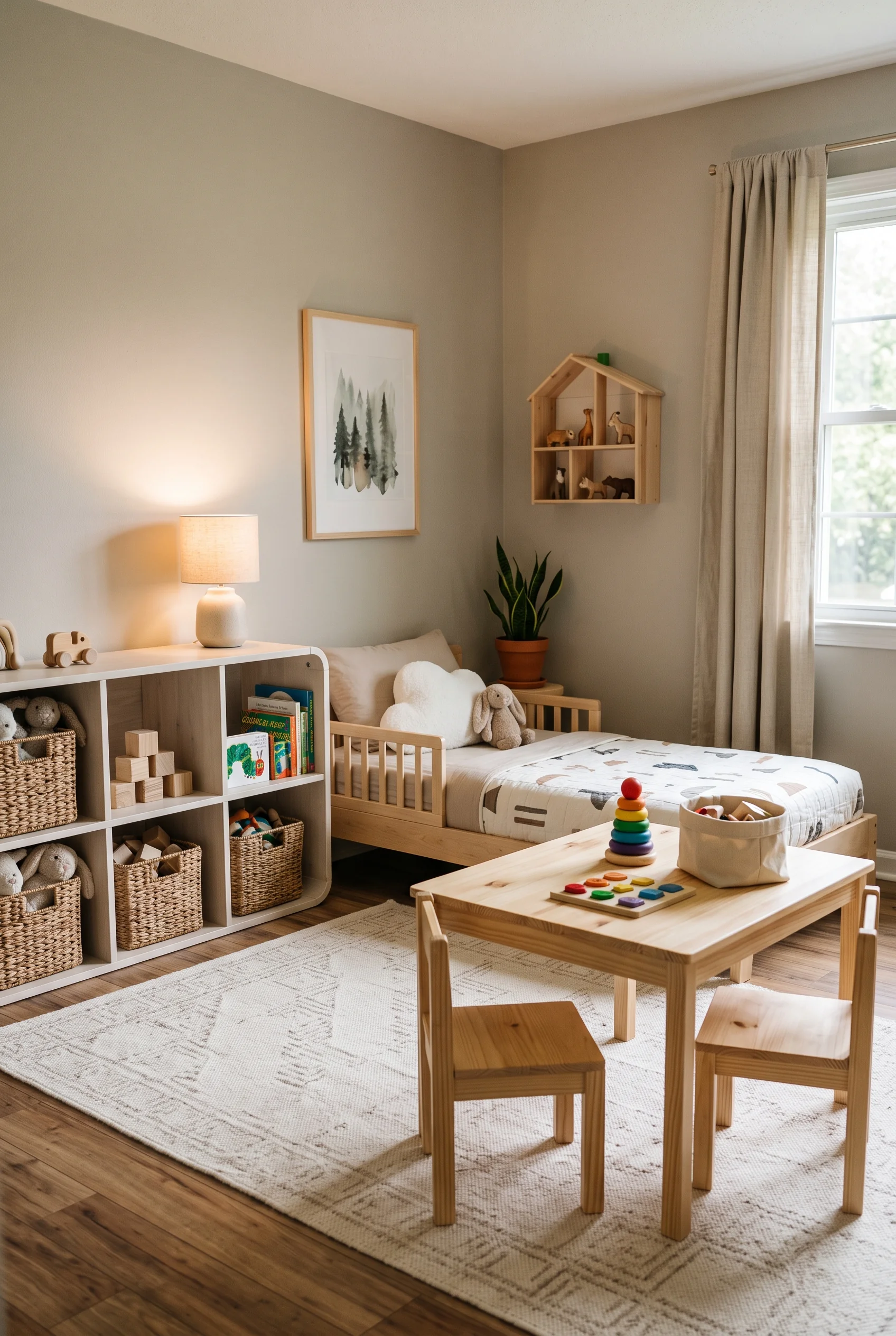
Every major piece in this bedroom is solid wood with a low-sheen, natural finish: the guardrail bed, the cubby shelf, the little play table. Materials like these take teething marks and toy collisions in stride, and they still look better a decade in than laminate does in year two.
Non-toxic paints and finishes matter most at this age, when everything within reach eventually gets tasted.
Washable cotton bedding finishes the room in fabrics that survive the laundry as gracefully as the furniture survives the toddler.
Details That Say This Room Is Yours
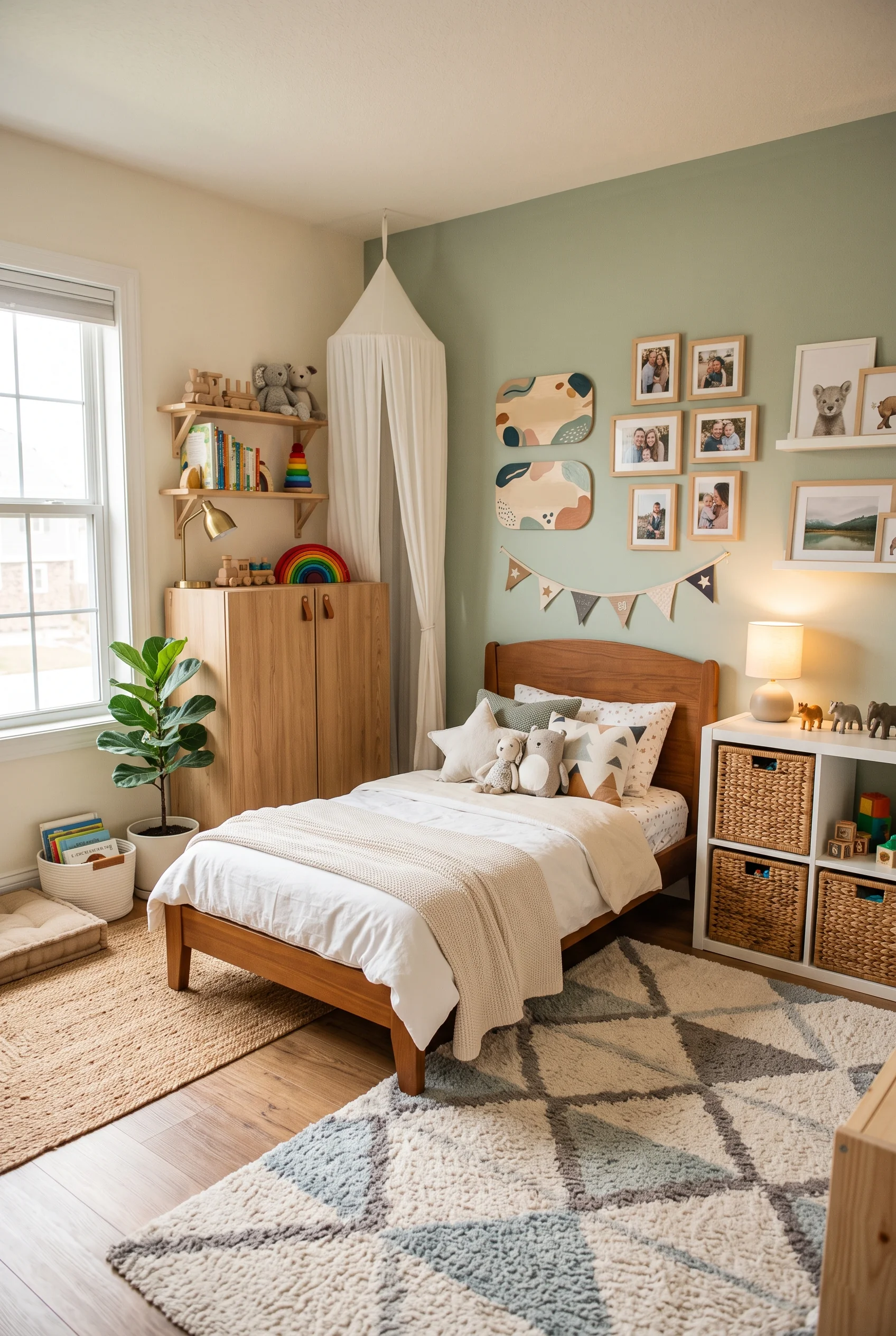
Family photographs hang in a warm grid beside the bed, joined by playful shape art and a fabric bunting. Seeing their own people on the wall gives a toddler the same settled feeling adults get from a favorite gallery wall.
The sheer canopy and the cabinet stocked with their treasures continue the theme. Nothing generic, everything chosen.
Rainbow toys and a lion print add whimsy, but the photos do the emotional heavy lifting. A room can be styled in an afternoon; it takes these personal layers to feel like it belongs to someone.
The Growth Chart That Doubles as Wall Art
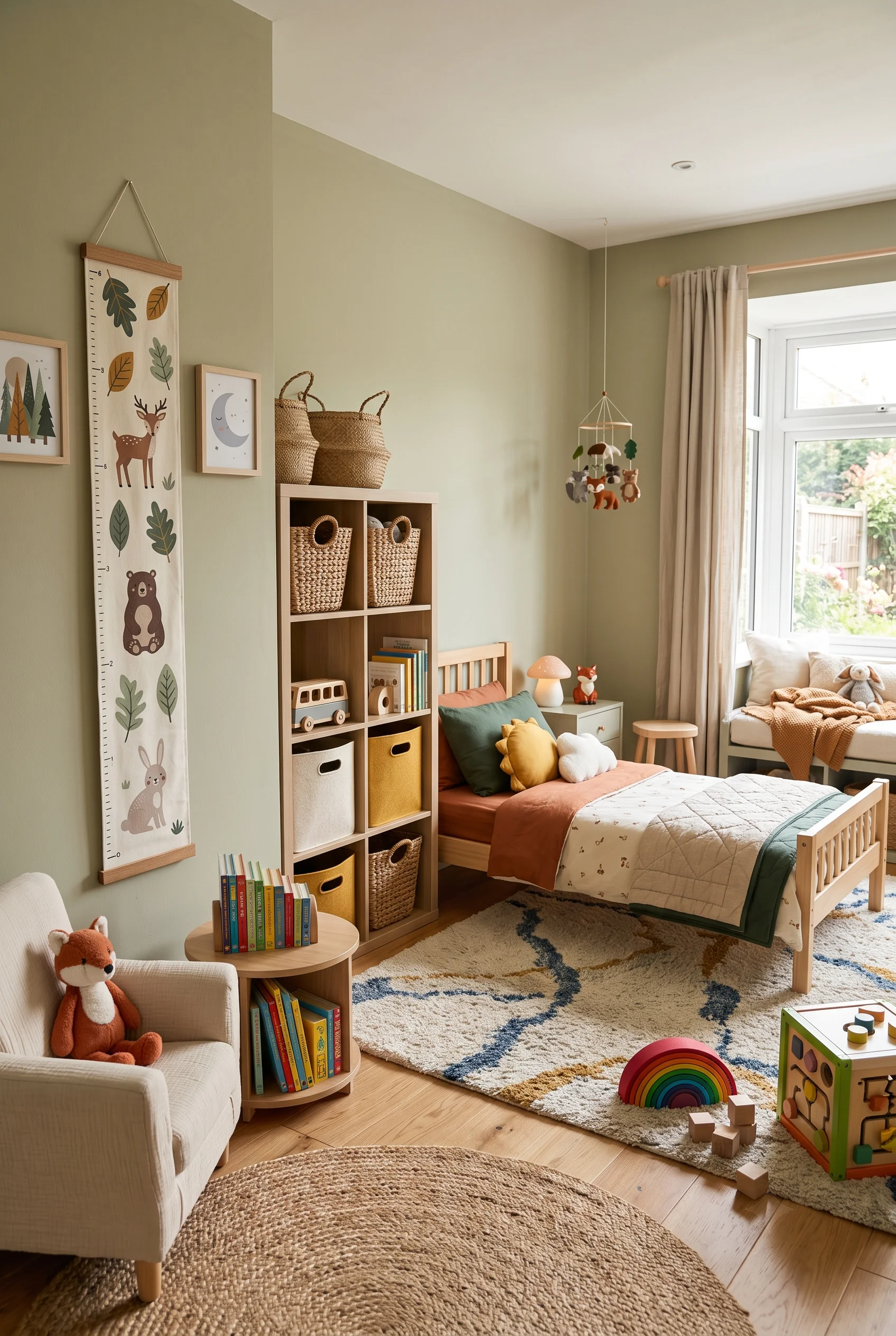
Deer, bears, and falling leaves climb a canvas growth chart hung beside the framed prints, where it reads as part of the gallery until you notice the ruler running up its side.
Toddlers love the ceremony of backing up against it, standing tall, and spotting the new mark. Parents love that the record rolls up and moves house with you, unlike pencil lines on a door frame.
The woodland palette echoes the sage walls and warm wood around it, so the keepsake never fights the decor.
Woodland Friends Without the Wallpaper Commitment
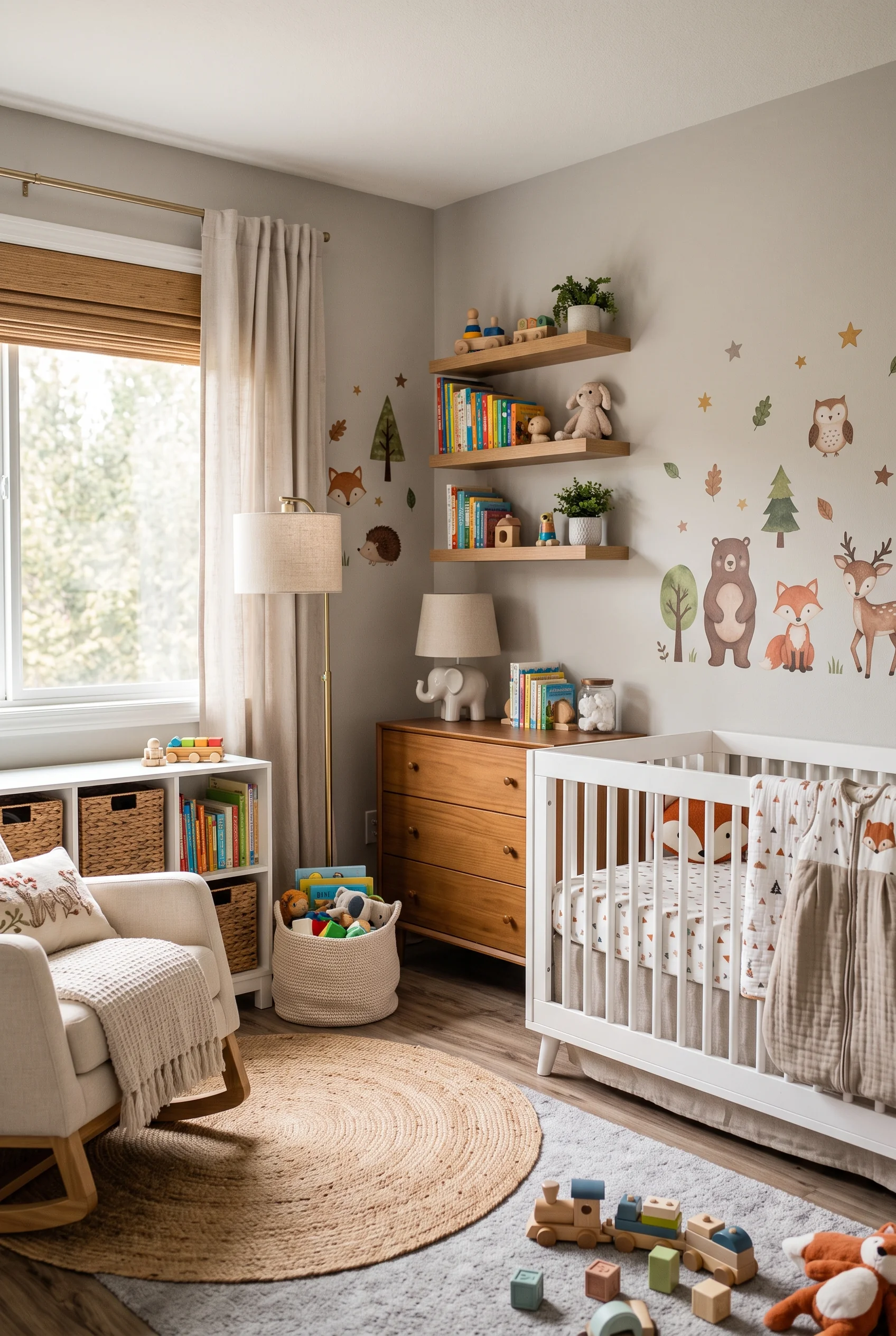
Bears, foxes, and little pine trees march across this nursery wall, and every one of them peels off in seconds when tastes change. Removable decals deliver a full themed mural for the price of a pizza night.
Clustering them beside the crib puts the parade exactly where a waking toddler’s eyes land. Floating shelves with plants and plush keep the scene from feeling flat.
When the dinosaur phase arrives, the forest comes down cleanly, and the paint underneath never knows the difference.
A Creative Station Sized for First Scribbles
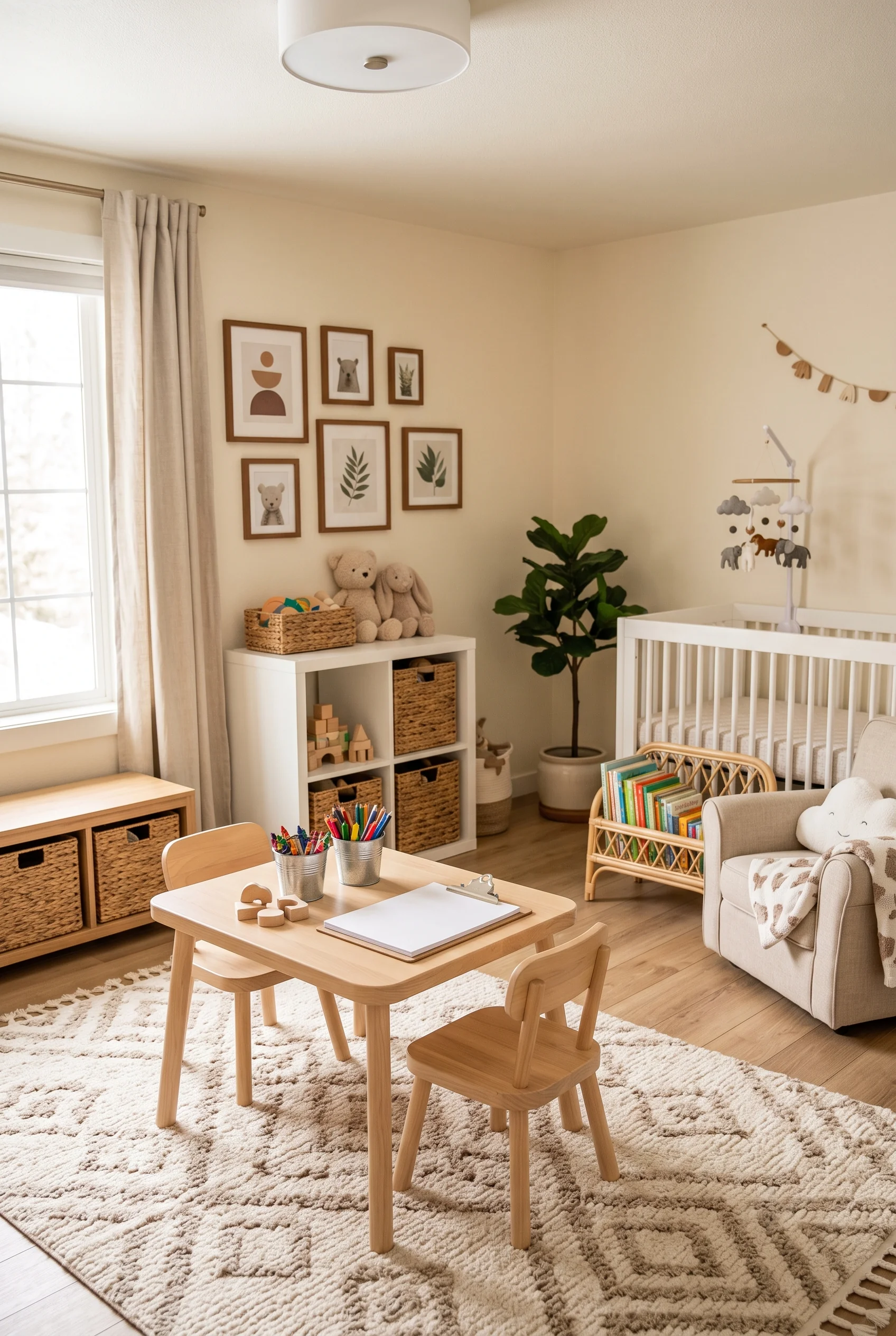
Blank paper on a clipboard, a metal caddy, and a cup of colored pencils wait on a child-height table in the middle of this room. Supplies are out and visible: the entire invitation; toddlers rarely ask for an art session; they simply sit down.
Keeping the station small and washable keeps the ambition realistic. Wood surfaces wipe clean, and the patterned rug below forgives a dropped crayon.
Framed animal prints above the shelf hint at where the next best masterpieces might hang.
Light, Texture, and Room to Move
Once the storage is solved, the sensory layer decides how a room actually feels: how dark it gets at nap time, how soft it is underfoot, how a toddler burns energy when the weather refuses to cooperate. These five rooms handle the physical experience of toddlerhood, from blackout curtains to an honest-to-goodness indoor slide, without sacrificing a bit of style.
The Nap-Saving Power of a Dark Curtain
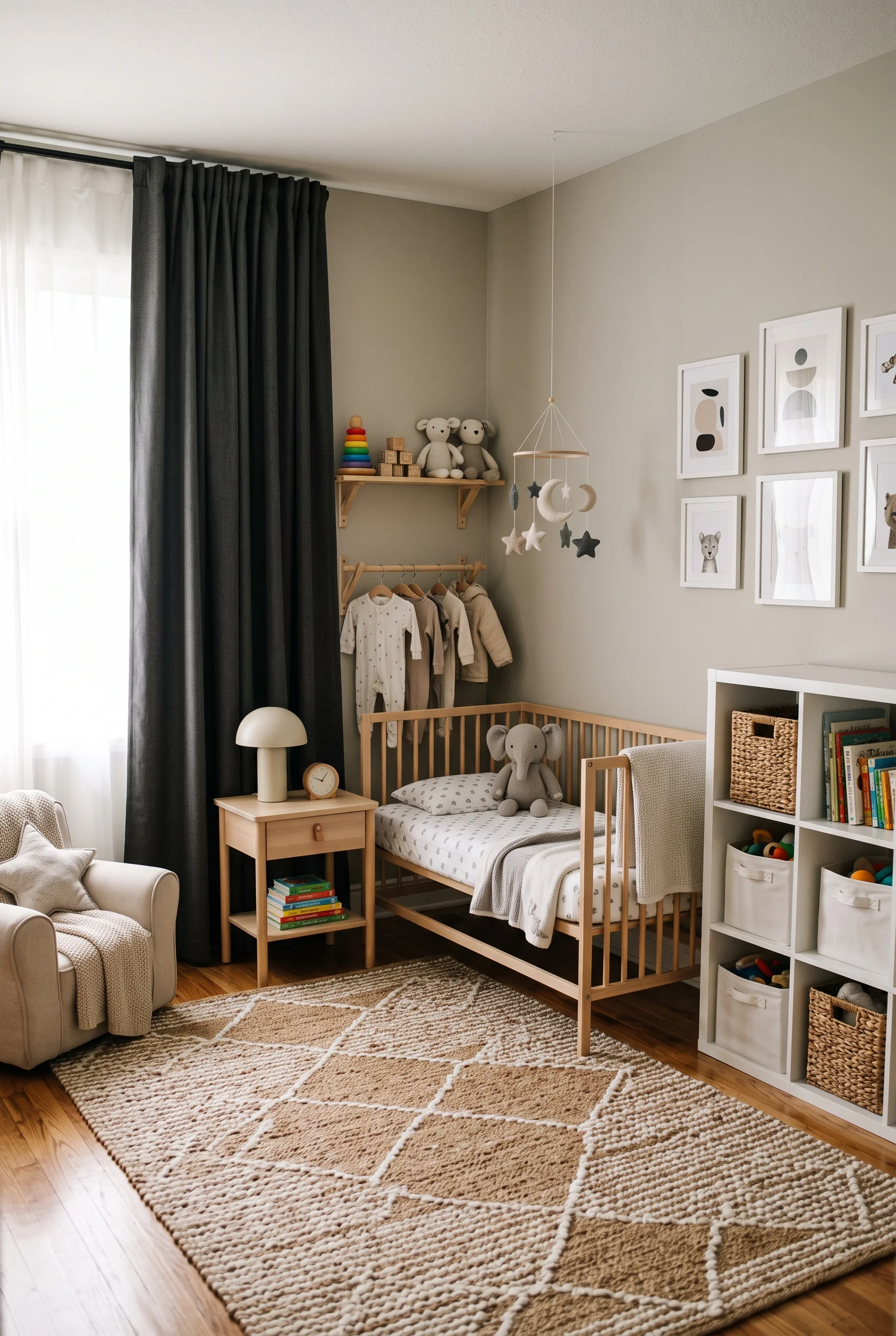
Charcoal blackout drapes layered over white sheers give this nursery a trick most toddler rooms desperately need: darkness on demand. Sheers filter daylight for play hours, then the heavy panel slides across for the 1 p.m. nap that saves everyone’s afternoon.
Choosing deep charcoal instead of a safe beige was the styling win. Against greige walls and a natural wood crib, the dark curtain reads as intentional contrast rather than a blackout compromise.
Better sleep rarely looks this considered.
Bedding That Forgives Sticky Fingers
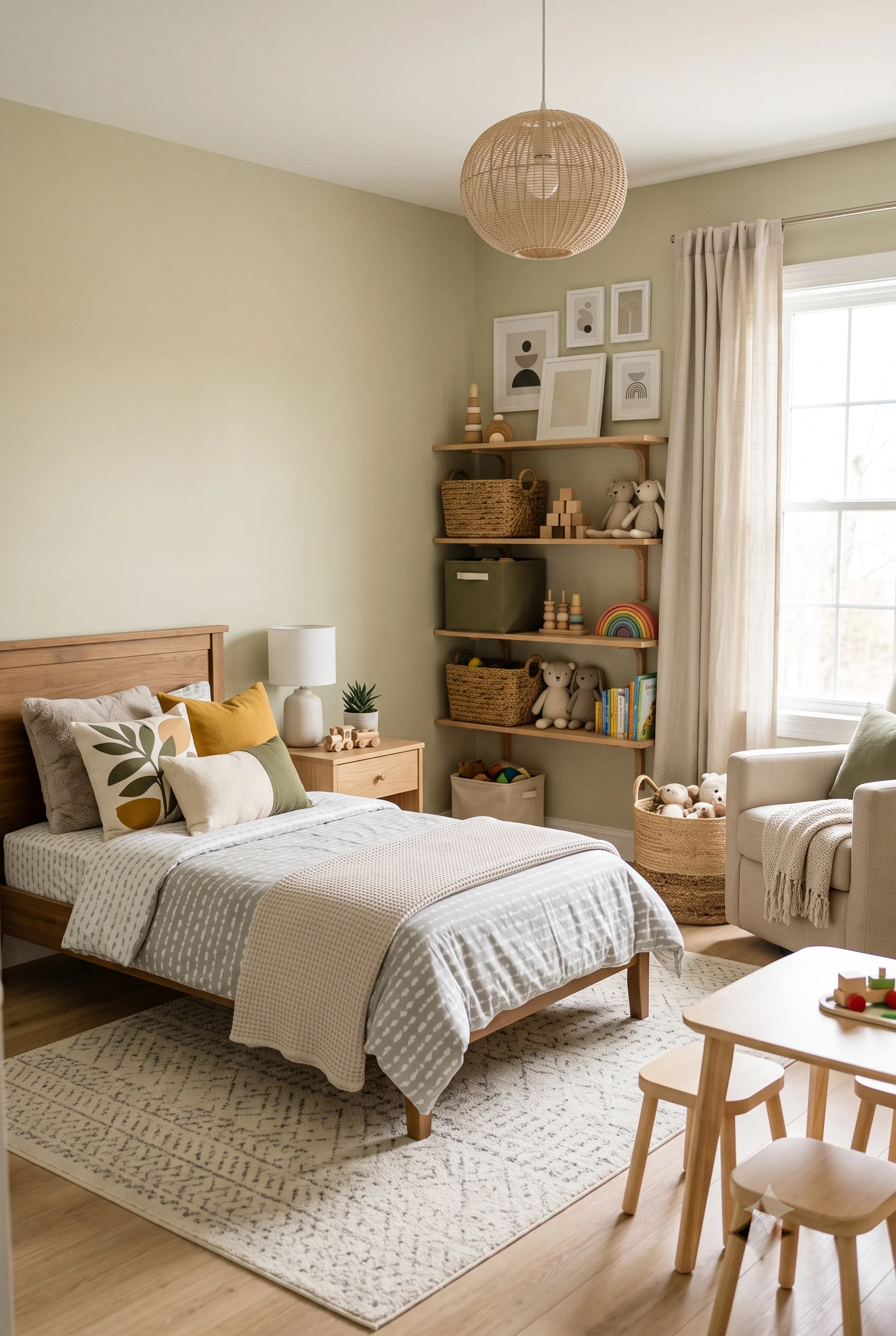
Layered quilts, dotted duvets, and a small mountain of pillows make this bed look indulgent, but every layer zips or slips off for the wash. That is the quiet genius of a toddler bed done right: it can be generous because nothing on it is precious.
Sage walls and a rattan pendant keep the palette soothing while the textiles carry the pattern.
Stain-resistant and machine-washable aren’t glamorous words, yet they’re why this room will still look like this photo six months from now.
A Little Indoor Forest for a Growing Mind
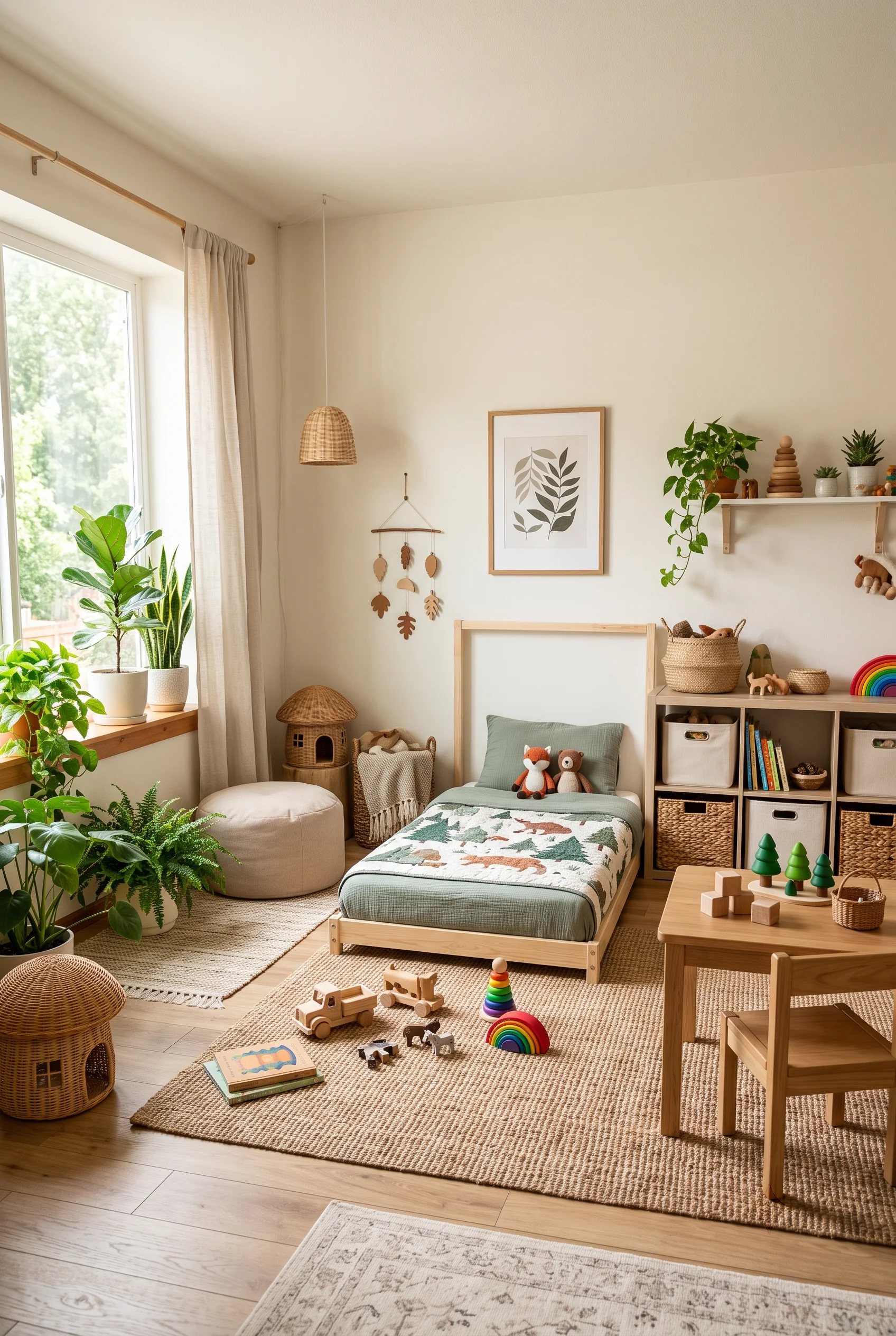
Potted plants line the windowsill, trail from shelves, and gather in the corners around this floor bed, turning the whole room gently green. Woodland-print bedding and a rattan pendant pick up the theme without a single cartoon.
Living things give toddlers something screens cannot: slow change worth checking on every morning.
Placement is the safety detail worth copying. Every plant sits up on a sill, shelf, or stand, out of range of curious hands, and choosing non-toxic varieties keeps the whole scheme worry-free.
Permission to Climb, Built Right In
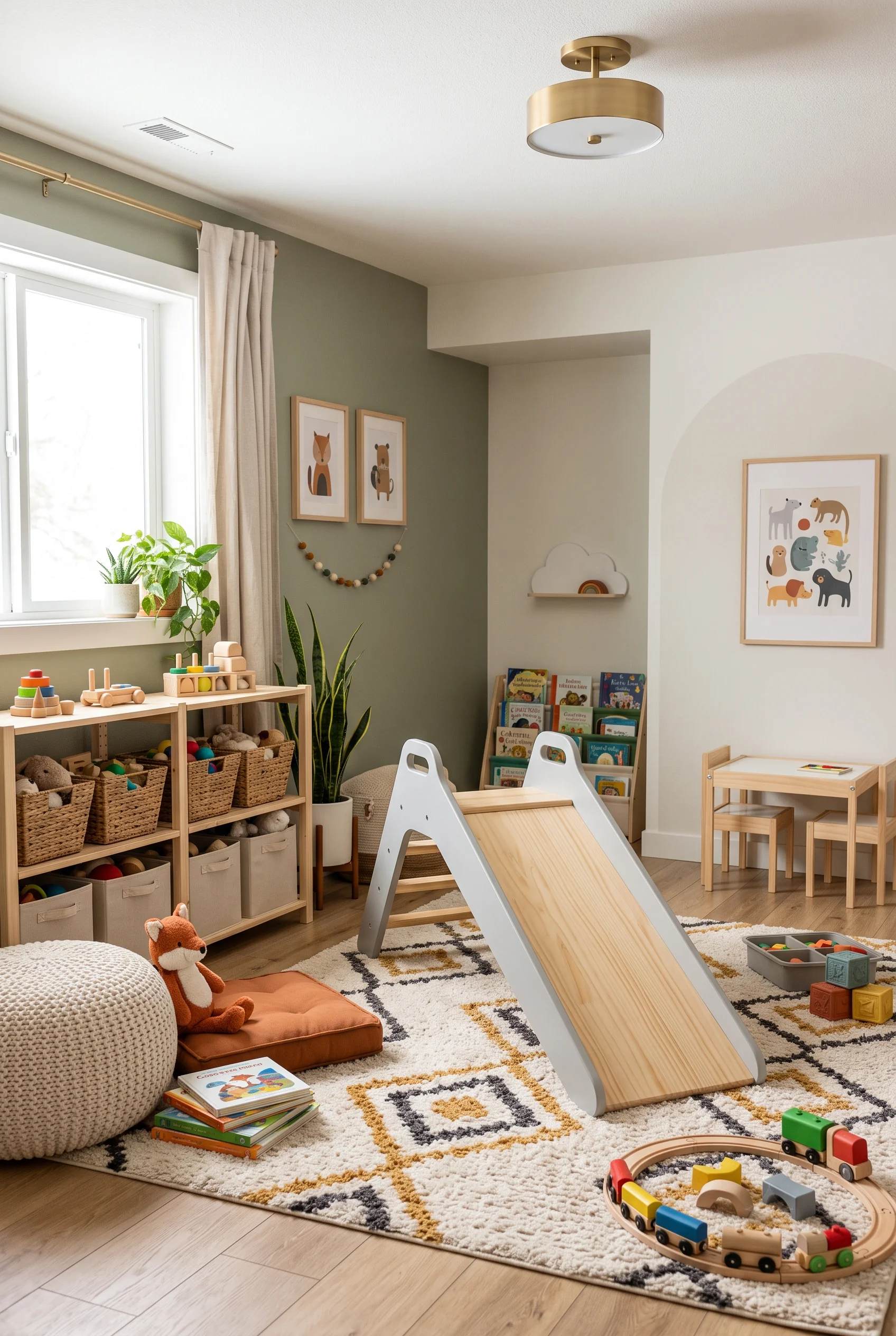
Right in the middle of the playroom, a small wooden slide with white rails claims its territory, and honestly it has earned it. Gross motor play usually gets exiled to the backyard; giving it real estate indoors changes winter afternoons entirely.
The thick cream rug beneath doubles as a landing pad, with a pouf and a floor cushion nearby for the inevitable dramatic dismounts.
Sage walls, wooden toys, and a tidy book display keep the space feeling styled. Active does not have to mean chaotic.
A Warm Glow for Winding Down
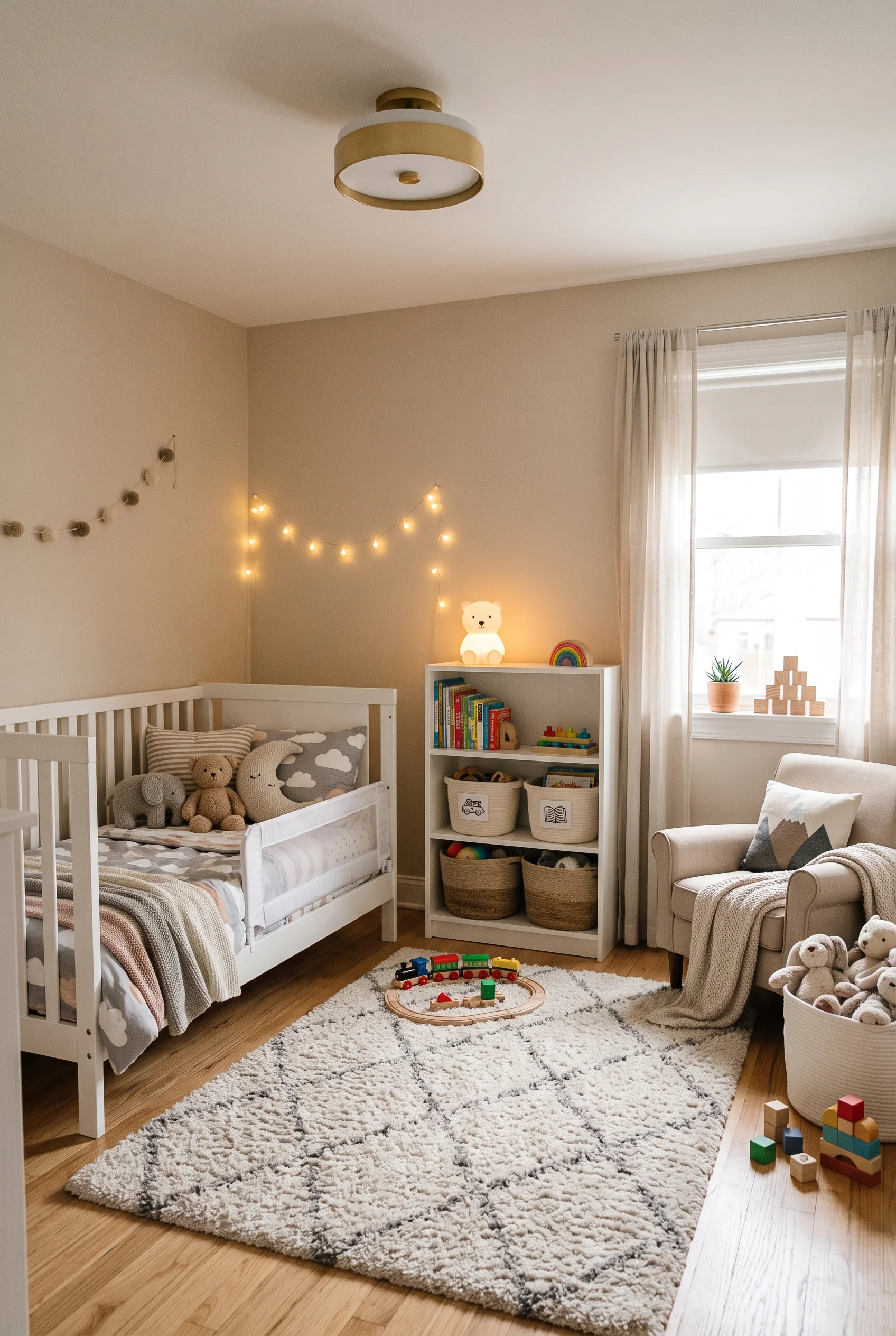
String lights loop across the wall, a little bear lamp glows on the bookshelf, and suddenly bedtime has an atmosphere instead of an overhead glare. Layered lighting lets the room shift from play mode to sleep mode with a couple of switches.
The bear nightlight earns its spot twice over: soft enough to sleep near, comforting enough to matter at 2 a.m.
Warm-toned bulbs throughout keep the glow amber rather than blue, a small choice that genuinely helps little bodies settle.
Little Zones With Big Purpose
A toddler room does not need to be large to hold several small worlds. A dress-up corner here, a craft table there, a quiet spot with cushions for the overwhelmed moments: zoning gives each activity a home and quietly teaches toddlers where things happen and where they go back. The six spaces in this group carve one room into many, and none of them required knocking down a wall.
A Costume Wardrobe That Stages Daily Theater
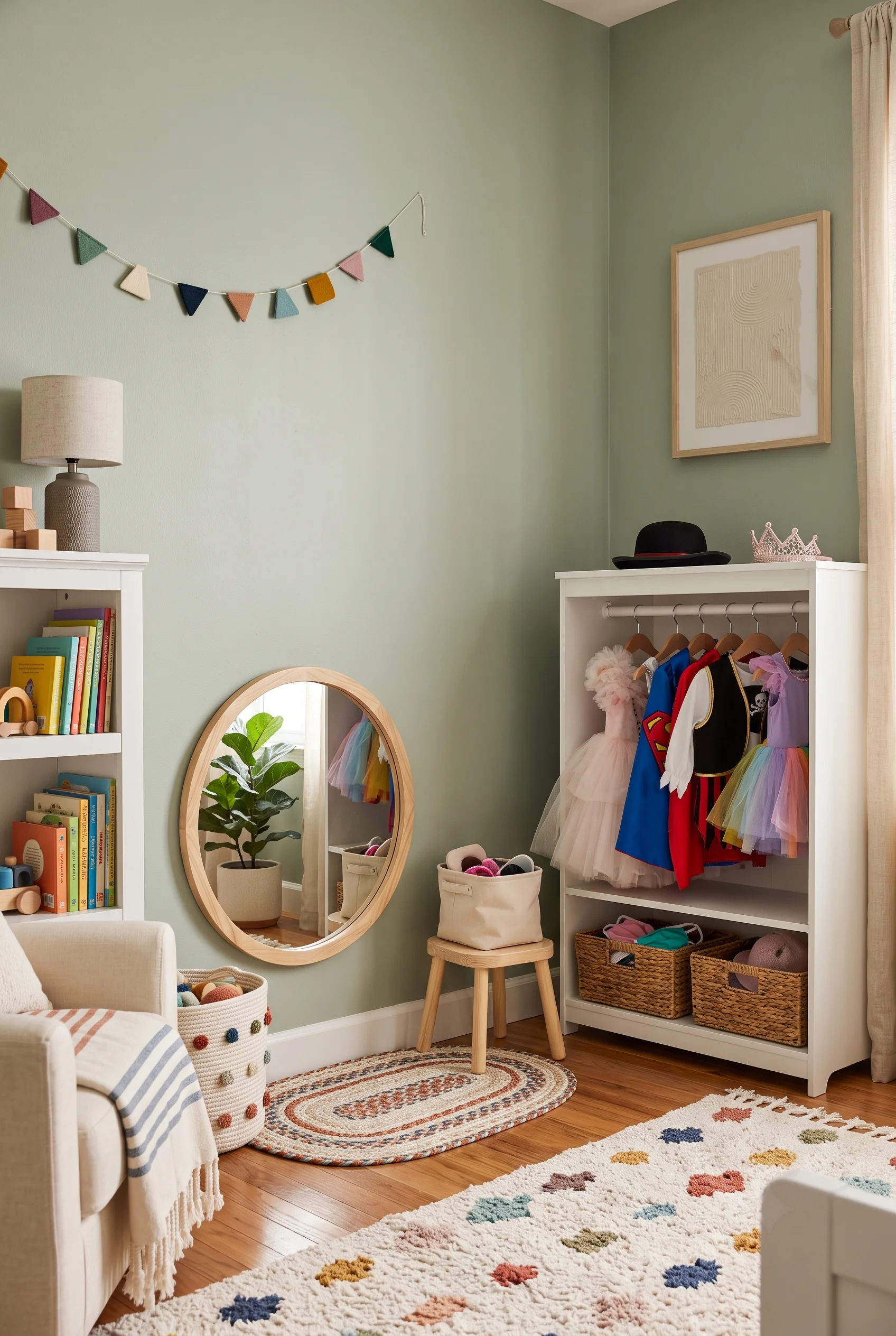
Tulle skirts, a superhero cape, and a tiny black hat hang at exactly grabbing height in this open wardrobe, with baskets of dress-up shoes below. Open storage is the entire trick; costumes behind a closed door get forgotten, costumes on display get worn to breakfast.
A round mirror leans low against the sage wall so its intended audience can admire the full effect.
The little stool and pennant garland complete a corner that invites a performance every single day.
The Hub Where Snacks, Crafts, and Tea Parties Collide
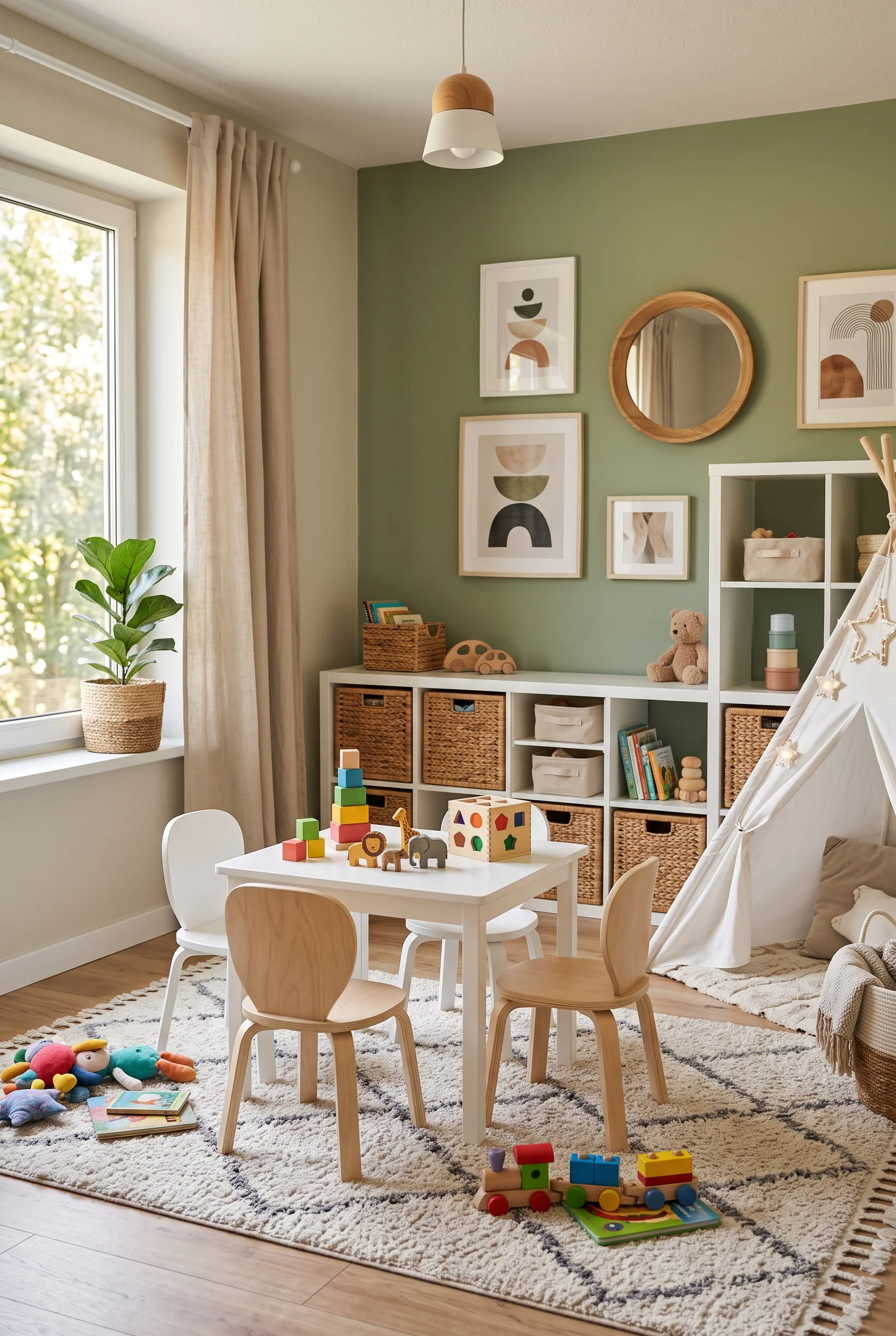
At the center of this playroom, a white-topped table with curved wooden chairs holds court, surrounded by everything that feeds it: basket-filled cubbies, a canvas teepee for retreating, a round mirror for checking in. The table is where a toddler’s day actually happens.
An olive green accent wall and a small gallery of abstract prints give the space more sophistication than most playrooms attempt.
Wooden animals and stacking toys sit on the tabletop, set out like an invitation rather than stored like an afterthought.
One Wall Where Drawing on Walls Is Encouraged
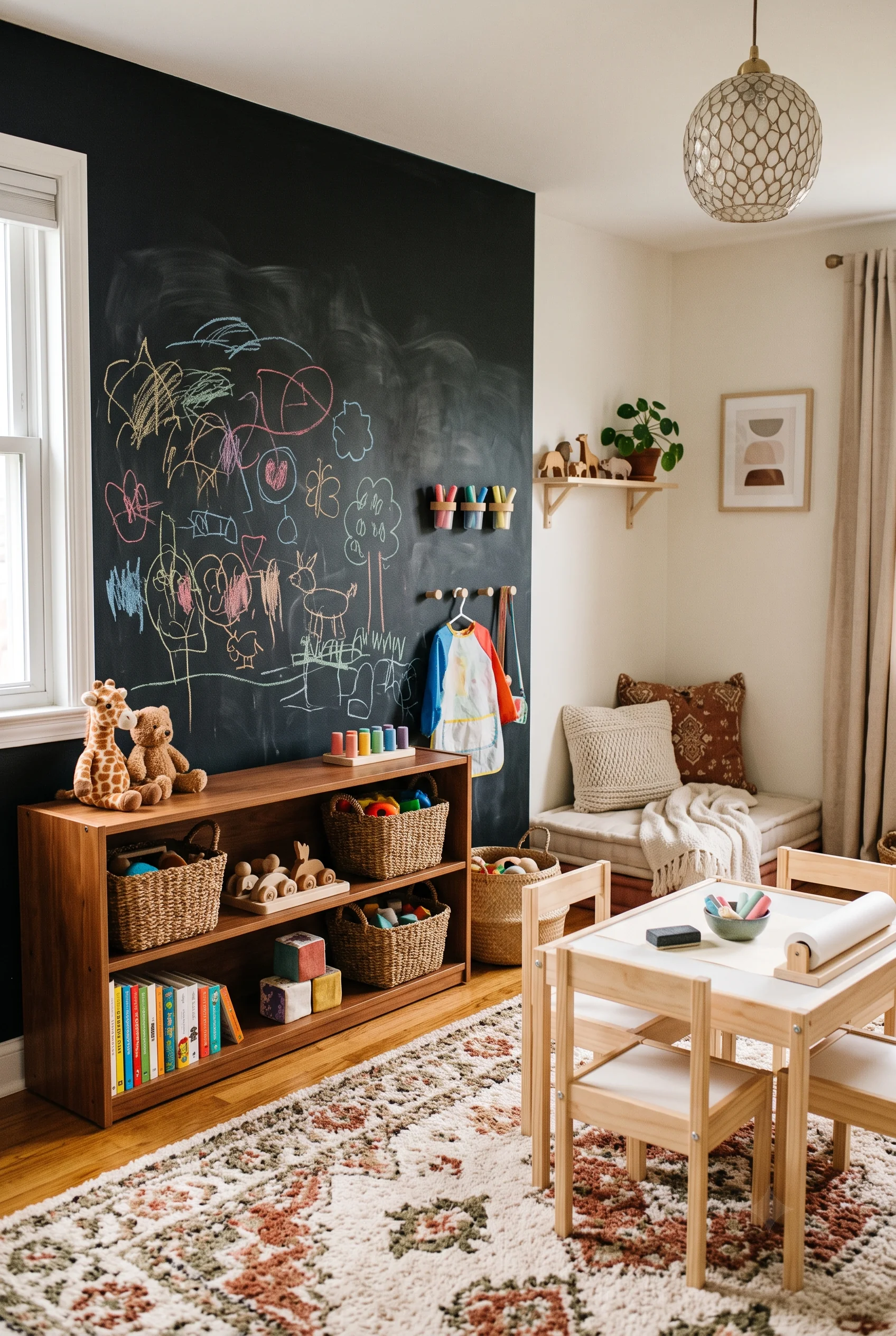
Black from floor to ceiling and already covered in rainbow scribbles, this chalkboard wall gives the playroom its personality and its best activity in one move. Mounted chalk cups keep supplies at hand, and the dark backdrop makes the wood shelf and woven baskets in front look almost gallery-worthy.
Every toddler eventually draws on a wall. Offering one where it is celebrated redirects the impulse and saves the others.
A cushioned bench waits in the adjacent corner, close enough for an adult to admire each masterpiece as it appears.
Display Space That Never Touches the Floor
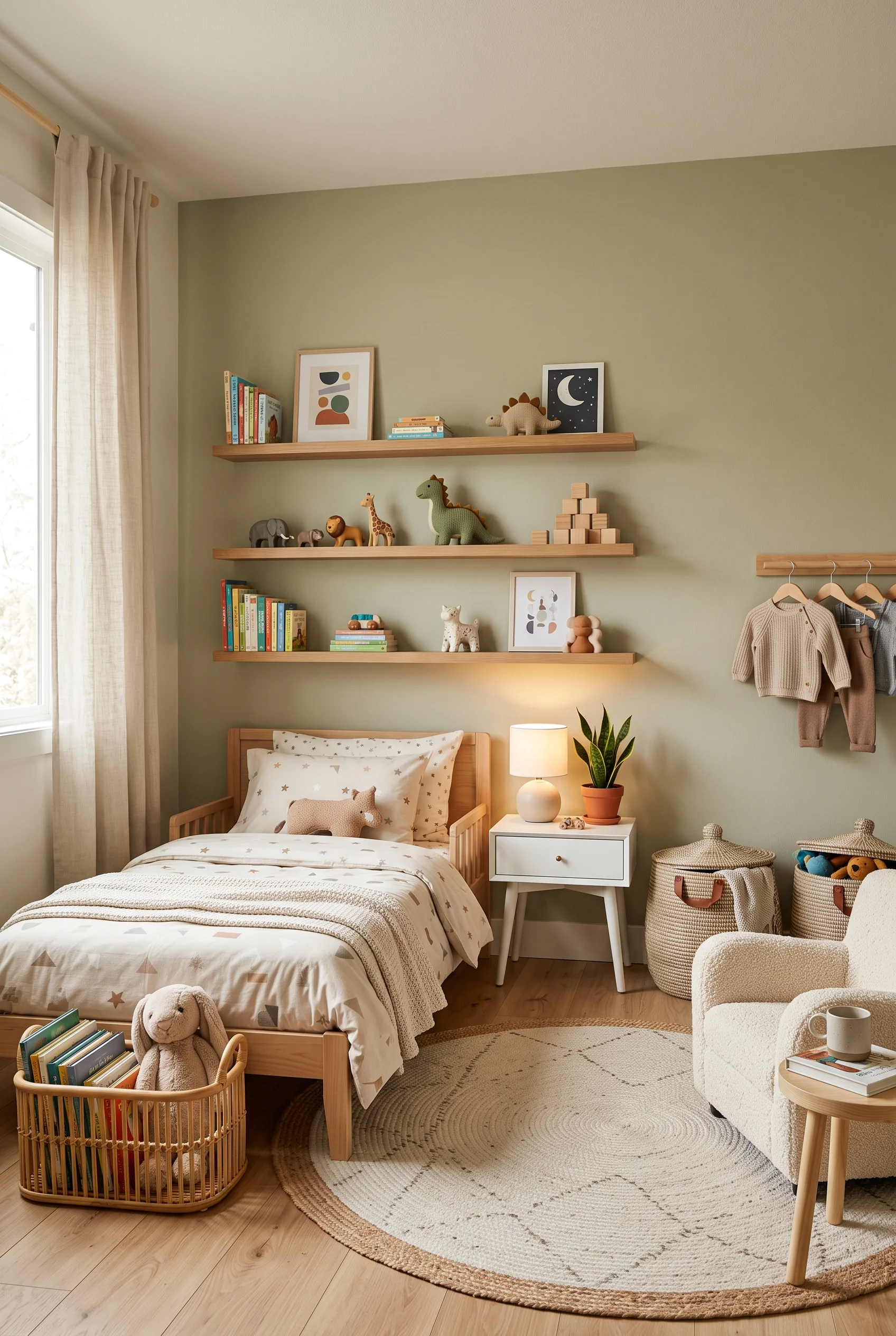
Three long floating shelves above the bed hold this room’s whole personality: dinosaurs, favorite picture books, and a moon print. Everything stays visible, nothing occupies floor space, and the lowest shelf sits close enough for supervised choosing.
A hanging rail nearby keeps tomorrow’s outfit off the furniture too, extending the floor-free logic to clothes.
Above a bed, secure anchoring and lighter objects are the sensible rule. Boards and brackets this simple make it an easy weekend project.
Independence Built Into the Floor Plan
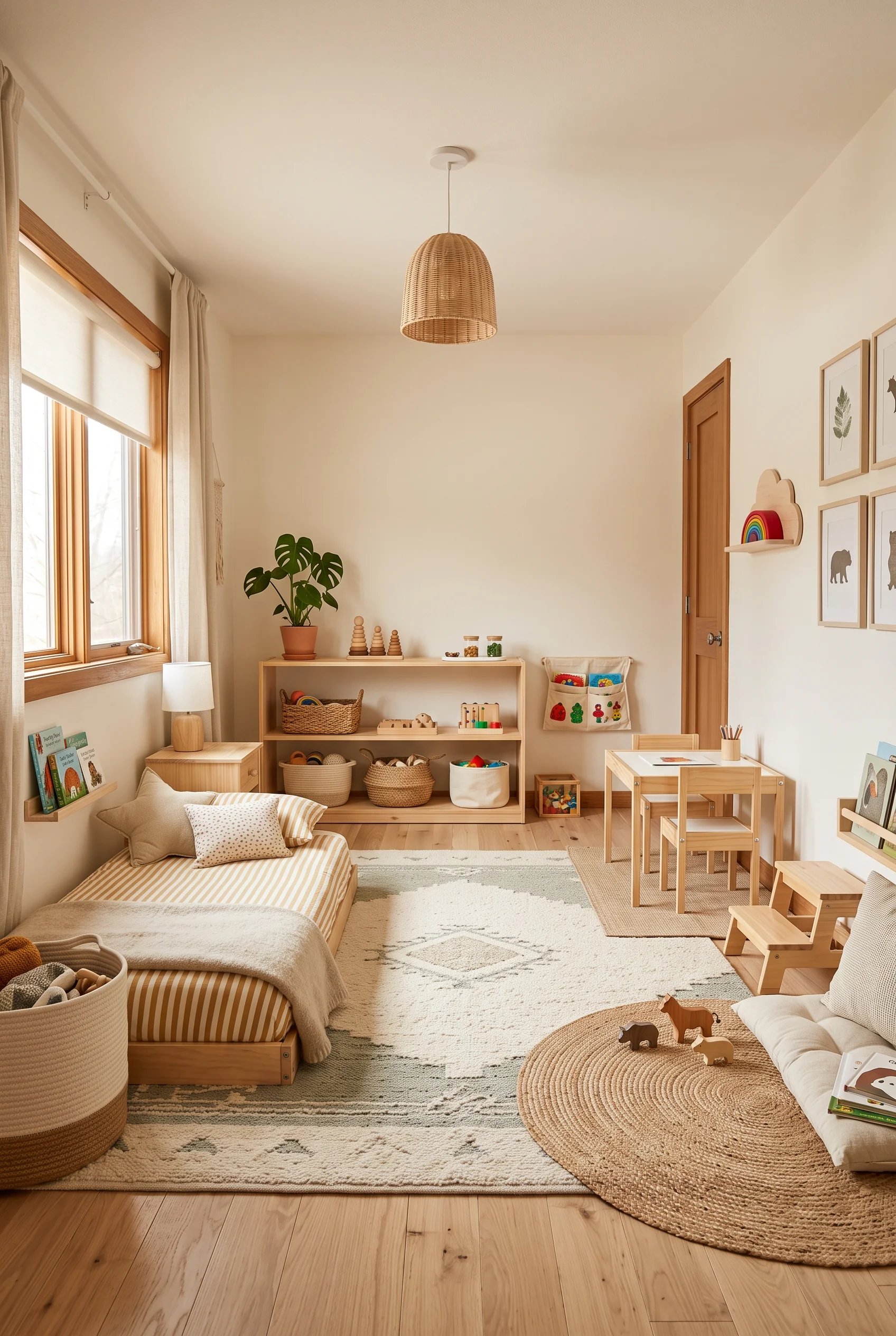
Low is the operating principle here: a mattress near floor level, shelves a two-year-old can reach, and step stools waiting by the reading chair. Every choice removes an obstacle between the child and their own things.
Book ledges and a floor cushion carry the philosophy into the corners. Even the toys face outward at knee height.
The payoff is a toddler who fetches their own book, climbs into their own bed, and starts to trust their own competence. My Montessori playroom ideas dig deeper into child-led setups like this one.
A Soft Landing for Big Feelings
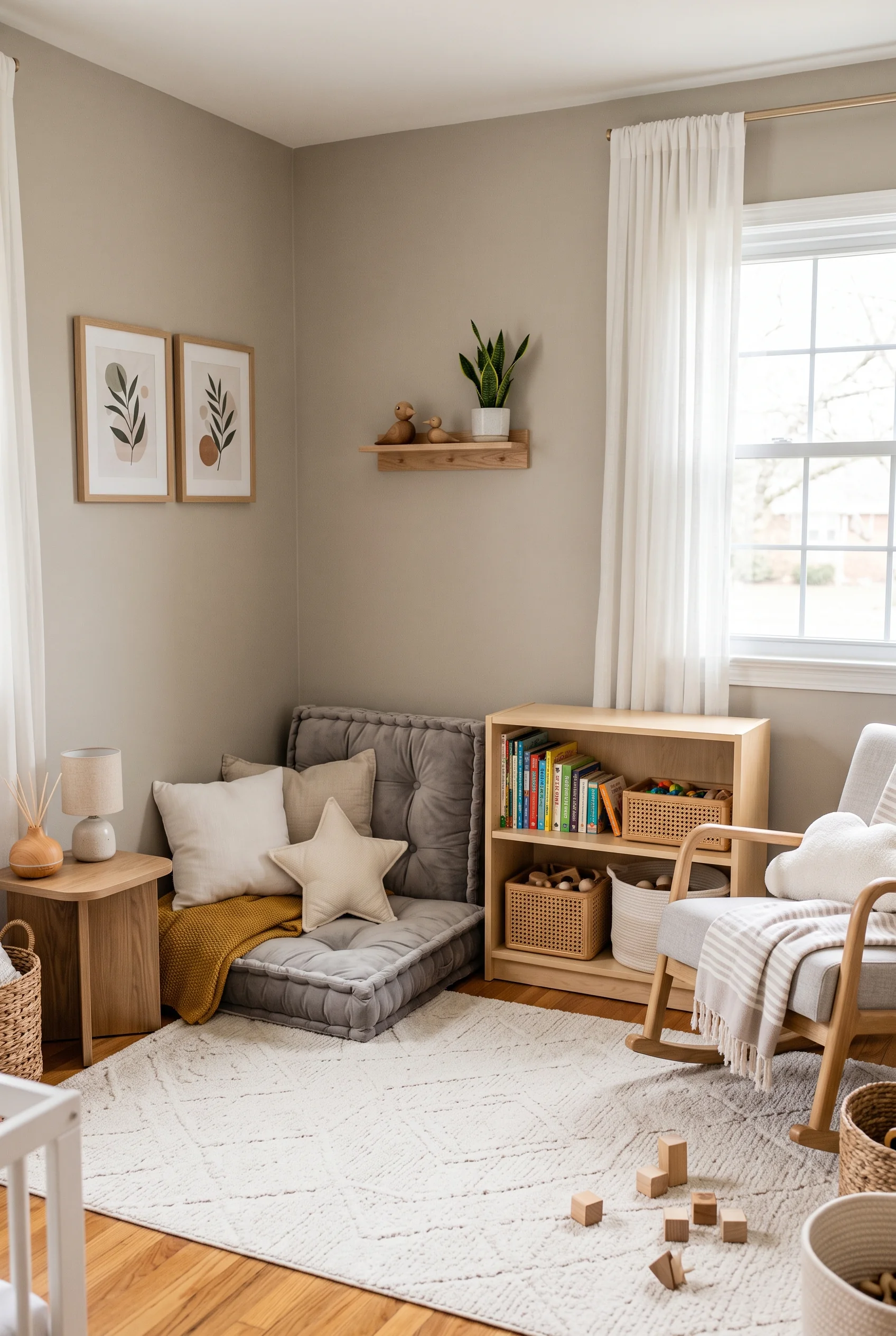
Tufted gray floor cushions stack into a low lounge in this corner, piled with pillows and a star-shaped cushion, with books and a mustard throw within arm’s reach. No screens, no stimulation, just softness.
Toddlers do not step away to collect themselves the way adults do, but they will absolutely melt into a cushion pile when one exists.
A calm corner gives big feelings somewhere to land other than the middle of the kitchen floor, and it costs little more than the cushions themselves.
The Finishing Layer of Cozy and Keepsakes
With the practical bones in place, the last layer is pure warmth: a canopy that makes bedtime feel like an occasion, baskets that turn storage into texture, and walls filled with the faces and artwork that matter most. These finishing touches are what people remember about a room, and conveniently, they are also the easiest ideas on this list to pull off in a single weekend.
A Canopy That Makes Bedtime an Occasion
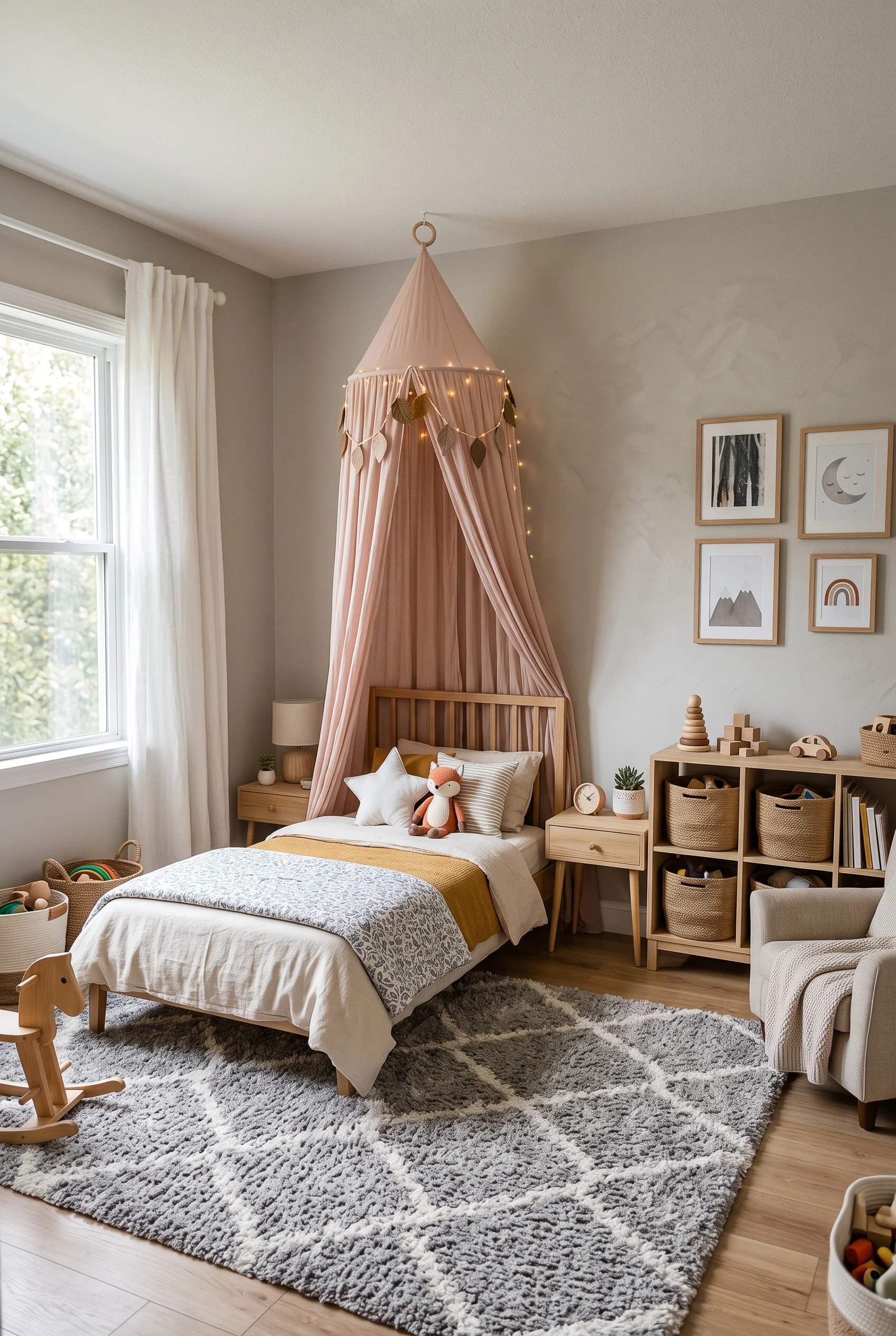
Blush pink fabric cascades from a single ceiling point over this bed, threaded with fairy lights and a leaf garland. Climbing under it feels like entering a tent, a fort, and a fairy tale at once, which is a persuasive argument at 7:30 p.m.
The gray diamond rug and mustard blanket keep the rest of the room grounded so the canopy can be the moment.
One ceiling hook and a length of fabric deliver more drama per dollar than almost any other update in this post.
Storage That Doubles as Texture
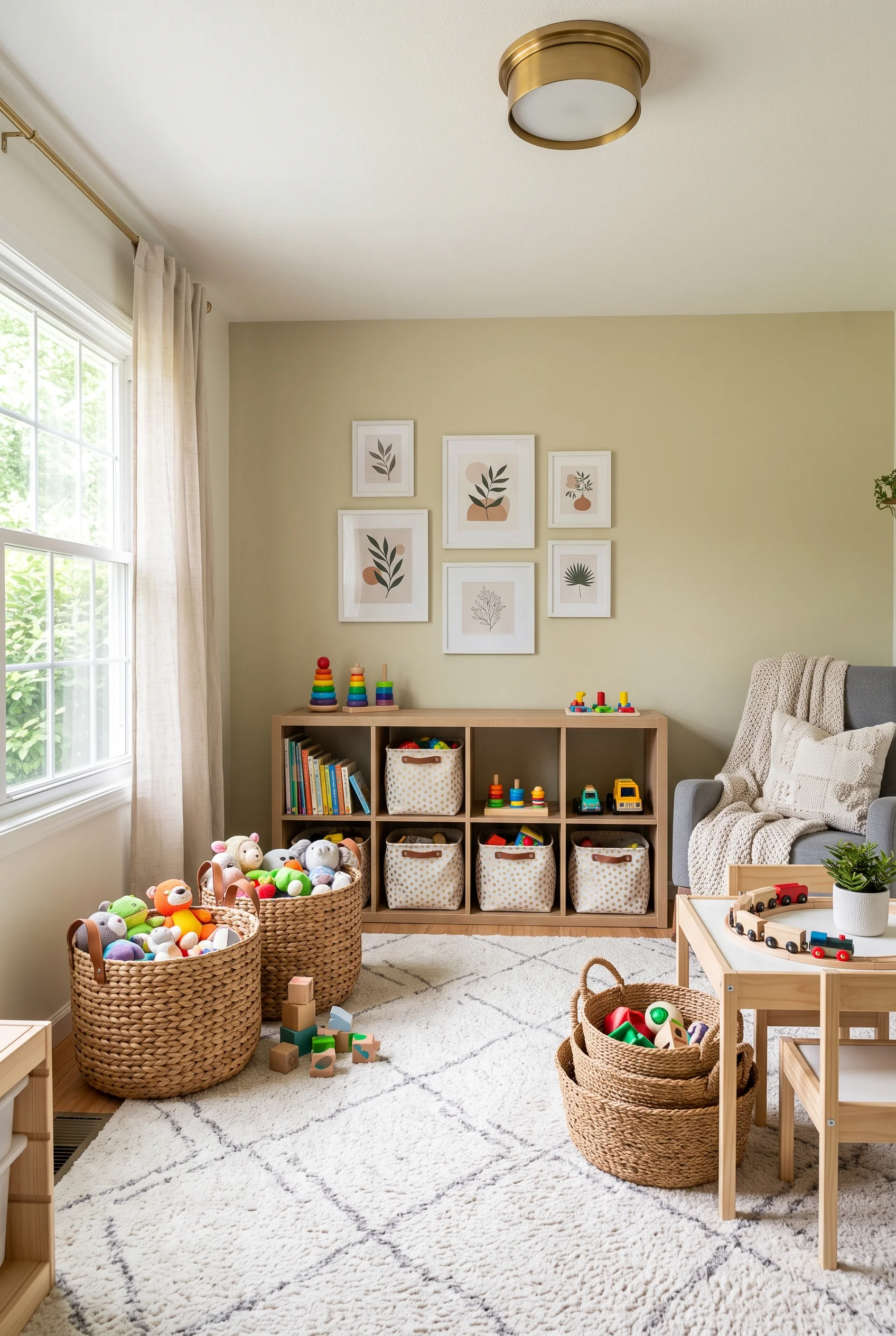
Two oversized woven baskets overflow with plush animals in this playroom, and somehow the overflow looks styled. Even full, even messy, natural fiber reads as texture rather than clutter.
A trio of nested baskets holds the wooden toys, while patterned bins tuck into the cubby shelf behind. Every container earns its place visually.
Cleanup becomes a toss-and-done affair a toddler can actually manage. No lids, no sorting, no system to maintain.
Their Masterpieces, Framed Like Fine Art
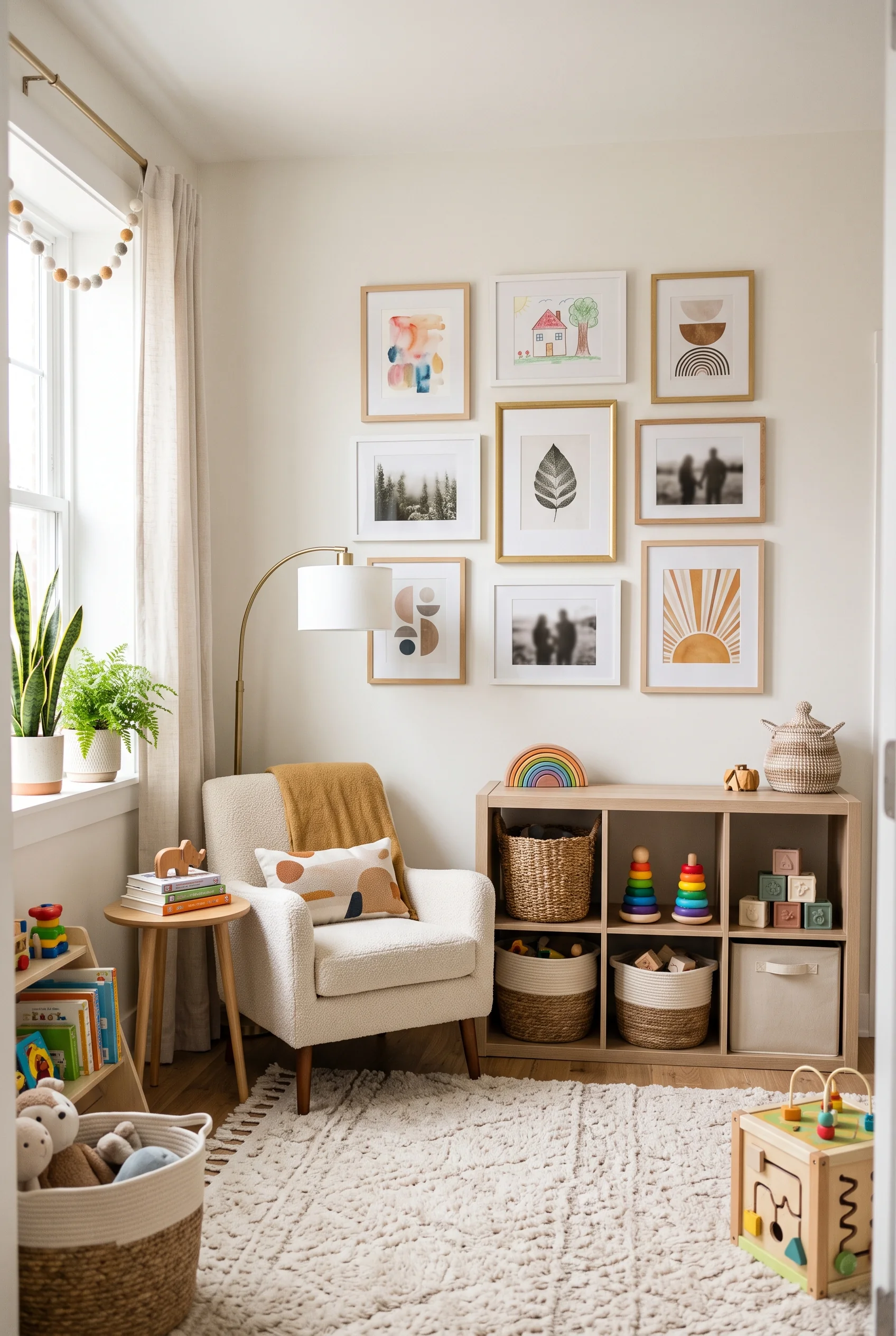
Nine frames hang in a loose grid here, mixing a child’s watercolor blobs and crayon house with family photos and a golden sun print. Treating toddler art with gallery seriousness tells a small person their work matters, and the mix keeps the wall from feeling like a museum.
Matching wood and white frames pull wildly different art styles together.
Swapping the art seasonally keeps the collection current, and the retired pieces slide straight into a keepsake box.
The Chair Where Everyone Ends Up at Bedtime
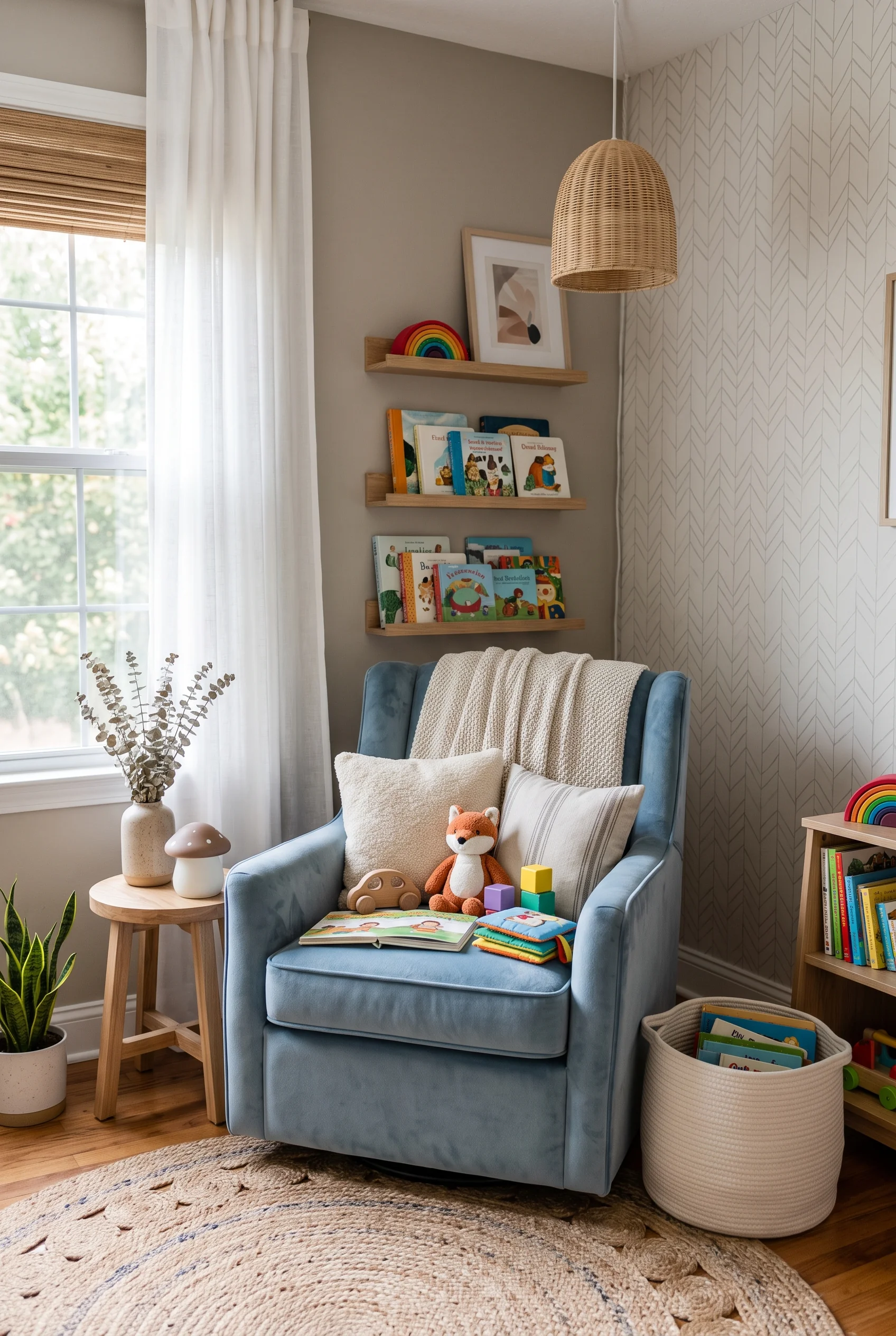
Dusty blue velvet gives this glider enough presence to anchor the whole corner, and enough depth to hold a parent, a toddler, and at least three books at once. Picture-ledge shelves on the wall keep covers facing out, because toddlers choose books by their faces, not their spines.
A basket of extras waits at arm’s reach so no one has to get up mid-snuggle.
Of every piece in a toddler room, the comfortable adult-sized chair may log the most meaningful hours.
Family Photos Hung Where Toddlers Actually Look
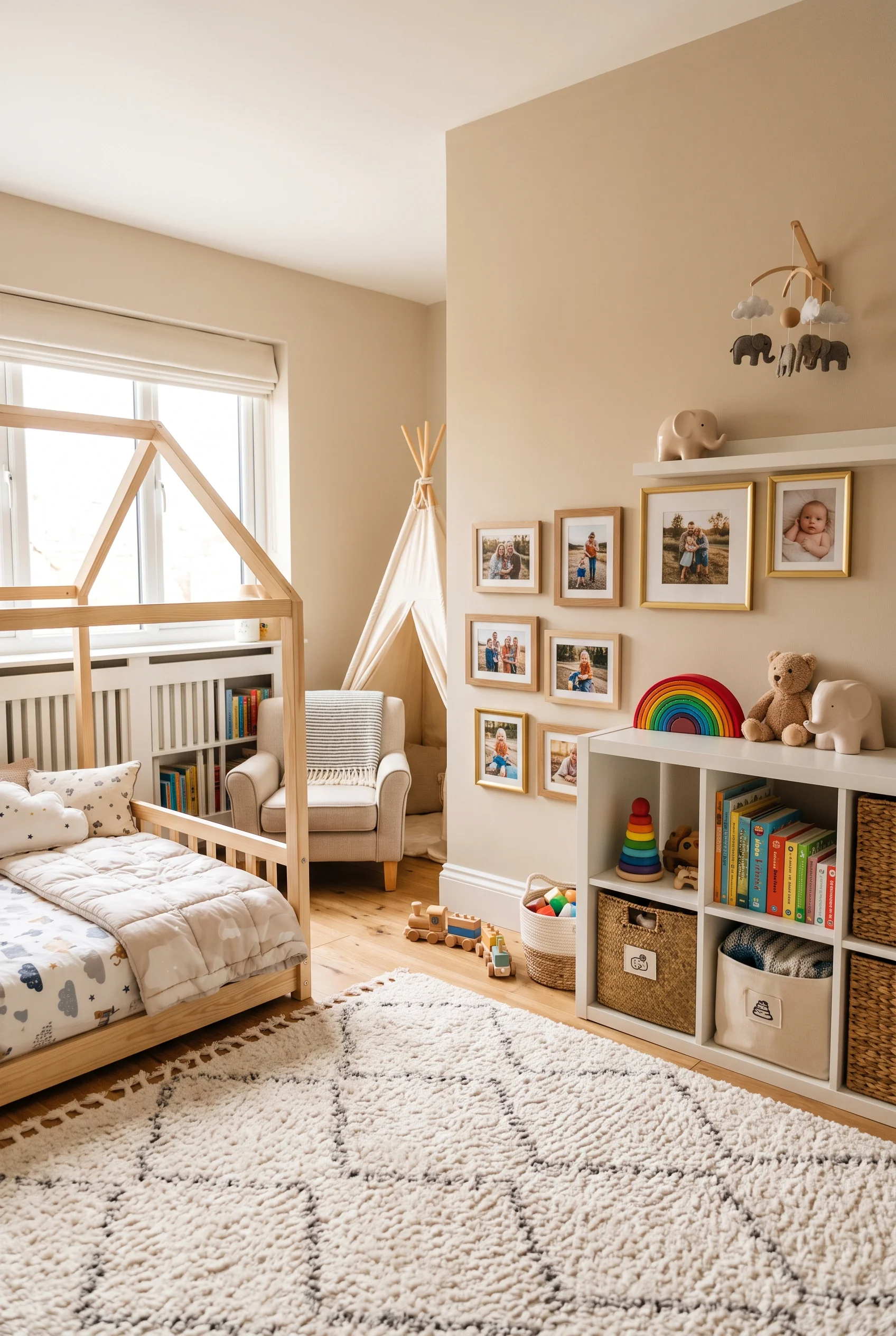
Framed family photos cluster low on this wall, some barely above the cubby shelf, all within easy sight of a child standing on the rug. Galleries are usually hung for adult eyes; dropping them two feet changes who they belong to.
A house-frame bed and a canvas teepee keep the room playful while the photos make it personal.
Toddlers will stand and name every face, every time. Few decor choices deliver that kind of daily return.
A Toddler Room That Grows With Your Family
Thirty-one rooms, and the same handful of ideas keep surfacing in different clothes. Calm, neutral backdrops that flex as tastes change. Furniture scaled to the child and built to convert. Storage everywhere, most of it disguised as decor. And woven through all of it, the personal layer: photos at toddler height, artwork in real frames, a growth chart quietly keeping score.
You don’t need to do all of this at once, and you definitely don’t need a bigger house. The most useful toddler room ideas are the small ones: a basket where the plush animals land, hooks low enough for a two-year-old to use, a lamp with a warm bulb instead of an overhead glare. Pick the one idea that solves your loudest daily frustration and start there. If clutter is that frustration, my minimalist kids’ room ideas pair well with nearly every room in this post.
Your toddler will not remember the throw pillows. They will remember reading in the big chair, drawing on the wall they were allowed to draw on, and seeing their own family framed at their eye level. Design for those moments, and the room turns out beautiful almost by accident.
Start small this weekend, one corner, one basket, one string of lights, and watch the whole space begin to feel like it was always meant for this stage.