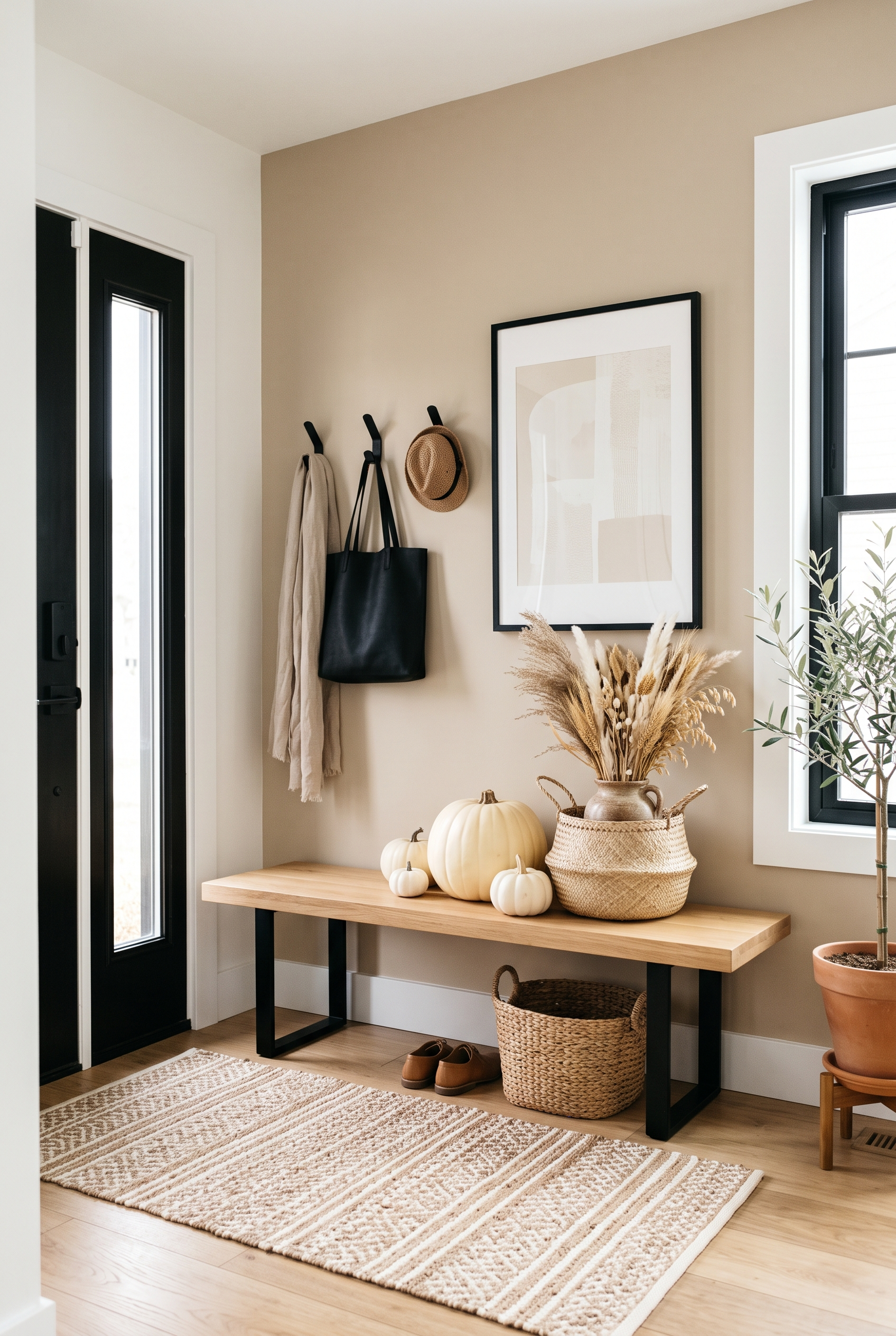
25 Entryway Organization Ideas to Keep Clutter Under Control
If your front door opens to a pile of sneakers and a chorus of “where’s my backpack,” these entryway organization ideas are for you. The entry is the hardest-working few square feet in a family home. Everyone passes through it at least twice a day, usually carrying something, usually in a hurry. When this one small zone works, the whole house starts the day calmer.
The good news: none of the twenty-five ideas below requires a renovation. Most are a single bench, basket, or hook rail away, and the same thinking that keeps clutter-free kids’ spaces tidy applies here too: give every item one obvious home. If you’ve already borrowed tricks from our toy storage roundup or squeezed real function out of a small nursery, you know how much a few smart systems can change a room.
Below you’ll find real, livable rooms, not showroom fantasies. Drop zones that catch keys and mail before they scatter. Benches that swallow shoes. Walls that hold the family calendar.
Pick the two or three ideas that match the way your family actually comes and goes, and start there.
DISCLOSURE: Some of the links provided on this page are affiliate links. This means if you choose to make a purchase through these links, we may receive a small commission at no extra cost to you.
The Landing Zone Every Busy Family Needs
Every family entry needs a landing zone: the stretch just inside the door where coats, shoes, and keys can touch down without spreading through the house. Get these first five feet right and everything downstream gets easier. The four spaces below each solve one piece of the daily drop, from hooks a preschooler can reach to baskets that hold a whole season, and together they form the backbone of a functional entryway.
Color-Happy Hooks at Every Height
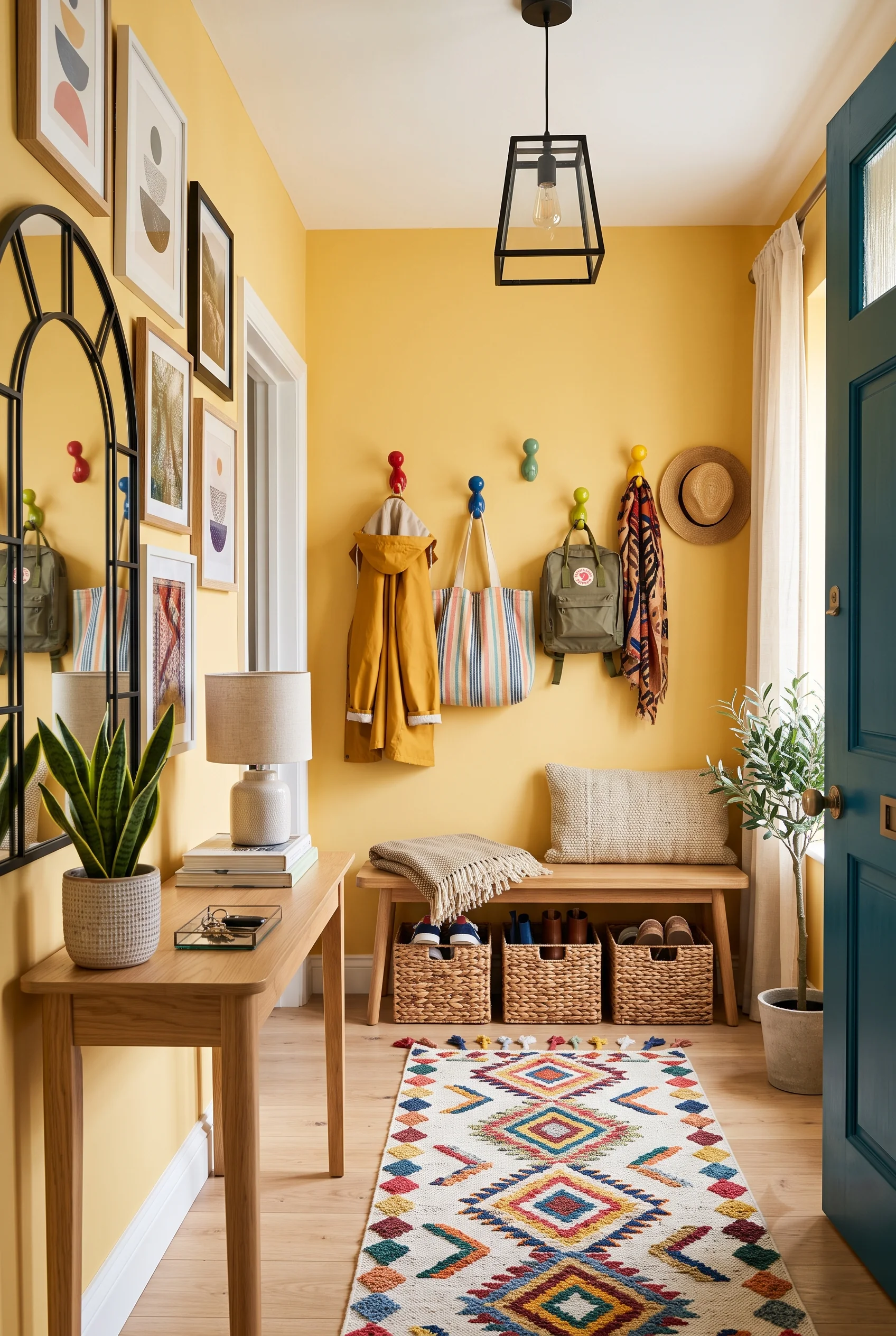
Sunshine-yellow walls could easily read as chaos, but the staggered rainbow of peg hooks keeps this entry in line. Each colorful knob holds exactly one thing: a mustard raincoat, a striped tote, a kid-sized backpack. The lower pegs sit right at child height, which quietly ends the daily argument about coats on the floor.
Below, a slim bench with woven baskets catches the shoe traffic, and a boldly patterned runner ties the whole palette together. Hooks are the cheapest storage in the house, and staggering their heights turns them into a system the entire family can reach without help.
The Bench That Ends the Shoe Pile
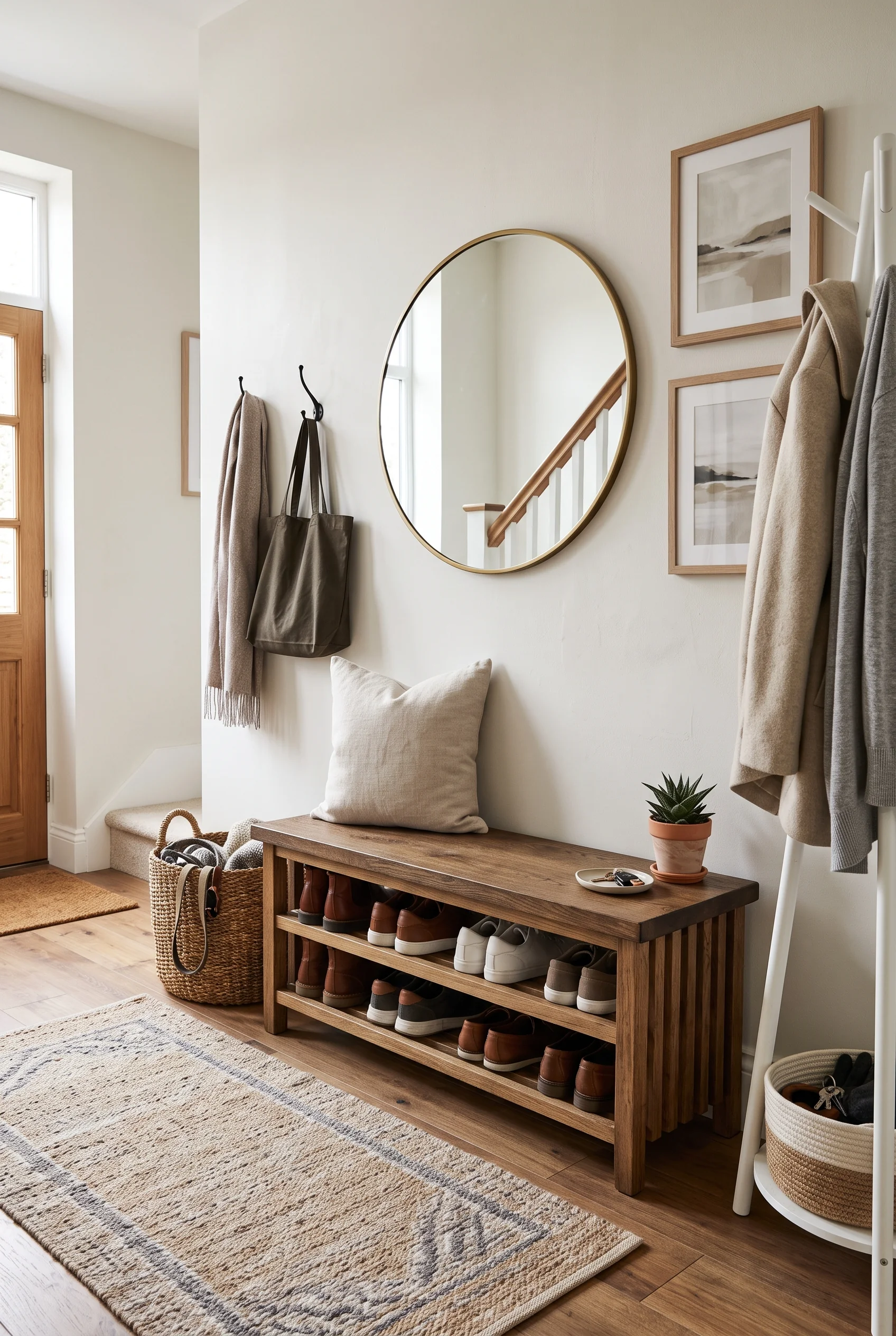
Shoes multiply faster than any other category at the door, which is why an open slatted bench earns its keep here. Two shelves hold a full family rotation in plain sight, and the warm wood top doubles as a place to sit while lacing up.
A linen pillow softens the seat, a round brass mirror lifts the eye, and a white ladder rack takes the coats the hooks can’t. Everything stays visible, so nobody digs through a bin at 7 a.m. On the busiest mornings, visible beats hidden every time.
A Five-Second Home for Keys and Mail
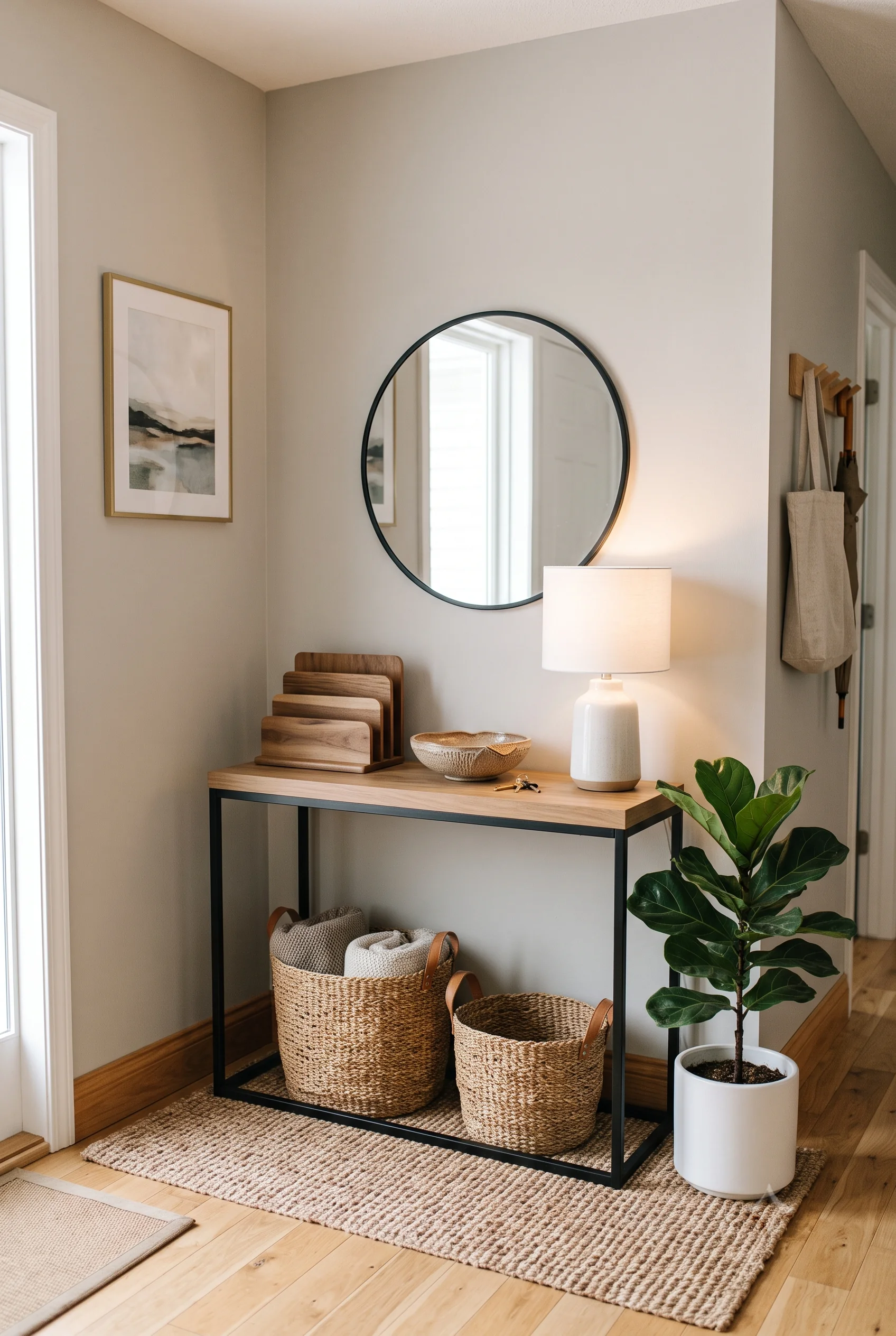
Keys have a way of vanishing at 7:42 a.m. sharp. The fix in this corner is almost too simple: a wooden mail sorter and a small bowl parked on the console, right where hands naturally empty on the way in.
Mail slides upright into slots instead of fanning across the table, and the bowl swallows keys and loose change. The black-framed console keeps the footprint airy, with woven baskets tucked beneath for bulkier overflow. Ten seconds of habit, and the counter clutter never makes it past the front hall.
Off-Season Gear, Hidden in Plain Sight
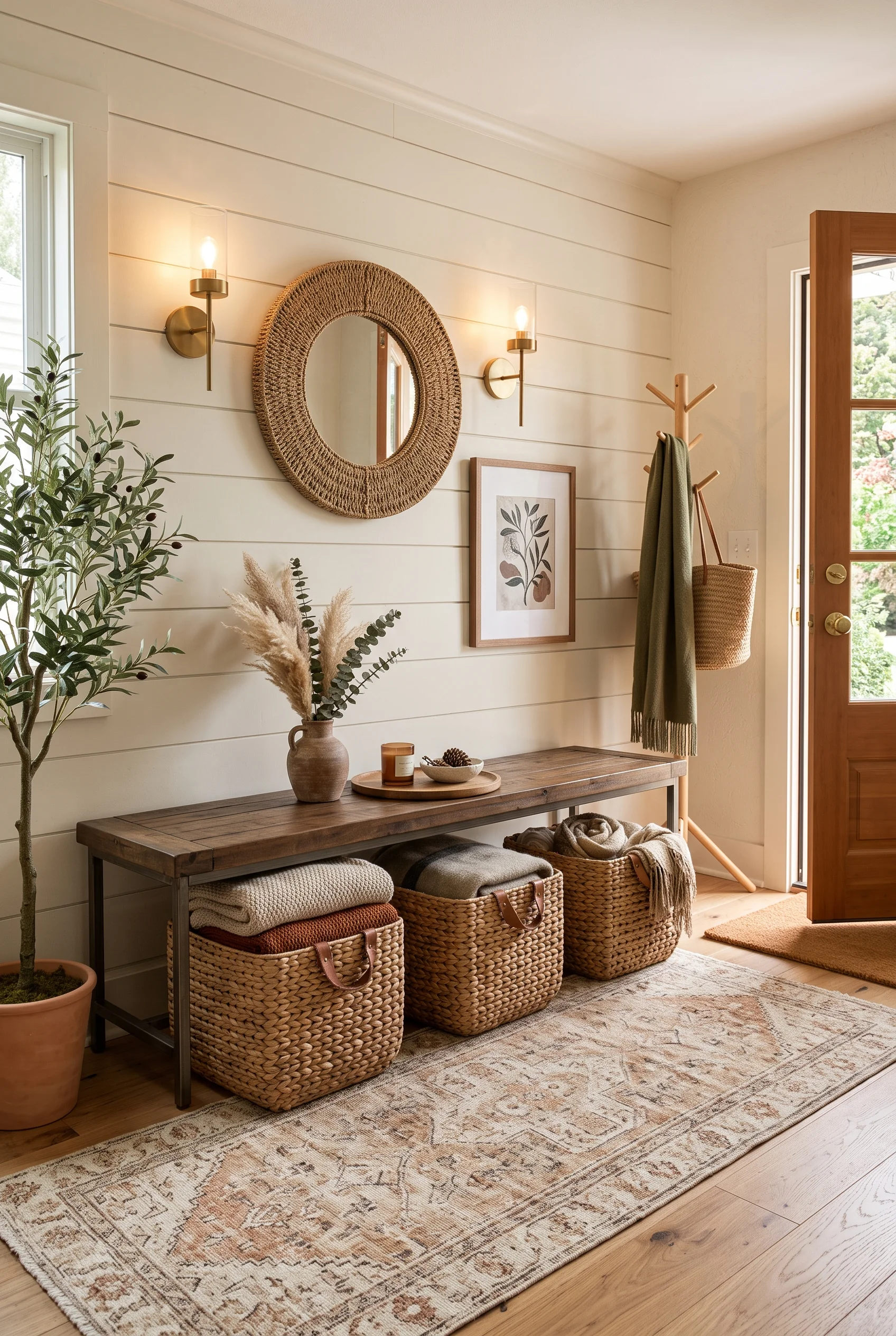
Woven texture does the heavy lifting along this shiplap wall. Three lidded seagrass baskets slide under a long bench, each one deep enough to hold a season of scarves, sweaters, and throws. Lids matter here. They turn open storage into furniture and keep curious little hands from unpacking everything you just folded.
Above, a rattan mirror and brass sconces carry the warm, natural palette up the wall. When the weather turns, the baskets swap contents instead of the room swapping furniture, and mittens live steps from the door exactly when you need them.
Small-Space Moves That Work Twice as Hard
Most entryways are short on square footage and long on demands, so the smartest solutions multiply what little space exists. Mirrors that stretch the room, walls that store and schedule, furniture slim enough for a hallway yet deep enough to matter. The five ideas in this group are all about extracting more function per inch, which is the real art of organizing a small entryway.
One Gilded Mirror, Twice the Light
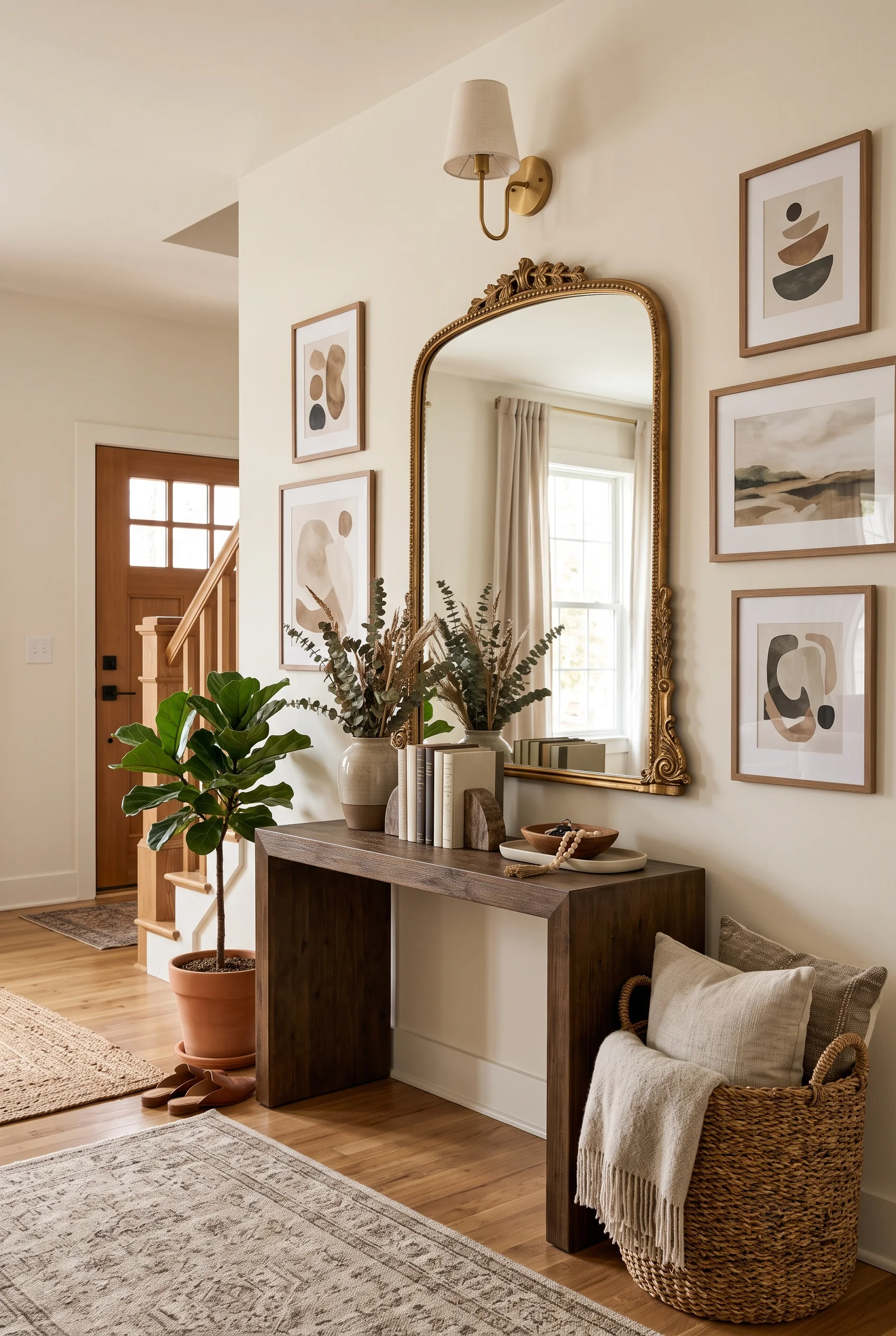
An ornate gold mirror is doing more than showing off above this walnut console. Its tall arched frame bounces window light back into the hall, and the vertical shape draws the eye up, which makes a narrow entry feel a full size larger.
Surrounded by a gallery of quiet abstract art, the mirror also earns its spot practically: one last coat check on the way out, hands full, no detour to the bathroom. In a space too small for extra furniture, a mirror is the rare upgrade that adds light, depth, and function without claiming an inch of floor.
The Wall That Runs Your Week
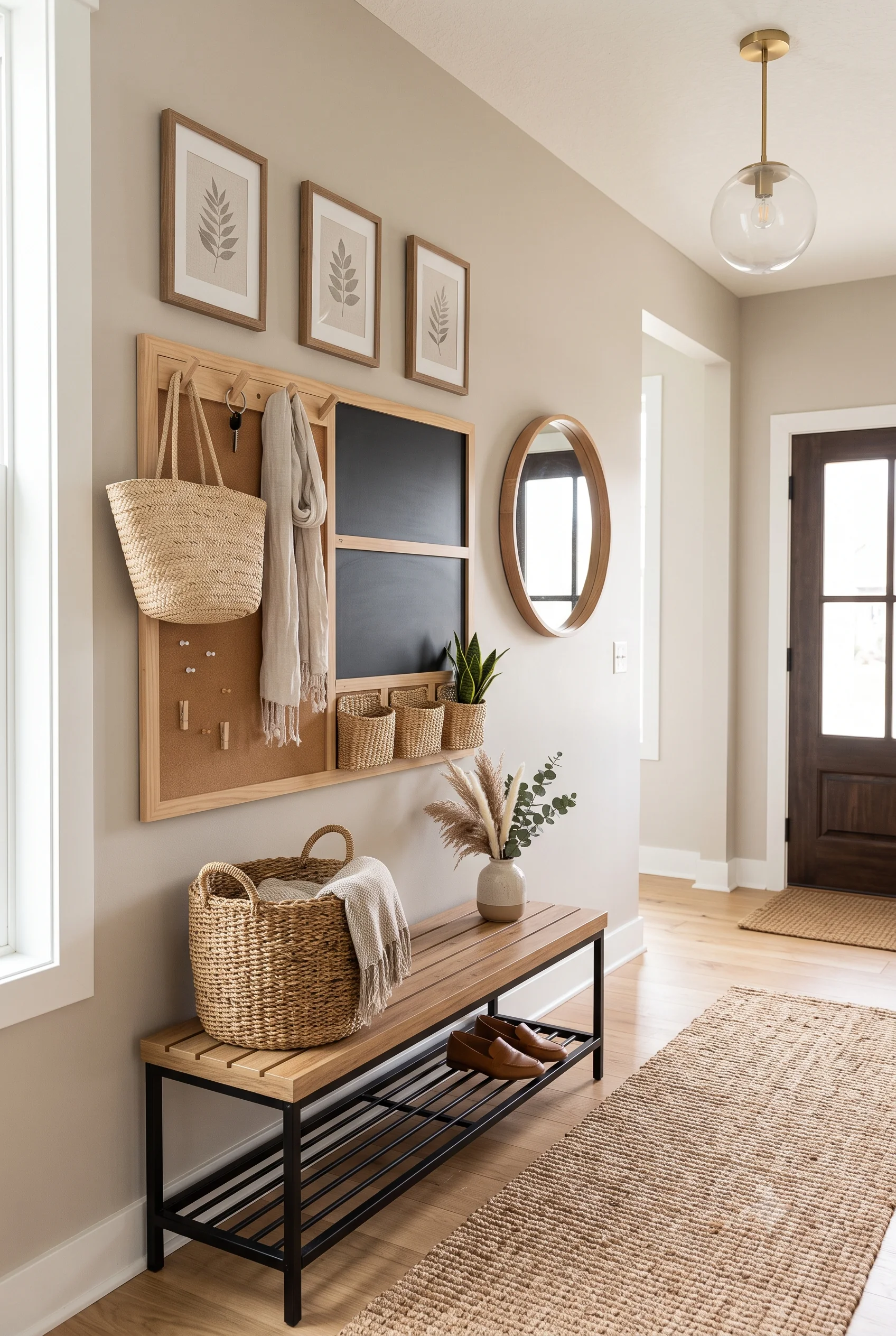
Every family runs on information: practices, permission slips, who needs to be where by five. Here, a framed corkboard-and-chalkboard panel gathers it all onto one wall. Keys hang from small hooks, a straw bag and scarf wait on pegs, and little woven baskets catch the paper flotsam before it migrates to the kitchen counter.
A bench with a shoe shelf sits below, so the command center lives exactly where the family already pauses. One glance on the way out the door replaces three shouted questions up the stairs.
Slim Console, Full-Size Function
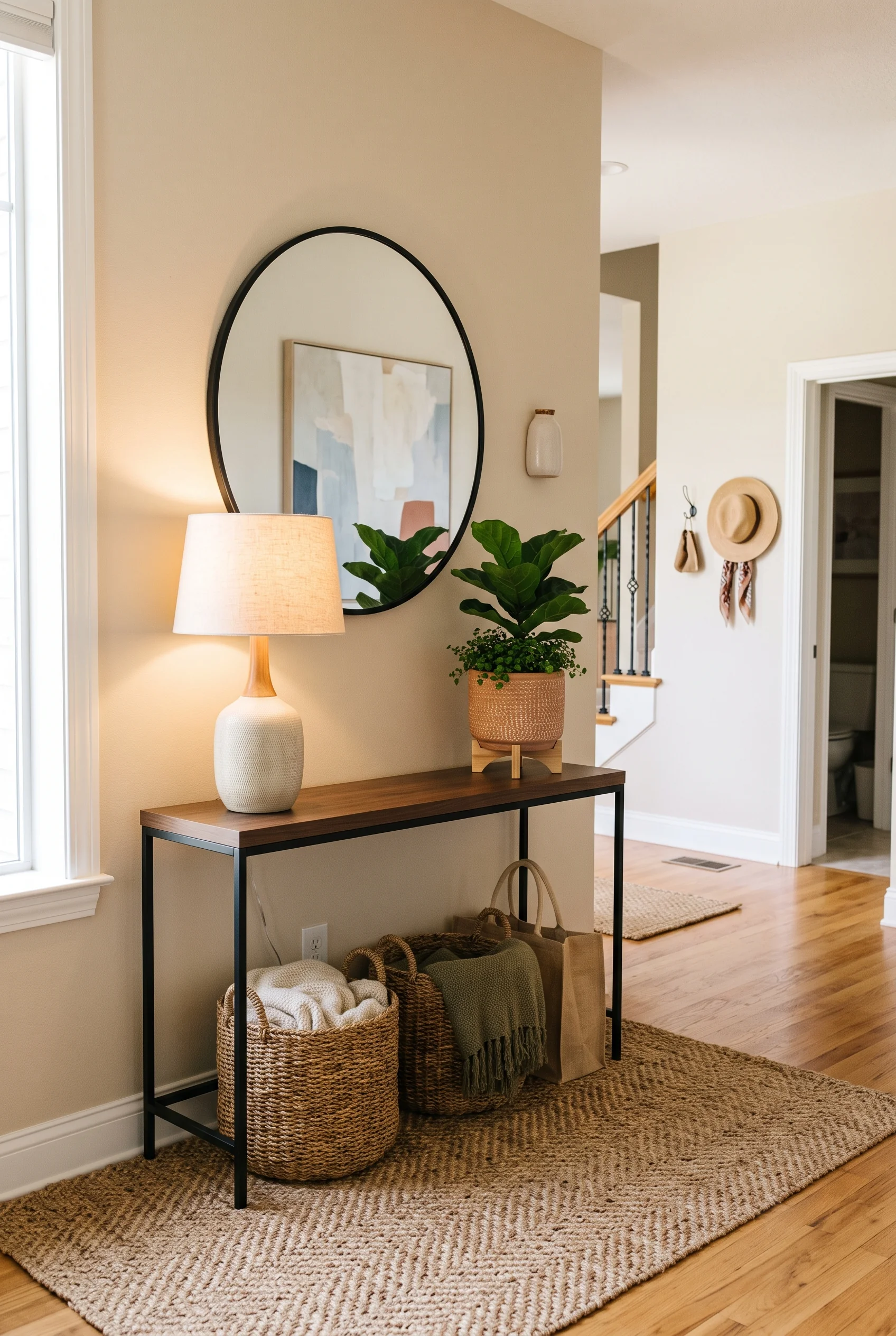
Barely more than a foot of depth is all this console asks for, and it gives back a lamp, a landing surface, and a shelf’s worth of storage below. The black metal frame keeps sightlines open, so even a tight hallway doesn’t feel crowded.
Down at floor level, a woven basket holds throws and a canvas tote stands ready for errands, while a herringbone jute rug handles the foot traffic. Narrow furniture like this is how a pass-through hallway becomes an actual entryway, without stealing space from the walkway itself.
Storage That Climbs Instead of Sprawls
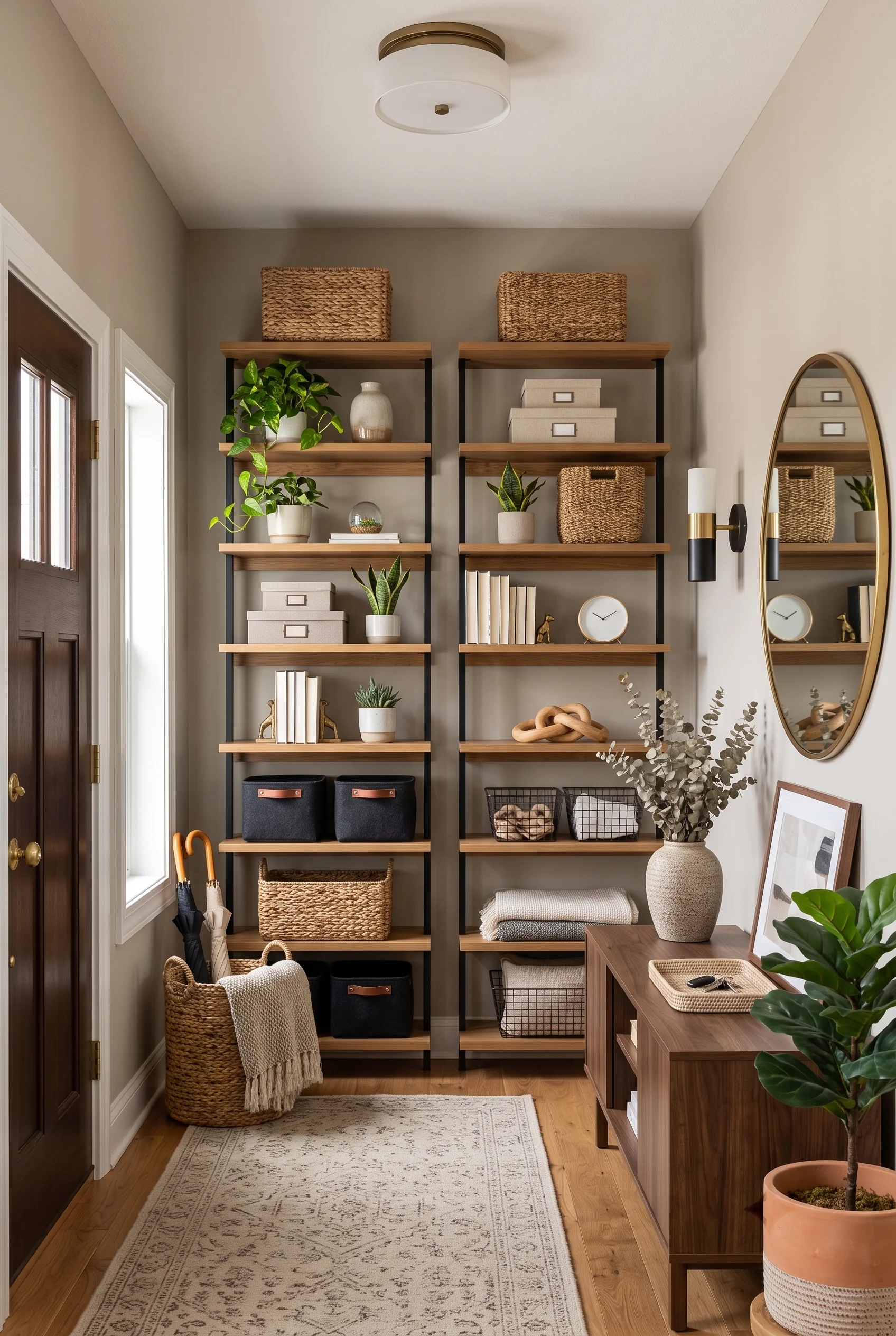
When the floor plan says no, go up. Two shelving towers climb nearly to the ceiling in this compact entry, and the arrangement follows a smart logic: everyday baskets and bins at reaching height, books and display pieces mid-level, big lidded baskets of off-season gear on top.
Wire bins keep hats and gloves visible, fabric bins hide the less lovely stuff, and trailing plants soften all that straight-lined storage. A round mirror between the towers keeps the space from feeling like a stockroom. Seven feet of wall just replaced an entire closet.
Two Pieces, One Hardworking Footprint
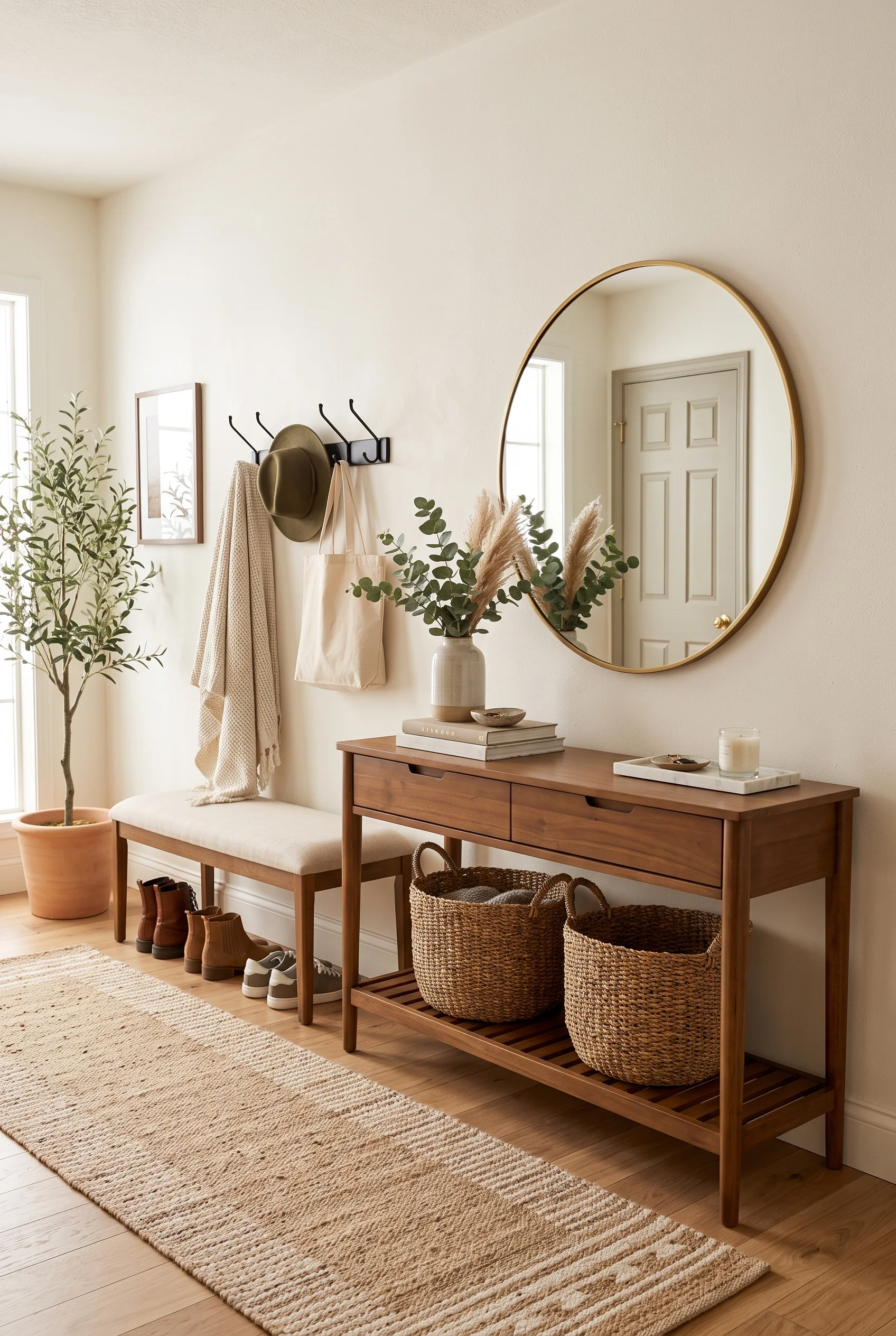
One long wall, two pieces, zero wasted inches. A walnut console with drawer handles mail, chargers, and the small stuff, while its lower shelf holds oversized baskets. Beside it, an upholstered bench gives everyone a seat, with the day’s shoes lined up underneath.
Black hooks above catch a hat, a cardigan, and a tote, so the vertical space works as hard as the furniture. Each piece would be useful alone. Side by side, they cover sitting, stashing, and hanging in a single pass, which is the whole job description of a family entryway.
Systems Built to Survive Real Family Life
An entry system only counts if it survives contact with real life: wet boots, lost gloves, school forms due yesterday. Durability and visibility are the themes here. Rugs that hide the mess between cleanings, walls that carry the family’s messages, and containers that show you their contents at a glance. These are the workhorse ideas, less glamorous than a gilded mirror but the reason everything else stays standing.
A Rug That Forgives Muddy Sneakers
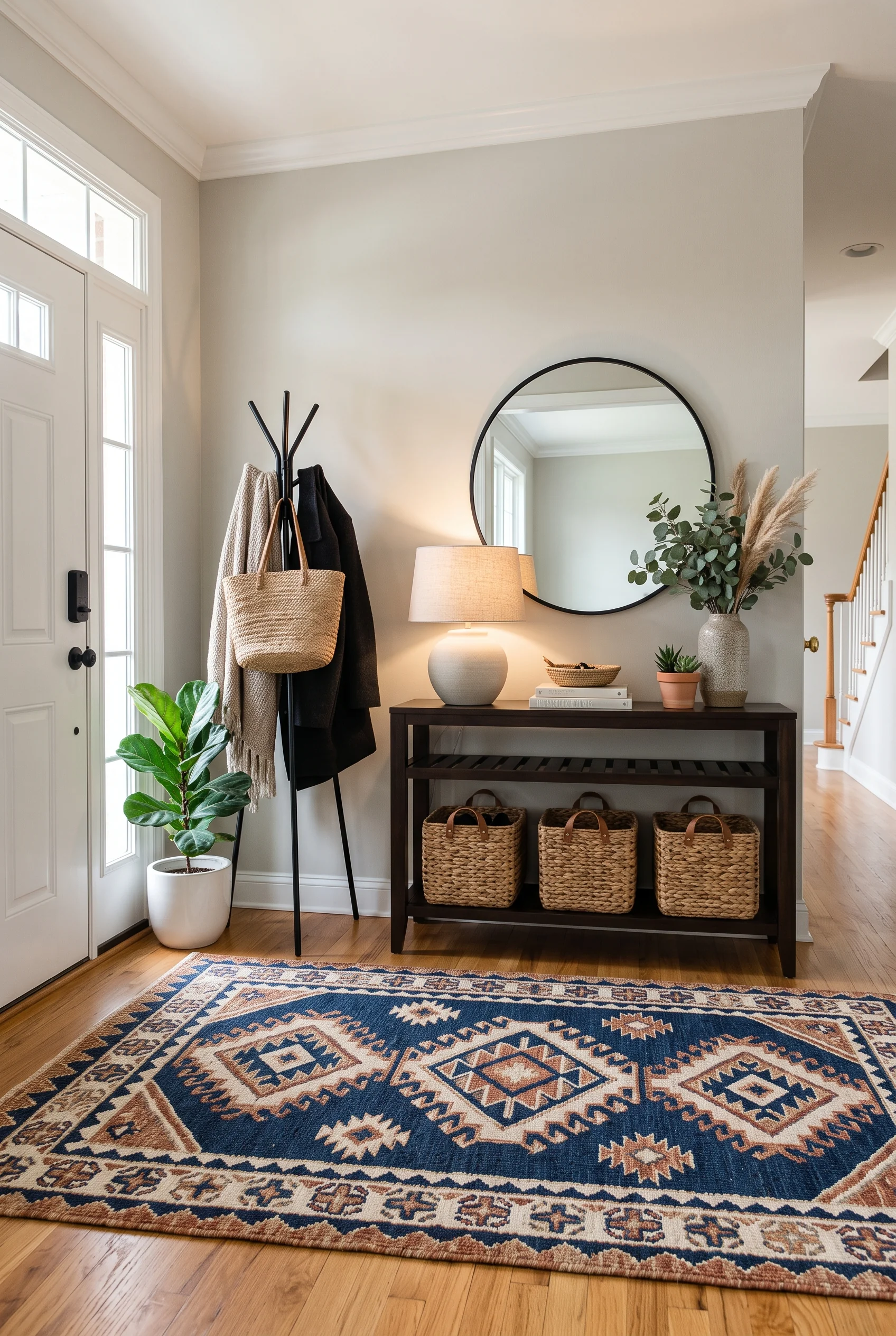
Rich indigo and rust hide a multitude of sins. A flat-woven rug in a busy geometric pattern anchors this entry, and the pattern is the point: scuff marks, paw prints, and drizzle simply disappear into it between vacuums.
Flat weaves shake out easily and dry fast, which matters in the one room where wet boots land first. The deep palette also grounds the pale walls and black console, giving the entry a settled, collected feel. Pretty rugs are everywhere. Pretty rugs that can take a soccer season are worth hunting for.
Notes, Doodles, and a Wall That Talks Back
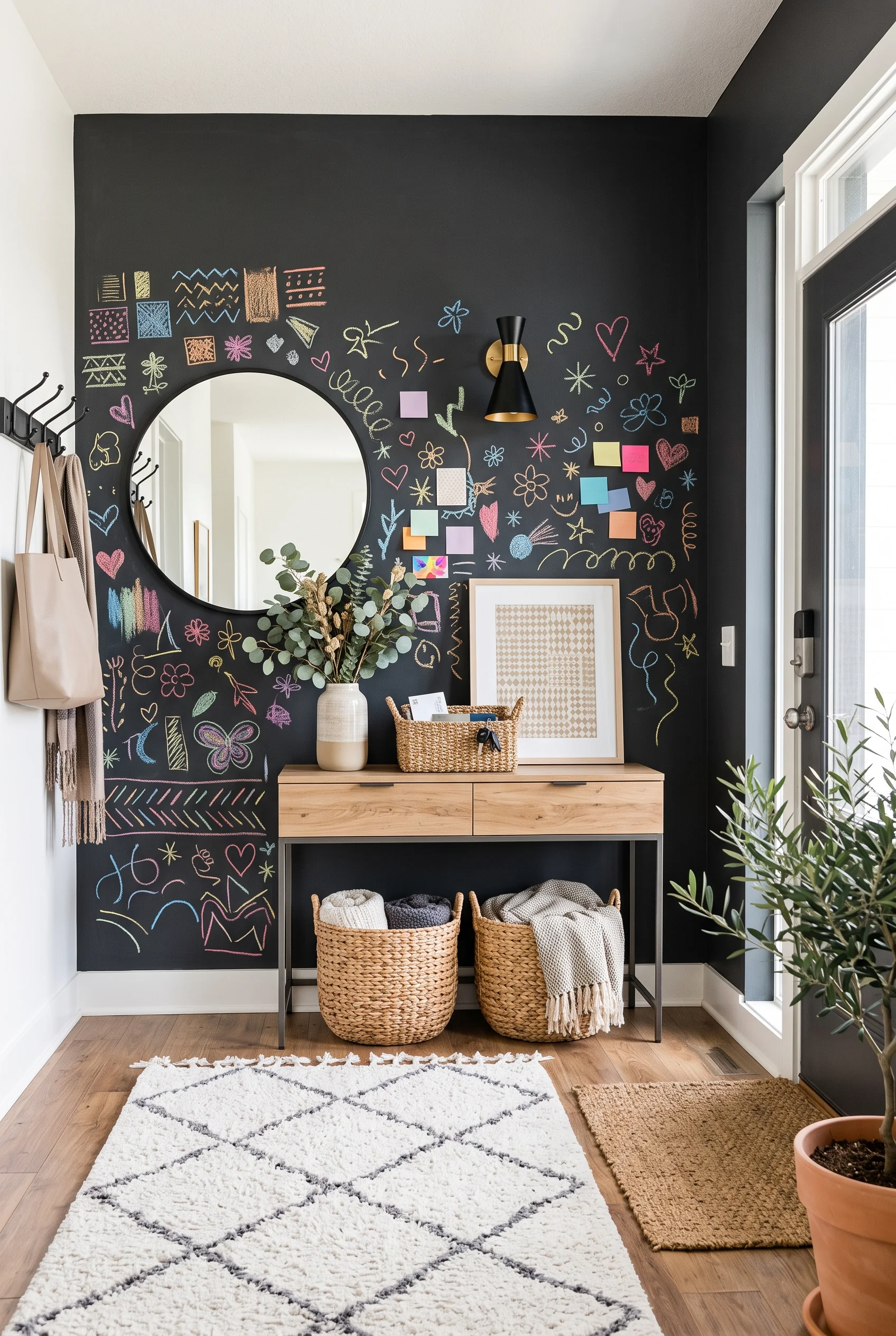
Chalk doodles climb this wall like a family mural in progress: hearts, butterflies, and a scatter of sticky notes in every color. Painting one entry wall in chalkboard paint hands the household a giant shared notebook, and kids treat it as an open invitation to leave their mark.
A round mirror and a warm wood console keep the black wall feeling styled rather than schoolroom. Notes get written at the exact spot where they’ll be seen on the way out. Some entries display art. This one makes it daily.
Small Stuff You Can Actually See
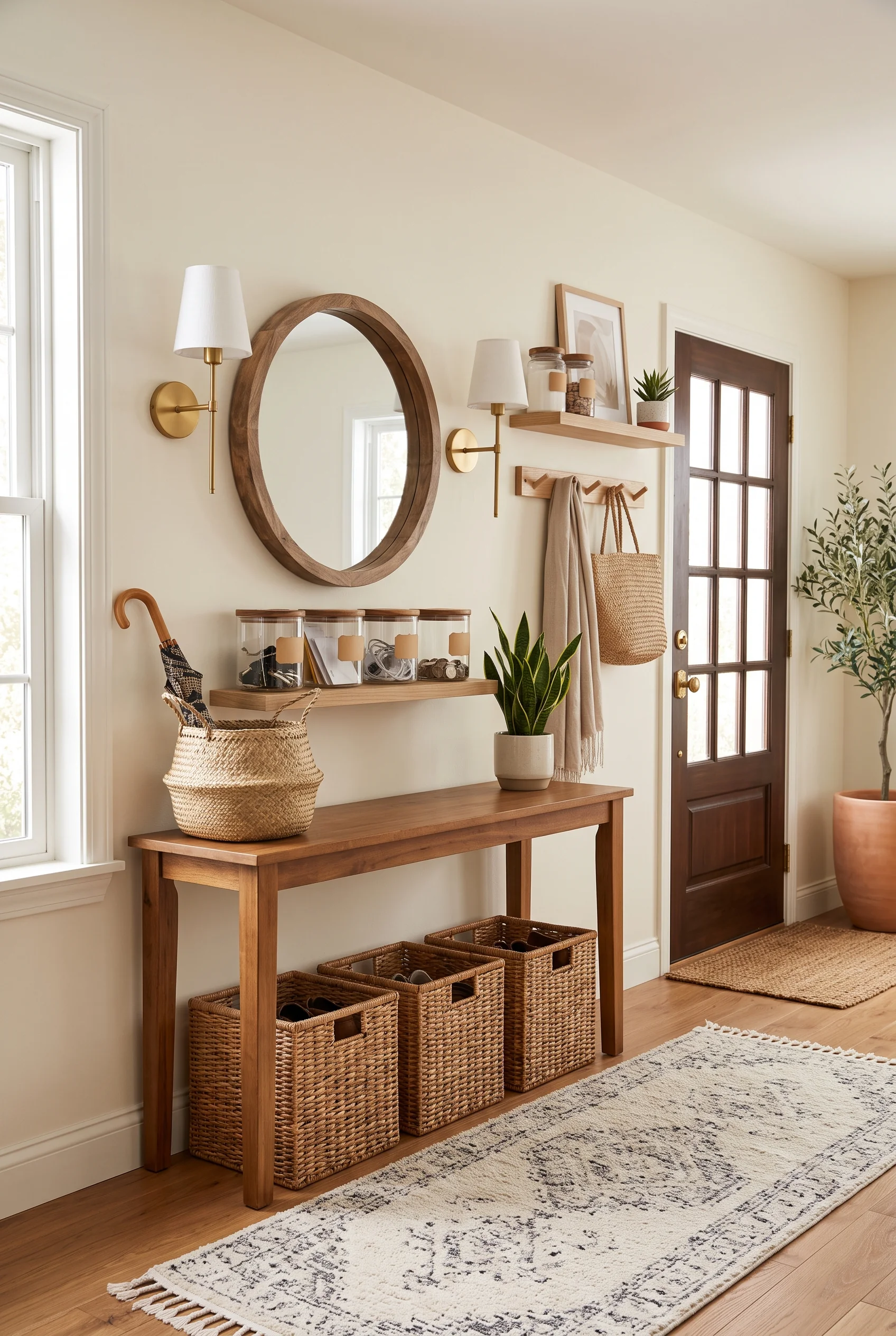
Glass canisters on a floating shelf settle the eternal question of where the small stuff went. Sunglasses, hair ties, and pocket-sized odds and ends sit in plain view under wooden lids, sorted by type instead of jumbled in a drawer.
Below, wicker baskets on the console shelf hold the shoe rotation, and a peg rail takes the scarf and bag. Clear storage works because it removes the need to remember. Nobody has to ask which bin the sunglasses live in when the answer is visible from ten steps down the hall.
Labels That Make the Seasonal Swap Painless
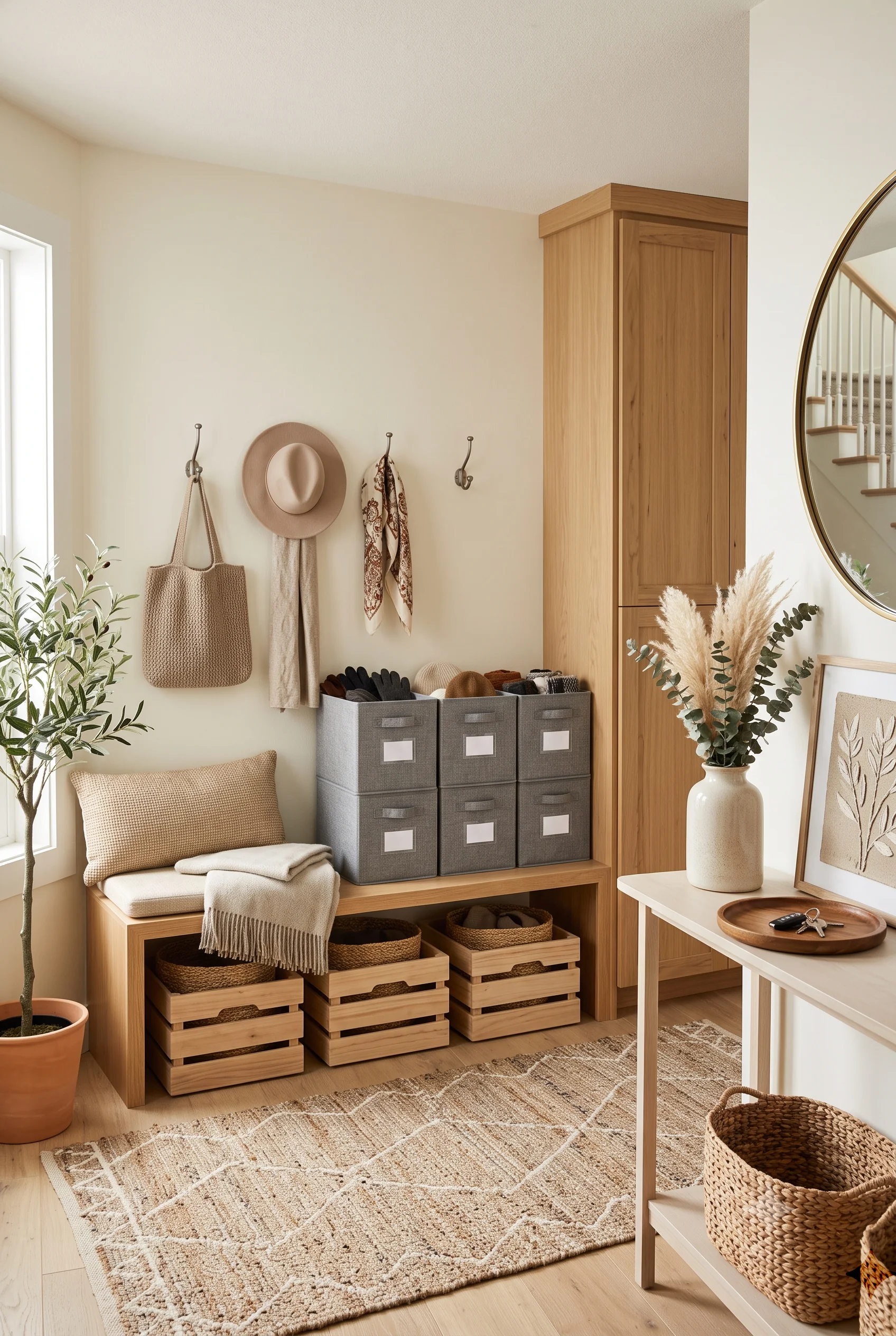
Gray fabric bins with label windows stack neatly in this bench nook, and every label ends a search before it starts: gloves here, hats there, one bin per person if you like. Underneath, wooden crates corral the shoes that would otherwise scatter.
When the seasons change, the bins swap places instead of the contents being rehomed all over the house. Sandals rotate up; mittens rotate down. Done in twenty minutes. A tall cabinet alongside holds the overflow. Rotation only works when it’s this easy, and the labels do the remembering.
Personality Without the Pile-Up
Organized does not have to mean impersonal. The most inviting family entries layer personality right over their systems, so the space feels like the people who rush through it every day.
Gallery walls, greenery, and painted pegboards all appear in this group, and each one adds character without loosening the underlying order. Light, mood-lifting palettes do the same job through color alone. Style, it turns out, is the reason a system actually gets maintained.
Familiar Faces at the Front Door
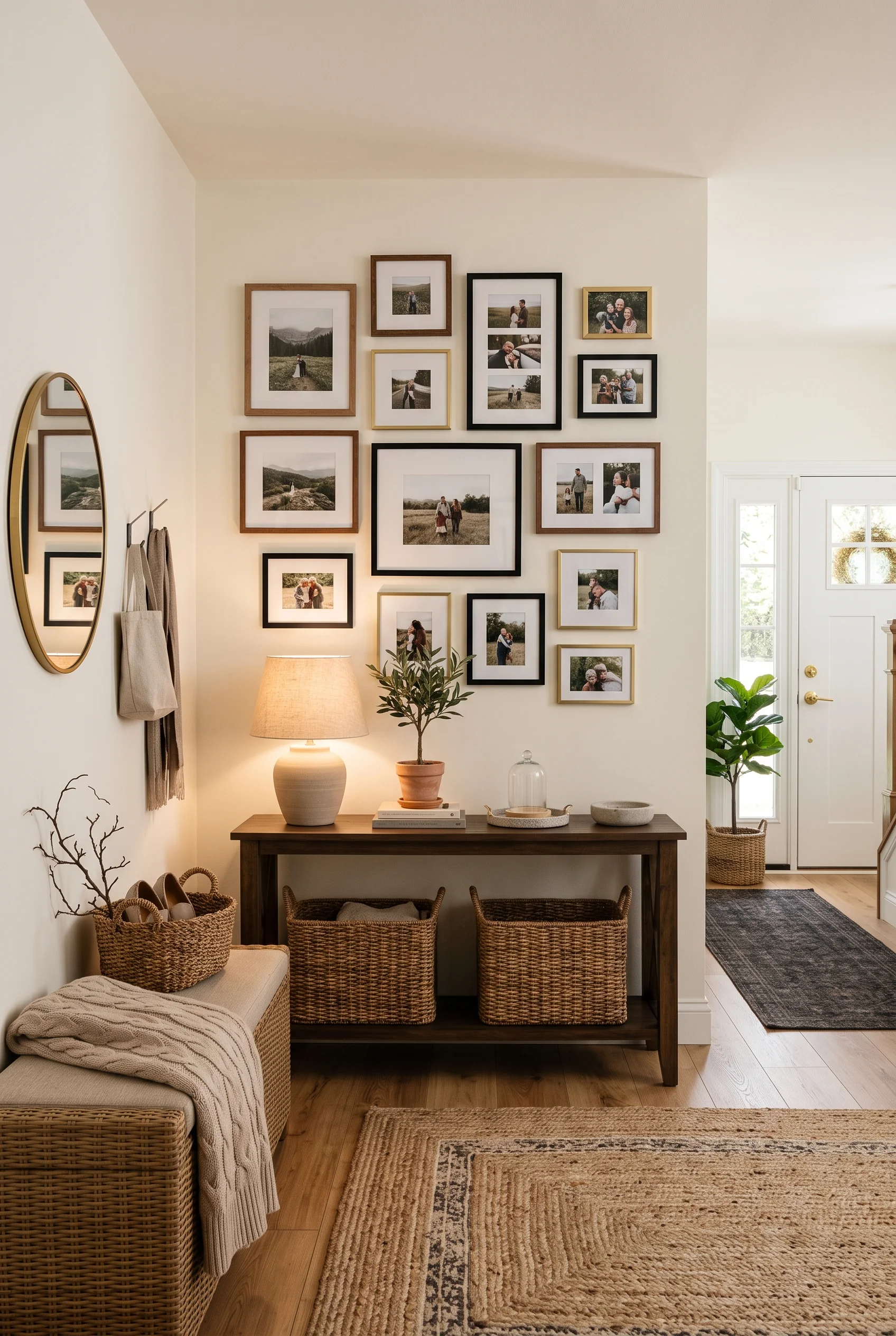
Framed family photos climb the wall above this console, a full gallery of hikes, holidays, and everyday faces in mixed wood and black frames. It changes how the space feels to walk into: less pass-through, more welcome home.
The styling below stays calm on purpose. A single lamp, a small potted tree, and baskets tucked under the console let the photographs carry the personality. Guests linger here, and kids point out their favorites.
An entry can be perfectly organized and still feel anonymous. Photos are the cheapest cure.
Greenery That Softens the Hustle
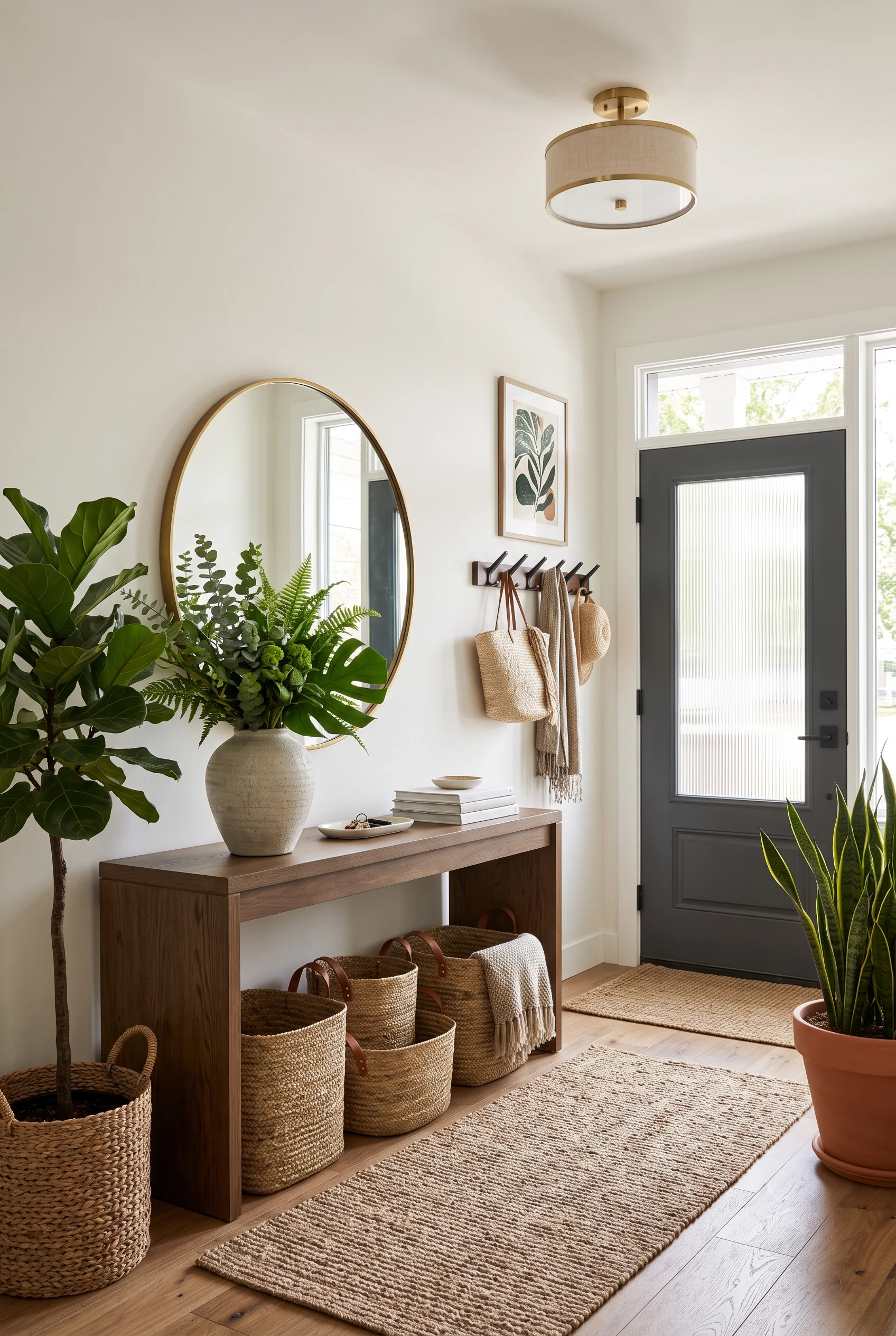
A fiddle leaf fig by the door, a loose arrangement of ferns and eucalyptus on the console, a snake plant in terracotta: three doses of green and this entry breathes. Plants soften all the hooks and baskets with something alive, which no container-store purchase can quite manage.
Low-maintenance varieties earn their place in a room you rush through, and they shrug off the temperature swings of a constantly opening door. Even one sturdy plant near the entrance changes the greeting from functional to fresh, morning after hurried morning.
Every Basket With One Job
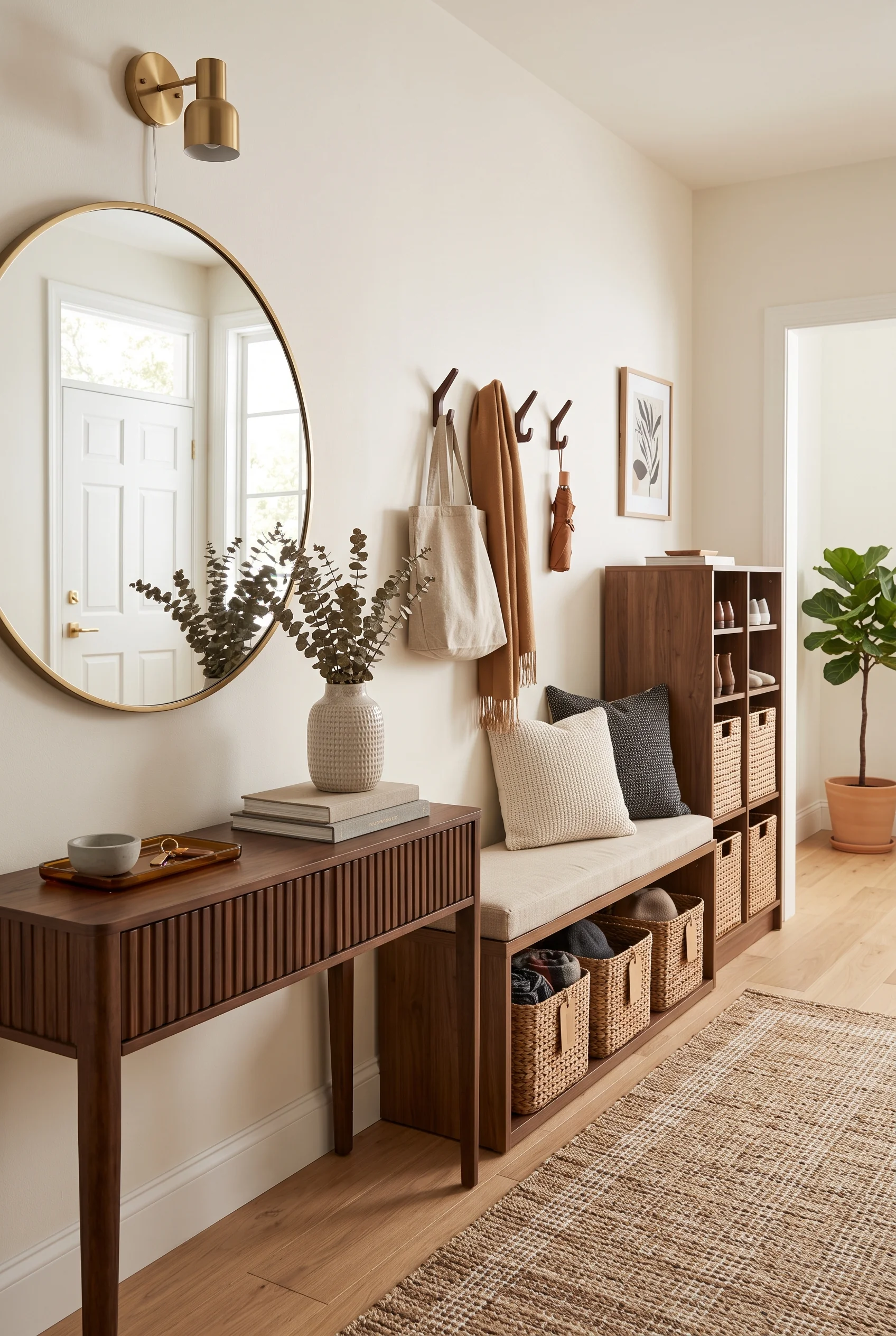
Inside this cubby unit, every basket has exactly one job. Hats in this one, everyday shoes in that one, a cushioned top for sitting while the sorting happens. Nothing shares, nothing overflows, and putting things away takes the same three seconds as dropping them on the floor.
A fluted walnut console and brass mirror nearby keep all that storage looking like furniture. Once a system this simple is in place, a strip of label tape settles whose basket is whose, and the pile-up by the door quietly stops happening.
A Pegboard That Rearranges Itself Around Your Life
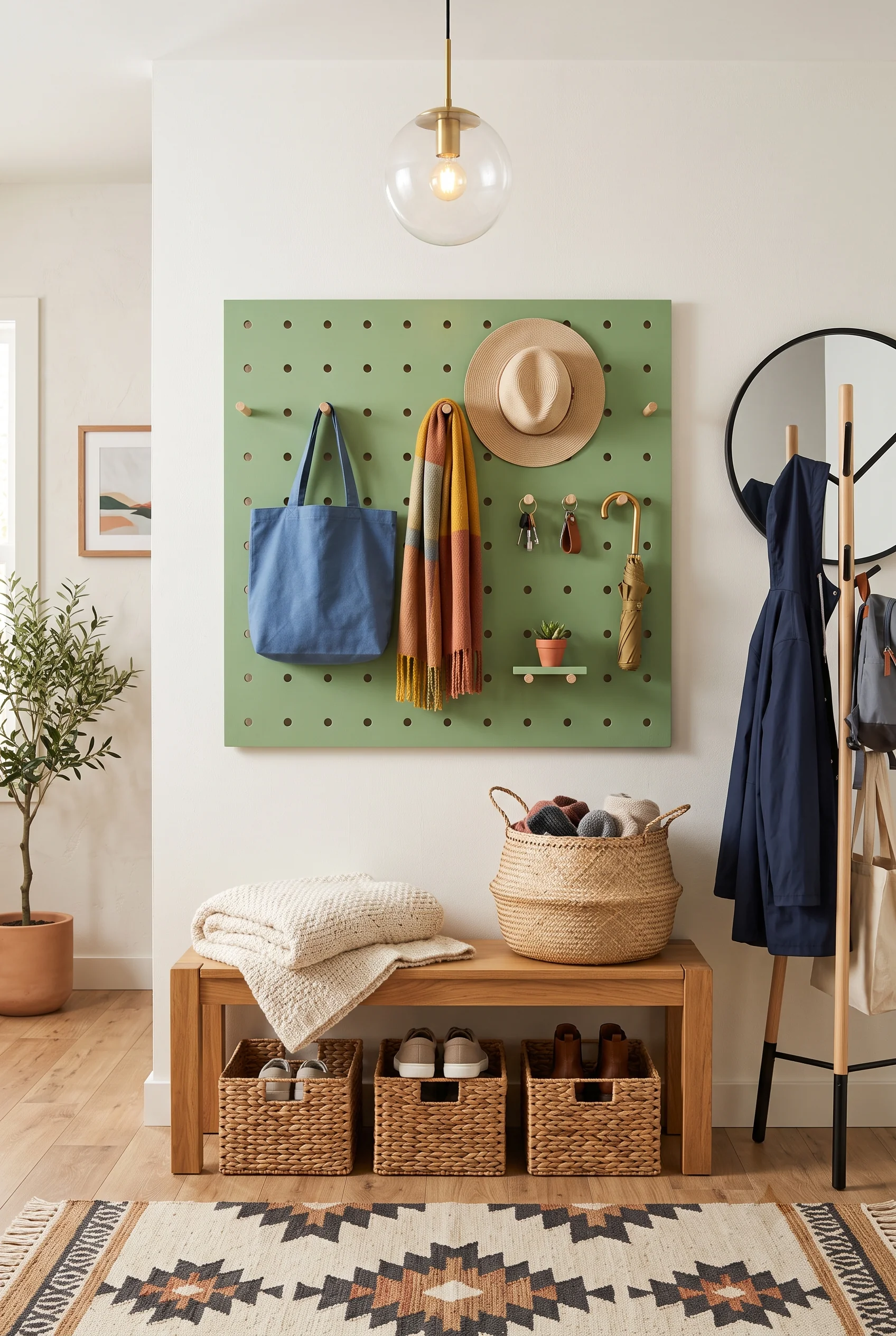
Sage green pegboard turns an entire wall into rearrangeable storage. Wooden pegs hold a tote, a sun hat, and an umbrella today, and can hold cleats and rain jackets tomorrow. A tiny shelf even carries a plant, because storage this flexible has room to be charming.
Paint is what elevates it. In a soft green, the pegboard reads as a design feature rather than a garage transplant. As the kids grow and the gear changes, the pegs move in seconds, and the wall keeps up without a single new purchase.
Light Walls, Lighter Mornings
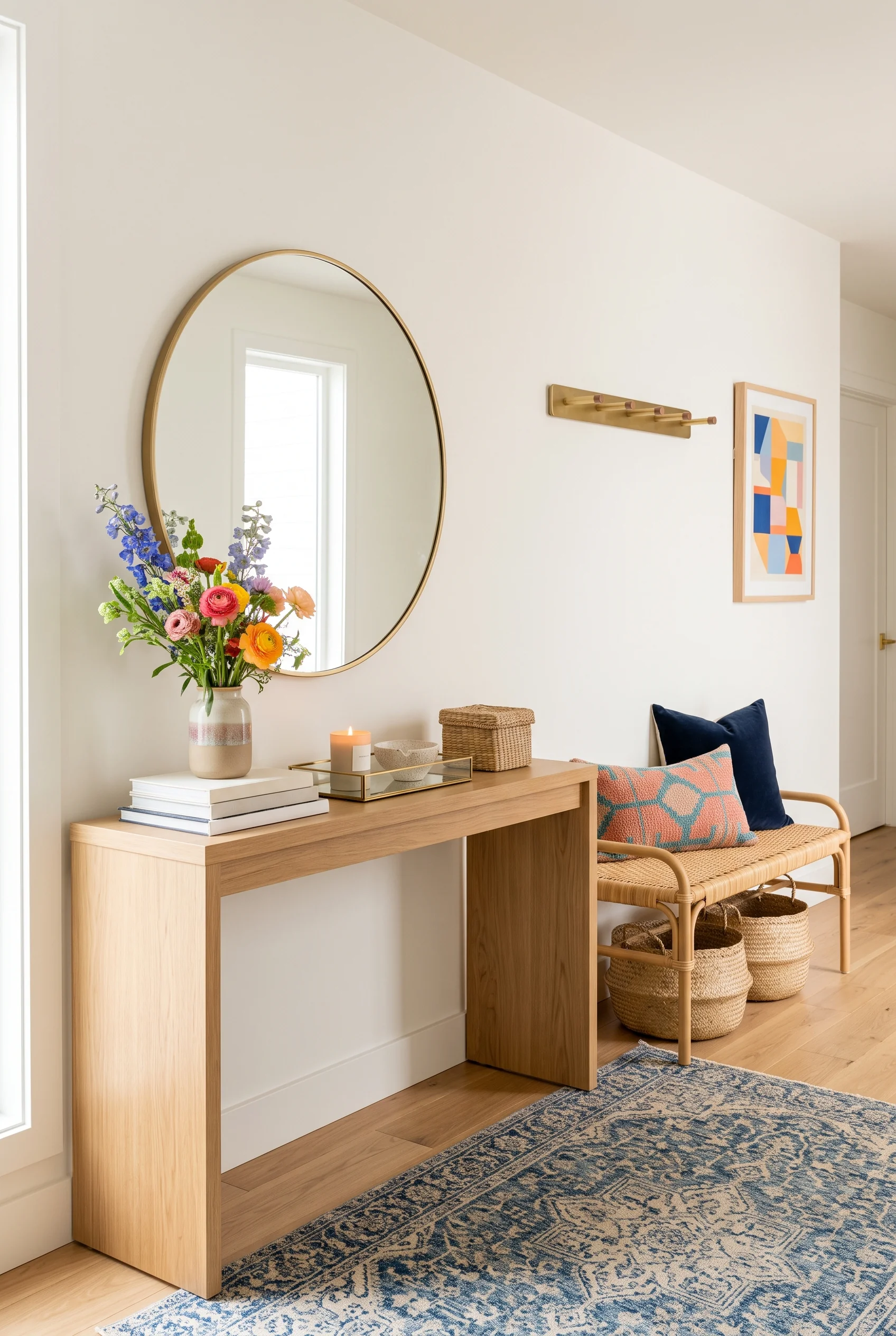
Bright white walls, a pale oak console, and a rattan bench keep this entry feeling airy even when the morning isn’t. A soft palette visually calms whatever clutter does appear, and it makes the space feel bigger than its footprint, the same quiet trick that makes neutral home decor so livable everywhere else in the house.
Color still gets a say. A jug of garden flowers, navy and coral pillows, and a graphic print bring the energy without darkening the room. Light backdrops forgive busy days, and this one glows by mid-morning.
The Finishing Layer of Everyday Convenience
The last layer of a great entryway is convenience: the lamp that greets you, the tray that catches your pockets, the stool that appears exactly when you need it. None of these pieces organizes a whole room on its own. Together they smooth a dozen small daily frictions, and small frictions are what busy family mornings are made of. Seven finishing touches, each one earning more than its size suggests.
Seating That Hides the Evidence
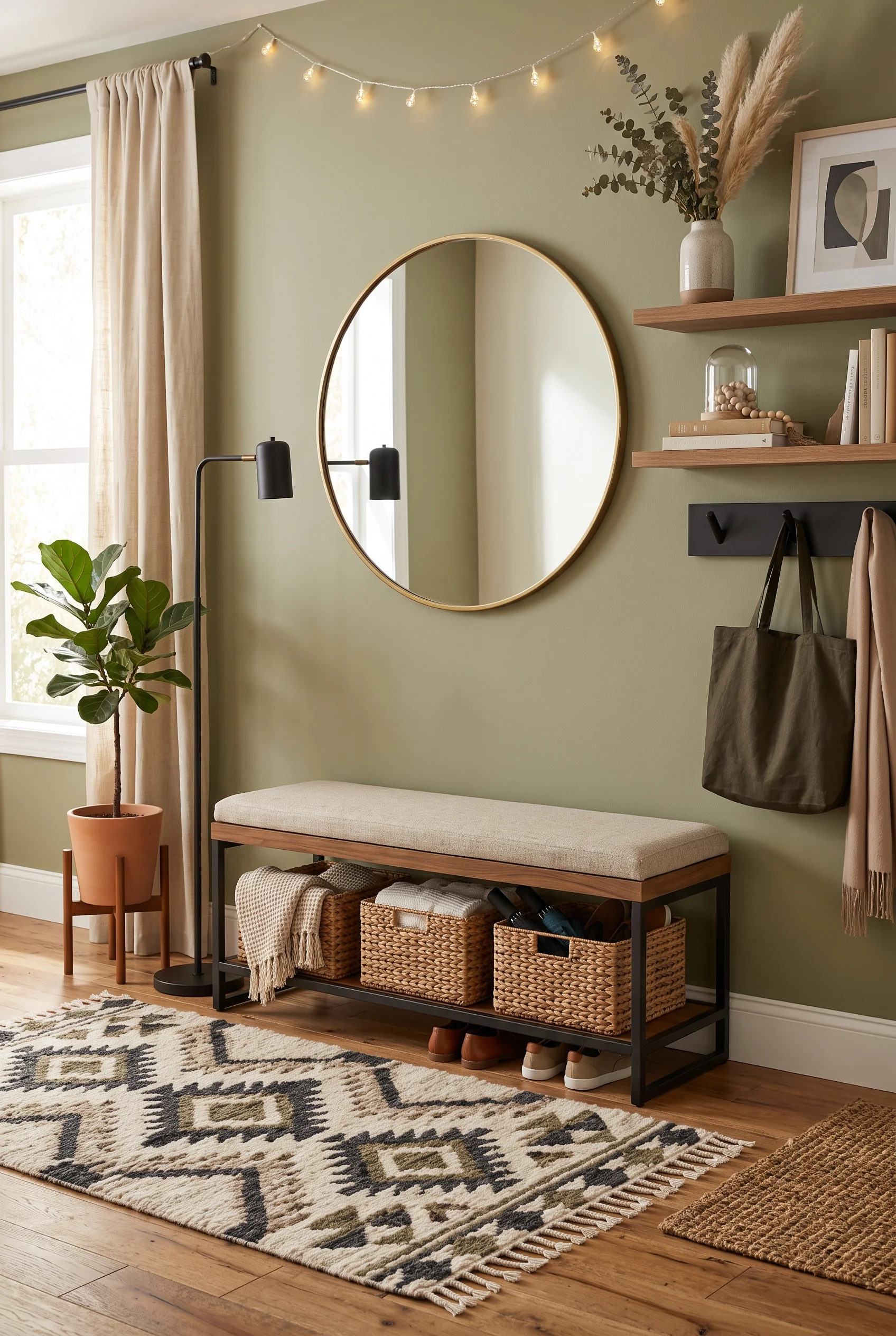
Under this cushioned bench, the storage shelf is already mid-week: woven baskets of shoes and knits, a pair of loafers, room for whatever lands next. The upholstered top means someone can actually sit to pull on boots, and the mess disappears below eye level instead of across the floor.
Against the sage green wall, string lights, floating shelves, and a brass-rimmed mirror make the corner feel intentional rather than utilitarian. A bench like this hides the evidence of a busy household while keeping everything one bend-and-grab away.
Outerwear Off the Banister at Last
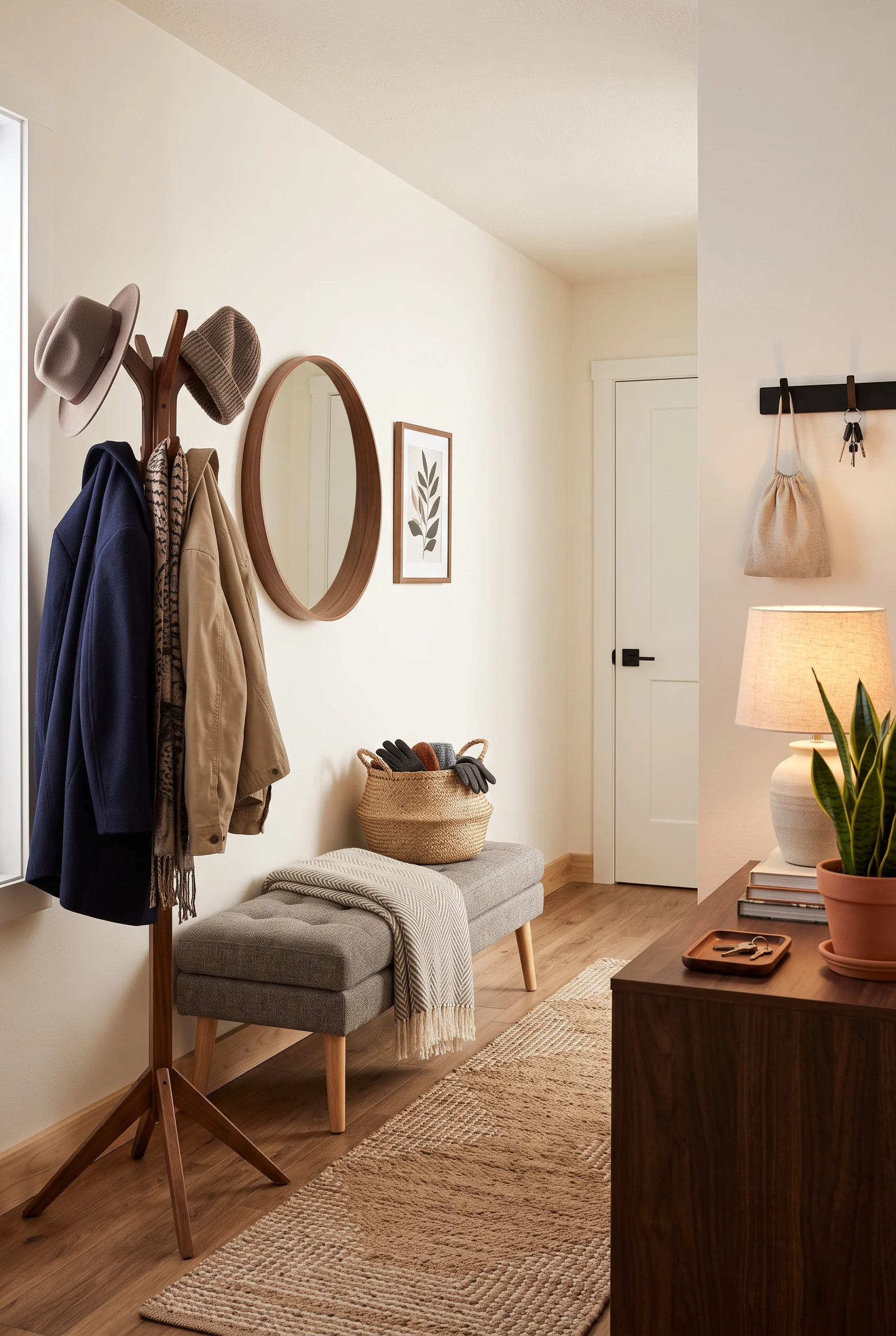
Coats claim every chair and banister in a house without a plan. A freestanding coat tree solves it in about two square feet, holding a wool overcoat, a scarf, and a couple of hats on its branching arms, no drilling required.
Placed beside the door with a tufted bench nearby, it becomes the obvious first stop on the way in. Renters get real storage without patching holes later, and the sculptural shape looks good even half-loaded. The banister, meanwhile, goes back to being a banister.
One Tray for the Pocket Dump
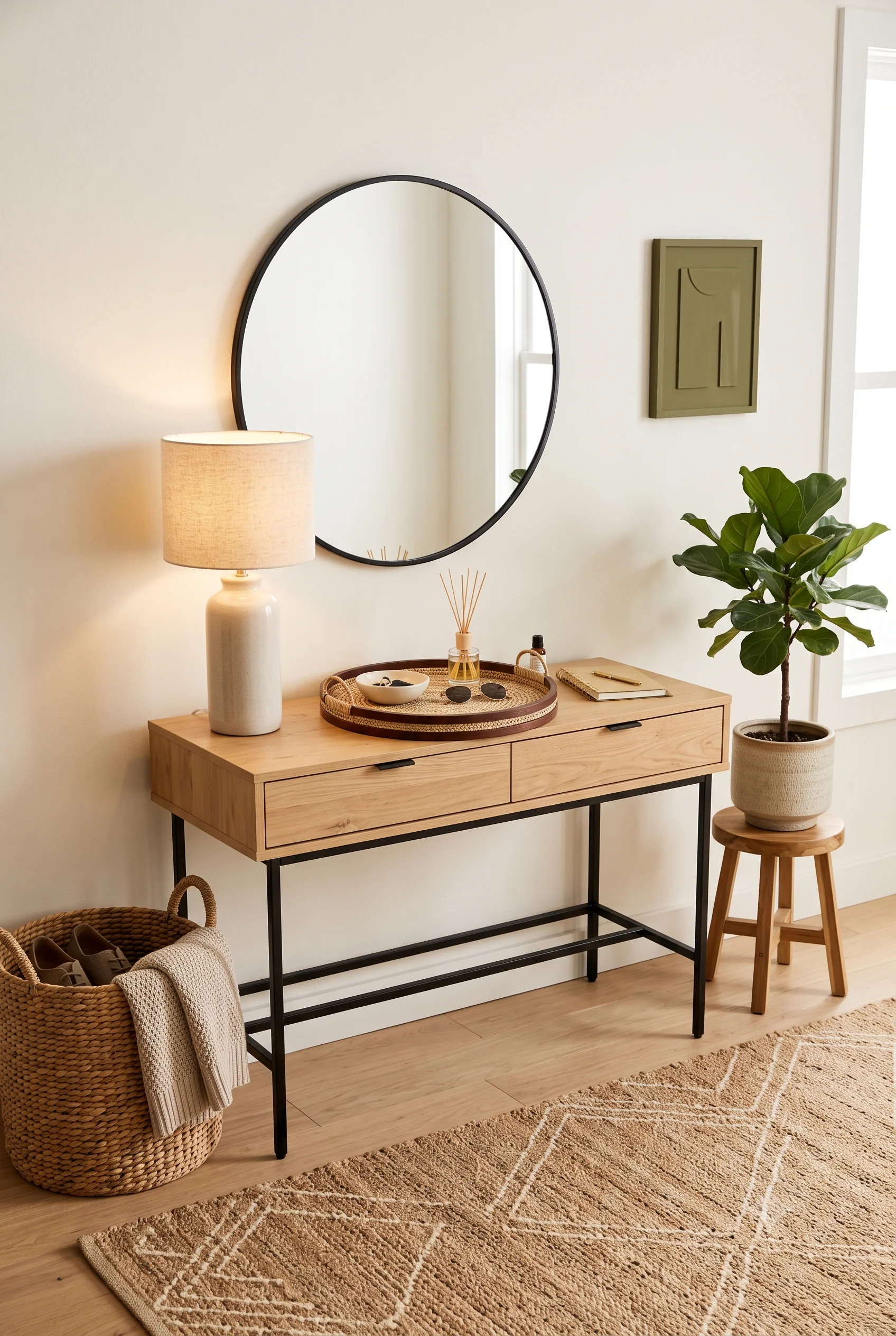
Every pocket empties somewhere. Here, a round rattan tray gives all of it a destination: sunglasses, a reed diffuser, a notebook and pen, corralled on the console instead of drifting across it. The raised edge is the quiet genius, keeping small things from migrating.
A tray also makes tidying instant. Straighten one object and the whole vignette looks styled again. It’s the smallest organizational purchase in this roundup, and possibly the one you’ll touch more than any other. Matched to the warm wood tones of the console, even the pocket dump starts looking deliberate.
A Tidy Landing Pad for Every Device
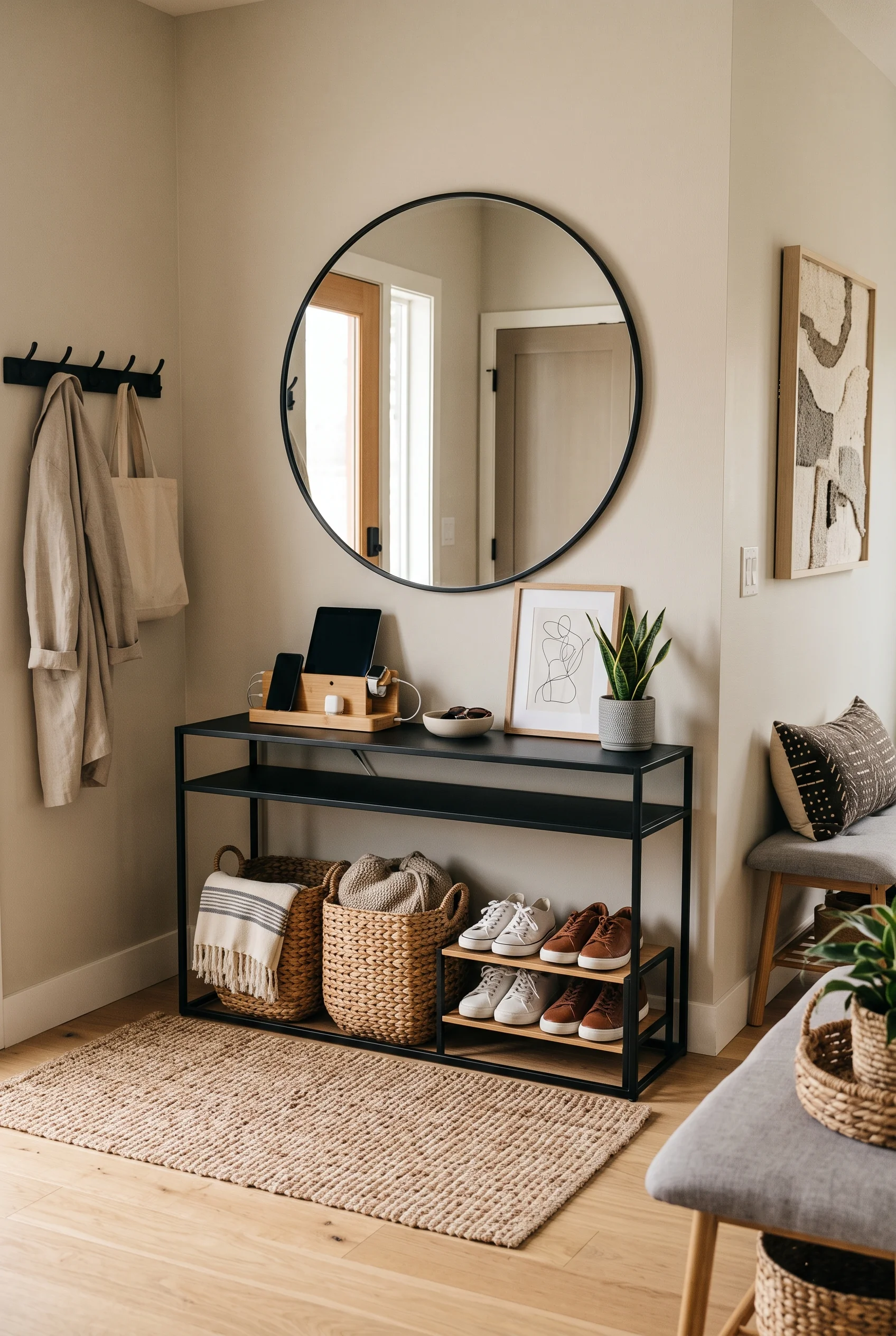
Devices need a bedtime too. A bamboo dock on this console gives the family tablet and phone an upright home, cords routed out of sight, screens charged and findable by morning. Parking it in the entry keeps devices out of bedrooms and puts them exactly where they’re grabbed on the way out.
The rest of the console stays serene: a small bowl, a succulent, a framed sketch. Below, baskets and a two-tier shoe rack handle the analog clutter. One dock ends the nightly hunt for chargers and the debate over whose turn the outlet is.
Shop this pick: Bamboo Charging Station Dock, The charging dock is a clearly recognizable, affordable impulse buy that directly solves the problem this section highlights, making it an easy click.
Warm Light for Early Exits and Late Returns
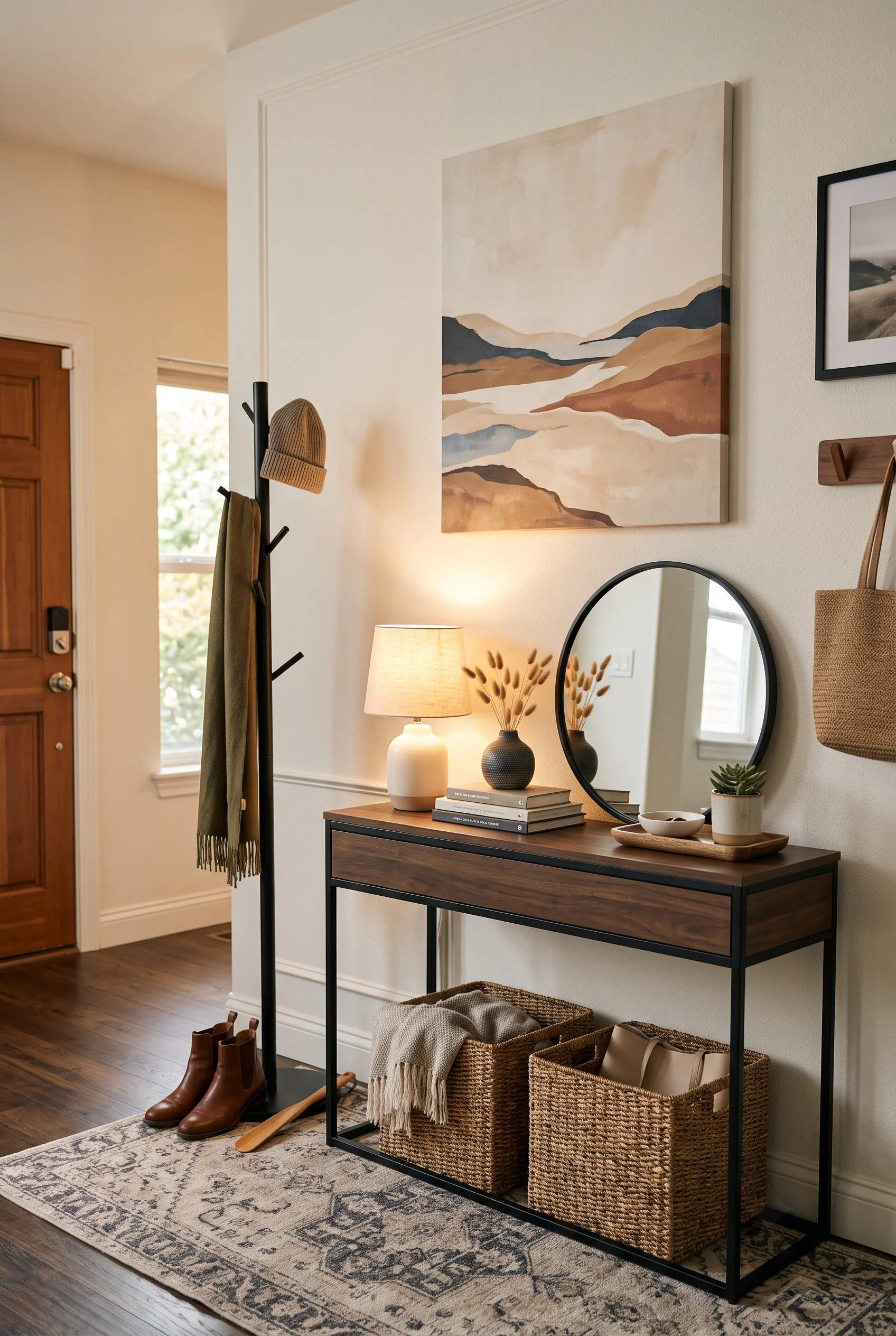
Warm lamplight changes the temperature of a goodbye. On this walnut console, a cream ceramic lamp throws a soft glow across a stack of books, a vase of bunny tails, and the boots waiting by the coat stand, a gentler welcome than any overhead fixture can manage.
Early school runs and late arrivals both happen in the dark for half the year. A small lamp by the door means the first and last light of the day is kind. Function fills the baskets below. The lamp handles the welcome.
Clutter, Boxed Up Beautifully
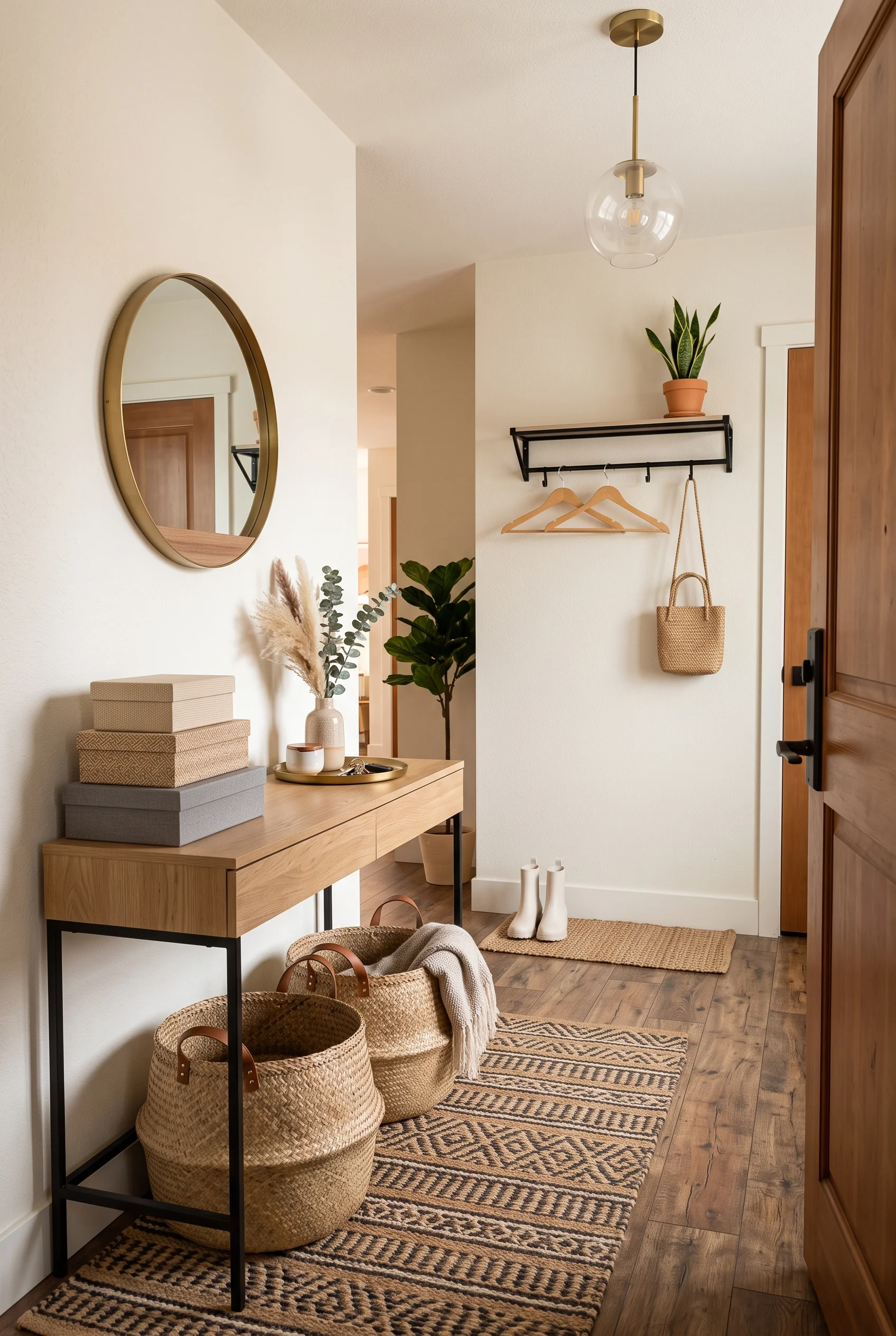
Stacked on the console, three decorative boxes in tan, woven cane, and slate gray hold the things no one needs to see: spare keys, sunscreen, the dog’s leash rotation, whatever your household’s small chaos happens to be. Closed storage at eye level keeps surfaces styled without going bare.
Mixing the finishes lets the stack read as decor rather than filing. Below, belly baskets continue the theme at floor level, and a glass pendant pulls it all together. Clutter doesn’t vanish in a family home. It just learns to dress well.
The Little Stool That Stays Out of the Way
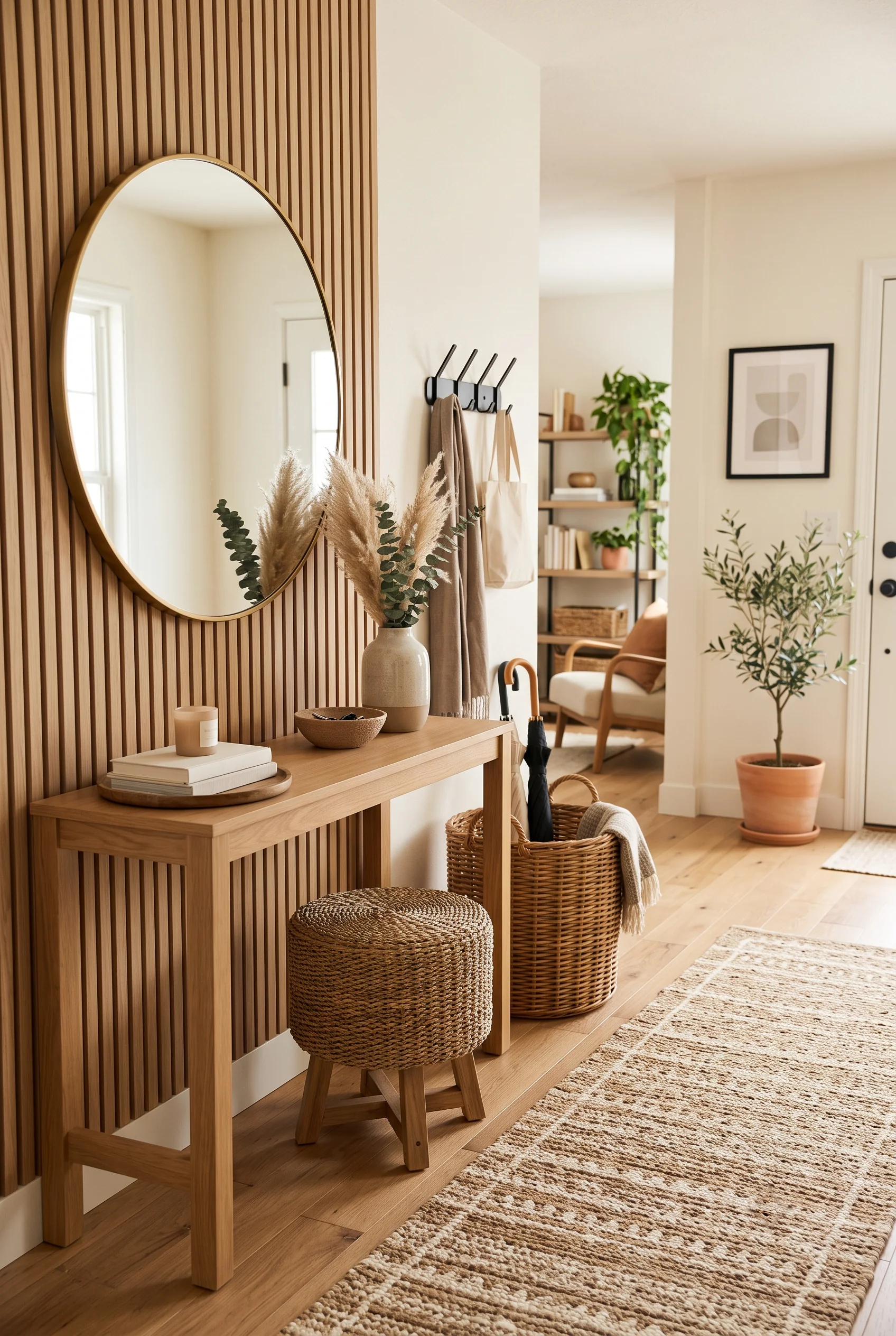
Tucked beneath the console, a round woven stool waits for its dozen daily jobs: a perch for tying shoes, a boost for the kid reaching a high hook, an extra seat when everyone is leaving at once. Light enough to move with one hand, small enough to disappear when it’s done.
The warm wood-slat wall and oak console around it stay serene because the stool never blocks the path. Small furniture like this rarely makes the shopping list, yet it earns its spot within a week of arriving.
An Entryway That Works as Hard as You Do
Twenty-five rooms, one shared idea: everything that crosses your threshold deserves a specific home. The families behind these entries didn’t organize by buying more. They organized by deciding where keys land, where shoes sleep, where the calendar lives, and then choosing pieces that make those decisions automatic.
A hook at kid height. A tray with a raised edge. A basket with one job.
Start small. Pick the single idea that targets your household’s loudest pain point, whether that’s the shoe pile, the mail avalanche, or the nightly charger hunt, and live with it for two weeks before adding the next. Systems that stick get built one habit at a time, the same way a shared kids’ bedroom comes together zone by zone rather than all at once.
And keep the warmth. The most inviting spaces in this roundup hold a lamp, a plant, or a wall of family photos right alongside the bins and benches. Organization that strips the personality out of a room rarely survives, because nobody wants to maintain a space that feels like a locker.
Your entry will never be a still life. It will be shed backpacks, half-zipped boots, and someone calling to say they’re leaving. The right entryway organization ideas don’t fight that motion; they give it somewhere graceful to land. Choose the two or three that fit the way your family actually lives, and let the front door start working for you.